Behavioural Finance · The NorthPath Letter · Afternoon Edition
The Tyranny of the Vivid: Salience Theory and the Long-Term Investor
The most expensive question in equity investing is rarely what is the company worth? It is the prior question of what am I looking at? A portfolio is built from the small set of opportunities a mind chooses to weigh, and that set is never neutral. It is curated, in real time, by a perceptual system that was tuned over evolutionary time for survival in the savannah, not for the calm assessment of a discounted cash-flow model in a low-yield decade. Things that stand out get weighed. Things that are quiet get nothing. Long before a value judgement is rendered, an attention judgement has already happened, and it is usually invisible to the person who made it.
The cleanest formal account we have of this distortion is salience theory, the framework Pedro Bordalo, Nicola Gennaioli and Andrei Shleifer published in 2012 in the Quarterly Journal of Economics. Their paper, “Salience theory of choice under risk,” argued that decision-makers do not weigh probabilities and payoffs in the abstract; they weigh whichever payoff is contextually salient — whichever one stands out against the choice set in front of them. The same lottery, presented next to a different alternative, becomes a different lottery in the mind. The model has since been used to explain phenomena as varied as the equity-volatility risk premium, the cross-section of stock returns, the persistence of household under-diversification, and the appetite for IPO lottery tickets. For the long-term equity investor, it is one of the most operationally useful results behavioural economics has produced in the last twenty years, because it names a force that already governs the contents of every watchlist on every desk.
The Mechanism: How Attention Becomes a Distortion of Value
The architecture is simple enough to state. When a person faces a risky choice, the mind does not compute a full expected-utility calculation. Instead, it compares states of the world. Within that comparison, certain payoffs jump out — the unusually high upside in one option, the unusually low downside in another — and those payoffs receive disproportionate decision weight. Bordalo and his co-authors formalise this with a salience function that depends on the contrast between a payoff and the average payoff in the choice set. The bigger the contrast, the bigger the weight; the more ordinary the payoff, the more it is ignored. The result is a systematic deviation from rational choice in a predictable direction: the chooser overweights extreme states and underweights middle ones, which is also the empirical signature of the probability-weighting function from prospect theory, but now derived from a primitive about attention rather than imposed as an assumption.
Two consequences follow that matter for an equity investor. The first is that the same security is valued differently depending on which other securities the investor is looking at next to it. A reliable compounder in defensive consumer goods looks unremarkable beside a fashionable artificial-intelligence vendor whose left tail is implausibly heroic; the same compounder looks bracing and rare beside the wreckage of a credit-cycle peak. Neither comparison set changes the present value of the compounder’s cash flows. Both change the weight it gets in the mind.
The second consequence is that the financial press, the brokerage app and the social-media feed are all, by design, contrast machines. Headlines select for the unusual. Order books surface the most active tickers. Notification systems alert on price moves of a magnitude that, by construction, has just occurred. Every piece of plumbing that delivers information to the modern investor is calibrated to amplify the most salient states of the world and to suppress the ordinary ones. Salience theory predicts what then follows: portfolio composition that drifts, week by week, toward whichever names have most recently produced the loudest contrast, and away from whichever holdings have done the boring work of compounding without complaint.
It is worth pausing on the asymmetry of this distortion. The BGS framework predicts that salience can pull weight toward either tail — a vivid loss is as attention-grabbing as a vivid gain — but in equity markets the upside tail does the heavier work, because the investor’s information environment over-supplies stories about wins and under-supplies stories about quiet survival. There are dedicated rankings of the year’s best-performing funds, sectors and stocks; there is no comparably promoted ranking of the year’s most disciplined refusals to act. The contrast machine, in other words, is not symmetric, and the BGS-implied distortion in observed portfolio behaviour therefore runs predominantly in the direction of over-allocating to recent winners. This is the empirical regularity that the cross-sectional asset-pricing literature on salience has documented for two decades.

The Empirical Record: What Regulators and Academic Researchers Have Measured
The clearest tests of salience theory in asset markets have come from the cross-section of stock returns. Mathijs Cosemans and Rik Frehen, in a 2021 paper published in the Journal of Financial Economics, constructed a stock-level salience measure from the contrast between a stock’s daily returns and the cross-sectional distribution that day. Stocks with the most salient upside — the ones whose recent extreme positive days stood out most against their peers — subsequently underperformed by an economically meaningful margin, even after controlling for size, value, momentum, and exposure to maximum-daily-return effects. The pattern was robust across decades and across international markets. It is the asset-pricing fingerprint of the BGS mechanism: investors pay too much for the salient upside, and the over-payment is wrung out of the price over the following months.
Regulators have catalogued the same behaviour from a different angle. The U.S. Securities and Exchange Commission’s October 2021 staff report on the equity and options market events of January 2021 documented that retail trading concentrated in a small number of names whose price action was, by any reasonable measure, the most attention-grabbing in the market that month. The staff report emphasised that the concentration was not driven by changes in fundamentals; it was driven by the salience of the price moves themselves and by the social-media platforms that amplified them. In Europe, the European Securities and Markets Authority’s 2022 statistical report on retail investor protection arrived at the same place from independent data. It found that retail flows into individual equities tracked the prior week’s most-talked-about names with a tightness that fundamentals could not explain, and that the average retail position taken in the most salient names underperformed broad-market benchmarks over the subsequent year.
Two regulator anchors from two regions, then, deliver the same finding: when the market produces a contrast that is loud enough to be salient, retail capital chases it, and the capital that chases it does worse than the capital that does not. The mechanism described by Bordalo, Gennaioli and Shleifer is not a curiosity confined to laboratory lotteries. It is visible in the order-flow data of the world’s deepest equity markets.

Two Historical Episodes That Are Easier to See in Hindsight
Salience does its work most efficiently when the contrast it amplifies is genuinely large and genuinely new, because nothing else in the choice set offers a similar payoff to compare it against. Two episodes from the modern era illustrate the pattern with unusual clarity.
The first is the late-1990s technology boom. The relevant feature, for a salience-theory reading, is not that internet-era stocks went up. It is the way the most extreme winners crowded everything else out of the comparison set. By 1999, a handful of dot-com IPOs had produced first-day returns in the high triple digits. Those returns were vivid, public, and constantly reprinted. The next IPO in the queue was no longer being weighed against the long-run distribution of new-issue returns; it was being weighed against the immediate memory of those triple-digit pops. The salience function shifted decision weight onto the upper tail, and capital followed. Roger Lowenstein’s contemporaneous reporting and, later, the academic record — including the work of Jay Ritter on long-run IPO under-performance — document the predictable consequence: the average new issue of 1999 and 2000 went on to disappoint, often severely, in the subsequent five years. The capital that was placed on the salient upside was largely transferred to the underwriters and insiders who supplied that upside to the market.
The second episode is the January 2021 meme-stock event already alluded to. Here the contrast was not an IPO pop but the daily candle on the chart of a handful of heavily shorted small-capitalisation names. Within three weeks, one stock rose by more than fourteen-fold; the chart, frozen and reposted millions of times on social platforms, became the most salient single image in the U.S. equity market. The SEC’s subsequent staff analysis recorded that retail option volume in the names concerned briefly exceeded the option volume of every large-cap technology stock combined. The price subsequently retraced most of the move. The salience-theory reading of the episode is not that retail traders were fools; it is that the choice set they were facing had been re-engineered, by the platforms that delivered it, to make one set of payoffs jump out of the screen at the expense of every other comparison.
A Counter-Measure Framework: Three Disciplines for the Long-Term Investor
The discipline that protects against salience is not the discipline of being unmoved by vivid information. No human investor is unmoved by vivid information. The discipline is structural: it consists of choices about which choice sets are allowed in front of the eyes, which metric is used to rank items inside those sets, and which decision is allowed to be made on the basis of a single day’s observation. Three concrete practices, drawn from the literature and from the operating manuals of careful investment firms, follow from the BGS framework directly.

First, fix the comparison set in advance and refuse to enlarge it on impulse. A well-run long-term equity portfolio operates from an investible universe that has been pre-defined: a screen, a list of qualifying businesses, a sector mandate. The salience trap is sprung when an unscheduled name — one outside that universe — is allowed to enter the comparison purely because it has just produced a vivid price move. The discipline is to require that any new candidate clear the same fundamental gating as every existing candidate before its chart is permitted to influence the next decision. The mechanical version of this is a written investment policy statement that names the universe and forbids ad-hoc additions; the human version is a co-investor, partner or analyst with the standing to ask, in a meeting, why a name that did not exist on the watchlist a week ago is now being treated as urgent.
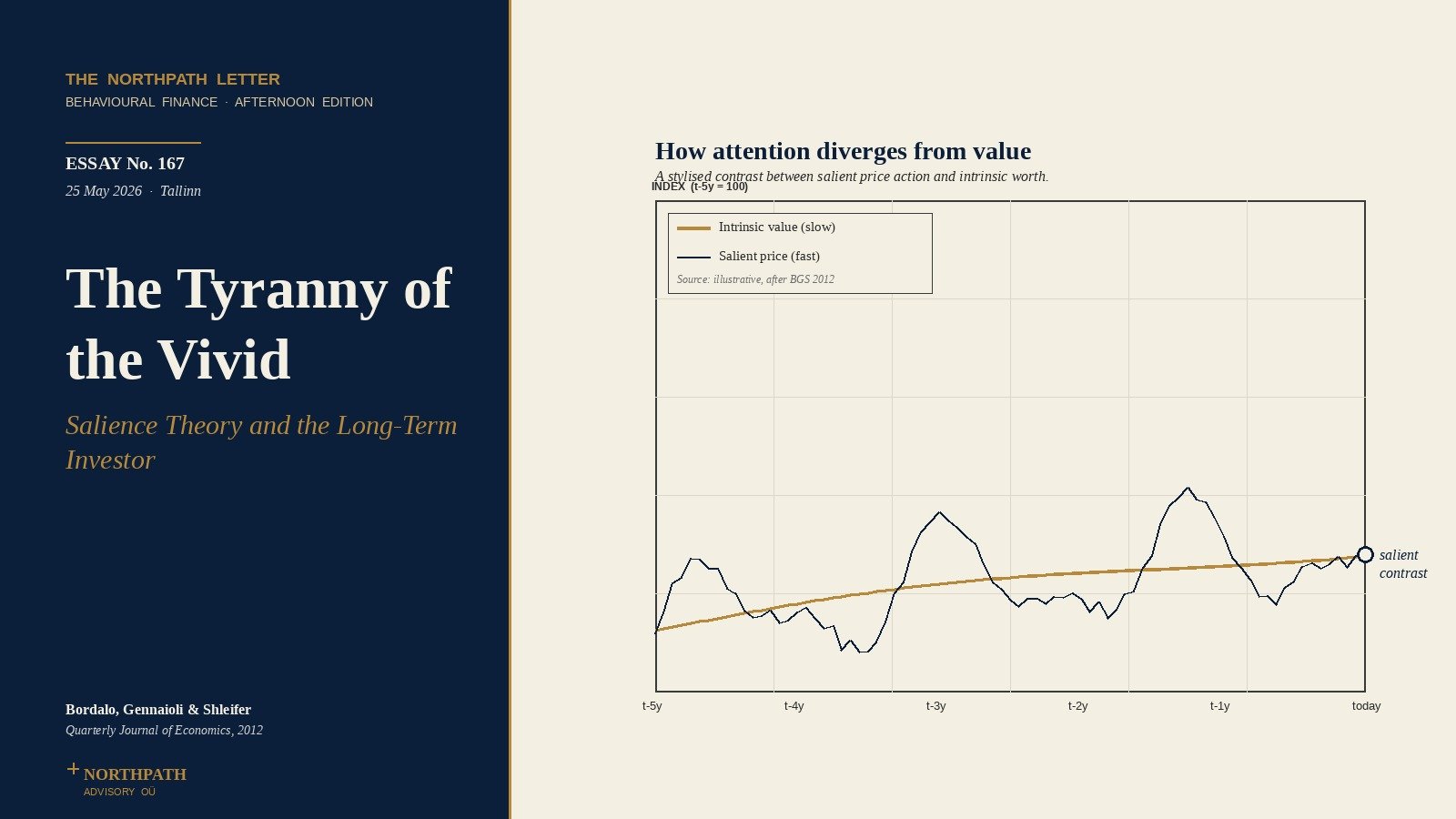
Second, rank candidates by a metric that is intrinsically slow. The salience signal is, by construction, a high-frequency one: it lives in the daily candle, the weekly news cycle, the rolling thirty-day return. Any ranking system that uses those inputs as primary will reproduce the BGS distortion mechanically. The defence is to elevate inputs that change slowly — ten-year average return on capital, multi-cycle free-cash-flow yield, decade-long revenue compounding, debt-to-equity over an interest-rate cycle — to the top of the ranking, and to permit short-horizon inputs only as tie-breakers. A spreadsheet that is sorted, by default, on a ten-year metric is harder to hijack than one sorted on yesterday’s move.
Third, separate the act of noticing from the act of deciding by an enforced delay. The behavioural-economics literature on what Walter Mischel called the cooling-off interval is consistent across domains: a salient impulse loses much of its decision weight if the decision is required to wait. A practical implementation, used by several long-tenured investment firms, is a written rule that no new position may be initiated within forty-eight hours of the news item, price move or social-media post that first put the name on the radar. The rule does not prevent the investor from researching; it prevents the salience-weighted decision from being executed before the salience has decayed. In firms that have adopted this discipline, the most common observation, repeated in internal post-mortems, is that the names that survive the forty-eight-hour pause are a small and notably different subset of the names that fail it.
None of these three disciplines requires the investor to suppress emotion, override intuition or pretend to a serenity the market does not allow. They simply re-engineer the choice architecture so that the BGS mechanism has less surface area to attack.
How the Long-Term Equity Tradition Has Addressed the Problem
The literature on salience is recent. The investment discipline that defeats it is not. At least two named practitioners in the long-term equity tradition have written and spoken, in their own vocabulary, about precisely the architecture this essay has just described.
Warren Buffett’s Berkshire Hathaway shareholder letters, taken in aggregate from 1977 onwards, contain a recurring insistence on a small, slow, pre-defined opportunity set. The discipline that produced the line about “the stock market is a device for transferring money from the impatient to the patient” is, in salience-theory language, the discipline of refusing to allow today’s contrast to determine tomorrow’s portfolio. Buffett’s repeated emphasis on the “circle of competence” performs the first counter-measure in this essay: it fixes the comparison set in advance, by sector and by business model, and resists the temptation to enlarge it on the basis of whatever has just been most vivid in the financial press. The 2021 Berkshire annual letter’s observation that Berkshire had “found it harder than usual to find things to do” in an expensive market is, read carefully, an admission that the firm had been holding the line on its comparison set despite considerable contrast pressure from the market around it.
Howard Marks of Oaktree Capital has written for two decades on what he calls “second-level thinking,” most fully in The Most Important Thing (Columbia Business School Publishing, 2011) and in the quarterly memos he has issued since 1990. The construct is, again, a defence against salience by another name. First-level thinking, in Marks’s vocabulary, takes the salient feature of the asset — the recent return, the popular narrative, the visible momentum — as the input to the decision. Second-level thinking insists that the investor go behind that surface to ask what the current price already discounts and what the market is therefore implicitly assuming about the future. The discipline is, in operational terms, an institutionalisation of the third counter-measure: a forced pause between noticing and deciding, populated by the asking of a different and slower set of questions. Marks’s 2007 memo “The Race to the Bottom” and his July 2020 memo “Coming Into Focus” are both examples of the method applied in real time to choice sets in which salience pressure was, at the moment, unusually high.
Two figures, one in Omaha and one in Los Angeles, have each spent careers operationalising what behavioural economists have now formalised. The investor who reads them carefully is being given, by people who paid the tuition for the lesson with their own capital, the user’s manual for the framework Bordalo, Gennaioli and Shleifer later wrote in equations.
A third figure deserves mention because his vocabulary is the most explicit of all. Charlie Munger’s 1995 address at Harvard Law School, “The Psychology of Human Misjudgement,” identifies what he calls “contrast-misreaction tendency” as one of the twenty-five standard cognitive biases that any serious operator of capital must learn to neutralise. The construct is, in plain English, salience theory in advance of the equations: the assertion that the mind’s evaluation of any item is heavily distorted by the items that happened to be presented immediately before it. Munger’s recommended counter-measure — the use of a checklist that imposes the same set of questions on every candidate, in the same order, regardless of the order in which the candidates happened to arrive on the desk — is, again, a structural defence rather than an emotional one. It survives because it operates on the choice architecture rather than on the chooser.
Key Takeaways
• Salience theory, as formalised by Bordalo, Gennaioli and Shleifer in 2012, predicts that decision weight is placed on payoffs that contrast most sharply with the choice set in which they are presented; the model has since been validated in the cross-section of stock returns and in regulator-collected retail-flow data.
• Modern information infrastructure — brokerage apps, news feeds, social platforms — is, by design, a contrast machine; it amplifies the very stimuli the BGS model says will distort an investor’s weighting most.
• The empirical record from two regulators in two regions, the U.S. SEC’s 2021 GameStop staff report and ESMA’s 2022 retail-investor statistical report, shows that retail capital follows the most salient names and, on average, underperforms the broad market over the subsequent year.
• Three disciplines defuse the trap without requiring emotional suppression: a pre-defined comparison set that resists ad-hoc additions; a ranking metric that is intrinsically slow, such as multi-cycle return on capital; and an enforced delay between the act of noticing and the act of deciding.
• The long-term equity tradition — Buffett’s circle of competence, Marks’s second-level thinking — encodes these defences in operating practice, and was doing so for decades before the academic vocabulary caught up.
— Manish Goel, FCA / NorthPath Advisory OÜ / Tallinn, Estonia
|
Important. |