Author: Manish Goel, FCA

  • What “Promoter” Means in Indian Listed Equity — and Why It Changes Everything

    What “Promoter” Means in Indian Listed Equity — and Why It Changes Everything

    Indian Market Context

    In Indian corporate law there is a word that has no precise counterpart in the US, UK, or continental European systems, and yet a foreign analyst trying to understand any Indian listed company will encounter it within the first thirty seconds of opening the annual report. The word is “promoter”. It appears, by my count, between 60 and 200 times in a typical Indian annual report. It defines a separate category of shareholder, a separate category of disclosure obligation, a separate category of regulatory restraint, and, in practice, a separate category of economic actor.

    The closest English-language word is “founder”, and in many cases promoter and founder refer to the same person. But the two are not synonyms. Founder is descriptive; promoter is legal. A founder may have died forty years ago and yet the company will still have a promoter group, listed by name in every quarterly filing, with disclosed shareholdings, pledge positions, and inter-se relationships. A company can have no founder and yet still have a promoter, created by a change of control. And a person who is plainly the founder may, by formal application, cease to be a promoter and be reclassified as a public shareholder — an event that has no US equivalent.

    The category matters because, in the Indian context, the promoter is the gravitational centre of the company. Promoters typically hold between 25% and 75% of the equity. They are usually represented on the board. They generally exercise day-to-day control of management. They are subject to a separate set of legal restraints and a separate set of disclosure obligations. And the analytical questions that determine returns from Indian listed equity — capital allocation, related-party exposure, succession, governance quality, alignment between controlling shareholder and minority — flow downstream from the identity, capability, and integrity of the promoter.

    This essay is the global analyst’s working primer on the concept. I will define the term precisely, walk through how the disclosure regime treats it, set out the structural shape of Indian listed-equity ownership it has produced, compare the result to the US and continental European models, and then describe seven concrete analytical implications. A reader who internalises this essay will, I hope, find every subsequent Indian annual report a more legible document.

    The legal definition, in three layers

    The term is defined in three separate statutes, each for its own purposes, and the three definitions are deliberately compatible but not identical.

    First, the Companies Act, 2013, Section 2(69), defines a “promoter” as a person:

    • (a) who has been named as such in the prospectus or is identified by the company in the annual return referred to in Section 92; or
    • (b) who has control over the affairs of the company, directly or indirectly, whether as a shareholder, director, or otherwise; or
    • (c) in accordance with whose advice, directions, or instructions the Board of Directors of the company is accustomed to act.

    The proviso clarifies that sub-clause (c) does not apply to a person acting merely in a professional capacity. So a Big-Four audit partner whose advice the board generally follows is not, by virtue of that fact, a promoter. The founder who controls 38% of the equity, whose son sits on the board, and whose advice the board habitually follows, is.

    The Companies Act definition is the parent. It is broad, principles-based, and worded around control rather than around any specific shareholding threshold. The two operative tests are: named in a public filing, and actually in control. Either is sufficient.

    Second, the SEBI (Issue of Capital and Disclosure Requirements) Regulations, 2018 — universally called “the ICDR” — provide the operative definition used in primary-market filings and in continuing disclosures. Regulation 2(1)(oo) of the ICDR adopts the Companies Act test and adds two further qualifications: the promoter must have been identified as such by the company in its annual returns or prospectus, and the term includes a person who, alone or together with others, is named as a promoter in any document filed for listing.

    Crucially, the ICDR also defines, at Regulation 2(1)(pp), the “promoter group”. The promoter group includes: the promoter; the immediate relatives of the promoter (spouse, parents, children, siblings); HUFs in which the promoter is a member; firms in which the promoter or his relatives are partners; companies in which the promoter, his relatives, or his HUF holds 20% or more; companies that hold 20% or more in the promoter; and, in the case of a corporate promoter, its subsidiaries and holding companies. The promoter group is therefore a wider concept than the promoter himself, and is the unit on which most disclosure obligations actually operate. When you see “promoter group holding 53.7%” in a quarterly filing, that 53.7% is the aggregated holding of every entity within this widely-drawn family-and-affiliate net, not the holding of any one individual.

    Third, the SEBI (Substantial Acquisition of Shares and Takeovers) Regulations, 2011 — the Takeover Code, or SAST — uses a substantially similar definition for the purpose of takeover obligations and pledge disclosures. The SAST is the regime under which any acquisition that takes a person across 25% of voting capital triggers a mandatory open offer to public shareholders for at least an additional 26% (Regulations 3 and 7), and under which promoter pledges of more than 50,000 shares or 5% of holding (whichever is lower) must be disclosed within seven working days (Regulation 31).

    The three statutes are coherent but operate in different domains: the Companies Act governs corporate-law relations, the ICDR governs primary-market issuances and continuing disclosures, and the SAST governs change-of-control events. A person is a promoter for all three purposes only if all three definitions are satisfied, which in practice is almost always the case.

    The disclosure regime — what an analyst can actually see

    The Indian disclosure regime treats the promoter as a separate disclosable category, distinct from public shareholders, with five specific reporting obligations.

    Shareholding pattern, quarterly. Under Regulation 31 of the SEBI (Listing Obligations and Disclosure Requirements) Regulations, 2015 — “the LODR” — every listed company must file, within 21 days of the end of each calendar quarter, a detailed shareholding pattern in a prescribed format. The pattern separately discloses, for each named promoter and each named promoter-group entity: the number of shares held, the percentage of total equity, the percentage on a fully-diluted basis, the number of shares pledged or otherwise encumbered, and any locked-in shares. This filing is public, downloadable in machine-readable format from the BSE and NSE corporate-filings sections, and is — for the diligent analyst — the single most valuable governance disclosure that exists in Indian listed equity. By contrast, the US 13D and 13G filings disclose only beneficial owners above 5%, on a much rougher and slower cadence, and with no equivalent of the line-item pledge disclosure.

    Pledge disclosure, event-based. Regulation 31 of the SAST, supplemented by Regulation 31A of the LODR for material events, requires the promoter group to disclose any creation, modification, or release of an encumbrance on shares within seven working days. Encumbrance is defined broadly: pledges, mortgages, non-disposal undertakings, negative liens, even certain inter-se promoter arrangements. The aggregate effect is that pledge information for any listed Indian company is essentially live, available on the exchange websites, and accurate to within a week.

    Related-party transactions, half-yearly and annual. Under Regulation 23 of the LODR and Section 188 of the Companies Act, all transactions with related parties — a category that includes the promoter, his relatives, and the entire promoter group — must be disclosed in financial statements (under Indian Accounting Standard 24, which is converged with IFRS IAS 24), in the Board’s Report (under Section 134 read with AOC-2), and in a separately filed half-yearly RPT disclosure to the exchanges. Material RPTs — defined as transactions exceeding ten per cent of consolidated turnover for the immediately preceding financial year — require prior shareholder approval, in which the promoter group itself is barred from voting (Regulation 23(4) of the LODR). This is the “majority of minority” vote; it is one of the most important governance protections in the Indian regime, and has no exact US analogue.

    Insider-trading disclosures. Under the SEBI (Prohibition of Insider Trading) Regulations, 2015, the promoter and his immediate relatives are automatically classified as “designated persons” (Regulation 9), subject to trading-window restrictions around results announcements, mandatory pre-clearance of trades above prescribed thresholds, and the post-facto disclosure of any trade in the company’s securities within two trading days. These disclosures are public and queryable on the exchange websites. The cumulative effect is that promoter trading activity in the listed entity is far more visible to outsiders in India than insider activity is in the US.

    Lock-in obligations. The ICDR requires, in any initial public offering, that promoters collectively hold at least 20% of the post-issue paid-up capital, and that this contribution be locked in for a defined period — recently shortened from three years to eighteen months by amendments effective in 2021 and 2022. The remainder of pre-issue promoter capital is locked in for six months. The function is to ensure that promoters cannot exit a freshly-listed company immediately; in practice it also creates a useful natural laboratory in which lock-in expiries are observable corporate events and the supply of shares from promoter sell-downs is forecastable.

    The five disclosure streams — shareholding pattern, pledge, RPT, insider trading, lock-in — together produce an information environment about controlling shareholders that is, in my professional view, more transparent than the United States and broadly comparable to or richer than the United Kingdom. The Indian regime is heavy-handed on disclosure precisely because the underlying ownership structure is concentrated; the disclosure regime is a deliberate counterweight to that concentration.

    The economic reality — what promoter ownership looks like at scale

    The legal category has produced a market that is structurally owner-operated. Some round-number facts about the Indian listed universe as of the most recent full-year disclosures:

    Roughly 70 per cent of NSE-listed companies have a promoter group holding of 25 per cent or more. The simple median promoter holding across the NSE 500 is in the high 40s. The Nifty 50, weighted by market capitalisation, has an average promoter holding of approximately 45 per cent. Even within the Nifty 50, the dispersion is wide: at one end, a small number of professionally-managed Indian companies have promoter holding in single digits (Infosys, which has had no controlling promoter group since the founders progressively sold down over twenty years, sits below 13 per cent) and at the other end, several large companies have promoter holding at or near the SEBI ceiling of 75 per cent (above which a listed Indian company must dilute under minimum-public-shareholding rules).

    The structure is therefore neither the dispersed-shareholder model that dominates the US large-cap universe, nor the family-controlled model with a small free float that exists in some emerging markets. It is a hybrid: a controlling-shareholder model with a substantial public float, in which the controlling shareholder is by law subject to ongoing disclosure obligations, in which minority shareholders enjoy a set of statutory protections (the majority-of-minority RPT vote, mandatory open offers above 25 per cent, equal-treatment principles under the takeover code) that do not always exist in the same form elsewhere.

    The comparison points are instructive. In the S&P 500, on the most recent rolling estimates, fewer than 10 per cent of companies have any individual or family group holding above 10 per cent of equity. Among the FTSE 100, the figure is somewhat higher but still under 20 per cent, with the exceptions concentrated in companies founded post-1990 (Wolfson, Ocado, IAG) and in dual-class structures grandfathered from earlier eras. In the CAC 40, France has a long tradition of family ownership (LVMH, Pernod Ricard, L’Oréal, Hermes), but the average controlling-shareholder concentration is lower than India. The German DAX has the Quandts at BMW and the Porsche-Piëch families at VW, and the Italian FTSE MIB has the Agnellis at Stellantis-Exor and the Del Vecchios at EssilorLuxottica, but these are individual high-profile cases against a broader backdrop of dispersed ownership.

    India is closer to the European family-controlled tradition than to the American dispersed model, but with two important differences: first, the controlling families are more numerous and more economically diverse (because the underlying economy is younger, more entrepreneur-led, and structurally less consolidated); and second, the disclosure regime is more granular than in continental Europe, particularly on pledge and related-party transactions.

    Seven analytical implications for the global reader

    Having defined what a promoter is and described the disclosure architecture, I want to spend the remainder of this essay on the seven concrete analytical implications. These are the things the global analyst should change about how he reads an Indian company, once he understands the promoter concept.

    1. Capital allocation is, in most cases, a single mind

    In a dispersed-ownership US large-cap, capital-allocation decisions are made by the chief executive within the bounds of a strategy approved by the board, in turn appointed by institutional shareholders who hold short tenures and rotate the chief executive every five to seven years. Capital-allocation outcomes are therefore aggregated across multiple executive regimes, mediated by the board, and constrained by the institutional shareholder base.

    In a promoter-controlled Indian company, capital-allocation decisions are, for practical purposes, made by one person or one family, over decades, with the board functioning as an oversight and compliance body rather than as an autonomous strategic actor. This has two important analytical consequences.

    First, the relevant biographical unit is the promoter, not the chief executive. To understand how an Indian listed company will allocate the next ten years of free cash flow, one studies what the promoter has done with the last twenty. Has he reinvested in the core business? Diversified well or poorly? Acquired competently? Distributed cash to shareholders? Compounded book value per share? The historical track record of the controlling individual is, in my experience, the single most predictive variable.

    Second, founder-led capital allocation tends to be either much better or much worse than professionally-managed capital allocation; it is rarely average. Long compounding records in Indian equity, when they occur, almost always trace to a thoughtful, conservative, return-on-capital-conscious promoter operating over twenty or thirty years. The handful of three-hundred-bagger outcomes in Indian listed equity since liberalisation in 1991 — Bajaj Finance, Eicher Motors, Asian Paints, Pidilite, Titan, HDFC Bank, and a few others — share this feature.

    2. Related-party transactions are the primary minority-shareholder risk vector

    I covered RPTs in some detail in last week’s primer on Indian annual reports. The key point is worth restating in the promoter context: because the promoter typically holds substantial economic interests outside the listed entity — in unlisted family businesses, in real-estate holdings, in financial-services ventures, in subsidiaries that did not list — the temptation to use the listed entity as a source of resource for non-listed promoter activities is structural rather than personal. It exists in every promoter-controlled company. The question is not whether the temptation exists; the question is what the historical record shows the promoter to have done with it.

    A clean RPT trajectory — small absolute levels, declining over time, no escalation in promoter-entity loans or guarantees — is, in my professional view, the single most positive governance signal an Indian listed company can present. A trajectory of growing RPT exposure, particularly in loans and advances to promoter-related parties, is the single most worrying one. The relevant unit of observation is the five-year time series. Looking at one year tells you nothing; looking at five years tells you almost everything.

    3. Pledge is quasi-debt at the promoter level

    Promoter share pledges to lenders are economically a loan against the listed equity, taken by the promoter personally or through promoter-group entities, usually to fund non-listed ventures or to plug funding gaps in promoter-affiliated activities. The economics are: the promoter retains the upside on the pledged shares but the lender has recourse to them in default. The lender will typically maintain a margin (loan-to-value ratios of 50–60 per cent are typical) and is contractually entitled to sell pledged shares if the LTV breaks, often with very short cure periods.

    The analytical reading is twofold. First, the pledge level is a window into the promoter’s personal balance sheet: a promoter with substantial unlisted commitments needing pledge financing is one whose attention is fragmented and whose financial position is leveraged. Second, the pledge creates a tail-risk in the share price: a forced sale of pledged promoter shares in a stressed market is one of the most acute downside-asymmetric events in Indian equity. The crises around IL&FS in 2018, DHFL in 2019, Zee Entertainment in 2019–20, and the Anil Ambani group through 2018–22 were each preceded by sharply rising promoter pledge percentages, in some cases approaching 100 per cent of promoter holding.

    The simple operating threshold I use: a promoter pledge level above 30 per cent of promoter holding is a yellow flag. Above 50 per cent is a red one. A rising trajectory at any level is informative regardless of the absolute number.

    4. Succession is a discrete event, not a continuous process

    In a dispersed-ownership US company, the chief executive succession is a continuous board-managed process, with internal candidates groomed over decades and external searches conducted publicly. The market prices it accordingly: the equity does not normally re-rate sharply on a CEO transition.

    In a promoter-controlled Indian company, the equivalent event is a generational transition within the founding family — the founder retiring, the son or daughter taking over, an outsider being appointed to operating leadership while the family retains ownership. These transitions are discrete, often poorly telegraphed, and historically have been very mixed in outcome. A first-generation founder who built the business out of an industry vacuum may have produced excellent compounding for twenty-five years; the second generation may or may not have inherited the capability.

    The analytical lens: when working on an Indian listed company with a first-generation promoter aged above sixty-five, the succession question is a primary one, not a peripheral one. Has the next generation been involved in the business for at least a decade? Has a non-family chief executive been progressively given operating authority? What is the documented separation of family wealth and listed-company resources? Where the answers are affirmative, succession risk has been priced in. Where they are not, the eventual transition is a material discontinuity.

    5. Skin in the game is unusually high — in both directions

    A promoter who holds 50 per cent of a listed company has an alignment with public shareholders on share-price outcomes that is, in pure economic terms, far stronger than any US public-company executive on a stock-option grant. He owns a quarter of his net worth, frequently, in this single equity. The capital appreciation of the company is, for him, the dominant variable in his lifetime wealth.

    The flip side is that this very concentration creates an incentive to maintain control even when independent capital allocation would dilute control. Equity raises that would be growth-positive but ownership-dilutive get postponed; debt is preferred over equity in funding decisions; cash is preferred over capital return because it preserves optionality at the parent level. The well-run promoter operates against these incentives. The less well-run one does not. The difference is observable in financing decisions over a decade.

    6. Reclassification of promoter is a corporate event in its own right

    Regulation 31A of the LODR, introduced in 2018 and revised in 2021 and 2024, sets out the framework under which a person can cease to be a promoter and be reclassified as a public shareholder. The conditions are stringent: the applicant and his immediate relatives must hold less than 10 per cent of voting capital; they must have no representation on the board; they must hold no key managerial positions; they must not have any veto rights or special information rights; and the reclassification must be approved by ordinary resolution of public shareholders, with the existing promoter group barred from voting.

    When a reclassification occurs — not common, but not rare; a typical year sees twenty to thirty reclassification approvals across listed Indian companies — it has substantive economic consequences. The reclassified person’s holding moves from “promoter” to “public”, free float computations change, index inclusion eligibility can change, and the dynamics of the shareholder register shift. For an outside analyst, the reclassification announcement is also one of the rare windows into intra-promoter dynamics: it usually signals a family split, a disengagement of one branch from operations, or the conclusion of a long inheritance dispute. The associated stock-exchange filings, taken with the supporting Form MGT-15 disclosures, often contain unusually candid commentary on what is happening within the controlling group.

    7. The promoter concept may itself be on its way out

    In 2021 SEBI’s Primary Market Advisory Committee issued a consultation paper proposing that the term “promoter” be phased out over time and replaced with “person in control”, on the reasoning that the existing framework has become operationally complex, that mature Indian companies increasingly resemble dispersed-ownership companies, and that retaining a separate promoter category creates inflexibility around capital raises and corporate transactions. The 2024 amendments to the ICDR moved partially in this direction by reducing the minimum promoter contribution and lock-in obligations in several scenarios, and by liberalising the treatment of professional venture-capital and private-equity shareholders post-IPO.

    A complete transition has not occurred. As of mid-2026 the promoter category remains the operative legal concept across the Companies Act, ICDR, LODR, and SAST. The five-year direction of travel, however, is towards a regime more like the European or UK norms, in which controlling shareholders exist as a matter of economic fact but not as a separate legal-disclosure category. The analyst should be aware that the regulatory architecture I have described in this essay is in a slow transition, and that some of the disclosure obligations may be diluted or repackaged in the next five to ten years. None of this changes the underlying economic reality of concentrated ownership; it changes only the disclosure framework around it.

    A step-by-step process for reading promoter information on any Indian listed company

    Practical application. Here is the sequence I follow, in order, when I want to understand the promoter situation of an unfamiliar Indian listed company. Total time investment: about forty-five minutes.

    1. Step 1 (5 minutes) — Download the most recent quarterly shareholding pattern. Go to the BSE or NSE corporate-filings page for the company and download the latest quarterly shareholding pattern filing. Note the total promoter group holding, the number of distinct named entities in the promoter group, and the total pledged shares as a percentage of promoter holding.
    2. Step 2 (10 minutes) — Pull the same data for the past five years. Either from the exchange archives or from any of the standard data aggregators. Plot promoter holding and promoter pledge over the past twenty quarters. Two trends are informative: is promoter holding stable, rising (through creeping acquisitions), or falling (through sell-downs or dilution)? And is promoter pledge stable, rising, or falling? Each pattern means something different.
    3. Step 3 (10 minutes) — Read the related-party-transaction note in the last three annual reports. Tabulate: total RPT volume (sales + purchases + loans + guarantees + reimbursements), aggregate loans and advances to promoter-related entities, aggregate guarantees given on behalf of promoter-related entities. Note the trend year-over-year.
    4. Step 4 (5 minutes) — Read the “Promoter Group” section of the corporate-governance report. Identify the named individuals and the names of all promoter-group entities. Cross-check whether any of those named entities also appear in the RPT note. A promoter-group entity that appears in the RPT note as a counterparty for material loans or services is the analytical centre of gravity.
    5. Step 5 (5 minutes) — Search for any reclassification, open-offer, or material-event filings. The exchange websites maintain a chronological log of material filings. Search for the words “reclassification”, “open offer”, “change in promoter”, or “intimation under Regulation 31A” in the company’s filings over the past five years. Any positive hit is an event of analytical importance.
    6. Step 6 (5 minutes) — Read the insider-trading disclosures for the past twelve months. All trades by designated persons in the company’s securities are filed within two trading days. Significant promoter buying is a positive signal. Significant promoter selling, particularly within the trading-window restrictions or shortly before adverse results announcements, is the opposite. Aggregate the net buying and selling across the most recent twelve months and against historical patterns.
    7. Step 7 (5 minutes) — Form a written one-paragraph summary. Who is the promoter, what is the holding, what is the pledge position, what is the RPT trajectory, what was the most recent material promoter-related event, and what was the net insider activity. This paragraph is the basis on which all subsequent fundamental work on the company should be evaluated.

    Forty-five minutes of this work, before any income-statement analysis, will tell the global analyst more about the structural risk-and-return profile of an Indian listed company than two days spent on a discounted cash flow model. The income-statement analysis still has to be done, of course. But it should be done in the context of an understanding of who controls the company and what they have historically done with the controlling position.

    Closing

    The Indian system has, in the “promoter” category, codified into law a fact about its economy that is true but largely informal in most other places: that listed companies in emerging economies are usually controlled by identifiable individuals or families with substantial personal economic exposure to the listed entity. The codification has consequences. It produces a richer disclosure environment than exists in most comparable jurisdictions. It creates a separate analytical layer that cannot be skipped. And it generates a specific set of risks — related-party leakage, pledge stress, succession discontinuity — that map directly to the structure.

    The global analyst who learns to read this layer competently has, in my experience, a real and durable analytical advantage. The one who tries to apply a 10-K-trained framework to an Indian annual report without understanding the promoter dimension is repeatedly surprised by outcomes that, with thirty minutes of additional reading, would have been entirely foreseeable.

    I will write further essays in this Indian Market Context series on related sub-topics: a separate deep-dive on the CARO 2020 framework, on standalone-versus-consolidated reading, on the Indian segmental-disclosure regime under Ind AS 108, on Form AOC-1 as a one-page x-ray of a group, on the BRSR, and on the specific accounting and audit norms that diverge between Ind AS and IFRS. Each is a piece of analytical infrastructure that, once internalised, makes every subsequent Indian annual report a faster and more productive read.

    The single Indian-law term that most reshapes how to read Indian listed equity is “promoter”. Learn it, learn the disclosure architecture around it, and the entire Indian listed universe becomes legible.

    — M. G.

    No spam. Unsubscribe in one click.

  • Reading an Indian Annual Report When You Didn’t Grow Up in India

    Reading an Indian Annual Report When You Didn’t Grow Up in India

    Indian Market Context

    The annual report of an Indian listed company is, on first encounter, a beast. The annual report of HDFC Bank for the financial year ended March 2025 runs to 712 pages. Reliance Industries’ for the same year runs to 768. Even a mid-cap consumer business with a single product line will typically file 280 to 350 pages. By comparison, the 2024 annual report of Procter & Gamble runs to 152 pages; LVMH’s runs to 372.

    This is not because Indian companies are more complex. It is because the Indian disclosure regime — primarily the Companies Act, 2013, the SEBI (Listing Obligations and Disclosure Requirements) Regulations, 2015 (universally referred to as “the LODR”), and the accounting standards (Ind AS, India’s IFRS-converged regime) — requires a substantially larger set of disclosures than the US or continental European systems. Some of these disclosures are genuinely useful. A few are extraordinarily useful and have no real counterpart in the 10-K. Some are bureaucratic noise. The competent global analyst learns to navigate from the useful to the very useful efficiently, and to skip the noise.

    This essay is that map.

    I will assume the reader has experience with US-format 10-Ks or UK-format annual reports, and will write throughout in comparison to those formats where the comparison is informative. I will not assume any knowledge of Indian corporate law beyond what a serious investor would pick up by reading three or four Indian annual reports.

    The structure of an Indian annual report, in order

    Indian annual reports follow a remarkably consistent structure across companies, because the structure is largely prescribed by law. The order is broadly:

    1. Notice of Annual General Meeting (mandated under Section 101, Companies Act 2013) — the formal call to shareholders, listing every resolution to be voted on. Often 20–40 pages on its own because each ordinary and special resolution requires a separate “Explanatory Statement” under Section 102.
    2. Board’s Report (Section 134) — the directors’ formal report to shareholders. Includes financial highlights, dividend recommendation, performance commentary, material changes, subsidiary information, corporate social responsibility report, directors’ responsibility statement, conservation of energy / technology / foreign exchange particulars, and dozens of other mandated items. Typically 30–70 pages.
    3. Management Discussion and Analysis (LODR Schedule V, Part B) — the qualitative commentary on the business. Nine prescribed sections including industry overview, opportunities and threats, segmental performance, outlook, risks, internal control adequacy, financial performance, HR developments, and key ratios. Typically 15–30 pages.
    4. Corporate Governance Report (LODR Schedule V, Part C) — board composition, committee composition and attendance, director profiles, remuneration disclosures, related-party transaction policy, whistleblower policy, code-of-conduct compliance, and a CEO / CFO certification. Typically 25–40 pages.
    5. Business Responsibility and Sustainability Report — BRSR (SEBI circular, mandatory for top-1,000 listed companies from FY 2022–23) — extensive ESG disclosures across nine principles. Typically 30–80 pages.
    6. Independent Auditor’s Report (Standalone) — the auditor’s opinion on the standalone financials, including Key Audit Matters under SA 701 and an annexure containing the report under the Companies (Auditor’s Report) Order, 2020 — universally called “CARO 2020”. 15–30 pages.
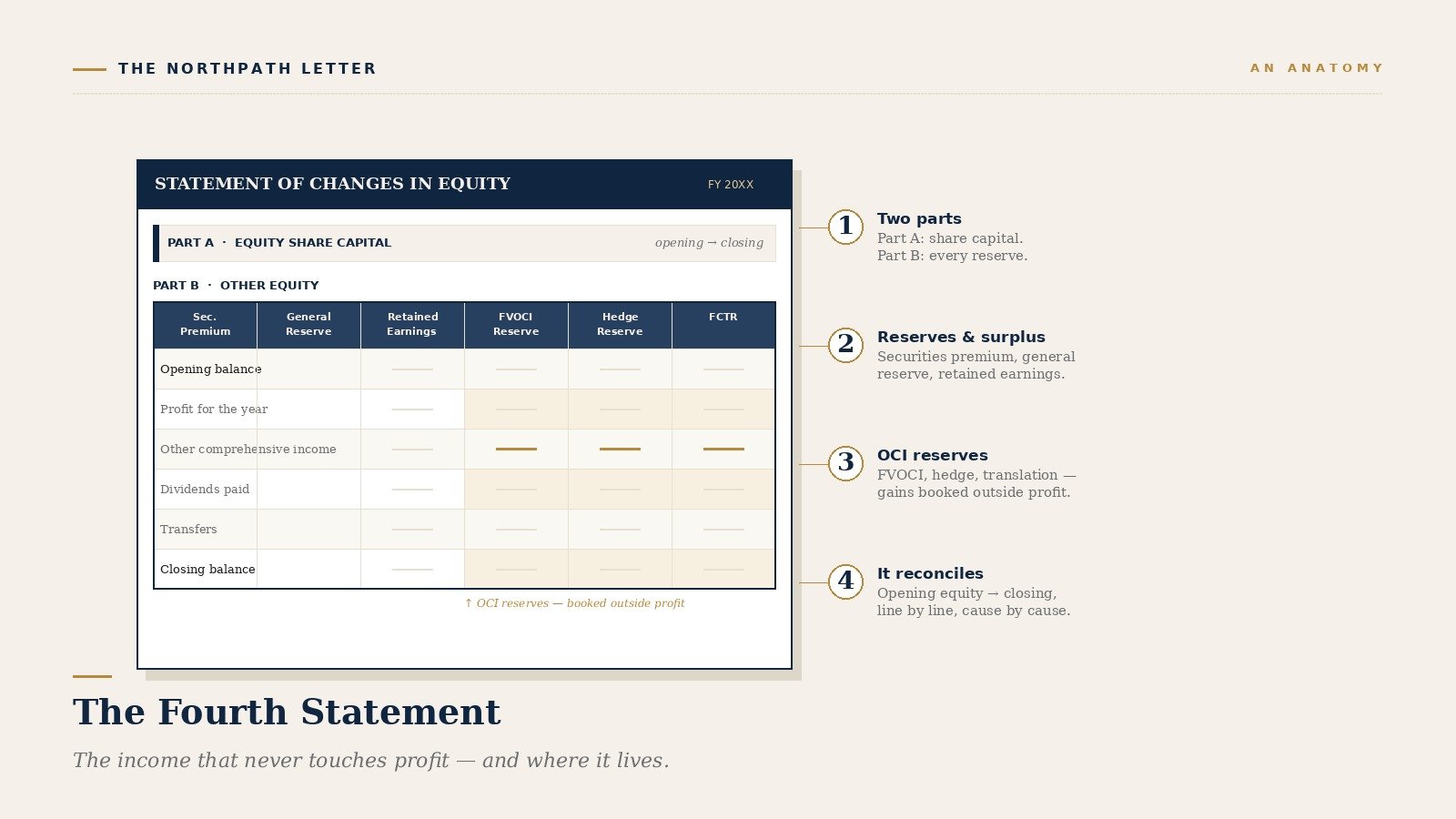
    7. Standalone Financial Statements — parent company only. Balance sheet, statement of profit and loss, cash flow statement, statement of changes in equity, and notes. 50–100 pages.
    8. Independent Auditor’s Report (Consolidated) plus Consolidated Financial Statements including subsidiaries, joint ventures, and associates. Same format as standalone but consolidated. Another 70–120 pages.
    9. Form AOC-1 — a single-table summary of every subsidiary and associate, including each entity’s standalone revenue, profit, total assets, and the parent’s investment in it. Typically 2–5 pages but contains a high density of information.
    10. Secretarial Audit Report — Form MR-3 (Section 204, mandatory for listed and certain unlisted companies). Independent secretarial auditor’s opinion on the company’s compliance with the Companies Act, SEBI regulations, depository regulations, and other applicable laws. 5–10 pages.

    The total — Notice + Board Report + MDA + CG + BRSR + Audit + Standalone FS + Consolidated FS + AOC-1 + MR-3 — is the 250–700 page object that arrives in the investor’s inbox each summer.

    A practical 30-minute reading sequence

    I will assume the typical use case: you have a finite amount of time, you want to understand a company quickly, and you are reading the annual report either as initial diligence or as part of a periodic re-review. In that order of priority — and explicitly skipping things in this first pass — here is what I would read.

    Minutes 0–5: Form AOC-1 (the one-table subsidiary summary). This is the single most information-dense page in the report. It gives you, in one table, every subsidiary’s revenue, profit after tax, total assets, total liabilities, and the parent’s investment. For a consolidated business, this tells you immediately which subsidiaries actually matter, where consolidated revenue is coming from, which subsidiaries are loss-making and need to be capitalised by the parent, and whether there are large subsidiaries that nobody talks about. AOC-1 is often the fastest way to discover that a company you thought was a domestic Indian business has a Mauritius subsidiary, a Cyprus subsidiary, and three step-down LLPs in Singapore — and to ask why.

    Minutes 5–10: Related Party Transactions note in the financial statements. This is usually Note 30-something in the standalone financials and a slightly different number in the consolidated. It lists every transaction with promoter-related parties: sales, purchases, loans given and taken, guarantees, leases, services. Two questions matter: are the RPT volumes large relative to revenue or profit? A consumer business that sells 30% of its output to a promoter-owned distribution company is structurally different from one that sells nothing to its promoter. And are RPT volumes trending up or down over years? The trend matters more than the absolute level. A small number of historical Indian corporate failures — Satyam in 2009, the IL&FS group in 2018, DHFL in 2019 — were visible in the RPT note years before they blew up. Not always specifically, but as patterns of expanding intra-group lending or expanding promoter-entity exposure.

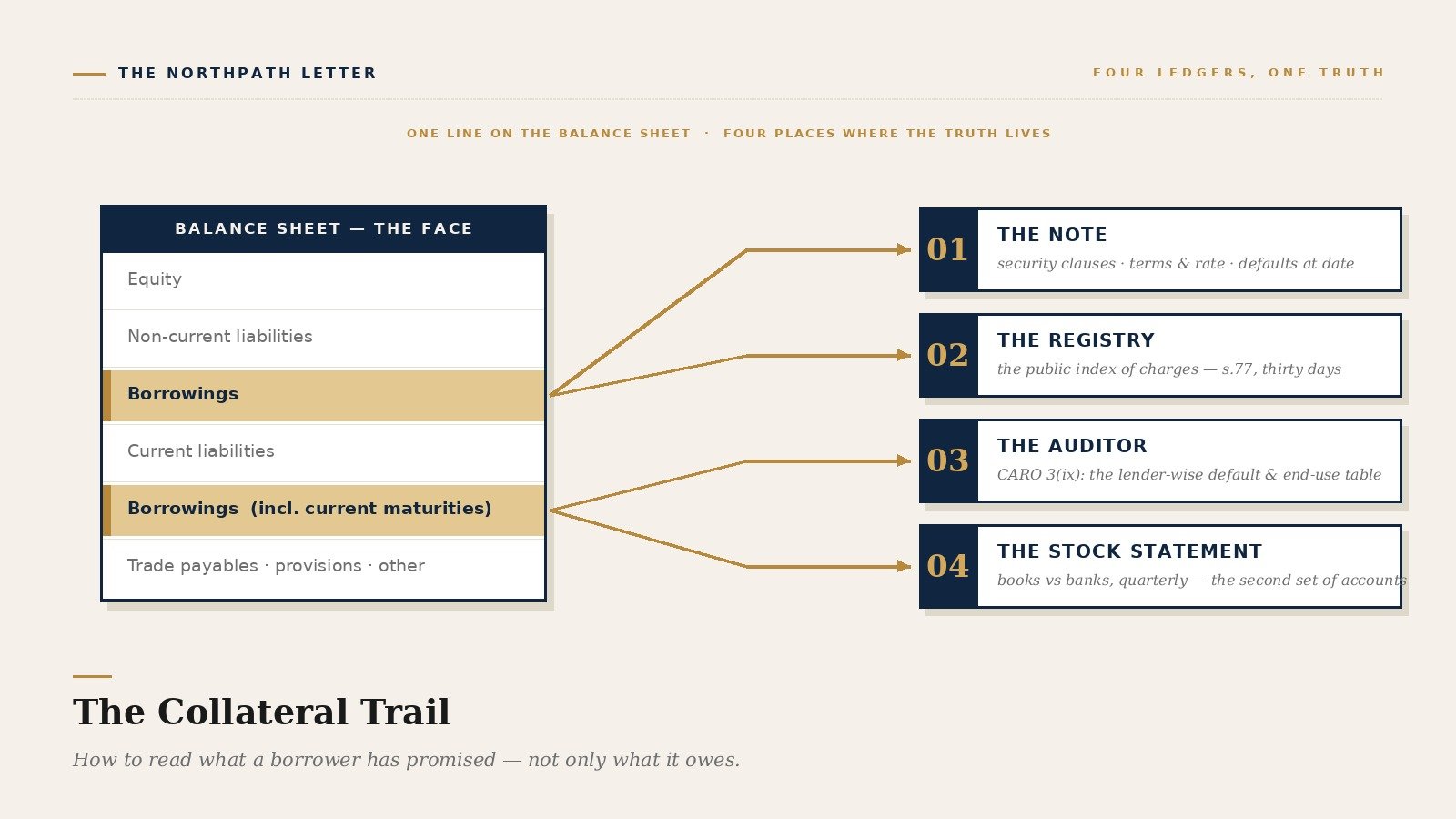
    Minutes 10–15: Auditor’s CARO 2020 annexure. The 21-clause CARO checklist is the auditor’s formal attestation on a series of operational and compliance matters. Read the auditor’s responses to clauses (vii), (ix), (xi), (xv), and (xxi):

    • Clause (vii) — whether the company has been regular in paying undisputed statutory dues (GST, income tax, provident fund, professional tax, and so on). Any “not regular” answer is a working-capital red flag.
    • Clause (ix) — whether the company has defaulted in repayment of loans or borrowings, and whether it has been declared a “wilful defaulter” by any bank or financial institution. Self-explanatory.
    • Clause (xi) — any fraud by or on the company reported to the auditor or noticed by the auditor during the year. A “yes” answer here, even if small in financial impact, demands further reading.
    • Clause (xv) — whether the company has entered into non-cash transactions with directors or persons connected with them under Section 192 of the Companies Act. Indirect related-party signal.
    • Clause (xxi) — auditor’s view on going concern, particularly relevant for loss-making or working-capital-stressed businesses.

    A clean CARO is the absence of an answer to any of these clauses. A CARO with affirmative answers to (vii), (ix), (xi), or (xxi) merits opening the annual report a second time.

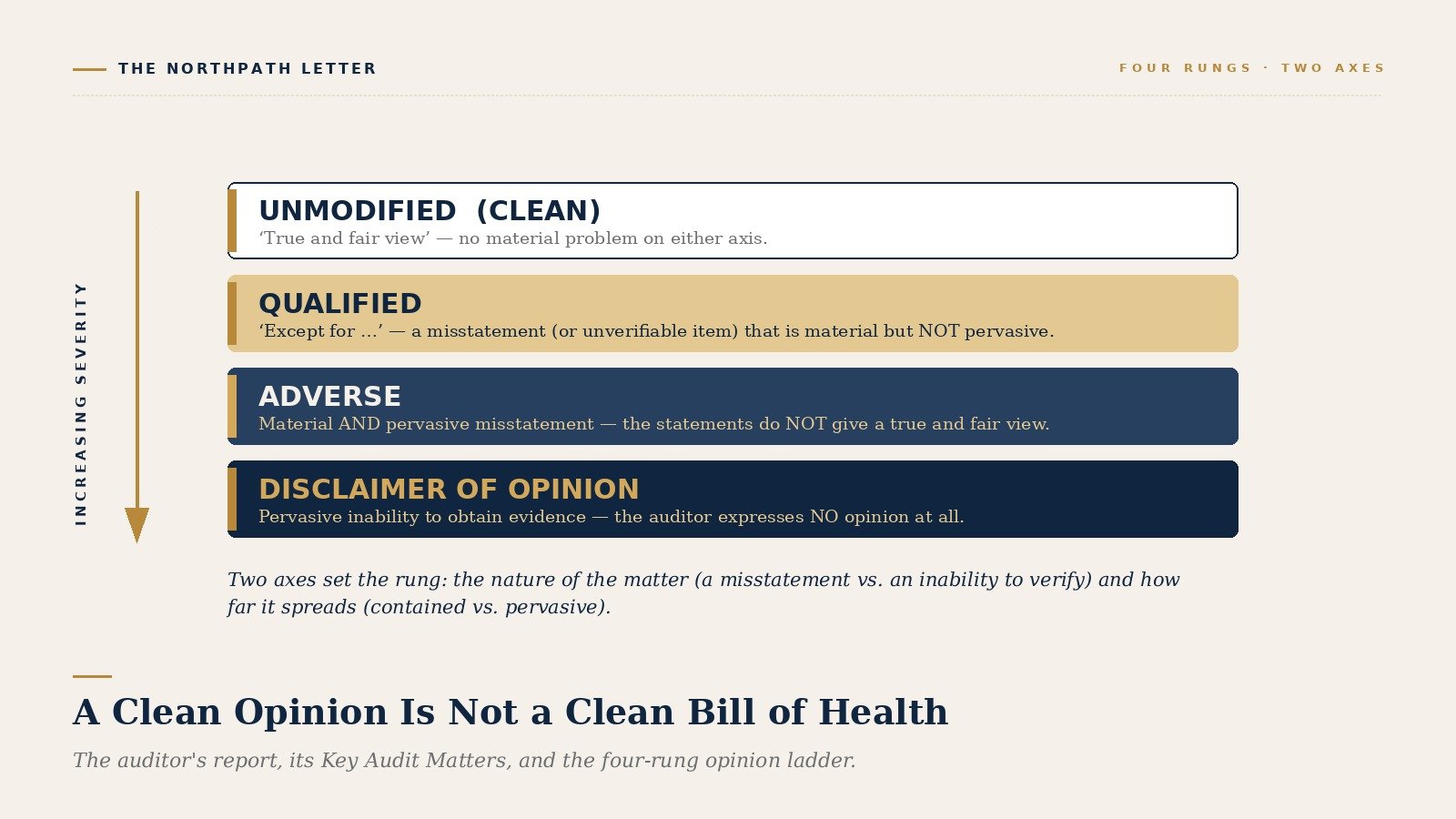
    Minutes 15–20: Key Audit Matters in the auditor’s report. Since the 2018 adoption of SA 701 in India, the auditor’s report on listed companies must disclose “Key Audit Matters” — the items the auditor considered most significant in the current period’s audit. Each KAM has two sections: a description of the matter and a description of how the audit addressed it.

    KAMs are interesting because they tell you what the auditor was worried about. If the KAM is “revenue recognition for long-cycle projects”, the auditor is signalling that revenue may be aggressive. If the KAM is “impairment of goodwill on the X subsidiary”, the auditor is signalling that the subsidiary may be in trouble. If the KAM is “valuation of derivatives” and the company is an FMCG business, the auditor is signalling something unusual. KAMs do not generally constitute an adverse opinion, but they are the auditor’s polite way of telling you what to dig into.

    Minutes 20–25: Shareholding pattern and promoter pledge disclosure. Found near the start of the Corporate Governance Report. Look at:

    • Total promoter holding. What percentage of the company do the founding family or controlling shareholders own? In Indian listed companies the range is from roughly 5% (Infosys, professionally managed, founders gradually sold down over decades) to roughly 75% (the upper SEBI ceiling for promoter holding in a listed company before it must dilute). Most owner-operated Indian companies sit at 40–65%.
    • Pledged shares of the promoter group. This is critical. Promoter shares pledged to lenders are economically a quasi-debt at the promoter level, often used to fund non-listed group ventures. A high pledge percentage — typically anything above 30% of promoter holding pledged — is a serious yellow flag, and a rising pledge percentage is a serious red one. The IL&FS, DHFL, Zee, and Anil Ambani group crises were all preceded by escalating promoter pledge levels.
    • FII holding and DII holding — institutional ownership levels and their trend.

    Minutes 25–30: Contingent liabilities note in the financial statements. Usually a sub-note within “Commitments and Contingencies”. Lists tax demands disputed by the company (income tax, GST, customs, excise) — often substantial for older Indian companies — ongoing legal proceedings, guarantees given to subsidiaries or third parties, and pending lawsuits and arbitrations. For old industrial companies, the contingent-liability schedule can run to a billion dollars in disputed tax demands. Most do not crystallise, but some do, and the trajectory year-over-year is informative.

    If your half-hour budget allows extra time, the next thing I would read is the auditor’s report on Internal Financial Controls (a separate report mandated by Section 143(3)(i) of the Companies Act), and after that the MD&A. Both are useful but in my experience never the most informative items in the file.

    Five Indian-specific disclosures the global analyst routinely overlooks

    I want to spend more time on each of five disclosures that exist in Indian annual reports and either do not exist in US/European reports or exist in a much less developed form. These five, in my experience, are where genuinely new information lives.

    1. The Standalone–versus–Consolidated split

    In the US, listed companies file consolidated financials only. Indian companies are required to file both standalone (parent-only) and consolidated (with subsidiaries, joint ventures, and associates) financials, and both are usually presented in the same annual report, one after the other.

    The standalone financials show what the parent company itself does — its own revenue, its own costs, its own assets, its own liabilities. The consolidated financials show the group as a whole. Where the two differ significantly, there is a story.

    A pharma company whose standalone shows ₹2,000 crore of revenue and whose consolidated shows ₹18,000 crore is a company whose business sits 90% in subsidiaries — typically the US generic operations in a Delaware LLC, the European operations in a German GmbH, and so on. The standalone is interesting only as a holding-company P&L. The consolidated is the real business.

    Conversely, an Indian conglomerate whose standalone profit is ₹3,500 crore and whose consolidated is ₹1,200 crore is a company where subsidiary losses are eating most of the parent’s profit. That dynamic — where the listed parent is profitable but the consolidated group is barely profitable — is structurally important and easy to miss if you only read consolidated numbers.

    When reading an Indian company for the first time, I always look at both. The questions are: where does revenue actually come from? Where do losses actually sit? Which subsidiaries is the parent capitalising? Are dividends from subsidiaries flowing up to the parent or being trapped offshore?

    2. The promoter concept and promoter shareholding

    “Promoter” has no US-law equivalent. The Companies Act 2013, Section 2(69), and the SEBI ICDR Regulations define a promoter as the person who has control over the affairs of the company (directly or indirectly), is named as a promoter in the offer document or the annual report, or in accordance with whose advice the board acts. In practice, “promoter” almost always means the founding family, the controlling shareholder group, or the original entrepreneurs and their successors.

    Indian listed companies are required to separately disclose the shareholding of the promoter group, both in the annual report and in the quarterly shareholding pattern filing with the exchanges. The promoter is also treated separately under various securities laws — insider trading restrictions, related-party transaction rules, takeover regulations.

    For the global analyst, the analytical implications are: Indian listed equity is largely owner-operated. Roughly 70% of NSE-listed companies are promoter-controlled in the sense that the promoter group holds 25% or more. This is structurally different from the US S&P 500, where dispersed institutional ownership dominates. The promoter’s economic interest is usually substantial in absolute terms and often dominant in relative terms. Promoter wealth is concentrated in the listed entity’s shares. This generally aligns the promoter with public shareholders on share-price outcomes but creates conflicts on cash flows (the promoter may prefer to extract value through related-party transactions rather than dividends). The quality of the promoter, both in business and in governance, is one of the single most important variables in Indian equity returns. There is no analogous variable for a US blue-chip.

    3. Related-party transactions, in detail

    Because most Indian listed companies are promoter-controlled and promoters typically own multiple group entities, the volume and quality of related-party transactions is a far more important analytical input in India than in the US.

    The RPT note in the financial statements lists, for each related party: nature of relationship (subsidiary, associate, key managerial personnel, promoter-affiliated entity); sales to and purchases from the related party; loans and advances given to or received from; guarantees and securities provided; reimbursements; and outstanding receivables and payables at year-end. The annual report also contains an RPT policy (in the Corporate Governance Report) and a section in the Board’s Report on material related-party transactions requiring shareholder approval under Section 188.

    What I look for, in order of importance: material related-party sales or purchases. If a meaningful percentage of revenue or COGS goes through promoter-related entities, the analyst needs to understand the pricing mechanism. Is it at arm’s length? Audited? Subject to a transfer-pricing report? Loans and advances to promoter-related parties. This is often where minority value is leaked. The parent lends to a promoter-related entity at concessional rates, the loan never quite gets repaid, and over a decade the parent’s balance sheet is quietly hollowed out. Trend matters more than absolute level. Guarantees given by the parent on behalf of promoter-related entities. These do not show up as debt on the parent’s balance sheet but are a real economic obligation. Trend over years. Stable or shrinking RPT exposure is healthy. Expanding RPT exposure, especially in loans, advances, or guarantees, is a yellow flag turning amber over time.

    The single best heuristic I have developed: companies whose related-party exposure shrinks every year tend to outperform companies whose related-party exposure grows every year, holding business quality constant.

    4. CARO 2020 — twenty-one clauses you should learn to read

    The Companies (Auditor’s Report) Order, 2020 — universally CARO 2020 — is an annex to the auditor’s report. It is, in effect, a 21-question checklist that the auditor must answer for every audited company above certain size thresholds. There is no exact US analogue. The closest US equivalent is the auditor’s report under PCAOB AS 3101, but CARO is far more granular and more operational.

    The 21 clauses cover, among other things, title of immovable properties, physical verification of inventory, working capital limits, loans and investments, deposits accepted, statutory dues, defaults on borrowings, application of fund-raising proceeds, frauds, related-party transactions, registration under various Acts, going concern, and resignation of the statutory auditor.

    The mechanism: for each clause, the auditor either says nothing of concern (essentially a clean response) or describes a specific observation. The CARO annexure for a clean, well-run business is short, sometimes only two or three pages, and consists largely of “in our opinion, the company is in compliance” responses. The CARO annexure for a stressed business can run to ten or fifteen pages of qualifications.

    Specific clauses to read with care, beyond the ones I listed in the 30-minute sequence: Clause (iii) — loans and investments to companies, firms, LLPs, parties covered under Section 189. If the company is making large loans to non-trade parties, that is informative. Clause (iv) — compliance with Sections 185 and 186 (regarding loans to directors and inter-corporate loans). Non-compliance is a serious governance signal. Clause (xiv) — internal audit system and whether the company has an internal audit commensurate with size and nature of business. A “no” answer here for a meaningful-sized company is unusual and informative.

    CARO is the single most efficient form of operational due-diligence available in an Indian annual report. It takes ten minutes to read, it covers things US reports never cover, and it occasionally contains the one disclosure that explains why a business is going to trouble.

    5. The BRSR ESG framework — flawed but emerging

    The Business Responsibility and Sustainability Report, mandatory for the top 1,000 listed Indian companies since FY 2022–23, replaced the older Business Responsibility Report (BRR). It is structured around nine “principles” derived from the National Guidelines on Responsible Business Conduct, covering ethics, product responsibility, employee welfare, stakeholder engagement, human rights, environment, public policy advocacy, inclusive growth, and consumer welfare.

    The BRSR is, frankly, of mixed quality. Disclosure standards are still settling, comparability across companies is limited, and a meaningful fraction of disclosures are still self-reported and unverified. However, it is the de facto Indian ESG-disclosure framework, and serious global ESG-aware investors are starting to read it.

    Two BRSR sections I have found useful: the principle 6 (environment) quantitative disclosures (greenhouse-gas emissions, water consumption, energy intensity), which are increasingly assured by independent third parties; and the principle 5 (human rights) disclosure of complaints, sexual-harassment cases, and grievance-redressal turnaround. Both have improved markedly in quality between FY23 and FY25 disclosures. I would not yet rely on BRSR for cross-company ESG ranking. I would read it on individual companies for directional signals.

    Five things to skip on a first read

    To save time, an experienced Indian-annual-report reader skips, on a first pass:

    1. The conservation-of-energy, technology-absorption, and foreign-exchange particulars (Section 134(3)(m) read with Rule 8(3) of the Companies (Accounts) Rules, 2014). Almost always boilerplate.
    2. The directors’ responsibility statement (Section 134(5)). A statutory affirmation of compliance, identical in form across companies.
    3. Director profiles in the Corporate Governance Report. Useful for one-off checks but not for ongoing reading.
    4. The notice of AGM resolutions and their explanatory statements, unless one of the resolutions is unusual (for example, a material related-party transaction approval or a substantial scheme of arrangement).
    5. Most of the MD&A. I am aware this is heretical. The MD&A is structurally constrained by the LODR-prescribed nine sections, is written by company management with PR review, and contains very little that you cannot get from a more concise analyst presentation or the earnings call transcript. There are exceptions — the MD&A of well-run owner-operated companies is genuinely good — but as a default, skip.

    Where to find what you need quickly

    A practical note on logistics. Most Indian annual reports are published as a single PDF and uploaded to: the company’s investor-relations page on its corporate website; the stock exchange filings (BSE: bseindia.com/corporates; NSE: nseindia.com/companies-listing/corporate-filings-annual-reports); and the SEBI’s centralised SCORES / LODR portal, indirectly.

    For older reports (five years back and earlier), the company website may have removed them but the exchange archives usually still hold them. For listed companies, all annual reports filed since FY2016 are available on the exchange websites.

    I would recommend, when starting work on an unfamiliar Indian company, downloading the last five annual reports and reading them not in chronological order but in reverse — most recent first, then the previous one to see what changed, then the one before that. Patterns in disclosure (RPT trends, contingent liabilities, promoter pledge, KAMs) are visible only in the time-series.

    One final practical note

    The Indian annual-report disclosure regime is heavy by international standards. It is also genuinely informative if you know what to read. The temptation, when first encountering a 600-page document, is to read it cover to cover or to dismiss it as unreadable. Neither is right. The correct response is to learn the structure, develop an efficient reading sequence, and over time build the habit of looking at the seven or eight things that actually matter.

    I will write further essays on individual sub-sections of the annual report in the coming weeks — separate deep-dives on the CARO 2020 framework, on reading Indian segmental disclosures, on Form AOC-1, on Indian contingent-liability schedules, and on the BRSR. Each is a piece of analytical infrastructure that, once internalised, makes every subsequent annual report you read faster and more productive.

    For the impatient: thirty minutes per company per year, executed in the sequence above, will catch eighty per cent of what matters.

    — M. G.

    No spam. Unsubscribe in one click.

  • What This Publication Is

    What This Publication Is

    Indian Market Context

    If you have arrived here as a result of a forwarded link, a search, or a half-curious click, the simplest way I can explain what you have found is this: The NorthPath Letter is a written publication about Indian businesses, written by a Chartered Accountant who has spent the last twenty-two years thinking about Indian capital markets, for a reader who is not Indian, who does not read Hindi-language broker reports, and who would rather understand an Indian company than be told what to do with one.

    There are many places on the internet where you can find an Indian stock tip. There are many more where you can find a “Top Five Multibaggers for 2026” headline. This is neither of those places.

    This is a publication about analysis. About businesses. About reading annual reports — and reading them carefully. About the long, unglamorous, compounding work of understanding why a particular Indian company is worth your attention, or, far more often, why it is not. It is published from Tallinn, Estonia, by NorthPath Advisory OÜ. It will arrive in your inbox every morning, seven days a week.

    It will, in due course, have a premium subscriber tier. Today, and for the foreseeable future, every issue is free.

    Why this publication exists

    Indian listed equity is one of the world’s largest and most under-translated capital markets. The Bombay and National Stock Exchanges between them list more than 5,400 companies. Total market capitalisation has crossed five trillion US dollars. Foreign portfolio investors hold, at the time of writing, approximately eighteen per cent of all free-float Indian equity — a fraction that has grown, with interruptions, for two decades.

    And yet the volume of high-quality, English-language, long-form written analysis of Indian listed businesses available to a global reader is, by international comparison, thin. There is no Indian-equity equivalent of Stratechery for technology, or Mostly Borrowed Ideas for US/global equities, or The Generalist for venture. The English-language Indian financial press is dominated by daily-news reporting (excellent at what it does, but not analytical); the sell-side research that does cover Indian businesses is locked behind institutional paywalls; and the open Indian financial blogosphere is overwhelmingly retail-oriented, focused on price targets, technical patterns, and short-horizon recommendations.

    That gap is the reason this publication exists.

    What you will find here

    Every morning, you will receive one essay. The essays will rotate, roughly, between five forms:

    Business deep-dives. Long-form (three to four thousand word) analytical breakdowns of individual Indian listed companies. The analytical focus will be capital allocation history, competitive position, management track record, accounting quality, and the structural features of the industry. We are interested in what a business has done with shareholder capital over a decade, not in what its stock will do next quarter.

    Capital-allocation essays. Frameworks for thinking about how capital flows in and out of Indian businesses — and how a global reader should think about those flows. Indian dividend policy. Indian buyback regulation. Indian rights issues. The Indian preference for retained earnings over distribution. The structural reasons why all of these differ from US and continental European norms.

    Sectoral and macro letters. Periodic letters covering Indian sectoral structure — Indian private-sector banking, the Indian capex cycle, the Indian power sector, Indian generic pharmaceuticals — and the macro context that shapes them. Reserve Bank of India policy. The Union Budget cycle. INR movements. The shifting composition of foreign portfolio flows.

    Indian-market context for the global reader. Pieces that explain the structural features of Indian listed equity to a reader who did not grow up with them. What “promoter” actually means. How the Companies Act 2013 reshaped governance. Why SEBI’s related-party transaction framework matters. The history and structure of Indian audit. The difference between standalone and consolidated financial statements in the Indian disclosure regime.

    Reading the news. Periodic short letters — under fifteen hundred words — that take a particular item from the Indian financial press, strip away the narrative, and read the underlying business or governance development for what it actually is.

    What you will not find here

    This publication is journalism and education. It is not investment advice. The distinction is regulatory — NorthPath Advisory OÜ is not a MiFID-authorised investment firm under European Union law, and we cannot provide personalised investment advice to European Union retail clients — but it is also editorial. We do not write “buy, sell, hold” calls because we believe such calls are usually counterproductive for both the writer and the reader. The reader who follows a stranger’s stock call without understanding the underlying business has learned nothing and is exposed to risk they cannot evaluate. The writer who issues such calls is incentivised to be loud rather than to be careful.

    You will not find:

    • “Buy this stock at this price with this target.” Ever.
    • Model portfolios you can copy.
    • Performance-attribution claims about prior calls.
    • Paid promotion of any company. Anywhere I hold a personal position in a security being discussed, the position will be disclosed at the bottom of the essay, in the standard MAR-compliant form.
    • Daily price commentary. The Indian market closes at 15:30 IST and a thousand outlets will tell you what it did. We will not.
    • Anything that depends on you having access to a Bloomberg Terminal, an institutional Refinitiv account, or paid Indian datasets.

    The essays are written so that they are readable by an intelligent person who does not work in finance, and useful to a person who does.

    Who is writing this

    My name is Manish Goel. I am a Fellow Chartered Accountant of the Institute of Chartered Accountants of India — I qualified in 2004. I began my career in corporate finance at Ranbaxy Laboratories Limited. In 2017, I founded an Indian capital-markets advisory firm, which I continue to operate. In 2026, I incorporated NorthPath Advisory OÜ in Estonia as a fully separate European publishing and advisory practice — the firm under which this Letter is published.

    I will sometimes write in the first person and sometimes in the third. When I express an opinion, I will mark it as an opinion. When I hold a position in a company I am writing about, I will say so at the bottom of the essay. When I am uncertain about something, I will say so in the body of the essay rather than at the bottom of it.

    Cadence and reliability

    The single most important commitment I am making to you is one of cadence. An essay every morning, seven days a week. No skipped days. No “see you in September.” When I am unable to write — which, given health, family, or travel will sometimes be true — there will be a brief note in lieu, and the essay will follow within forty-eight hours.

    In a world where many newsletters publish three times in the first month, twice in the second, and silently die in the third, predictable cadence is itself a feature.

    Pricing, and the premium tier

    Today every issue is free. A premium subscriber tier will launch in the second half of 2026. The premium tier will include all free essays plus longer-form quarterly deep-dive reports, an annual sector-by-sector survey of Indian listed equity, and access to a subscriber-only archive of essays that we choose to retain behind the paywall for legal or commercial reasons (for example, essays containing detailed discussion of small-cap businesses where wider dissemination would be undesirable).

    Premium pricing will be announced at launch. As a rough guide for those who like to plan, expect a range comparable to other serious English-language equities publications — approximately twelve to twenty euro per month, or one hundred and fifty to two hundred and forty euro per year. Free subscribers who are on the list before the premium tier launches will receive a meaningful “founding subscriber” discount.

    A note for readers in the European Union

    Because of European Union law, I want to be explicit about what this publication is, in regulatory terms.

    NorthPath Advisory OÜ is an Estonian-domiciled professional services and publishing firm. It is not authorised under Directive 2014/65/EU (MiFID II) to provide investment services. The NorthPath Letter is a journalistic and educational publication. It does not constitute “investment research” within the meaning of Article 36 of Commission Delegated Regulation 2017/565 to the extent that we have framed and disclosed it as personal opinion and educational content. It does not constitute “investment advice” within the meaning of MiFID II Article 4(1)(4), because it is general in nature and not personalised. It does not constitute an “investment recommendation” within the meaning of MAR Article 20 except insofar as any specific opinion on a financial instrument is clearly identified, accompanied by the methodology used, and disclosed alongside any position the author holds.

    For readers outside the EU, the substance of these constraints is similar in most major jurisdictions. The short version: nothing in this Letter is a recommendation to buy, sell, or hold any security, and the reader is responsible for their own investment decisions and for engaging a regulated investment adviser in their own jurisdiction.

    What I am asking of you

    If, after reading this, you think you might want to receive an Indian-equities essay in your inbox every morning, please subscribe using the form below. It is free. The subscription is one click in, one click out, and your email is not for sale.

    If, after reading the first few essays, you find that you are reading them all the way through, that you are looking forward to the next one, that you are forwarding particular issues to one or two people you respect — that is the only metric I care about, and it will, in time, be the metric that builds whatever this publication is going to become.

    The first business deep-dive will follow tomorrow.

    Welcome to NorthPath.

    — M. G.

    No spam. Unsubscribe in one click.