Behavioural Finance · 5 June 2026 · Afternoon Edition
In the winter of 1952, the man who had just invented modern portfolio theory sat down to allocate his own retirement account. Harry Markowitz had shown, in the paper that would eventually win him a Nobel Prize, that an investor should weigh every asset by its expected return, its variance, and its covariance with everything else he owns. Asked years later by the journalist Jason Zweig how he had applied this machinery to his own contributions, Markowitz confessed that he had not applied it at all: “My intention was to minimize my future regret. So I split my contributions fifty-fifty between bonds and equities” (Zweig, Money, January 1998).
The rule of equal parts is far older than the theory it ignored. Writing in roughly the fourth century, Rabbi Issac bar Aha set out what may be the first recorded asset allocation: “A man should always place his money, a third into land, a third into merchandise, and keep a third at hand” (Talmud Bavli, Baba Metzia 42a). A third, a third, a third. The instinct survived sixteen centuries intact: when the giant American academic pension system TIAA-CREF offered exactly two choices — a bond vehicle and a stock vehicle — the most common allocation of contributions, chosen by about half of all participants, was precisely fifty-fifty (Samuelson and Zeckhauser, Journal of Risk and Uncertainty, 1988).
Equal division feels like prudence. Often it is harmless; sometimes, as we shall see, it even embarrasses the optimisers. But it conceals a structural defect that this letter regards as one of the most underrated hazards in long-term investing: if you divide your money evenly across whatever list you are handed, then whoever writes the list controls your portfolio. The chooser believes he has expressed a risk preference. He has expressed nothing. The menu has spoken for him.
The bias: diversification by division
The canonical demonstration is Shlomo Benartzi and Richard Thaler’s “Naive Diversification Strategies in Defined Contribution Saving Plans,” published in the American Economic Review in March 2001 (vol. 91, no. 1, pp. 79–98). The paper documented what the authors called the 1/n strategy: confronted with n investment options, many savers simply divide their contributions evenly across them, so that “the proportion invested in stocks depends strongly on the proportion of stock funds in the plan.”
The field evidence opened with a contrast that has since become a classic of the literature. The retirement plan of TWA’s pilots offered five core stock funds and one fixed-income fund; its members held 75 per cent of their money in equities, well above the contemporaneous national average of 57 per cent (Greenwich Associates, 1996). The University of California’s plan offered one stock fund and four fixed-income funds; its members held 34 per cent in equities, well below the average. Two large groups of professionals, facing the same question — how much risk should my retirement savings carry? — arrived at answers forty-one percentage points apart. The most economical explanation was not that airline pilots are constitutionally twice as risk-tolerant as university staff. It was that neither group had really answered the question. The menus had.
The mechanism: why equal parts feel safe
Benartzi and Thaler traced the rule to a broader habit that Daniel Read and George Loewenstein had named the “diversification bias” (Journal of Experimental Psychology: Applied, 1995). Read and Loewenstein ran one of their experiments on Halloween night. Trick-or-treaters who visited two houses in sequence, choosing one candy bar at each, picked two different bars only 48 per cent of the time. Children offered the same two piles at a single house, with the invitation to take any two, diversified without exception: every child took one of each. The contents of the bag were identical either way; only the framing of the choice had changed. Itamar Simonson had found the same pattern in adults choosing snacks (Journal of Marketing Research, 1990): asked to pick three in advance, 64 per cent chose three different items; asked to pick one each week, only 9 per cent varied.
Spreading choices evenly is a sensible hedge when future tastes are uncertain — variety protects a lunchbox against boredom. The trouble begins when the habit is transplanted into domains where it does not belong. A portfolio is not a lunchbox: securities are claims on the same future, their risks aggregate rather than satiate, and the unit across which one spreads — the fund menu — is an administrative artefact, not a map of the world’s risks. Three further forces lock the habit in. Equal division minimises anticipated regret, as Markowitz candidly explained: no single line item can be conspicuously wrong. It economises on effort, being the only allocation that requires no information whatsoever. And the menu itself is read as advice — if the committee put eight equity funds and two bond funds on the list, does the list not hint that 80 per cent equities is normal? The saver treats the menu as an implicit recommendation, when its composition may reflect nothing more than fashion: Benartzi and Thaler noted that the equity share of newly added plan options rose from 25 per cent in 1976 to 68 per cent in 1996, tracking the bull market.
The empirical record
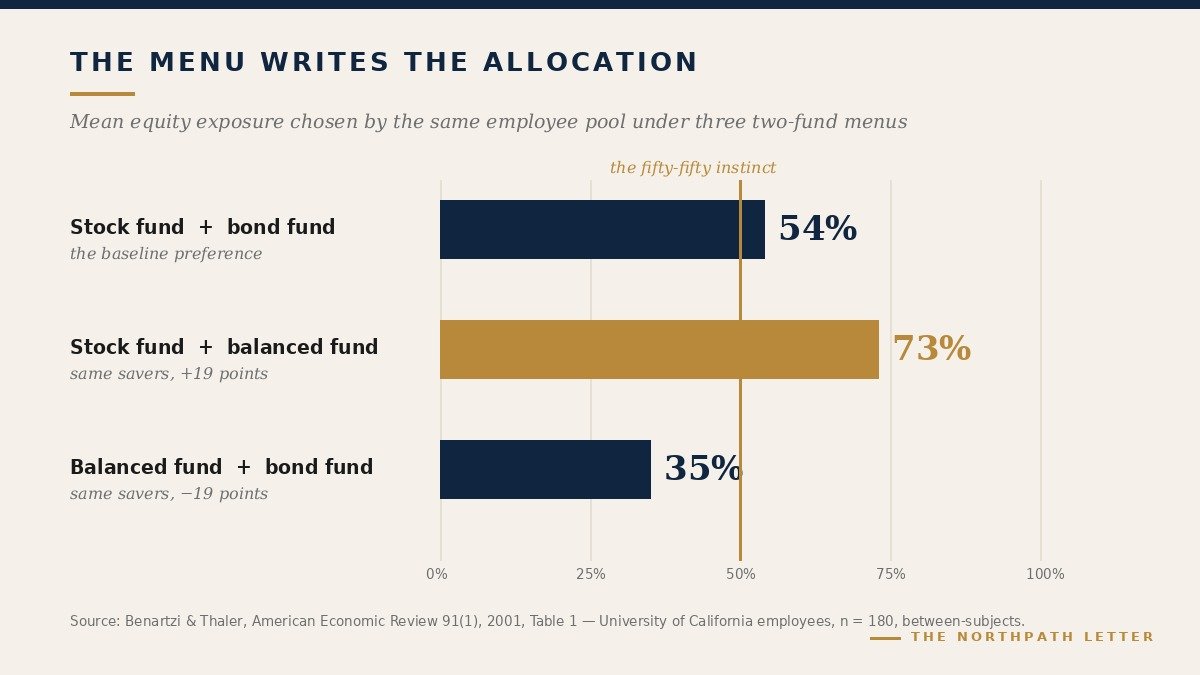
The paper’s experiments stripped the mechanism bare. University of California employees were surveyed by mail and asked to allocate retirement contributions between two funds. When the funds were a stock fund and a bond fund, the mean allocation to equities was 54 per cent. When the menu was a stock fund and a balanced fund (half stocks, half bonds), implied equity exposure rose to 73 per cent. When it was a balanced fund and a bond fund, equity exposure fell to 35 per cent. In every condition the modal choice was the fifty-fifty split; what changed was merely what fifty-fifty meant. Subjects drawn from the same pool, randomly assigned to menus, behaved like different species of investor.
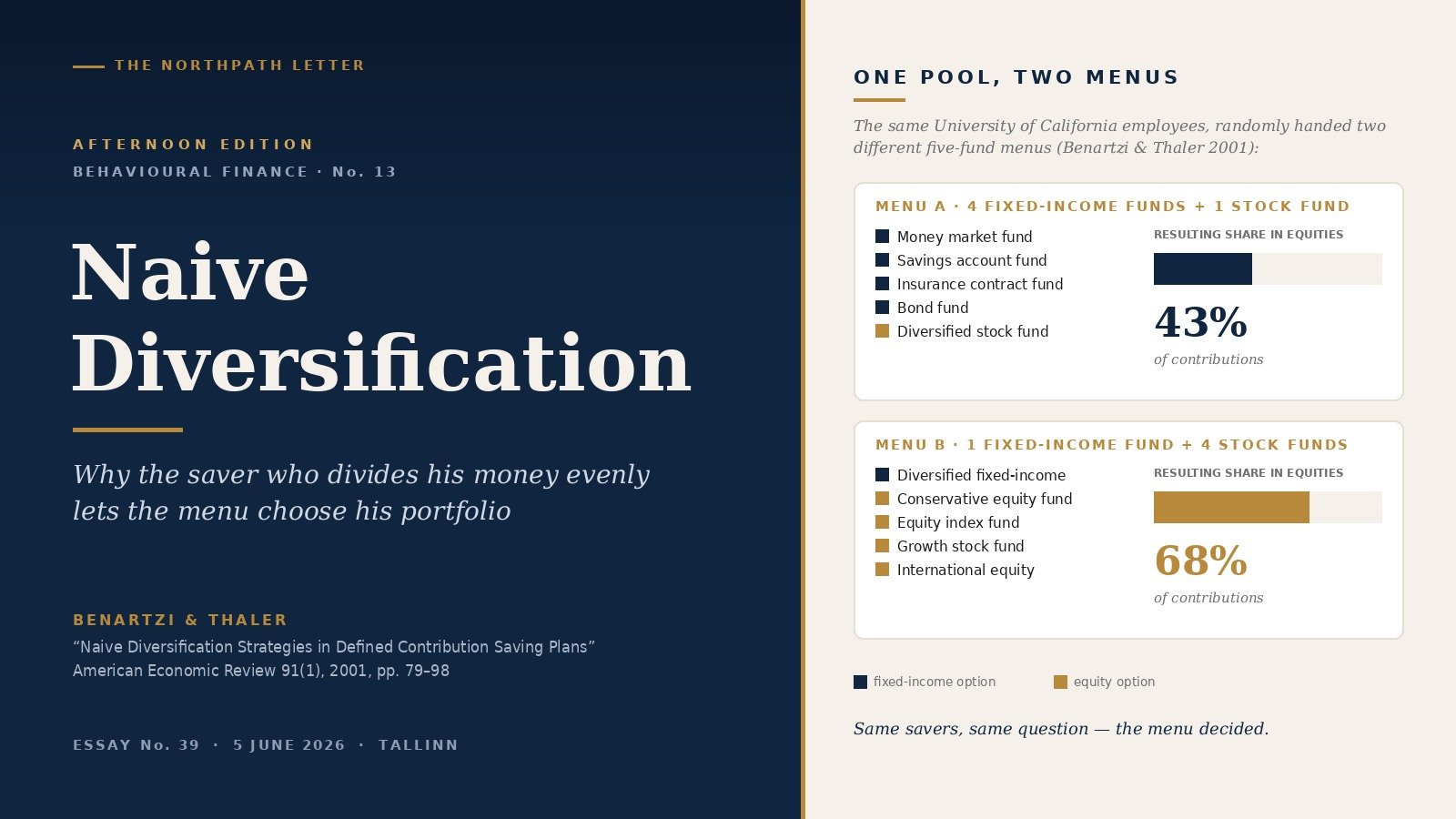
A second experiment reconstructed the TWA-versus-California contrast in the laboratory, offering the same employee pool five funds: four fixed-income and one stock fund in one condition, the reverse in the other. The first group allocated 43 per cent to equities; the second, 68 per cent — a twenty-five-point gap produced entirely by menu composition, each result sitting strikingly close to the real plan it imitated.
The field data scaled the finding. From a proprietary Money Market Directories database covering 170 retirement plans with 1.56 million participants and roughly $50 billion in assets, Benartzi and Thaler found that 61.76 per cent of all options offered were equity funds — and 62.22 per cent of aggregate assets sat in equities. Sorting plans into thirds by the equity share of their menus, participants’ equity exposure climbed from 48.64 per cent in the lowest tercile to 64.07 per cent in the highest. A mean-variance optimiser facing the same menus, they calculated, would have moved from roughly 50 to 53 per cent. In regression terms, replacing a single bond fund with a stock fund in a ten-fund plan shifted participants’ equity allocation by between 3.7 and 6.3 percentage points. A time-series case made the same point within one company: when its plan added three stock funds in late 1994, participants’ equity exposure jumped from 18 to 41 per cent; when the bond fund was later dropped, exposure rose again from 62 to 71 per cent. Nobody’s risk appetite had changed. The list had.
Subsequent work refined the picture without rescuing the chooser. Gur Huberman and Wei Jiang, examining records of more than half a million participants across roughly 640 plans (Journal of Finance, 2006), found that people typically use only three or four funds however many are offered — menus in their sample ranged from 4 to 59 options — and tend to divide contributions evenly across the funds they do pick: a conditional 1/n. In their larger sample the link between menu composition and equity exposure was weaker than in Benartzi and Thaler’s plans, suggesting the crude form of the heuristic operates most powerfully when menus are small. And then there is the result that gives the bias its delicious irony: Victor DeMiguel, Lorenzo Garlappi and Raman Uppal showed (Review of Financial Studies, 2009) that across seven datasets, none of fourteen optimising portfolio models consistently beat the simple 1/N rule out of sample on Sharpe ratio, certainty-equivalent return or turnover — estimation error consumed the theoretical gains, and a 25-asset mean-variance strategy would need roughly 3,000 months of data to win reliably. Equal weighting, applied to asset classes deliberately chosen, is a respectable rule. The bias is not the arithmetic. The bias is letting an administrative list decide what n contains.
Two episodes in the price of a menu
Sweden ran the experiment at national scale. When the country launched the funded leg of its state pension in the autumn of 2000, the design was, in Henrik Cronqvist and Richard Thaler’s phrase, “pro choice” at every stage (“Design Choices in Privatized Social-Security Systems,” American Economic Review, May 2004): any qualifying fund could enter, 456 did, savers could pick up to five, and a state advertising campaign urged them to choose for themselves. Two-thirds — 66.9 per cent — did so. Their aggregate portfolio held 96.2 per cent in equities, 48.2 per cent in Swedish shares (a country then comprising about 1 per cent of world market capitalisation), 4.1 per cent in indexed vehicles, at average reported fees of 0.77 per cent. The carefully constructed default they had been nudged away from held 82 per cent in equities, was 60 per cent indexed, and charged 0.17 per cent. The single most popular actively chosen fund, Robur Aktiefond Contura, a technology-and-healthcare vehicle, had returned 534.2 per cent over the preceding five years — the best record of all 456 funds on the list, sitting at the top of the catalogue precisely as the technology bubble peaked. Over the following three years it lost 69.5 per cent. From 31 October 2000 to 31 October 2003 the default fund lost 29.9 per cent; the average active chooser lost 39.6 per cent. The choices then froze: in each of the first three years, more than 96 per cent of participants made no change at all, and among new entrants the share choosing their own portfolio collapsed from 56.7 per cent of the young in 2000 to 8.4 per cent by April 2003 — and to 0.9 per cent by 2016 (Cronqvist, Thaler and Yu, AEA Papers and Proceedings, 2018). A menu assembled by market entry, sampled once at the top of a bubble, wrote the retirement risk of a generation.
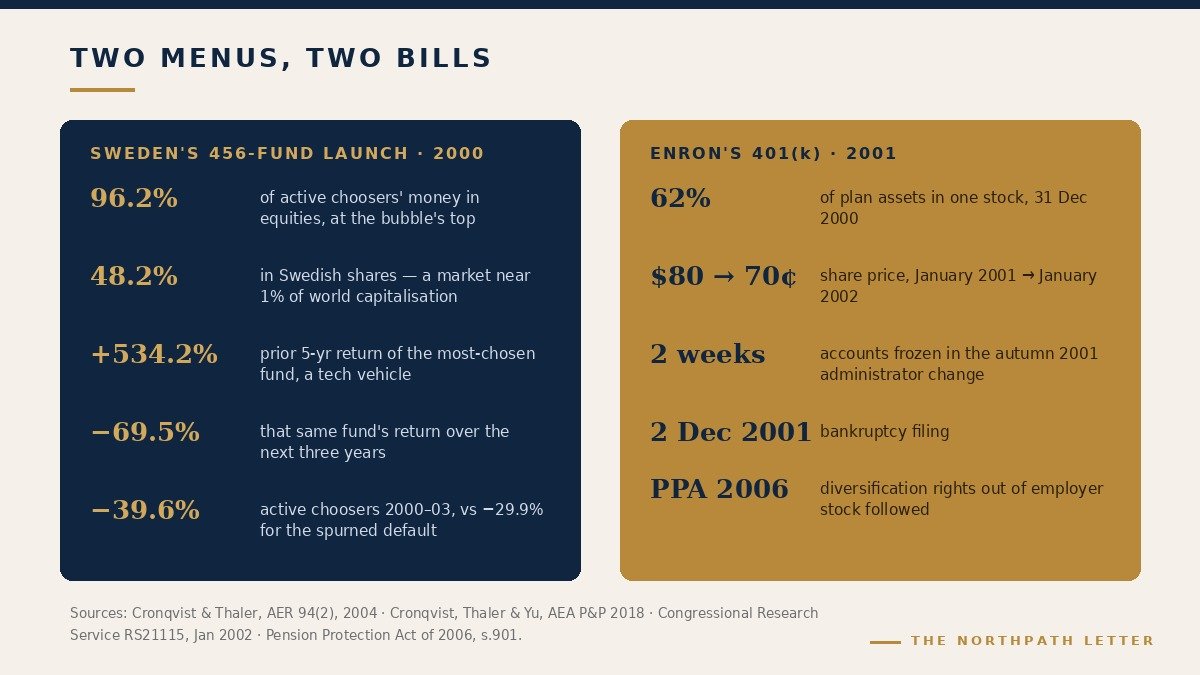
The American episode was crueller because the menu’s largest line was the employer itself. As of 31 December 2000, 62 per cent of the assets in Enron Corporation’s 401(k) plan consisted of Enron stock, 89 per cent of it bought by employees themselves, the remainder arriving as the company’s match — paid in shares that plan rules prevented participants from diversifying before age 50 (Congressional Research Service, RS21115, January 2002). Benartzi and Thaler had documented the general pattern a year before the collapse: in plans offering company stock, employees treated it as its own mental account — it absorbed roughly 42 per cent of assets, and savers then split the remainder close to fifty-fifty between other equities and fixed income, leaving total equity exposure above 71 per cent (a 1995 John Hancock survey had found, remarkably, that a majority of respondents considered their own company’s stock safer than a diversified fund). Enron shares traded above $80 in January 2001 and below 70 cents a year later; in between, a routine change of plan administrator froze participant accounts for roughly two weeks in late October and early November 2001, while the stock fell and the company slid toward its 2 December bankruptcy. Congress answered with the Pension Protection Act of 2006, which obliges plans holding publicly traded employer stock to let participants diversify their own contributions out of it immediately and employer contributions after three years of service, into at least three alternative diversified options (new section 401(a)(35) of the Internal Revenue Code); Gary Engelhardt has estimated the provision cut company-stock concentration in the affected plans by roughly seven percentage points (Center for Retirement Research, 2011).
The regulators’ broader response on both sides of the Atlantic amounted to a quiet concession of Benartzi and Thaler’s point — that for most savers the menu and its default are the allocation, so the default had better be built like a portfolio. The US Department of Labor’s final regulation on qualified default investment alternatives (24 October 2007, 72 FR 60452, effective 24 December 2007) gave fiduciaries safe harbour only for defaults that are themselves diversified mixes — target-date funds, balanced funds, managed accounts — and pointedly not for cash-like holding pens. The United Kingdom, rolling out automatic enrolment from October 2012, capped charges on default arrangements at 0.75 per cent from April 2015 precisely because it knew where enrolled workers would sit: the state-established NEST scheme reported about 13.8 million members and £49.7 billion under management as of March 2025, with roughly 98 per cent of members in the default strategy. Sweden itself, after fund-marketplace scandals, legislated in 2018 to prune and police its menu. Three jurisdictions, one lesson: choice architecture is portfolio management by other means.
The counter-measure framework: three disciplines
The defence against naive diversification is not effortful originality. It is sequence: decide the portfolio before looking at the list.
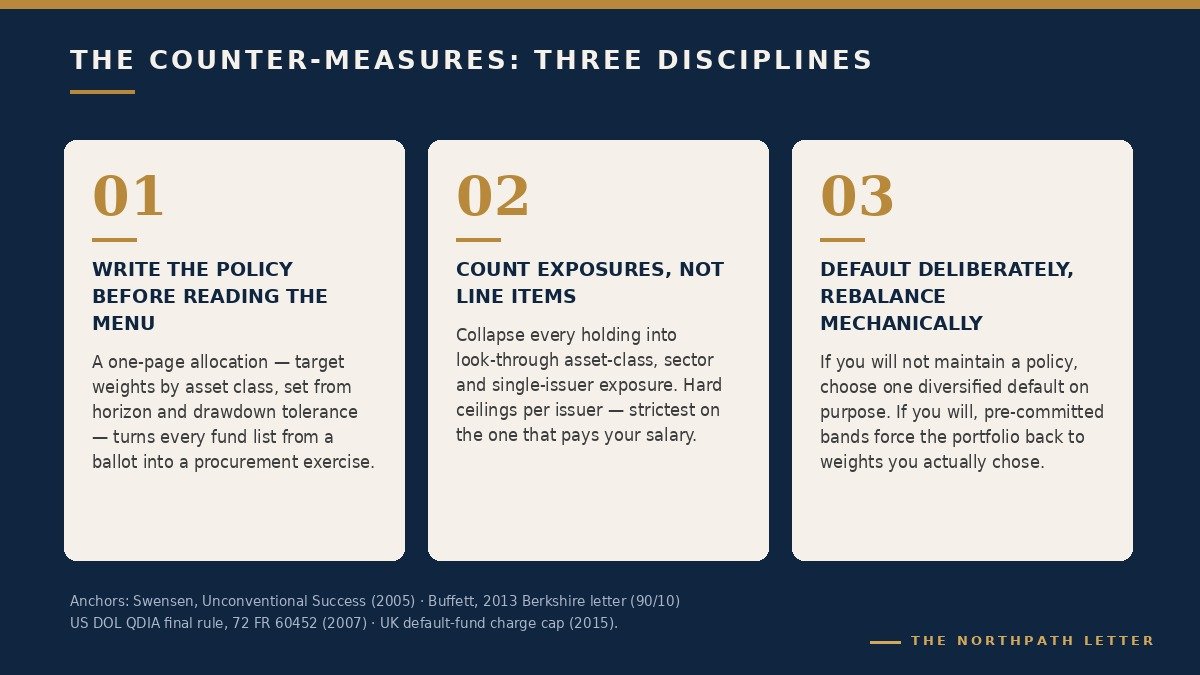
First, write the policy before reading the menu. A one-page investment policy — target weights to broad asset classes, set from horizon, obligations and tolerance for drawdown, with permitted ranges — converts every menu from a ballot into a procurement exercise. The question “how do I divide money across these twelve funds?” becomes “which of these twelve best fills each sleeve of an allocation I have already chosen?” The first question invites 1/n; the second cannot even be phrased in its terms. The policy needs writing once a decade; the menu changes constantly, which is exactly why it must not be the unit of decision.
Second, count exposures, not line items. Sweden’s active choosers held portfolios that looked diversified — several funds, long names — and were in substance one position: 96 per cent equities, half of it in one small home market, much of it in one sector. Enron’s savers held a dozen menu lines and one fate. The discipline is look-through aggregation: collapse every holding into its underlying asset-class, sector, currency and single-issuer exposures, and apply hard ceilings at that level — above all to any single issuer, and most ruthlessly to the issuer that also pays your salary, since that position is correlated with your livelihood twice over. Ten funds are not ten decisions. They are however many decisions survive the aggregation.
Third, default deliberately and rebalance mechanically. The Swedish data showed entry-date allocations persisting almost untouched for years — Cronqvist and Thaler noted that Vanguard 401(k) participants who enrolled near the 1999 peak were still directing 72 per cent of contributions to equities in mid-2003, while those enrolling in early 2003 chose 48 per cent: the accident of the start date, frozen by inertia. For an investor unwilling to maintain a policy, selecting a single well-constructed diversified default — and the QDIA regulation effectively published the specification for one — is itself a defensible, active decision. For an investor running his own policy, pre-committed rebalancing bands do what inertia will not: they force the portfolio back to chosen weights, so that drift and entry-date luck stop compounding into an allocation nobody ever chose.
How the practitioners keep the menu at arm’s length
David Swensen, who ran Yale’s endowment for 36 years, devoted his book for individual investors (Unconventional Success, 2005) to exactly this sequence: he specified a policy portfolio of six asset classes with fixed targets — 30 per cent domestic equity, 15 per cent foreign developed, 5 per cent emerging markets, 20 per cent real estate, and 15 per cent each in conventional and inflation-protected Treasuries — and then, only then, discussed vehicles. The weights were chosen for function (growth, diversification, deflation and inflation protection), not for the number of products on any platform; equal division across six deliberately chosen classes and rigorous rebalancing did the rest. Warren Buffett’s instruction for the trustee of his wife’s bequest, set out in his 2013 letter to Berkshire Hathaway shareholders, is the same discipline compressed to a sentence: “Put 10% of the cash in short-term government bonds and 90% in a very low-cost S&P 500 index fund.” The allocation is stated first, in one line, and no menu on earth can amend it. John Bogle preached the identical sequence for half a century — decide the stock-bond split by age and circumstance, then own the whole haystack at minimum cost rather than hunting needles within someone’s fund list. Three practitioners, one common structure: the n in their 1/n was always their own.
Markowitz himself deserves the coda. His fifty-fifty was a regret-minimising shortcut — but it was his shortcut, a deliberate division across the two great asset classes. The failure mode this essay warns against is humbler: the saver whose equity exposure is 43 per cent under one menu and 68 per cent under another, and who will retire on the difference without ever learning that a committee’s list, not his own judgement, wrote his result.
Key takeaways
- The 1/n heuristic outsources the portfolio to the menu. Benartzi and Thaler (2001) showed savers dividing contributions evenly across whatever funds are offered: equity exposure ran from 35 to 73 per cent across menus in identical populations, and TWA pilots (75 per cent equities, five stock funds offered) versus University of California staff (34 per cent, one) differed by the list, not by preference.
- Equal division is ancient regret management, not analysis. From the Talmud’s thirds to Markowitz’s fifty-fifty to trick-or-treaters taking one of each, spreading evenly is the choice that minimises anticipated regret and information cost — which is why it survives even where it answers no investment question.
- The menu is never neutral. Sweden’s 456-fund launch left active choosers 96 per cent in equities at the top of a bubble (default −29.9 per cent, choosers −39.6 per cent over three years); Enron’s plan design left 62 per cent of retirement assets in one stock. Regulators in Washington, London and Stockholm responded by regulating the default itself — QDIA 2007, the UK’s 0.75 per cent charge cap, Sweden’s 2018 menu reform.
- Equal weights are not the sin — an unchosen n is. DeMiguel, Garlappi and Uppal (2009) found no optimising model that consistently beat 1/N out of sample; applied across deliberately selected asset classes, the rule is robust. Applied across an administrative fund list, it is abdication.
- The defence is sequence. Write the policy before reading the menu; count look-through exposures, not line items, with hard single-issuer ceilings; default deliberately and rebalance mechanically. Swensen’s six fixed sleeves and Buffett’s one-sentence 90/10 are the same discipline at different lengths.
— Manish Goel, FCA / NorthPath Advisory OÜ / Tallinn, Estonia
|
Important. |