Indian Market Context · 5 June 2026 · Morning Edition · Issue 38
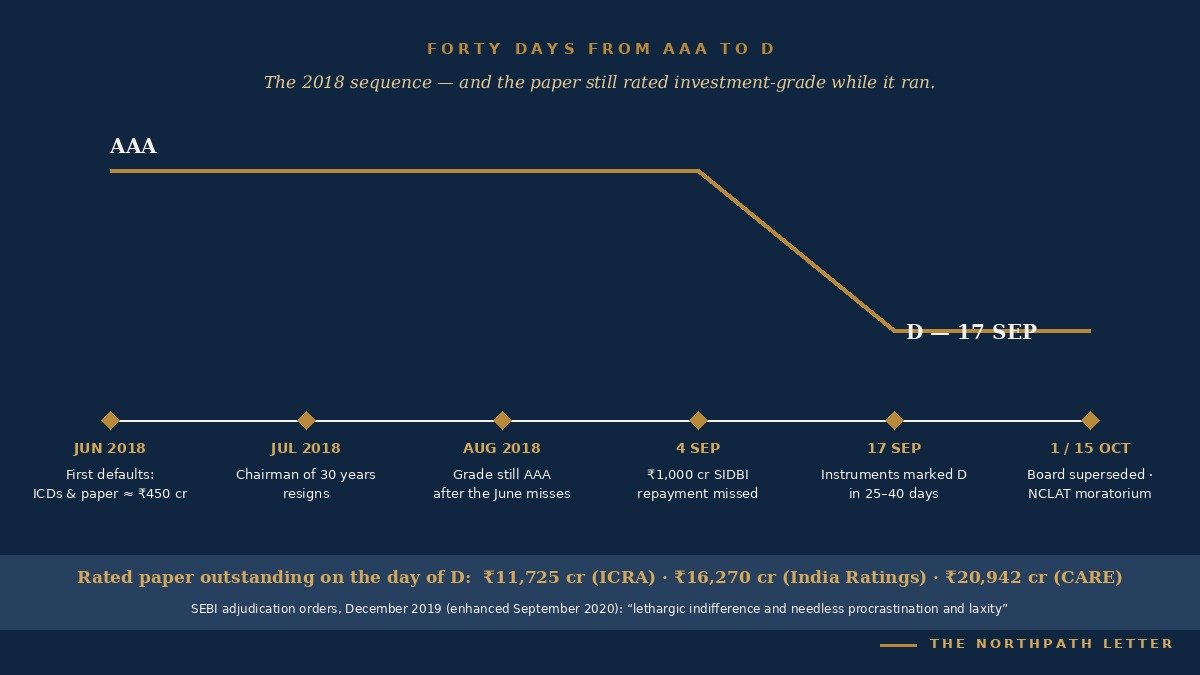
The first cheques that failed were small ones. In June 2018, Infrastructure Leasing & Financial Services — a forty-five-company name compressed into one acronym, IL&FS — missed payments on inter-corporate deposits and commercial paper worth roughly ₹450 crore. In July its chairman of three decades, Ravi Parthasarathy, resigned. Through August, the group’s paper still carried the highest credit grade on the Indian scale. Then, in the first fortnight of September, IL&FS Financial Services missed a ₹1,000 crore short-term loan repayment to SIDBI, the state development bank, and the dam gave way. By 17 September 2018 the rating agencies had marked the group’s instruments down to D — default — a journey from AAA completed in roughly forty days.
What failed was not a fly-by-night financier. It was a 347-entity group with ₹91,091 crore — about thirteen billion dollars — of consolidated debt, owned by the most reassuring shareholder register in Indian finance: Life Insurance Corporation of India, State Bank of India, Housing Development Finance Corporation, Central Bank of India, ORIX of Japan and the Abu Dhabi Investment Authority. Its commercial paper sat inside money-market mutual funds that retail savers treated as parking spaces. Its bonds sat inside pension and provident funds. When it stopped paying, the entire funding market for Indian non-bank lenders shut within a fortnight, and the government reached for a statutory weapon it had used at scale only once before, at Satyam in 2009: it threw out the board.
Seven and a half years on, the resolution arithmetic is largely settled and the regulatory consequences are fully built. That makes IL&FS readable now in a way it was not in 2018 — not as a scandal, but as a syllabus. Nearly everything that mattered was visible in public documents years before September 2018: the entity count, the leverage, the maturity mismatch, the location of the debt relative to the location of the cash flows. This essay is a retrospective in the practitioner’s sense: what the documents said, who failed to read them, and the specific disciplines a reader of Indian group accounts should carry away.
The institution India mistook for the state
IL&FS was incorporated in 1987, promoted by the Central Bank of India, HDFC and the Unit Trust of India, to do something India’s project-finance market could not yet do: develop and fund infrastructure on commercial terms. Over three decades it became the country’s original public-private-partnership machine. It built or financed roads, tunnels, townships, power and water projects — including, through its roads arm, the Chenani-Nashri tunnel in Jammu & Kashmir, then India’s longest road tunnel. Foreign institutions bought in: ORIX Corporation of Japan accumulated 23.54 per cent, the Abu Dhabi Investment Authority 12.56 per cent. LIC, the state life insurer, held 25.34 per cent as the largest shareholder; HDFC held 9.02 per cent, Central Bank of India 7.67 per cent and SBI 6.42 per cent, per the FY18 shareholding disclosures.
Note what is missing from that list: a promoter. IL&FS had no controlling owner with skin in the game, and — critically — the parent was unlisted. The market saw the group only through three listed windows: IL&FS Transportation Networks (the roads operator), IL&FS Investment Managers (the private-equity manager) and IL&FS Engineering & Construction. The parent where the leverage concentrated filed its accounts with the registrar, held an annual general meeting attended by almost nobody, and was analysed by almost no one. Institutional ownership substituted for scrutiny. The reasoning, rarely stated aloud, ran: LIC and SBI sit on the register; the government would never let it fail. That assumption was worth perhaps two notches of credit rating, and it was wrong in the only way that matters — it was untested.
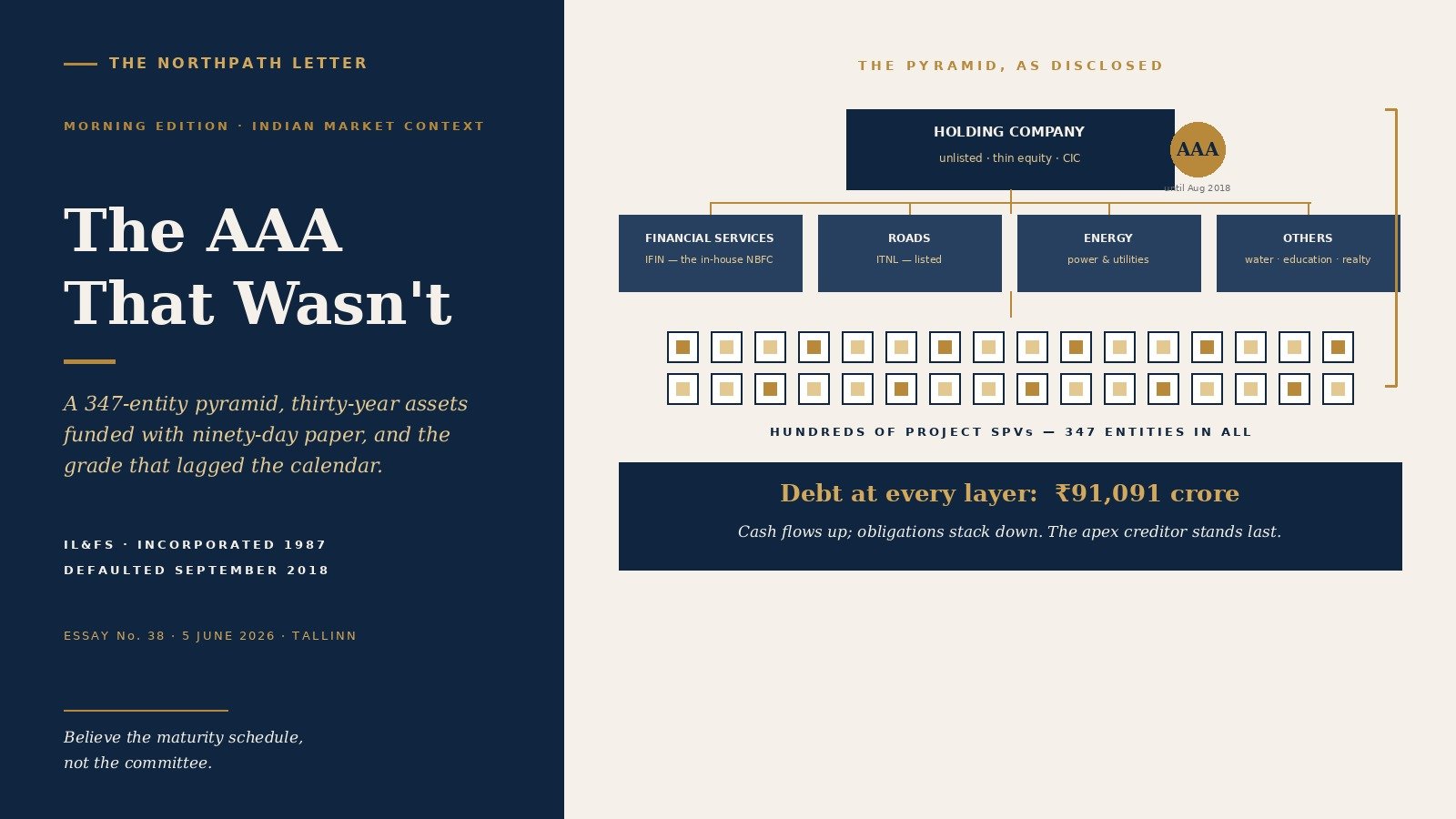
By 2018 the group comprised 347 entities — domestic and offshore, across four broad verticals: financial services, transportation, energy, and a long tail of water, education, technology and real-estate ventures. The board that presided over this — packed with decorated names from Indian finance — would later be described by the new administrators as having failed at the most basic supervisory questions. A reader armed with nothing but the group structure chart had grounds for unease years earlier: no single management team can supervise 347 balance sheets.
A pyramid of other people’s money
The architecture, reconstructed afterwards by the new board and the Serious Fraud Investigation Office, was a pyramid in the engineering sense: load-bearing at every level, with the thinnest material at the top. At the apex sat the unlisted holding company, a core investment company by RBI classification, with modest equity. Below it, the verticals: IL&FS Financial Services (“IFIN”, the in-house NBFC), IL&FS Transportation Networks (“ITNL”, roads), IL&FS Energy, and the others. Below them, hundreds of project-specific special purpose vehicles, each holding a concession — a road, a power plant, a water contract — and each carrying its own project debt.
Debt was raised at every layer. The SPVs borrowed against project cash flows. The verticals borrowed to seed the SPVs’ equity. The holding company borrowed to seed the verticals. Each layer’s obligations were serviced by cash upstreamed from the layer below — dividends, fees, and inter-corporate deposits. This is structural subordination in its purest form: the holding company’s creditors stood last in a queue that began three layers down, behind every project lender. ₹91,091 crore of aggregate debt rested, ultimately, on the operating surpluses of toll roads and power plants, many of them young, delayed, or in arbitration with government counterparties over stuck receivables.
The load-distributing member of the structure was IFIN. An NBFC inside a group exists, in theory, to lend to third parties. IFIN’s book, the forensic work by Grant Thornton later showed, was substantially an instrument of group treasury: lending to group entities, including stressed ones, in patterns where fresh loans retired older ones — the geometry of evergreening. Reporting after the collapse established that RBI inspections had raised concerns about IFIN’s group exposures and capital position well before the default. The market could not see the inspection reports. But the audited accounts disclosed, year after year, the scale of related-party lending — for those who read the related-party footnote against the loan book and asked what fraction of the “financial services” business was simply the group lending to itself.
The run nobody priced
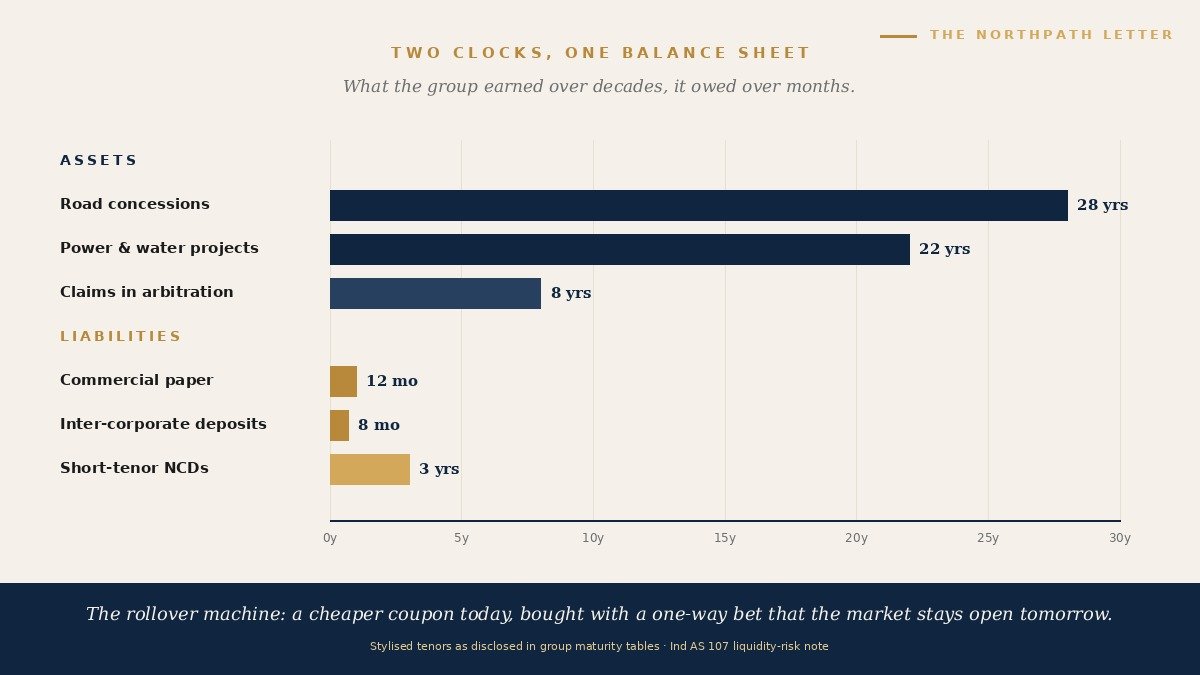
The second structural defect was temporal. Infrastructure assets pay back over fifteen to thirty years. IL&FS funded them, at the holdco and vertical level, substantially with short money: commercial paper of three to twelve months, inter-corporate deposits, and short-tenor debentures. Short funding of long assets is the oldest bargain in finance — it buys a cheaper coupon today by selling a rollover obligation tomorrow. It embeds a one-way bet: that the market will always be open. The maturity tables in the group’s own financial statements disclosed the bet to anyone who laid the asset column against the liability column.
Through 2018 the bet soured by degrees. Projects ran late; receivables from concession authorities sat in arbitration; the holdco’s interest bill compounded ahead of its dividend stream. The June defaults were the first public symptom. The September SIDBI default was the proof that the group could not find ₹1,000 crore — pocket change against its balance sheet — which told the money market everything about the liquidity beneath the AAA. Commercial-paper investors did what CP investors do: they declined to roll, all at once. A rollover-dependent structure does not decline gradually; it halts.
The halt propagated. Money-market and debt mutual funds, suddenly required to mark IL&FS paper to default, turned seller of every non-bank financier’s paper they held. On 21 September 2018, a fund’s distressed sale of Dewan Housing Finance bonds repriced the entire housing-finance sector’s equity in an afternoon — DHFL’s stock fell by more than two-fifths intraday — though DHFL’s own reckoning came later, in June 2019. The cost of three-month money for NBFCs gapped; issuance volumes collapsed; the RBI leaned on open-market operations and banks to refinance the gap. India’s shadow-banking sector, which had grown its share of system credit through the bank-NPA years, repriced in a quarter. That is contagion: not a metaphor but a funding-market mechanism, and it ran through mutual-fund portfolios held by ordinary savers.
The grade and the balance sheet
The ratings record deserves its own ledger line. The group’s instruments carried AAA and equivalent grades from ICRA, CARE and India Ratings into August 2018 — after the June defaults had occurred. The downgrades, when they came, compressed the entire scale into roughly 25 to 40 days, ending at D on 17 September 2018. On that day, by SEBI’s later accounting, the outstanding instruments rated by ICRA, India Ratings and CARE stood at ₹11,725 crore, ₹16,270 crore and ₹20,942 crore respectively — close to ₹49,000 crore of paper whose holders had been told, weeks earlier, that it carried the lowest credit risk on the scale.
SEBI’s adjudication, in December 2019, found the agencies had shown “lethargic indifference and needless procrastination and laxity” and fined each ₹25 lakh; in September 2020 the regulator revisited the quantum and raised it to ₹1 crore apiece. The orders are worth reading less for the penalty than for the anatomy of the failure. The agencies had leaned on the consolidated strength of the group and the implicit support of its institutional parents — the same halo the market wore. A credit rating, the episode teaches, is an opinion with institutional latency: it is produced by a committee, anchored on the previous rating, and adjusted at the speed of meetings. The balance sheet, meanwhile, moves at the speed of maturities. When the two diverge, the maturity schedule is the truth and the grade is the lag. The practitioner’s response is not cynicism about ratings; it is to read the rating rationale — where the support assumptions are written down in plain sight — and to treat any rating that rests on “parentage” or “expected support” as a different instrument from one that rests on cash flow.
The supersession — the state’s heaviest corporate tool
On 1 October 2018 the Ministry of Corporate Affairs moved the National Company Law Tribunal under Sections 241 and 242 of the Companies Act 2013 — the oppression-and-mismanagement jurisdiction, invoked on the ground that the company’s affairs were being conducted in a manner prejudicial to the public interest. The same day, the tribunal suspended the entire board and seated a six-member replacement nominated by the government, chaired by Uday Kotak. It was the heaviest corporate intervention since the Satyam board supersession of 2009 — and where Satyam was a fraud in a single operating company, IL&FS was a solvency failure across a group the insolvency code could not then reach: the Insolvency and Bankruptcy Code excluded financial-service providers (the dedicated FSP route arrived only in November 2019, and was first used on DHFL), and Indian law had no group-insolvency mechanism at all.
The courts improvised one. The NCLT declined a moratorium on 12 October 2018; on 15 October the appellate tribunal, NCLAT, granted one anyway — a stay on creditor enforcement across the whole group, justified on public-interest grounds. Within it, the new board sorted the 302 entities under resolution into a three-colour ledger: green for those that could service all obligations, amber for those that could pay operational and senior secured creditors, red for those that could not meet payment obligations at all. Resolution then proceeded entity by entity, asset by asset — sales, terminations, and the transfer of road assets into an infrastructure investment trust.
The arithmetic, as it stands: against an aggregate resolution target of ₹61,000 crore — roughly two-thirds of the group’s ₹91,091 crore debt — the group had discharged ₹45,281 crore by March 2025 and ₹48,463 crore by September 2025, with 202 of the 302 entities fully resolved. The InvIT route alone accounts for ₹25,893 crore via monetisation, termination and transfer of assets. The remainder of the gap is the loss, distributed across banks, mutual funds, and the pension and provident funds that held the paper of the apex companies — the layer where structural subordination did exactly what the documents always said it would.
What the failure rewrote
Most failures produce a report. IL&FS produced a rulebook. The RBI’s response rebuilt non-bank regulation in three layers. First, liquidity: the November 2019 liquidity-risk framework imposed granular maturity-bucket monitoring and board-owned funding plans, and introduced a liquidity coverage ratio for large NBFCs — phased from 50 per cent in December 2020 to 100 per cent by December 2024 for non-deposit-taking NBFCs above ₹10,000 crore of assets and all deposit-taking ones. The rollover bet IL&FS ran is now, for its successors, a regulated quantity. Second, proportionality: the Scale-Based Regulation framework, announced in October 2021 and effective 1 October 2022, sorted NBFCs into Base, Middle, Upper and Top layers, with capital, governance and disclosure obligations escalating with systemic weight — an explicit admission that a ₹1 lakh crore NBFC is a bank-shaped risk whatever its licence says. Third, structure: the core-investment-company framework was tightened in 2020 to cap the number of CIC layers in a group at two — a direct strike at the IL&FS pyramid — and a prompt-corrective-action regime for NBFCs followed from October 2022.
The accountability machinery ground slower but further. The SFIO filed a criminal complaint against thirty parties, including the auditors of IFIN — Deloitte Haskins & Sells (sole auditor through FY17, joint in FY18) and BSR & Associates (joint FY18, sole FY19) — alleging collusion in concealing the true state of the book. The Ministry of Corporate Affairs petitioned under Section 140(5) of the Companies Act for the auditors’ five-year debarment; the Bombay High Court quashed the proceedings; and on 3 May 2023 the Supreme Court reversed, upholding the section’s constitutionality and ruling that an auditor cannot escape the enquiry by resigning the engagement. The IL&FS docket is also the case that made India’s new audit regulator real — NFRA’s first enforcement actions grew out of the IFIN audits, a story this letter told separately in “Who Audits the Auditors”. And the rating agencies now operate under tightened SEBI disclosure norms — standalone-versus-support-built ratings, probability-of-default benchmarks, and faster recognition obligations — written in the shadow of those forty days.
Reading a group balance sheet after IL&FS
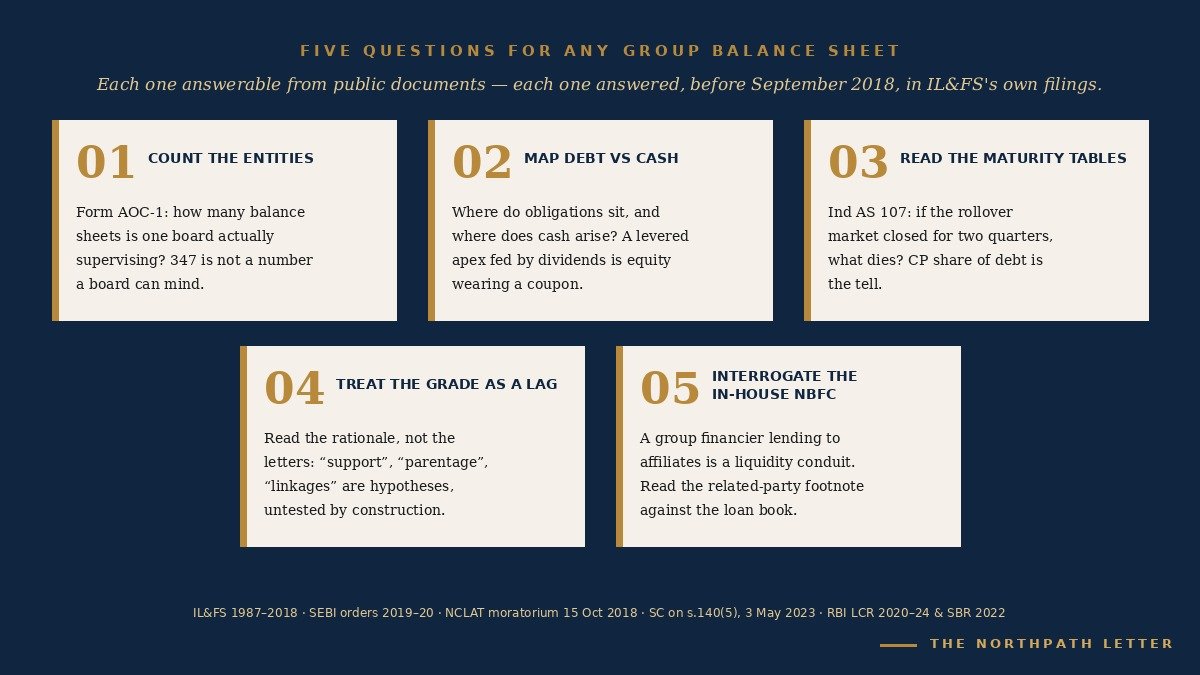
The retrospective earns its place only if it changes how the reader works. Five disciplines follow directly from the record.
First, count the entities. The single highest-yield number in any Indian group’s annual report is the count of subsidiaries, associates and joint ventures in Form AOC-1. A group with 347 entities is not 347 times harder to supervise than a single company; it is categorically unsupervisable by a board that meets eight times a year. Beyond a few dozen entities, treat the consolidated statements and AOC-1 as the only honest documents in the binder, and treat standalone-only analysis as a category error.
Second, map where the debt sits against where the cash arises. Structural subordination is visible: holding-company borrowings serviced by dividends and fees from below are a different credit from operating-company borrowings serviced by customers. The segment disclosures, the borrowings note and the AOC-1 together let a reader draw the pyramid in an afternoon. If the apex is levered and the cash is three layers down, the apex paper is equity wearing a coupon.
Third, read the maturity tables. Ind AS 107 requires a maturity analysis of financial liabilities; NBFCs additionally publish asset-liability bucket disclosures under RBI norms. The IL&FS bet — long assets, ninety-day money — was printed there every year. Compute commercial paper and sub-one-year borrowings as a share of total debt, and ask the only question that matters: if the rollover market closed for two quarters, what dies?
Fourth, treat the grade as a lagging floor, not a forward signal. Read the rating rationale for the words “support”, “parentage” and “linkages”; a rating built on expected rescue is a hypothesis about behaviour under stress, untested by construction. Watch for dispersion — when agencies disagree, or when outlooks turn before grades do, the committee process is telling you it is behind its own evidence.
Fifth, interrogate the in-house financier. A group NBFC whose loan book leans toward its own affiliates is not a lending business; it is the group’s liquidity conduit, and its receivables are only as good as the weakest borrower in the family. The related-party footnote, read against the loan book’s size, exposes this in minutes — it remains the most consequential footnote in the Indian annual report.
IL&FS cost its creditors a sum that will end somewhere near a third of ₹91,091 crore, cost India a year of credit growth, and cost the AAA symbol a portion of its meaning that has not fully returned. The compensation is that the lesson is now written down — in SEBI orders, RBI master directions, Supreme Court reportable judgments, and resolution progress reports — for any reader willing to do what the market did not do in the years before September 2018: read the documents that were public all along.
The one-line takeaway: a AAA grade is an opinion that moves at the speed of committees; a maturity schedule is a fact that moves at the speed of the calendar — when they diverge, believe the calendar.
— Manish Goel, FCA / NorthPath Advisory OÜ / Tallinn, Estonia
|
Important. |