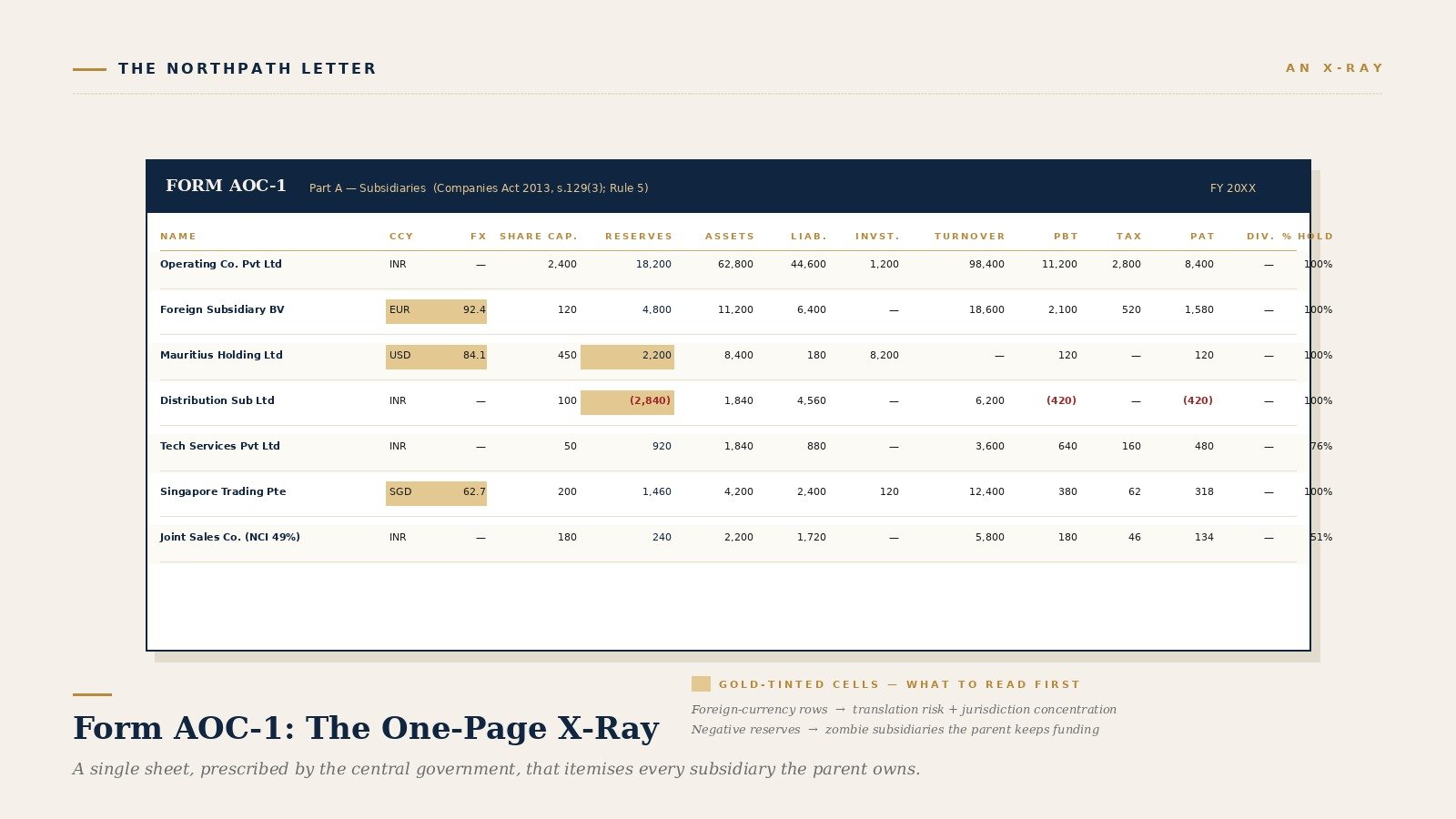
If you spend long enough reading annual reports across jurisdictions, you begin to grade them not by what they print but by what the underlying law forces them to print. On that test, Indian listed parents carry a small piece of disclosure machinery that is genuinely rare in the global filing landscape — a single sheet, prescribed line by line by the central government, that itemises the financial summary of every subsidiary, every associate and every joint venture the parent owns. It is called Form AOC-1, it is attached to the Board’s Report, and at large groups it can run to dozens of pages of rows, each row a different entity inside the holding structure. Read carelessly, it is a wallpaper of names and numbers. Read carefully, it is the closest thing an outside investor has to an x-ray of the group.
The form is not new. It has existed in essentially its present shape since the Companies (Accounts) Rules came into force on 1 April 2014, replacing the older “Section 212 statement” that limped along under the Companies Act 1956. What is new — and what most non-Indian readers have not absorbed — is that the post-2013 regime, taken together with Section 129(3) of the Companies Act 2013 and Indian Accounting Standard 110, produces a disclosure stack denser than what the equivalent SEC filing or Companies House filing requires. The 10-K has Item 21, a flat list of subsidiary names and jurisdictions with no financials at all. The UK Companies Act requires disclosure of subsidiaries in a note to accounts, again typically without per-entity financials beyond an aggregate. IFRS 12 demands summarised financial information for material non-wholly-owned subsidiaries and associates but allows considerable discretion in what counts as “material”. Form AOC-1 demands a fixed schema: thirteen financial line items per subsidiary, every subsidiary, irrespective of materiality.
That last point is what makes the form interesting. The Indian rule is mechanical. Materiality is not a defence. If the entity is a subsidiary as defined in Section 2(87) of the Companies Act — which captures both equity-control subsidiaries and “more than one-half of total voting power” arrangements — it appears, and its financial summary appears with it. The same is true for associates and joint ventures, captured under Section 2(6) and Section 2(76)(v) respectively, which Part B of the form addresses. For a conglomerate parent with a hundred-plus subsidiaries — and several listed Indian conglomerates carry well over that — the result is a long, dense, mechanically standardised table that, to a sophisticated reader, contains more analytical signal than the consolidated financials themselves.
This letter walks through what Form AOC-1 contains, how to read it as a practitioner, what it gives you that other jurisdictions do not, and where its limits lie.
The statutory basis, in one paragraph
Section 129(3) of the Companies Act 2013 requires every company with one or more subsidiaries — including associates and joint ventures — to prepare consolidated financial statements alongside its standalone accounts. The first proviso to that sub-section adds a separate obligation: the parent shall also attach to its standalone financial statement “a separate statement containing the salient features of the financial statement of its subsidiary or subsidiaries in such form as may be prescribed.” The prescription comes from Rule 5 of the Companies (Accounts) Rules 2014, which names Form AOC-1 as the statutory format and divides it into Part A (subsidiaries) and Part B (associates and joint ventures). The form is signed by directors and certified by the auditors, and any consolidated financial statement filed without it is procedurally deficient. The Ministry of Corporate Affairs has updated the form’s content twice — once via the Companies (Accounts) Amendment Rules 2016 and again in a minor 2018 clarification — but its core schema has held.
Part A — the thirteen financial fields per subsidiary
The columns in Part A are these, in order: the administrative columns — serial number; name of the subsidiary; the date since when the subsidiary was acquired (added in 2016 — useful for spotting recent acquisitions); the reporting period of the subsidiary, if different from the parent’s; the reporting currency and exchange rate as on the last day of the financial year (for foreign subsidiaries). Then the financial columns — share capital; reserves and surplus; total assets; total liabilities; investments; turnover; profit before taxation; provision for taxation; profit after taxation; proposed dividend; percentage of shareholding held by the parent.
That is the entire schema. Thirteen financial line items if you count the percentage shareholding as a financial datum, eleven if you treat it as administrative. The columns are short on context — there is no breakdown of revenue by segment, no detail of what assets comprise, no working-capital schedule — but the columns are present for every subsidiary, every year, and they tie directly to amounts that appear in the consolidated financial statements after intercompany elimination. The arithmetic does not always reconcile to the consolidated numbers because of those eliminations and because the AOC-1 reflects each subsidiary’s own audited accounts before consolidation adjustments. That difference, properly understood, is part of what the form gives you.

Part B — associates and joint ventures, where consolidation choice gets exposed
Part B addresses entities the parent does not control outright but in which it holds significant influence — typically, an equity interest of 20% or more, though the test under Ind AS 28 is one of substance rather than threshold. The columns are different: name; latest audited balance sheet date; date associated or acquired; number of shares held; amount of investment; extent of holding percentage; description of how significant influence is established; reason why the associate or joint venture is not consolidated, if applicable; net worth attributable to shareholding as per the latest audited balance sheet; and the profit or loss for the year split into the portion considered in consolidation and the portion not considered in consolidation.
That last split is what most rewards close reading. An associate’s earnings flow into the parent’s consolidated profit and loss account via the equity method only if the parent has chosen to consolidate that associate. Indian law allows two exceptions to mandatory equity-method consolidation: where the investment is held for sale, and where the associate operates under “severe long-term restrictions” that significantly impair its ability to transfer funds to the investor. Both exceptions are narrow. When a parent uses them, Part B forces it to name the entity, state the reason, and quantify the un-equityed share of profit. That number — the “profit not considered in consolidation” — is, in practice, one of the most useful red flags an outside analyst can extract from any Indian filing.
What the form gives the analyst that nothing else does
Set Form AOC-1 next to Item 21 of a US 10-K and the contrast is immediate. Item 21 is governed by Item 601(b)(21) of Regulation S-K: it requires a list of significant subsidiaries with the name and jurisdiction of organisation. That is the entire requirement. Most large US filers print a five-page list of names and US states. There are no financials. A Berkshire Hathaway 10-K does not tell you what GEICO’s individual turnover was; you would extract that, if at all, from segmental notes and from GEICO’s own state-insurance filings. The disclosure obligation simply does not extend to per-subsidiary financial statements.
The UK Companies Act 2006, read with Schedule 4 of the Large and Medium-sized Companies Regulations 2008, requires more — a note to the accounts must disclose the name, principal place of business and proportion of nominal value of shares held for every subsidiary undertaking — but, again, no per-entity financial summary. A FTSE-100 parent typically presents a multi-page “list of significant subsidiaries” in a note, sometimes with country-by-country tax disclosures appended, but the AOC-1’s column-by-column financial summary has no UK equivalent. The closest match in IFRS-land is IFRS 12, which mandates “summarised financial information” for each subsidiary that has material non-controlling interests and for each material associate and joint venture. The qualifier “material” is doing heavy work in that sentence. In practice, IFRS 12 disclosures tend to surface for a handful of named entities, not for the hundred-plus that an Indian group might list.
The result is that Form AOC-1 is, for any global investor analysing an Indian listed parent, the densest single source of structural information available in the public file. If you want to understand where the parent’s risk actually sits — what it owns, in what currency, with what profitability, in which jurisdiction — the answer is in this attachment, not in the consolidated income statement.

A seven-pass practitioner playbook
A useful AOC-1 reading routine, after roughly two decades of doing this for Indian groups, looks like the following. None of these passes requires more than a spreadsheet and twenty minutes per group; together they will tell you more about the structural shape of an Indian conglomerate than any management presentation.
The first pass is the count. How many entities are listed in Part A and Part B together? The number is a coarse measure of structural complexity. A clean operating company will have five to fifteen subsidiaries. A holding-company structure routinely shows fifty to two hundred. Anything over two hundred — and several large Indian groups carry this — should produce a follow-up question about why the structure has been allowed to bloom to that size. The answer is sometimes legitimate (legacy demergers, jurisdiction-specific operating requirements, regulated entities that must sit in their own vehicles). It is sometimes less so.
The second pass is geography. Tag every entity by the jurisdiction implied in its name and its reporting currency. The form does not require a country column, but the reporting currency field is a strong proxy: USD-reporting subsidiaries are typically incorporated in the US or, more often, in a USD-denominated offshore jurisdiction. The list of jurisdictions that recur in the Indian-group context is short and worth knowing — Mauritius, Singapore, the United Arab Emirates, Cyprus, the Netherlands, the British Virgin Islands, and the Cayman Islands. Concentration of subsidiaries in any one of these jurisdictions is not by itself a red flag; many legitimate group structures route through Mauritius for treaty reasons, or through Singapore for regional headquarter purposes. But a concentration that does not match the parent’s operating footprint should produce a question.
The third pass is currency. A parent reporting in Indian rupees that nevertheless derives material turnover from USD-reporting and EUR-reporting subsidiaries is carrying translation risk that the standalone income statement obscures and the consolidated income statement only partly reveals. The AOC-1 lets you sum subsidiary turnover by currency and ask the corresponding question about hedging policy.

The fourth pass is the reporting-period column. Indian listed parents are on an April-to-March financial year. Subsidiaries on calendar years, or on local-statutory year-ends inherited from acquisition, will show a different reporting period. Where the period differs by more than six months — which Ind AS 110 generally prohibits but which still appears in legacy structures — the subsidiary’s contribution to the consolidated accounts will be either a fitted partial period or a roll-forward, and the analyst should treat the comparable-period numbers with care.
The fifth pass is negative net worth. Sort the entire subsidiary list by reserves and surplus. Any subsidiary where reserves and surplus is materially negative — implying accumulated losses larger than equity contributions — is a candidate zombie. Indian parents routinely keep loss-making subsidiaries operating long past the point at which they would have been wound up in a more disciplined jurisdiction, partly because Indian insolvency law is procedurally heavy and partly because the parent prefers to absorb the losses through equity infusions rather than recognise a goodwill impairment. The number to watch is whether the parent has subscribed to additional equity in the current year — a sign that the loss-makers are still drawing capital.
The sixth pass is turnover concentration. Sort the subsidiary list by turnover. The top three to five subsidiaries usually account for 60% to 90% of the consolidated turnover. Identifying them tells you what the group actually is, in operating terms, regardless of how the parent’s segmental disclosures slice the same revenue. For a holding-company structure, this pass often reveals that the consolidated revenue is in substance the revenue of one or two large subsidiaries, with the remaining entities contributing very little.
The seventh pass is the investment-to-net-worth comparison. For each subsidiary, take the parent’s investment shown in the parent’s standalone balance sheet and compare it to the subsidiary’s own (share capital + reserves and surplus) on the AOC-1. Where the investment is materially larger than the underlying net worth, the difference is in substance goodwill that the parent has paid above book on acquisition — and which, in consolidated accounts, is either capitalised as goodwill (subject to annual impairment testing under Ind AS 36) or written off through reserves. The standalone investment-versus-AOC-1-equity gap is a quick way to see where impairment risk sits, before opening the goodwill note in the consolidated financials.
The disclosure quality of an Indian group is not measured by whether Form AOC-1 is present — it always is — but by whether the analyst opens it.
Limits — what the form does not give you
A clear-eyed read of Form AOC-1 also requires acknowledging what it does not contain. It does not segment a subsidiary’s revenue by business line or geography; it gives only the aggregate turnover figure. It does not disclose related-party transactions between subsidiaries; for that, the analyst must read the Notes to Accounts and the auditor’s report on standalone-level related-party disclosures. It does not give cash flow, working capital, or debt-equity composition; only the totals. And critically, it does not disclose subsidiary names that the parent has been able to argue are immaterial under any specific carve-out, although the rules do not actually permit such carve-outs for legal subsidiaries — every legal subsidiary, as defined in Section 2(87), must appear, regardless of size.
The form also does not name promoter-affiliated entities that fall outside the legal subsidiary definition. A company in which the parent holds 18% — below the associate threshold under most readings of significant influence — does not appear in Part B. For that universe, the analyst must triangulate through the related-party transactions note, the shareholding-pattern filings of the affiliated entities themselves, and the SEBI Substantial Acquisition disclosures. Form AOC-1 is comprehensive within the legal-control universe; it is silent outside it.
Two analytical case-study sketches
Consider, in purely analytical terms and without any view on the merits of the equity, what Form AOC-1 reveals about Reliance Industries Limited’s consolidated structure: well in excess of two hundred legal subsidiaries across multiple operating verticals — petrochemicals, refining, telecommunications, retail, digital services — incorporated across jurisdictions including India, the US, the UK, the Netherlands, the UAE and Singapore. The subsidiary-by-subsidiary turnover view from AOC-1, summed by vertical, is in some years a more reliable starting point for understanding the group’s revenue mix than the segmental disclosure in the consolidated income statement, because Ind AS 108 segmental reporting reflects management’s internal reporting view, while AOC-1 reflects legal-entity reality. The two views frequently disagree at the margin.
Consider also, in equally analytical terms, the case of a conglomerate where Part B carried a string of associates incorporated in offshore jurisdictions with reporting currencies in USD and “significant influence” descriptions that did not align with the equity holdings disclosed. That kind of pattern is exactly what the short-selling report on the Adani Group, published in January 2023, drew attention to — and the data the report relied upon to make its initial structural claims was, in large part, exactly the data Indian regulation requires to be printed annually in Part B of Form AOC-1. The structural disclosure was already in the public file. The disclosure was simply not being read.
Why this matters for the global reader
The wider point is that India is often characterised, by people who have not done the reading, as a jurisdiction with weak disclosure. The reality is more nuanced. Indian disclosure law in some areas — segmental reporting under Ind AS 108, related-party transactions under SEBI’s LODR Regulations, and the CARO 2020 auditor’s report on top of them — is genuinely demanding. Form AOC-1 belongs in that group. It is more granular than what the US, the UK or general IFRS regimes require, and it sits in the public filing pack of every Indian listed parent.
What India does have, in places, is a delivery gap between the legal disclosure requirement and the practical readability of the resulting document. Form AOC-1 is sometimes printed in eight-point type, sometimes split across orientations, sometimes presented in scanned image form rather than searchable PDF, and almost always positioned where a casual reader will not encounter it. That is a presentation problem, not a regulatory one. For an outside investor who is prepared to put twenty minutes per group into the seven-pass routine described above, the form yields more structural information than almost any other single page in the file.
One-line takeaway: Form AOC-1 is the densest source of subsidiary-level financial detail in any major listed market’s standard disclosure pack; the disclosure quality of an Indian group is not measured by whether the form is present — it always is — but by whether the analyst opens it.