In a typical Indian listed company the single most informative disclosure is not the chairman’s letter, the segment table, or even the cash-flow statement. It is a note that most readers skip — the one headed, depending on the year and the auditor, “Related Party Disclosures” or “Related Party Transactions.” It usually sits in the back third of the notes to accounts, set in the smallest type the printer could justify, and it is where the real economics of a promoter-controlled enterprise either reconcile with the reported profit or quietly diverge from it.
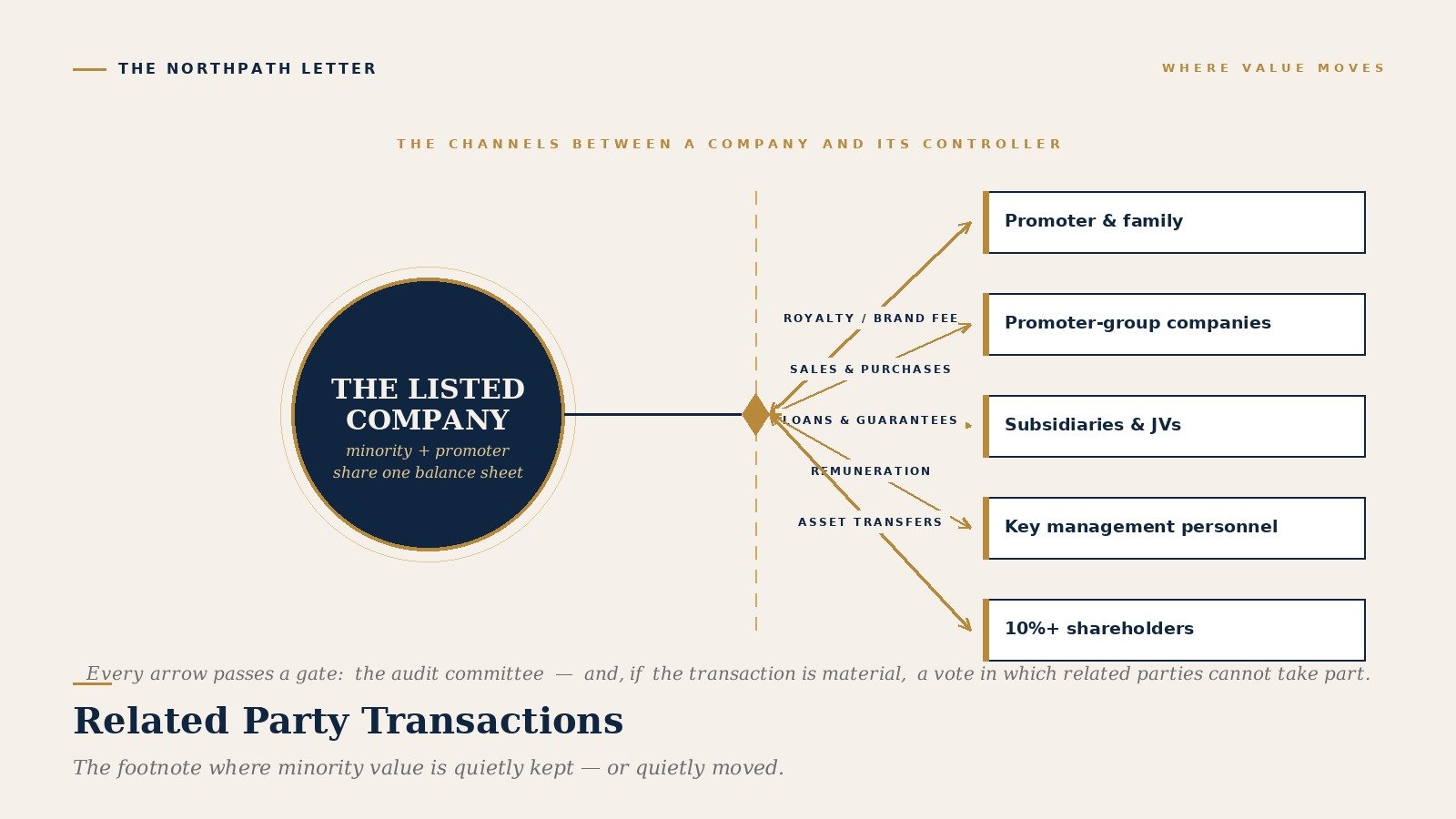
This matters more in India than in almost any other large market because of a structural fact this letter has returned to before: control is concentrated. The promoter — the founding family or group that the law treats as the company’s controlling mind — holds, at the median, around half the equity of an Indian listed company. That same promoter very often controls a constellation of other entities: an unlisted holding company, a brand-owning vehicle, suppliers, customers, a real-estate arm, an overseas subsidiary. Every rupee that moves between the listed company and that constellation is a related party transaction, and every one of them is a place where value can be moved toward, or away from, the minority shareholder who owns the other half.
Economists have a blunt word for the second case. They call it tunneling — the transfer of resources out of a firm for the benefit of those who control it. The term was coined by Johnson, La Porta, Lopez-de-Silanes and Shleifer in 2000, borrowed from the Czech tunelování used to describe the looting of newly privatised companies. Two years later, Marianne Bertrand, Paras Mehta and Sendhil Mullainathan applied the idea directly to this market in a paper every analyst of Indian equity should know — “Ferreting Out Tunneling: An Application to Indian Business Groups” (Quarterly Journal of Economics, 2002). Using 18,600 Indian firms across 1989–1999, they showed that profits in group companies where the controlling family held low cash-flow rights behaved as if they were being siphoned toward companies where the family held high cash-flow rights. The mechanism — the pipe through which the value flowed — was, overwhelmingly, related party transactions.
The reader of an annual report cannot run Bertrand-Mehta-Mullainathan on a single company. But you can read the footnote they were, in effect, modelling. This letter is about how to do that: what the law counts as a related party, what it counts as a transaction, the three overlapping rulebooks that govern the disclosure, what changed only a few months ago, and the specific channels where, in my experience reading these statements for two decades, value most often moves.
Three definitions, three widening circles
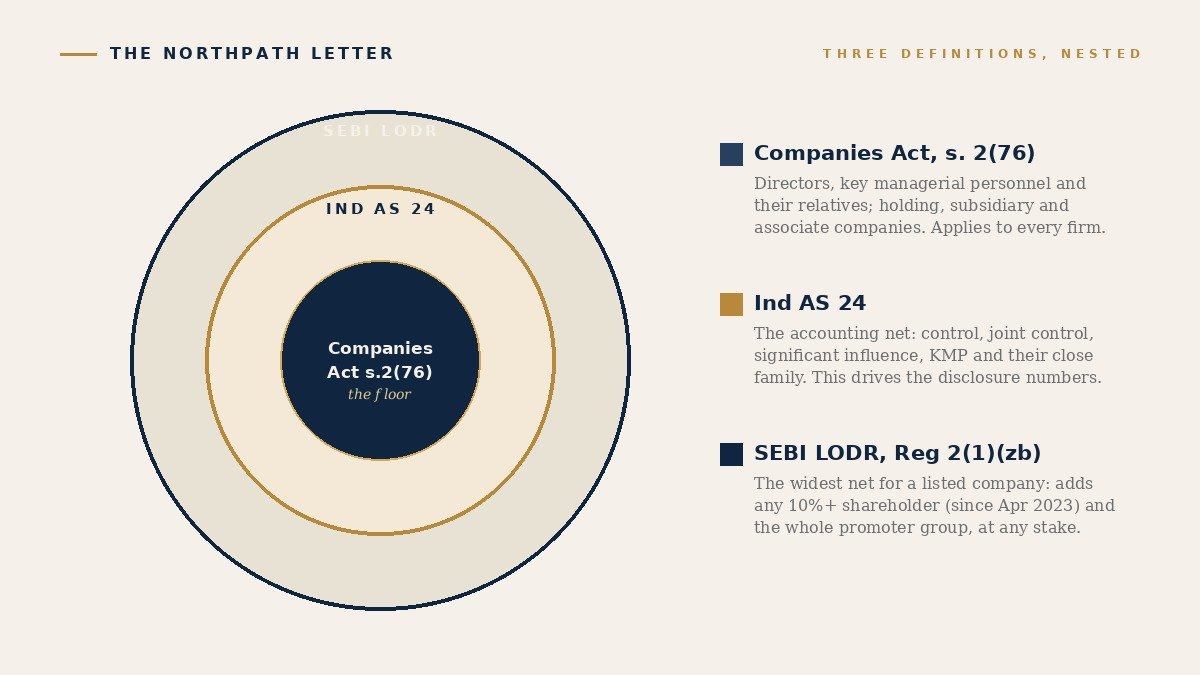
The first difficulty is that “related party” does not have one meaning in India. It has three, and they nest like rings.
The innermost ring is the Companies Act, 2013, Section 2(76). It captures the obvious relationships: a director or key managerial person and their relatives; a firm or private company in which a director or relative is a partner, member or director; any holding, subsidiary or associate company; and a handful of control-based catch-alls. This is the floor that every company, listed or not, works from.
The middle ring is the accounting definition, Indian Accounting Standard (Ind AS) 24, which mirrors the international standard IAS 24. It is framed around control, joint control and significant influence, and it reaches things the Companies Act list can miss — close members of the family of any controlling individual, post-employment benefit plans, and entities controlled or significantly influenced by key management personnel. Ind AS 24 is what actually drives the numbers you see in the disclosure note, because it is an accounting standard and the auditor signs to it.
The outermost and widest ring is SEBI’s Listing Obligations and Disclosure Requirements (LODR) Regulations, 2015, Regulation 2(1)(zb). For a listed company this is the definition that bites hardest, because SEBI deliberately cast it wider than either the Companies Act or Ind AS. It pulls in everyone the other two rings catch, and then adds, by amendment phased in over 2022 and 2023, any person or entity holding a significant stake — initially 20% or more of equity from 1 April 2022, lowered to 10% or more from 1 April 2023 — whether or not they otherwise look “related.” And critically, it deems any member of the promoter or promoter group a related party irrespective of shareholding. That last clause is the heart of the Indian regime: it means the controlling family cannot escape related-party treatment by holding its stake through a lightly-owned vehicle.
For the analyst, the practical instruction is simple. Read the Ind AS 24 note for the numbers, but understand that the regulatory perimeter — the one that triggers approvals and shareholder votes — is the SEBI one, and it is wider than the names the company chooses to list.
What counts as a transaction — and the 2023 “purpose and effect” trapdoor
A related party transaction, under LODR Regulation 2(1)(zc), is broadly any transfer of resources, services or obligations between a listed entity (or its subsidiary) and a related party, regardless of whether a price is charged. The breadth is deliberate: a guarantee given for free, a loan at a soft rate, a brand licensed at no charge in one direction and an inflated royalty in the other — all are transactions.
The most important expansion came into force on 1 April 2023. From that date the definition reaches a transaction between the listed entity (or its subsidiary) and any person or entity — even an apparent third party — where the purpose and effect is to benefit a related party. This is the anti-avoidance clause, and it is aimed squarely at the structure where a promoter routes value through a nominally unconnected counterparty. It shifts the test from form to substance, which is exactly where a sceptical reader should already be looking.
The three-layer rulebook
Indian RPT governance is layered, and confusing the layers is the most common error I see in foreign analysts reading these companies for the first time.
The floor — Companies Act Section 188. This applies to every company. It requires board approval for a defined set of arrangements with related parties: sale or purchase of goods, property or services; leasing; appointments to an office or place of profit; and underwriting. Where the value crosses thresholds set in Rule 15 of the Companies (Meetings of Board and its Powers) Rules, 2014, prior shareholder approval is also needed. Those thresholds, since the 2019 simplification, are percentage-based: broadly 10% of turnover for goods, services or leasing; 10% of net worth for buying or selling property; and 1% of net worth for underwriting. Two features of Section 188 matter enormously and are widely misunderstood. First, since the Companies (Amendment) Act, 2017, the shareholder approval required is an ordinary resolution, not a special one — a simple majority. Second, and most important, Section 188 does not apply at all to transactions entered into in the ordinary course of business and on an arm’s-length basis. That carve-out is the single most-used exemption in Indian corporate law, and, as we will see, the favourite hiding place for transactions that are neither as ordinary nor as arm’s-length as the certificate claims.
The ceiling — SEBI LODR Regulation 23. For listed companies, SEBI builds a far stricter regime on top of the Companies Act floor, and it does not honour the ordinary-course/arm’s-length exemption. Under Regulation 23, all related party transactions require prior approval of the audit committee — a body that must be majority-independent. Material transactions additionally require prior approval of shareholders. From 1 April 2023 the audit committee’s reach extends to transactions of a subsidiary where the listed parent is not even a party, once they cross a turnover-linked threshold. There is no ordinary-course escape hatch here: a recurring, perfectly commercial supply contract with a promoter entity still needs audit-committee sign-off every period.
The disclosure layer — Ind AS 24. Independently of who approved what, the accounting standard requires disclosure of related-party relationships, the transactions and outstanding balances with each category, commitments, and — a line analysts routinely under-use — the compensation of key management personnel, broken into short-term, post-employment, other long-term, termination and share-based components. Parent-subsidiary relationships must be disclosed even when there were no transactions at all, because the relationship itself is information.
What changed in November 2025 — and why the threshold is no longer a single number
Here is where a reader relying on a textbook or on memory will now be wrong, and where the lesson of triple-checking every regulatory fact against the current rule earns its keep.
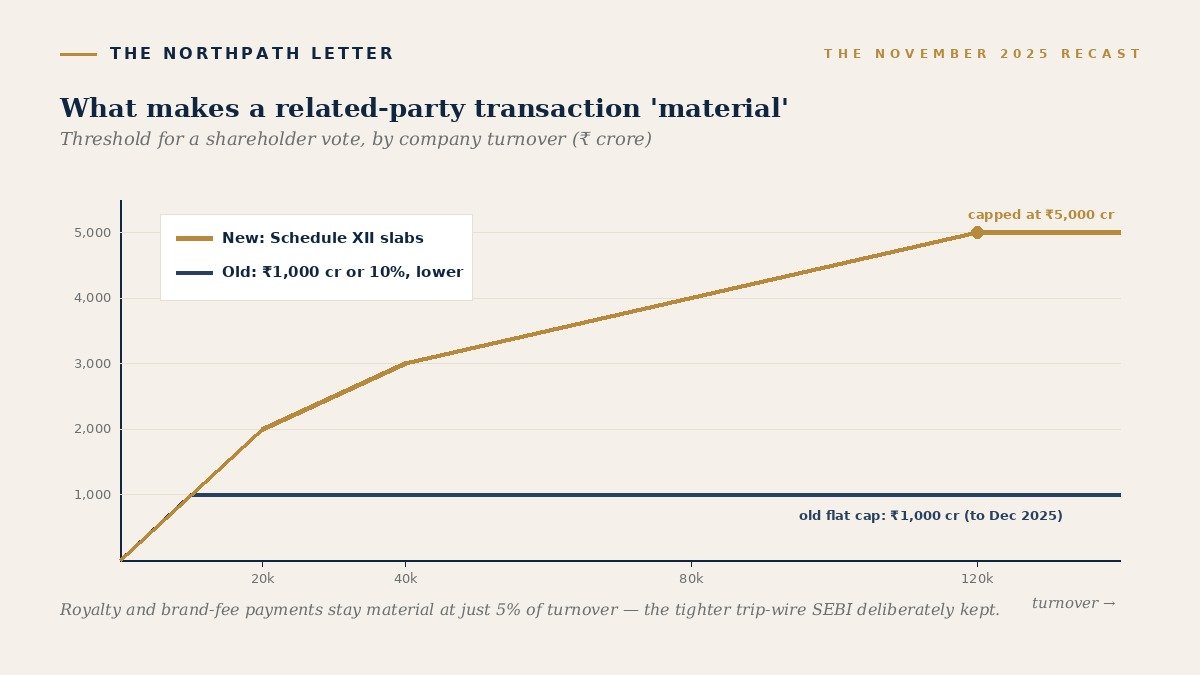
From 1 April 2022 until late 2025, the test for whether an RPT was “material” — and therefore needed a shareholder vote — was a single twin-threshold: a transaction, or transactions taken together in a year, that exceeded the lower of ₹1,000 crore or 10% of consolidated turnover. That number is now history. On 19 November 2025, SEBI notified the LODR (Fifth Amendment) Regulations, 2025, and the relevant provisions — including a brand-new Schedule XII — took effect on 18 December 2025.
The flat threshold has been replaced by a scale-based, slab structure keyed to the size of the company:
- turnover up to ₹20,000 crore: the old 10% of consolidated turnover still applies;
- turnover between ₹20,000 crore and ₹40,000 crore: ₹2,000 crore plus 5% of turnover above ₹20,000 crore;
- turnover above ₹40,000 crore: ₹3,000 crore plus 2.5% of turnover above ₹40,000 crore — the whole figure capped at ₹5,000 crore.
The logic is that the old flat ₹1,000-crore cap was punishing for the largest conglomerates — for a company turning over ₹2 lakh crore, a ₹1,000-crore intra-group transaction is rounding error, yet it triggered the full shareholder-vote machinery — while being lax for small companies, where 10% of a modest turnover could be a trivial sum. SEBI’s own consultation estimated the recast would cut the number of RPTs requiring a shareholder vote by roughly 60% for the hundred largest companies on the NSE by turnover. One threshold was not relaxed: payments for brand usage or royalty remain material at just 5% of consolidated turnover, a deliberately tighter trip-wire because royalty is the channel through which value most often leaves toward a promoter or foreign parent.
A balanced reading of this change is important, because it cuts two ways. The optimistic case is that the regime had become so granular it was generating votes on transactions no rational minority shareholder cared about, dulling the very mechanism it relied on. The sceptical case is that India spent 2021–2023 tightening RPT governance precisely because tunneling through intra-group transactions had been a recurring scandal, and that loosening the materiality net — even sensibly — moves more of those transactions out of shareholder sight and back into the audit committee’s. Which reading is right will depend on whether audit committees prove to be the independent gatekeepers the structure assumes. That is a question of culture, not regulation, and the honest answer is that it varies enormously by company.
The mechanism that actually protects the minority
If you remember one rule from this letter, remember Regulation 23(4). When a material RPT goes to a shareholder vote, no related party may vote in favour of the resolution — whether or not that party is connected to the specific transaction. In practice this disenfranchises the promoter block on the very resolutions where its interest is most acute, and hands the decision to the majority of the minority: the resolution passes only if more of the non-related public shareholders vote for it than against.
This is the most powerful minority-protection tool in Indian securities law, and it has teeth. There are documented cases of promoter-sponsored royalty increases and asset transfers being voted down by minority institutions despite the promoter holding a nominal majority — because on that resolution the promoter’s shares simply did not count. When you read an Indian company’s voting results (disclosed to the exchanges after every general meeting), the RPT resolutions are the ones to study: a large “against” vote from public institutions on a related-party item is a governance signal worth more than a page of the chairman’s prose.
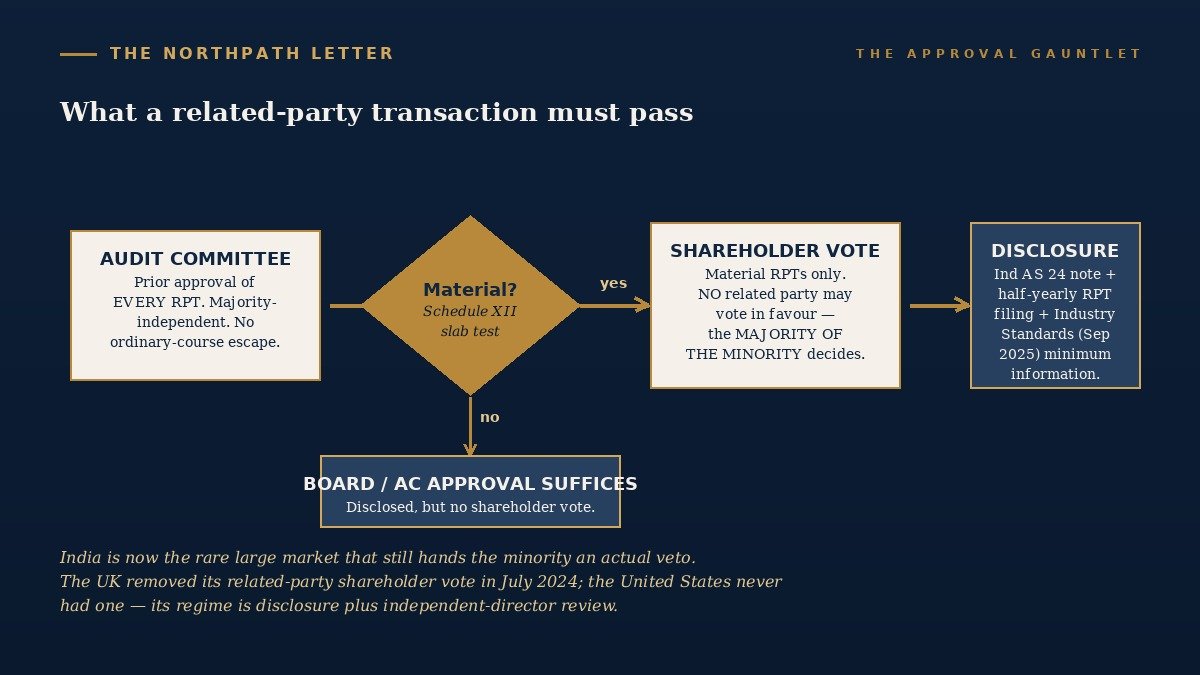
The comparative picture sharpens why this matters. The United Kingdom, for premium-listed companies, ran a broadly similar related-party regime for years — but in the July 2024 overhaul of the UK Listing Rules, the mandatory shareholder vote for large related-party transactions was removed, replaced by a board-and-sponsor “fair and reasonable” opinion and a market announcement. The United States never had the vote at all: its regime, under SEC Regulation S-K Item 404, is essentially disclosure of transactions above $120,000 plus audit-committee review, hardened only by the Sarbanes-Oxley Section 402 ban on personal loans to directors and officers. So the world’s two largest developed equity markets rely on disclosure and independent-director review; India, uniquely among large markets, still hands the minority an actual veto. For a market with India’s ownership concentration, that is the right design — disclosure alone assumes a diffuse shareholder base that can exit cheaply, which is not the Indian reality.
The channels — where to actually look
Regulation and theory aside, value moves through a small number of recurring pipes. When I read a related-party note, I read for these in order.
Royalty, brand and “technical know-how” fees. A payment from the listed company to a promoter-owned or parent-owned entity for the use of a brand or technology is the cleanest tunneling channel, because it scales with revenue and rarely reverses. The tell is the trend: royalty as a percentage of sales, tracked over five years. A creeping ratio, or a step-up timed to coincide with a sales boom, deserves scrutiny. This is precisely why SEBI kept the royalty materiality threshold at a tight 5%.
Sales to, and purchases from, group companies — and the pricing basis. Intra-group trading is often genuinely commercial. The question is the margin. If the listed company sells to a promoter entity, is it at the price it charges third parties? If it buys, is it paying more than the market? The disclosure rarely gives you price, but it gives you volume and counterparty; a large and growing share of revenue or cost concentrated in related parties is the flag.
Loans, advances, inter-corporate deposits and guarantees. This is the channel that has destroyed the most Indian minority value, because it can move large sums without ever touching the income statement. A listed company that lends to, or guarantees the borrowings of, a stressed promoter entity is exporting its balance-sheet strength for the family’s benefit. Map related-party loans and guarantees against the company’s own net worth; a guarantee that is a meaningful fraction of equity, given for a related party, is a contingent liability the headline numbers will not show you.
Asset transfers and the valuation basis. When property, a business unit or an investment passes between the listed company and a related party, the entire question is the valuation — and valuations of unlisted assets are elastic. Look for the independent valuer, the method, and whether the transaction enriched the promoter’s side at the listed company’s expense.
Related-party receivables and their ageing. A sale to a group company that is never collected is a gift dressed as revenue. If related-party receivables are large relative to the related-party sales that generated them, or if they age without provision, the “sale” was a transfer.
Key management remuneration. Disclosed under Ind AS 24, often overlooked. Promoter-executive pay that rises faster than profit, or commission structures tied to revenue rather than returns, is a related-party transaction in all but name.
A practitioner’s reading order
To turn this into a repeatable pass, here is the sequence I use on any Indian annual report:
First, reconcile the two disclosures. The Ind AS 24 note (accounting) and the Regulation 23 / stock-exchange RPT filing (regulatory) should tell the same story. Divergence is itself information.
Second, read the pricing-basis and approval columns, not just the amounts. Note every transaction parked under the Section 188 “ordinary course and arm’s length” exemption — that is where to apply the most pressure, because arm’s-length is self-certified.
Third, trend the royalty line as a percentage of sales over five years.
Fourth, size the loans and guarantees to related parties against net worth.
Fifth, age the related-party receivables against related-party sales.
Sixth, read the voting results on RPT resolutions from the last general meeting, and look specifically at how public institutions voted.
Seventh, since 1 September 2025, check the company against the new Industry Standards on minimum information for RPT approval — a SEBI-blessed framework from the Industry Standards Forum (ASSOCHAM, CII, FICCI) that prescribes exactly what the audit committee and shareholders must be shown. A company disclosing less than the standard requires is telling you something.
The limit of the rules
For all three layers of regulation, one truth survives: disclosure is not fairness. A transaction can be fully disclosed, board-approved, audit-committee-cleared and shareholder-ratified, and still transfer value from the minority to the controller — because “arm’s length” is an assertion, valuations are opinions, and an audit committee is only as independent as its least independent member. The 2025 recast made the regime more proportionate; the 2025 Industry Standards made the disclosure richer. Neither does the analyst’s work for them. The footnote will tell you where the pipes are. Whether value is flowing the right way through them is a judgment you still have to make yourself.
The one-line takeaway: in a market built on promoter control, the related-party note is not a compliance afterthought — it is the place where you find out whether you and the controlling family are actually on the same side of the table.
Important. All content on this site and in this email is journalism and education for a general audience. Nothing here constitutes investment advice or a recommendation in respect of any specific financial instrument, nor an offer or solicitation to buy or sell any security. Companies and transactions are discussed only to illustrate analytical and regulatory points. Readers should consult an authorised financial adviser regulated in their own jurisdiction before making any investment decision.