Standalone vs Consolidated: Reading Indian Group Financials

northpath artifact issue4

Indian Market Context

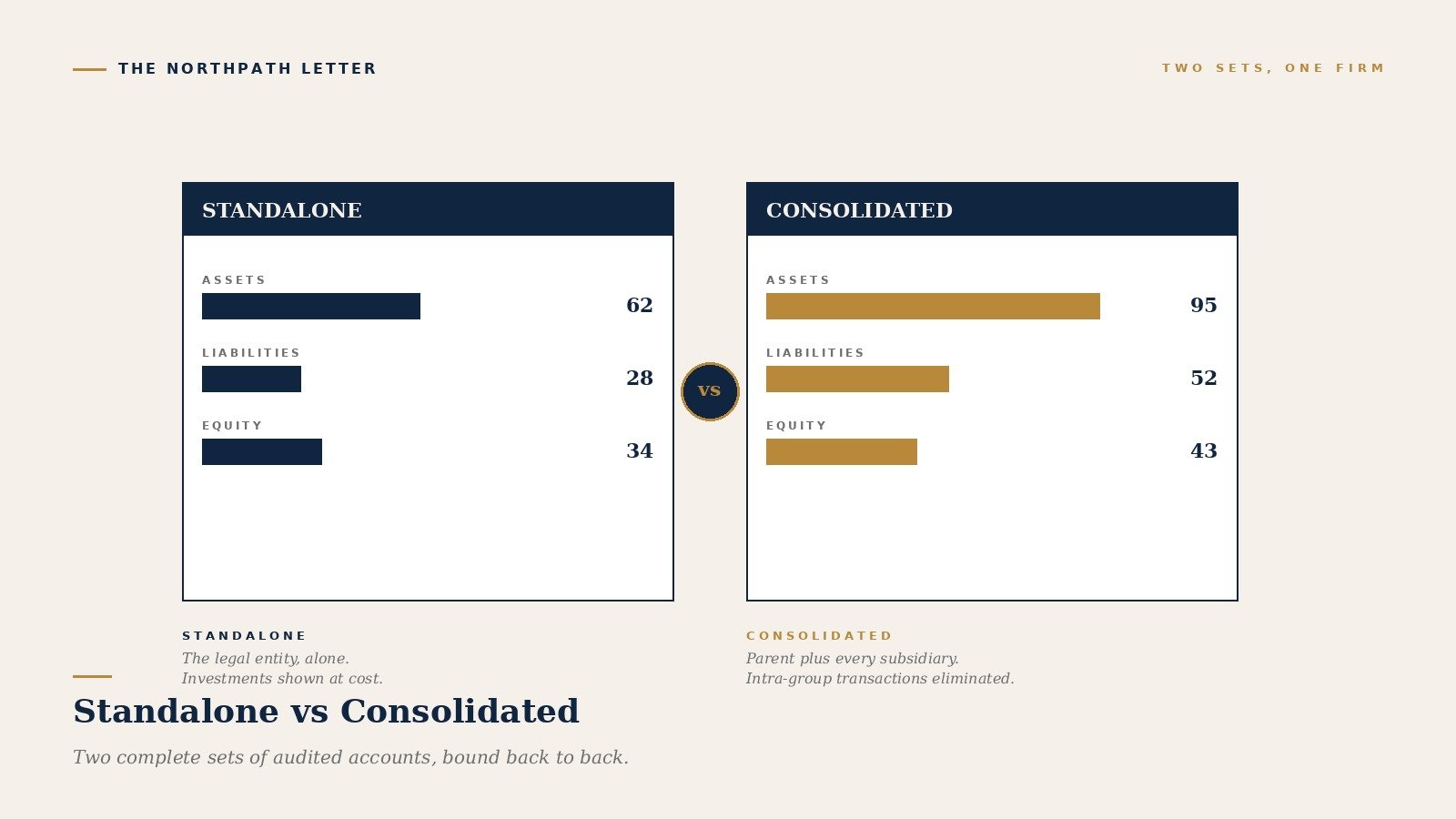
For a long-only foreign portfolio manager who has spent a career reading United States 10-K filings, opening an Indian annual report for the first time is mildly disorienting. The financial statements section is roughly twice as long as it should be — not because the disclosures are more elaborate (in several respects they are less elaborate), but because there are two complete sets of financial statements bound back-to-back in the same volume. One is labelled Standalone Financial Statements. The other is labelled Consolidated Financial Statements. Both are audited. Both carry the auditor’s signature. Both are presented in full — Balance Sheet, Statement of Profit and Loss, Statement of Changes in Equity, Statement of Cash Flows, and Notes — for the current year and the comparative prior year. There is no analogue in the United States Securities and Exchange Commission’s reporting regime, and only a thin one in the United Kingdom.

The temptation, particularly for the reader pressed for time, is to look at the larger of the two numbers and use those — usually consolidated, since by construction consolidated revenue is greater than or equal to standalone revenue. That instinct is wrong almost as often as it is right. Standalone is not the redundant copy of consolidated. The two sets answer different questions, and an analyst who collapses them into one number is, in many Indian situations, simply skipping the most informative disclosure in the volume.

This letter sets out, first, the legal basis for the dual presentation; second, what each set is actually for; third, how the items on the two balance sheets and two profit-and-loss statements relate to each other line by line; and fourth, a practical framework for which set to read first depending on the question one is asking.

I. Why Two Sets of Accounts Exist

The dual presentation is not an accounting tradition or a market convention. It is mandated by primary legislation. Section 129(3) of the Companies Act 2013 requires every company in India that has one or more subsidiaries, associates or joint ventures to prepare consolidated financial statements in addition to its own standalone financial statements, and to lay both before its annual general meeting. The third proviso to the same sub-section requires the company to attach a statement containing the salient features of the financial statement of each subsidiary, associate and joint venture — the well-known Form AOC-1, prescribed under Rule 5 of the Companies (Accounts) Rules 2014.

The format of both sets is prescribed by Schedule III to the Companies Act, with Division I applicable to companies still preparing accounts under the older Indian Generally Accepted Accounting Principles, Division II for Indian Accounting Standards (Ind AS) compliant non-financial entities, and Division III for Ind AS-compliant non-banking financial companies. The consolidation principles themselves are set by Ind AS 110 — Consolidated Financial Statements, which replaced the older AS 21 and aligned Indian practice with IFRS 10. Equity-method accounting for associates and joint ventures is governed by Ind AS 28, business combinations and goodwill by Ind AS 103, and the carrying value of subsidiary investments on the standalone balance sheet by Ind AS 27 — Separate Financial Statements.

The Securities and Exchange Board of India closes the loop on the listed-company side. Regulation 33 of the SEBI (Listing Obligations and Disclosure Requirements) Regulations 2015 requires every listed entity that has subsidiaries to publish both standalone and consolidated results every quarter, subjected to limited review, and audited annually. There is no opt-out for the parent that prefers to disclose only one. The investor opens the annual report and finds two of everything because the statute requires two of everything.

The dual presentation is mandated. Section 129(3) of the Companies Act 2013 requires both sets; Regulation 33 of SEBI LODR enforces both quarterly. The redundancy is statutory, not stylistic.

This is a structural choice that the Indian Parliament and SEBI made deliberately. Other jurisdictions made the opposite choice. The cost is doubling the size of the financial reporting section. The benefit is what the rest of this letter is about.

II. Three Things Standalone Does That Consolidated Cannot

The standalone accounts are not a quaint historical artefact. They drive three live economic decisions that consolidated accounts cannot speak to.

First, the dividend computation. Under Section 123 of the Companies Act 2013, a dividend can be declared and paid only out of the profits of the company for the relevant year, or out of accumulated profits of previous years remaining after providing for depreciation, or out of monies provided by central or state government. “The company” in this section means the legal entity — the parent — not the group. Group profits earned inside a subsidiary cannot be distributed to the parent’s shareholders unless and until that subsidiary itself declares a dividend upstream to the parent. The standalone profit-and-loss account is therefore the only legally relevant pool from which the parent can declare its dividend. The consolidated number is, for this purpose, decorative.

Second, the corporate tax base. The Income Tax Act 1961 assesses each company as a separate taxable person. The parent files its return on its own income; each subsidiary files its own return on its own income. There is no concept of consolidated group taxation in India — no analogue of the United States consolidated return regime under Internal Revenue Code Section 1501, nor of the United Kingdom’s group relief and consortium relief provisions, nor of group taxation under the Estonian distributed-profit model. The tax expense on the standalone profit-and-loss is the actual cheque the parent writes to the income-tax department. The tax expense on the consolidated profit-and-loss is an arithmetic aggregation that no single regulator collects against.

Third, the regulatory thresholds. A large list of SEBI, MCA and Reserve Bank of India thresholds is applied at the legal entity level. Materiality for related-party transactions under Regulation 23 of SEBI LODR is computed against standalone annual consolidated turnover (a hybrid, but applied to the listed entity); the twenty-one clauses of the Companies (Auditor’s Report) Order 2020 are reported by reference to the standalone financial statements of each in-scope entity; Section 186 ceilings on loans, guarantees and investments apply to the company that is granting them; Section 73 restrictions on the acceptance of deposits attach to the company as a person; capital adequacy for a non-banking financial company is regulated by the Reserve Bank at standalone level. The standalone balance sheet is the legal entity that the regulator inspects, the auditor signs, and the lender draws covenants against.

Consolidated accounts are powerful, but they cannot pay a dividend, file a tax return, or satisfy a regulator. Standalone accounts can.

III. Three Things Consolidated Tells You That Standalone Hides

The reverse is equally true. The consolidated set carries three pieces of information that simply do not exist in the standalone view.

The first is the group operating reality. Standalone revenue for a typical Indian holding-company structure is largely dividend income received from subsidiaries plus, perhaps, royalty or management-fee income from the same subsidiaries. None of that revenue corresponds to a customer paying for a product. The consolidated revenue line — net of inter-company eliminations — is the actual figure for what the operating engine of the group sold to outside customers. Earnings before interest, tax, depreciation and amortisation calculated at standalone level can be a meaningless number for a parent that does not itself operate; consolidated EBITDA is the productive output of the franchise.

The second is the inter-company plumbing. Loans from parent to subsidiary, sales from one subsidiary to another, royalties paid up the chain, management-fee mark-ups, transfer pricing on shared services — all of these are real economic transactions on the standalone books of each entity but cancel out on consolidation under Ind AS 110 paragraph B86. If a parent’s standalone profit is propped up by an aggressive transfer-pricing mark-up on services billed down to a wholly-owned subsidiary, the parent’s standalone P&L will look better than it should and the subsidiary’s standalone P&L worse than it should. The consolidated P&L is unaffected. The contrast between the two is the analyst’s signal.

The third is goodwill, non-controlling interests, and the equity method uplift. When a parent acquires a subsidiary at a premium to its identifiable net assets, the excess is recognised as goodwill under Ind AS 103, and that goodwill sits on the consolidated balance sheet only — the standalone balance sheet shows the acquisition price as a single “Investment in subsidiary” line. When the parent owns less than 100% of a subsidiary, the minority shareholders’ interest in the subsidiary’s net assets and profits is presented as a separate line — Non-Controlling Interests under Schedule III, on consolidated only. When the parent has associates or joint ventures (typically 20% to 50% ownership), the equity-method pickup flows in as a single line — Share of profit/(loss) of associates and joint ventures — on consolidated only; on standalone, the same investment is normally carried at cost under Ind AS 27, and income from it appears only when the associate declares a dividend.

These three differences are the substance of the consolidation exercise. Standalone simply cannot show them.

IV. A Line-by-Line Map

The reader who wants to use both sets in parallel will find it useful to keep a mental map of which line item lives where, and how the two views reconcile to each other.

Balance Sheet differences

Investments in subsidiaries, associates and joint ventures. Large, often the single biggest non-current asset, on a parent’s standalone balance sheet — carried at cost under Ind AS 27 (with an irrevocable election to use fair value through profit and loss or the equity method, rarely chosen in Indian practice). On consolidated, this line vanishes; in its place appear the actual assets and liabilities of the subsidiary, line by line.

Goodwill on consolidation. Appears only on consolidated. Tested annually for impairment under Ind AS 36. A material write-down here is a confession by the management and the auditor that historical acquisitions have failed to earn their cost of capital.

Non-controlling interests. A line within total equity, presented below the parent shareholders’ equity, under Schedule III Division II General Instructions and Ind AS 110 paragraph 22. Consolidated only.

Inter-company receivables and payables. Present on standalone as ordinary trade or financial receivables and payables between the parent and each subsidiary. Eliminated on consolidation.

Profit-and-loss differences

Dividend income from subsidiaries. A large line in Other Income on standalone for a parent that is essentially a holding company; eliminated on consolidated.

Inter-company revenue and expenses. Royalty income, management-fee income, brand-fee income, shared-services billing — all present on standalone; eliminated on consolidated.

Share of profit/(loss) of associates and joint ventures. A single line, after operating profit and finance costs, on consolidated only, under Ind AS 28. On standalone, the same investment is dormant on the asset side and contributes only when a dividend is declared.

Profit attributable to non-controlling interests. A presentational split below net profit on consolidated only. Schedule III requires both “Profit attributable to owners of the parent” and “Profit attributable to non-controlling interests” to be disclosed, summing to the consolidated profit for the year.

Cash flow differences

The standalone statement of cash flows captures dividends received from subsidiaries as cash inflows (operating or investing, depending on policy), and capital infusions into subsidiaries as cash outflows. The consolidated cash flow eliminates intra-group flows and presents the group’s external cash conversion. A growing parent whose standalone cash flow looks healthy because the subsidiaries are paying it dividends, but whose consolidated cash flow is weak because the subsidiaries themselves are starved of working capital, is in a different position to one where the two cash flows agree.

V. The Subtleties That Cost People Money

The above is mechanics. The judgement lies in knowing which structures make standalone the more informative view, and which make consolidated the more informative view.

Pure holding companies. Bajaj Holdings & Investment Limited, Tata Investment Corporation Limited, JSW Holdings, Pilani Investment and Industries Corporation, Maharashtra Scooters — these are entities whose principal asset is a portfolio of equity stakes in other listed and unlisted companies. Standalone P&L is dominated by dividend income; consolidated P&L is normally identical to standalone, because the underlying investee companies are accounted for as associates (under 50% holding), not subsidiaries, and their profits flow in only via the equity-method line. The dividend-paying capacity of these holding companies is governed entirely by what dividends they themselves receive. A reader who looks only at consolidated equity-method earnings overstates the holding company’s distributable pool.

Operating-company-with-financial-arm structures. Larsen & Toubro consolidating L&T Finance Holdings; Aditya Birla Capital consolidating multiple regulated subsidiaries; Mahindra & Mahindra consolidating Mahindra Finance and Mahindra Lifespace. Consolidating a financial subsidiary into a manufacturing or services parent’s accounts produces a hybrid balance sheet on which the asset side looks like a bank’s and a manufacturer’s stitched together. Working capital ratios, debt-to-equity, return on assets — none of the standard metrics retain their normal meaning when applied to the consolidated balance sheet of a hybrid. The analyst has to mentally separate the financial subsidiary again — which is precisely what the standalone view of the manufacturing parent already does, free of charge.

Banks consolidating non-bank subsidiaries. HDFC Bank, post the July 2023 merger with HDFC Limited, consolidates HDB Financial Services and a number of insurance and asset-management entities. ICICI Bank consolidates ICICI Securities, ICICI Prudential Life Insurance, ICICI Lombard General Insurance and ICICI Prudential Asset Management. The Reserve Bank regulates capital adequacy at the standalone bank level — the bank’s standalone risk-weighted assets and standalone tier-one capital ratio are what determine its prudential headroom. The consolidated franchise economics — fee pools, distribution leverage, embedded value of insurance subsidiaries — sit on the consolidated set. Both are needed, and the questions they answer are different.

Recently completed mergers. When HDFC Limited merged into HDFC Bank in July 2023, the merged entity’s standalone balance sheet expanded by the entirety of the absorbed mortgage book. The Ind AS 103 Appendix C provisions on business combinations under common control required the comparatives to be restated as if the merger had always happened, an accounting fiction that the analyst must remember when comparing year-on-year growth rates. The consolidated set is less affected, because most of HDFC Limited’s subsidiaries were already consolidated under it. The standalone set is more affected, because a previously off-balance-sheet entity is now on-balance-sheet.

Conglomerates with unlisted parents. Tata Sons Private Limited is the unlisted holding company of the Tata Group. Indian regulation does not require an unlisted parent to publicly file its consolidated accounts in the same way as a listed one (it must prepare them under Section 129(3), and they are filed at the Ministry of Corporate Affairs, but they do not appear in stock-exchange disclosures). The result is that the consolidated picture of the entire Tata Group is not publicly visible the way the consolidated picture of Reliance Industries Limited is. The analyst who wants to understand the Tata Group has to do the work of aggregating the listed Tata operating companies one by one — Tata Consultancy Services, Tata Motors, Tata Steel, Tata Power, Tata Consumer Products, Titan Company, Tata Chemicals, Trent — and is implicitly running a manual partial consolidation. Reliance Industries by contrast publishes the entire group consolidated, including the c. 85% held Reliance Retail and the majority-owned Jio Platforms, in one document.

Standalone tells you what the legal entity earns. Consolidated tells you what the franchise earns. The first decides how much the parent can pay you in dividends and how leveraged it can become before its lenders revolt; the second decides whether the underlying business is creating value.

VI. The International Comparison

To appreciate why India’s dual presentation is informative, it helps to see what other regimes ask for.

The United States. Form 10-K under Regulation S-X requires consolidated financial statements (Rule 3-01 et seq.). The parent-only — “registrant only” — view appears in Schedule I, Condensed Financial Information of Registrant under Rule 5-04 of Regulation S-X, only when restricted net assets of consolidated subsidiaries exceed twenty-five percent of the consolidated net assets at the end of the most recent fiscal year. For the great majority of S&P 500 filers, the parent-only view simply does not exist in the public record. An equity analyst at a New York mutual fund covering JPMorgan Chase, Apple or ExxonMobil works exclusively from consolidated accounts. The standalone perspective is not part of the analytical vocabulary.

The United Kingdom. Sections 399 to 408 of the Companies Act 2006 require a parent to prepare group accounts unless an exemption applies. The parent’s own balance sheet is included in the same Annual Report, typically as a short statement; Section 408 permits the parent’s profit and loss to be omitted entirely from the published accounts if the group accounts are presented. The standalone information that does survive is far less granular than India’s full parallel set, and the parent P&L is routinely absent.

The IFRS regime. IAS 27 — Separate Financial Statements — permits a parent to prepare separate (standalone) accounts, but these are not mandatory under IFRS itself. The requirement to publish them is jurisdictional. A South African or German parent under IFRS will typically file consolidated only.

India is unusual: a full parallel set of audited standalone accounts, every quarter, every year, for every listed entity that has a subsidiary. It is the most generous public-disclosure regime on the question of what is happening at the legal entity level of any large capital market in the world. The investor who does not use that disclosure is leaving the most distinctive feature of Indian financial reporting on the table.

VII. A Practical Reading Order

For the analyst sitting down with an Indian annual report for the first time, the suggested order is as follows.

  1. Consolidated Statement of Profit and Loss first. Read revenue, gross margin, EBITDA, finance costs, share of profit of associates and joint ventures, profit before tax, tax expense, and the split of profit between owners of the parent and non-controlling interests. This is the operating economics of the franchise.

  2. Consolidated Balance Sheet next. Note goodwill, the size of non-controlling interests, the breakdown of borrowings between current and non-current, the inventory and receivables build, and any large intangible assets other than goodwill. This is the leverage and asset-intensity of the franchise.

  3. Standalone Statement of Profit and Loss. Identify dividend income from subsidiaries within Other Income. Compare standalone profit after tax to the consolidated profit attributable to owners of the parent. The gap, after adjusting for inter-company eliminations, is the analyst’s window into how much of group profit currently sits at the operating-subsidiary level rather than the parent.

  4. Standalone Balance Sheet. The Investments in subsidiaries, associates and joint ventures note (mandated under Ind AS 27 and Schedule III) lists each subsidiary’s name, the number of shares held, the cost of acquisition, and any impairment recognised. This is the at-cost book; comparing it line by line to the actual net worth of each subsidiary tells the reader where unrealised value has accumulated and where impairment is overdue.

  5. The Note on Subsidiaries, Associates and Joint Ventures. Mandated by the third proviso to Section 129(3) and the disclosure requirements of Ind AS 112. Lists each subsidiary’s principal activity, country of incorporation, percentage held, and whether consolidated or carried at equity method.

  6. Form AOC-1. A single-page summary, prescribed by Rule 5 of the Companies (Accounts) Rules 2014, giving for each subsidiary, associate and joint venture the share capital, reserves, total assets, total liabilities, investments, turnover, profit before tax, tax, profit after tax and proposed dividend. This is the analyst’s “x-ray” of the group and deserves its own essay.

  7. Note on Related-Party Transactions. Disclosed under Ind AS 24 on standalone, where the underlying transactions are real; on consolidated, intra-group transactions are eliminated, so the related-party note shrinks to transactions with associates, joint ventures, key management personnel and other related parties outside the consolidation perimeter. The standalone note is therefore the richer disclosure.

This order is not law — it is practitioner habit. But it produces fewer surprises than the alternative of reading consolidated, drawing a conclusion, and never opening standalone.

VIII. Disclosure Lessons from Indian History

The dual presentation has, on several occasions, given Indian analysts visibility into events that a 10-K-style consolidated-only regime would have masked.

Satyam Computer Services (2008-09). The accounting fraud that destroyed Satyam was visible, in retrospect, only when the standalone accounts were read carefully against the consolidated accounts and against the cash balances disclosed in the standalone schedule of bank balances. The fictitious cash held by the parent was at standalone level. A consolidated-only reader would still have seen the same fictitious cash; but the reconciliation of inter-company flows between the parent and its subsidiaries was where the abnormality was most testable.

IL&FS Group (2018). The collapse of Infrastructure Leasing & Financial Services Limited and its subsidiary network was preceded, for years, by a consolidated picture at the listed operating subsidiary level that did not look catastrophic. The standalone leverage at IL&FS Limited (the unlisted holding company) was orders of magnitude larger than the leverage visible at any listed operating subsidiary’s standalone accounts. The analyst who tried to understand the group only via its listed pieces, in isolation, was looking at the wrong unit of analysis. The standalone of each entity, separately, was the data; the consolidation work had to be done manually because there was no single listed parent disclosing the entire chain.

DHFL (2019-20). The default and resolution of Dewan Housing Finance Corporation Limited was preceded by a deterioration in the standalone balance sheet — commercial-paper dependence, asset-liability mismatch on the standalone book of the housing finance company — that was visible quarter by quarter from the standalone disclosures under SEBI LODR Regulation 33 well before the rating agencies acted.

In each case, the standalone disclosure carried information that the consolidated did not, or carried it earlier. The lesson is not that standalone is “better” than consolidated. The lesson is that they are different instruments measuring different things, and an analyst who uses only one has only half a stethoscope.

IX. Takeaway

Standalone tells you what the legal entity earns. Consolidated tells you what the franchise earns. Read both, in that order, every time.