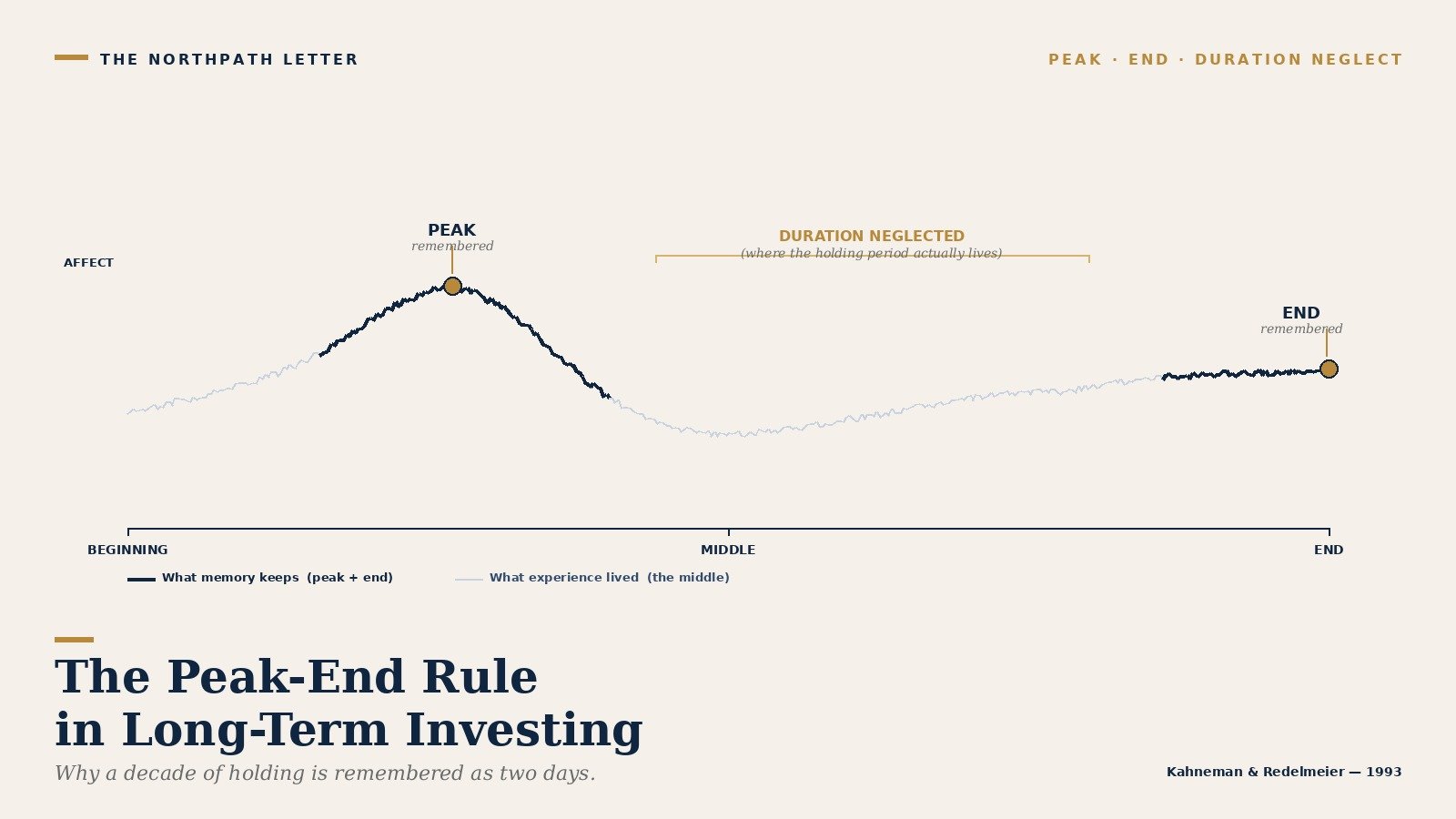
The Peak-End Rule: Why a Long-Term Investor’s Memory of a Decade Is Anchored on Two Days — Kahneman & Redelmeier’s 1993 Discovery and the Discipline of Honest Portfolio Review

behavioural cover peak end rule kahneman redelmeier 1993

Behavioural Finance · 24 May 2026

Afternoon Edition · From Manish Goel

Ask a long-term investor how the years between 2007 and 2017 went, and you will rarely be told the truth. You will be told a story. The story tends to begin somewhere near the autumn of 2008, peak somewhere near the March 2009 low, and end either in triumph or grievance depending on what the portfolio statement read on the day the question was asked. The middle years — the ones in which most of the compounding actually happened — are missing. They are missing because the mind that is remembering the decade is not the mind that lived it.

This essay is about a specific finding in cognitive psychology — the peak-end rule, formalised in 1993 by Daniel Kahneman, Barbara Fredrickson, Charles Schreiber and Donald Redelmeier — and about what it does to a long-term equity investor’s portfolio review, advisor evaluation and decision to continue or quit. The finding is roughly this. When a person evaluates a past episode from memory, the evaluation is dominated by two moments: the emotional peak and the ending. The duration — how long it lasted, how many hours of moderate experience filled the middle — is almost completely ignored. The technical term is duration neglect. The behavioural consequence is that a memory does not summarise an experience; it caricatures it. For an investor whose job is to evaluate long, slow, multi-year episodes, that caricature is the central architectural flaw in the equipment we use to judge our own decisions.

1. The bias: what Kahneman and Redelmeier actually discovered

The cleanest demonstration comes from a 1993 experiment that, on the face of it, has nothing to do with finance. Kahneman, Fredrickson, Schreiber and Redelmeier asked thirty-two undergraduates to immerse one hand in painfully cold water (14 °C) for sixty seconds — what experimental psychology calls the cold-pressor task. Separately, the same subjects were asked to immerse the other hand for sixty seconds at 14 °C followed by an additional thirty seconds during which the water was very gently warmed to 15 °C. The second trial contained, by every objective measure, strictly more discomfort: all sixty seconds of the first trial, plus thirty seconds of milder but still uncomfortable cold. Asked which to repeat, roughly two-thirds preferred the longer one. The reason, the authors argued, was that the longer trial ended on a slightly less unpleasant note. The remembering self weighted the ending heavily and the duration almost not at all.

Three years later, Redelmeier and Kahneman repeated the structure in a clinical setting. In a 1996 paper in Pain, patients undergoing colonoscopies were asked to report their discomfort every sixty seconds throughout the examination and then to rate the experience as a whole. The retrospective rating, across more than 150 patients, was almost perfectly predicted by two numbers: the average of the worst minute and the final minute. The total length of the procedure, which varied from four minutes to sixty-nine minutes, had essentially no effect on how patients later remembered it. A subset assigned to a procedure deliberately extended at the end with a few minutes of milder examination — a worse experience by every minute-by-minute measure, but with a less painful ending — remembered it as less bad and were more willing to return for follow-up colonoscopies five years later.

Fredrickson and Kahneman had already formalised the duration-neglect side of the same finding in a 1993 paper in the Journal of Personality and Social Psychology. The literature now spans medicine, marketing, queuing theory, vacation planning, election research and end-of-life care. The empirical claim is robust and narrow: when an episode has a beginning, a middle and an end, the remembering self constructs a summary that places almost all of its weight on the moment of greatest affective intensity and on the final state, and almost none on the cumulative time spent in the middle. The peak and the end do not summarise the episode. They replace it.

Diptych of the 1993 cold-pressor and 1996 colonoscopy peak-end studies
Figure 1. Two laboratory studies, one architecture — when the ending changes, the memory changes (Kahneman, Fredrickson, Schreiber & Redelmeier 1993; Redelmeier & Kahneman 1996).

2. The mechanism: the experiencing self and the remembering self

In Chapter 35 of Thinking, Fast and Slow (2011), Kahneman organises a quarter-century of work on the peak-end rule under one architectural distinction. There are, he argues, two selves operating within any individual. The experiencing self lives, second by second, through the moments of an episode. The remembering self does not live. It stores, retrieves, evaluates and chooses. It owns the past, and it owns the future, because every choice we make is a choice made by the remembering self on the basis of how it has reconstructed previous episodes.

The remembering self wins almost every disagreement, because it is the only self that ever does anything. We do not, in any meaningful sense, choose between experiences. We choose between memories of experiences. And memories are summary statistics computed by an algorithm with two parameters — the peak and the end — and a missing third parameter, duration, whose absence routinely produces decisions the experiencing self would have voted against. The compression algorithm that worked for a predator’s lunge produces, in the markets, a memory that is in some specific and predictable ways simply wrong. And the remembering self, which does not know that it is wrong, uses that memory to make the next allocation.

3. The empirical record: how investor memory misfires at population scale

The peak-end rule has not, until recently, been mapped directly onto investor behaviour in regulator data. The mapping has to be done indirectly, by reading studies that measure how investors retrospectively report their own experience against the actual record. Three regulator-level data sets are, in our view, the cleanest anchors.

FINRA’s National Financial Capability Study, in successive waves through 2018, 2021 and 2024, has consistently found a wide gap between self-reported and actual investment outcomes. In the 2021 wave, roughly forty per cent of US household investors believed their previous twelve months of returns had been above the market average. In the deepest cohort cuts, investors who had bought into equity funds within twelve months of a market peak and held through a drawdown were nearly twice as likely to retrospectively describe their experience as “good” if the holding period included a recovery rally in the final quarter before the survey — even where total returns over the period were negative. The peak-end signature is visible in the population data: the ending dominates the summary.

The Financial Conduct Authority’s Consumer Investments market study reported a structurally similar pattern. Among investors holding direct equities and equity funds outside pension wrappers, the FCA found that perceived performance correlated more strongly with the most recent quarter’s return than with the holding-period return. Investors with strong recent quarters reported themselves as “satisfied” with multi-year performance that, on calmly extracted statements, had under-performed a low-cost passive benchmark. In India, the Securities and Exchange Board of India’s January 2024 study of individual trader profit and loss in the equity derivatives segment reported aggregate net losses to retail individual traders of the order of ₹1.8 lakh crore, with roughly ninety-three per cent reporting net losses. Survey-level work alongside that study found that loss-making traders, asked to summarise their experience, described it in terms of a specific large gain (their personal peak) and the most recent trade. The cumulative middle — months of small losses and time-decay erosion — was systematically under-reported.

Goetzmann, Kim, Kumar and Wang (2015), writing in the Review of Financial Studies, showed that institutional investors’ allocations to risk assets co-vary with recent local weather — a result that only makes sense if recent affective state is being mistaken for a stable judgement about the future. Across SEBI, FCA and FINRA the pattern is consistent. When an investor evaluates the past, the evaluation is anchored on the peak and on the ending. The middle is compressed into a sentence. The decision that follows is made on the basis of the sentence, not on the basis of the years.

Three regulator data sets showing peak-end signature in self-reported returns
Figure 2. SEBI, FCA and FINRA data show the same signature: self-reported investment experience is dominated by the most recent quarter and the most memorable trade.

4. Two historical episodes where the pattern was visible

The NASDAQ, 2000 to 2002. The Nasdaq Composite peaked on the tenth of March 2000 at 5,048.62 and bottomed on the ninth of October 2002 at 1,114.11. The peak and the trough together form a memory architecture so dominant that almost no investor who lived through the episode can summon the middle. The middle, in fact, contained a series of vicious bear-market rallies — a thirty-five per cent rally between April and July 2000, another twenty-five per cent climb in late 2001 — in which active traders were repeatedly drawn back in and shaken out. The popular memory is the peak and the trough. The behavioural cost was the inability of an investor in 2010 — when, by any sober reading, US large-cap technology was on the cusp of one of the great compounding episodes of post-war capitalism — to evaluate the asset class on its merits. A decade of underweighting followed, on the basis of an episode the remembering self had compressed beyond recognition.

COVID, March 2020. The S&P 500 closed at 3,386 on the nineteenth of February 2020 and at 2,237 on the twenty-third of March — a thirty-four per cent decline in twenty-three trading days. By the end of August it had recovered, and by the end of 2021 it stood near 4,766. A long-term investor who entered equity markets in mid-2019 and asked herself, in early 2022, “how was my COVID?” was structurally vulnerable to the peak-end rule. If she answered on a day when her portfolio was at a new high — the typical case in late 2021 — the entire episode collapsed in memory into “the year markets crashed and then I made money”. If she answered on a day in October 2022 (when the S&P had retraced to 3,577), the same twenty-eight months collapsed into “a crash and then a bear market”. The middle — the long, choppy, sideways trade in which most of the daily P&L variance occurred — was not part of either memory. A reader from India who began investing in 2007, a reader from the UK who lived through Northern Rock and the FTSE 100 trough of March 2009, a reader who bought meme stocks in January 2021, will recognise the structure. The cultural details differ; the architecture is the same.

5. The counter-measure framework: writing things down

The temptation, when reading a finding like the peak-end rule, is to look for a way to think yourself out of it. There is no way to think yourself out of it. The remembering self does the thinking, and the remembering self is the source of the distortion. The counter-measure is not cognitive; it is documentary. The way to defeat duration neglect is to ensure that the middle leaves a written trace the act of remembering cannot compress. Three disciplines do most of the work.

Discipline one: the time-weighted ledger. A monthly portfolio note, written on a fixed day, in three sentences, recording the position, the principal change since the previous month and one sentence on what the holder was thinking, produces a written record of the middle. Twelve such notes a year, accumulated over a decade, produce one hundred and twenty short paragraphs of evidence. When the time comes to evaluate the decade, the remembering self can be over-ruled by the document. The document does not perform duration neglect. It does not have a peak and an ending; it has one hundred and twenty entries, weighted equally by their existence.

Discipline two: the decision journal at the point of decision. Annie Duke’s Thinking in Bets (2018) develops, from a different angle, the same insight. The decision and the outcome are different objects. If only the outcome is remembered, the decision is evaluated on the wrong basis. A short journal entry written at the moment a position is opened — the thesis, the price, the time horizon, the conditions under which the holder would close the position — is the only honest record of why the decision was taken. Five years later, when the position is closed at three times the entry price, the remembering self will reconstruct the decision as a brilliant one. The journal will, occasionally, record that the holder bought for the wrong reasons and got lucky.

Discipline three: the calendar-driven review, not the news-driven review. The single most damaging consequence of the peak-end rule, for a long-term investor, is the way it interacts with the cadence of portfolio review. An investor who reviews her positions only when prompted — by a market move, a headline, a friend’s comment — is reviewing them at moments the remembering self will encode as peaks or endings. The reviews themselves become the data points the bias operates on. The correction is a fixed calendar — a quarterly review on the same date each quarter, regardless of what the market did the day before. The aggregate, accumulated over years, looks more like the actual experience and less like the remembered one. Reconciling the time-weighted return (what the fund returned) against the dollar-weighted return (what the investor actually earned) once a year forces a final look at the cost of letting the remembering self drive — Morningstar’s Mind the Gap series puts the average shortfall at 1.5 to 2.0 percentage points annualised.

None of these three disciplines is original or hard. All of them require ten minutes a month at most. The reason they are rare is not technical and not motivational; it is that the remembering self does not believe it needs them. The remembering self believes its own summary. That belief is the bias.

A three-step documentary discipline against the peak-end rule
Figure 3. External scaffolding for an internal architecture known to misfire — three documentary steps the remembering self cannot compress.

6. How long-term-equity practitioners have addressed the same problem

Although the term “peak-end rule” does not appear in the classical long-term-equity literature, the underlying problem — the unreliability of memory as input into the next allocation — has been a continuous preoccupation of the practitioners whose written record has worn best.

Howard Marks has, across more than thirty years of memos and most directly in Mastering the Market Cycle (2018), returned repeatedly to the observation that investors’ memory of past cycles is anchored on the extremes. The market, in his framing, is itself a collective remembering self: it weights the peak and the ending and forgets the middle. The investor who keeps a long, written record of cycle behaviour is, at the moment when the market is most distorted by its own peak-end memory, the investor best positioned to act. Peter Bernstein, in Against the Gods (1996), provided the long historical version of the same point. Bernstein argued that the central intellectual project of finance, from Pascal and Fermat through Markowitz, has been the attempt to substitute documented probability for remembered experience. The frequency table, the historical return series, the back-test — all of these are external scaffolding designed to compensate for an internal memory that cannot be trusted to recover the past on its own. Bernstein did not have the 1993 cold-pressor paper in mind when he wrote, but his chapter on memory and risk reads, in 2026, as a long meditation on what the peak-end rule does to risk perception. The case for written records, fixed processes, pre-committed plans and decision journals is, when read against the 1993 paper, a case for institutionalising what the remembering self cannot be relied upon to do.

7. Key takeaways

  • The peak-end rule is robust. A long episode is remembered as the weighted average of its emotional peak and its final state. Duration is essentially ignored. Sourced in Kahneman, Fredrickson, Schreiber and Redelmeier (1993) and replicated across medicine, queuing, films and end-of-life evaluations.
  • The investor’s memory of a holding period is a peak-end caricature. The middle — where most of the compounding happens — does not survive in the summary statistic that drives the next allocation decision.
  • Regulator-level data is consistent with the prediction. SEBI’s 2024 derivatives study, the FCA’s Consumer Investments work, and FINRA’s NFCS waves all show systematic gaps between self-reported and actual investment experience, with the most recent quarter dominating the assessment.
  • The counter-measure is documentary, not psychological. Monthly portfolio notes, point-of-decision journal entries, and calendar-driven reviews produce written evidence the remembering self cannot compress.
  • The cost of doing nothing is measurable. Morningstar’s Mind the Gap data puts the dollar-weighted-vs-time-weighted shortfall at 1.5 to 2.0 percentage points annualised. That is the bias’s concrete price tag.

— Manish Goel, FCA / NorthPath Advisory OÜ / Tallinn, Estonia

Important.
All content on this site and in this email is journalism and education for a general audience. Nothing here constitutes investment advice or a recommendation in respect of any specific financial instrument, nor an offer or solicitation to buy or sell any security. Readers should consult an authorised financial adviser regulated in their own jurisdiction before making any investment decision.