Float Economics: How an Insurance Balance Sheet Became the Most Powerful Compounding Engine in Modern Finance

valueinv cover float economics

VALUE INVESTING · MORNING EDITION · 24 MAY 2026

The single most powerful sentence Warren Buffett has ever written about Berkshire Hathaway is also the shortest. Discussing the firm’s insurance operations in the 2009 shareholder letter, he defined the engine of its multi-decade compounding in nine words: “Float is money we hold but do not own.” Read those words slowly. They are the door behind which the most important structural advantage in modern long-term equity investing has been hiding in plain sight for nearly six decades, and they are the reason why a private investor in 1965 who bought a single share of Berkshire at $19 owned, by 2024, an asset trading above $700,000. The pages that follow examine the principle in the form a serious global long-term equity investor must understand it: not as a piece of Buffett trivia, but as a mental model for recognising where leveraged compounding actually comes from, what discipline it demands of the capital allocator, and which of its features can and cannot be replicated outside the insurance industry.

1. The principle: what float actually is

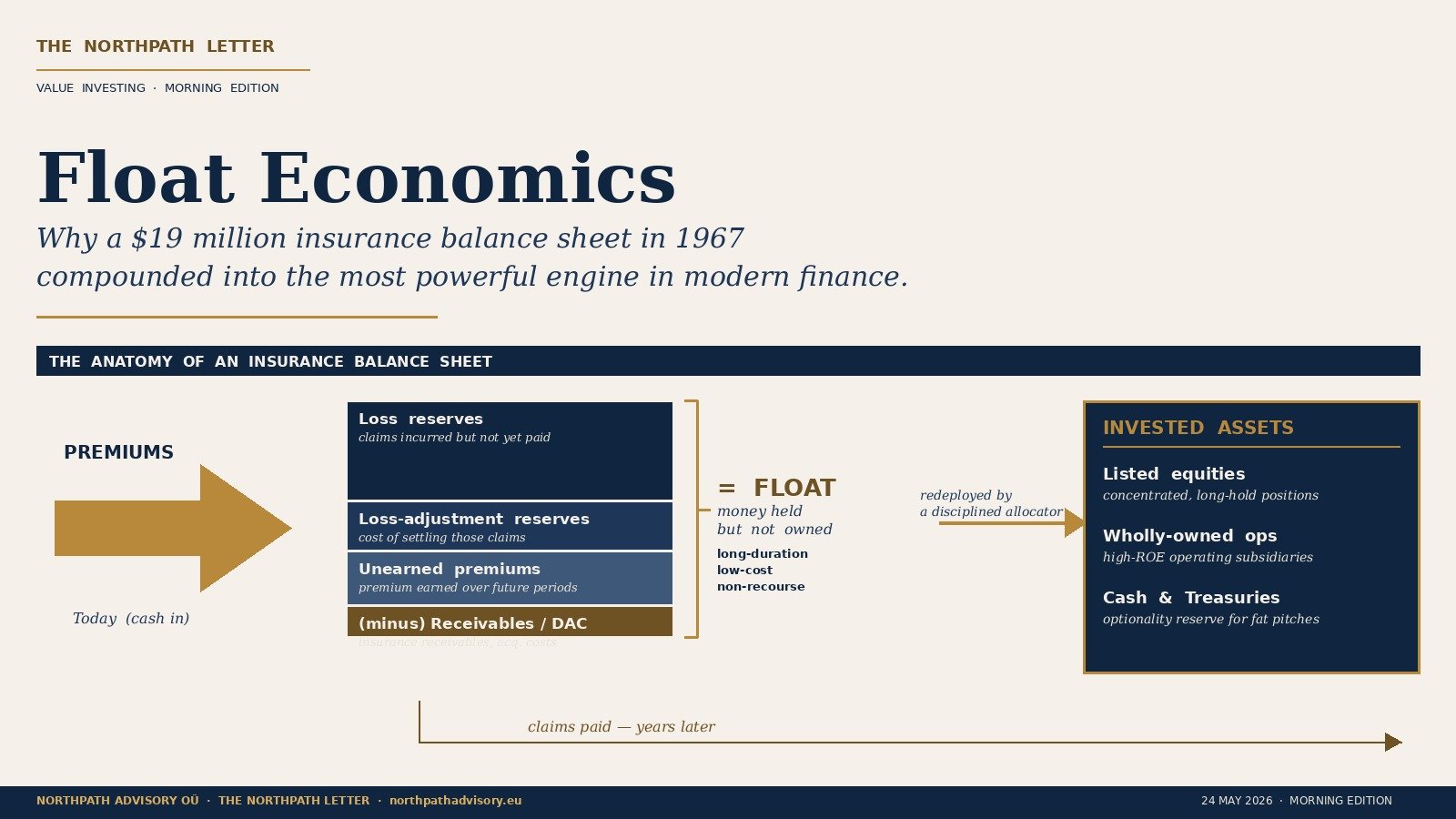
Float, in the precise insurance-accounting sense Buffett uses, is the difference between what an insurer has collected in premiums and what it will eventually pay out in claims. It is the cash held on the balance sheet against future obligations — technically, the sum of loss reserves, loss-adjustment-expense reserves and unearned premiums, less insurance receivables, deferred acquisition costs and certain prepaid expenses. The definition first appeared informally in Buffett’s 1967 letter, the year after Berkshire acquired Jack Ringwalt’s National Indemnity for $8.6 million. It was made rigorous in the 2009 letter and has been repeated, almost verbatim, in every subsequent annual report.

The crucial property of float is that, although it sits on the asset side of the balance sheet as cash and securities, it does not belong to the insurer. It is held in trust, against claims that will, eventually, be paid. From the perspective of generally accepted accounting principles, float is a liability. From the perspective of the practising investor it is something far more interesting: it is a pool of capital the insurer can invest, for as long as the policies remain in force, without paying interest. If the insurer’s underwriting is disciplined enough that premiums earned exceed expected losses and operating costs, the cost of float drops below zero. The insurer is then being paid by its policyholders for the privilege of investing their money.

This is the source of Buffett’s most-quoted, most-misunderstood claim. He has written, repeatedly, that Berkshire’s float has carried “a negative cost” over the long run. He does not mean that Berkshire has somehow defied the basic arithmetic of insurance. He means precisely that, year after year, premiums have exceeded claims and expenses by enough to add an underwriting profit on top of the investment returns generated by the float pool. The leverage is not borrowed; it is given. That single fact, more than any other, is what separates Berkshire’s compounding record from every other long-only equity vehicle of the last sixty years.

2. The mechanism: three structural advantages compounding at once

A long-term investor analysing float as a principle, rather than as Berkshire trivia, must isolate three distinct mechanical advantages that operate simultaneously. None of the three is exotic. What is exotic is the way the insurance balance sheet bolts them together.

The first advantage is duration. Property-and-casualty policies on average pay out claims years after the premium is collected. Long-tail lines — workers’ compensation, professional liability, medical-malpractice reinsurance, super-catastrophe reinsurance — can stretch a single premium-to-claim cycle to ten or fifteen years. Over that horizon the float behaves, economically, like permanent capital. Berkshire’s reinsurance subsidiary, BHRG, run since 1986 by Ajit Jain, was specifically constructed to maximise this duration advantage, accepting low-frequency, high-severity risks that almost no one else would underwrite on terms that left the underlying float economically permanent.

The second advantage is cost. Conventional corporate leverage costs whatever the bond market charges — today, for an investment-grade industrial, perhaps four to six per cent before tax. Float costs whatever the underwriting loss ratio in excess of one hundred per cent turns out to be, plus or minus operating expenses. For an insurer that prices risk competently, that number is zero. For one that prices risk well, it is negative. Buffett has reported that Berkshire’s float has carried a negative cost in most years since the mid-1990s; the AQR paper Buffett’s Alpha (Frazzini, Kabiller and Pedersen, Financial Analysts Journal, 2018) decomposes Berkshire’s long-run leverage at an average of 1.7 times equity and concludes that the “cheap and stable” nature of that leverage explains a material fraction of the return advantage over the broad market.

The third advantage is non-recourse. A holder of Berkshire debt or equity may, in a crisis, demand repayment, sell the stock, or refuse to roll a maturing bond. A policyholder cannot. The policy obligates Berkshire to pay claims as they emerge, on terms set when the policy was written, in cash that the insurer accumulates over the life of the policy. There is no margin call on float. The 2008 financial crisis is the cleanest demonstration: every leveraged financial company in the United States that depended on overnight funding hit a wall in September 2008. Berkshire’s insurance balance sheet, by contrast, was unaffected. The float pool did not run; the policies did not lapse; the cash continued to come in faster than it went out.

These three mechanical advantages — long duration, near-zero cost, and non-recourse character — combine multiplicatively, not additively. A long-duration pool of capital that pays nothing to use and cannot be withdrawn by its owners is the closest thing to perpetual equity that finance has ever produced. Buffett’s achievement is not that he discovered this; the insurance industry has known about float since the seventeenth century. His achievement is that he reinvested the float, year after year, in operating businesses and listed equities at returns that compounded the entire structure at twice the rate of the underlying market.

3. The empirical record

The numbers are public and, by any standard of modern finance, unprecedented. Berkshire’s float was approximately $19 million in 1967, the year after Buffett bought National Indemnity. It reached $1.6 billion in 1990, $28 billion in 2000, $66 billion in 2010, and $169 billion by year-end 2023. The compound annual growth rate of the float pool over fifty-six years is approximately 17.4 per cent. Over the same period Berkshire’s per-share book value compounded at 19.8 per cent against 9.9 per cent for the S&P 500 total return index. The gap of roughly nine percentage points per annum, sustained over more than half a century, is the largest documented excess return of any long-only equity vehicle in the history of public markets.

The AQR decomposition, published in the Financial Analysts Journal in 2018, attempted to deconstruct that record into systematic factors. The authors found that Berkshire’s portfolio could be substantially explained by a combination of quality, low-beta and value exposures — well-known equity-style factors — but only when the analysis was adjusted for leverage of approximately 1.7 times. The source of that leverage, the paper makes plain, was overwhelmingly insurance float rather than bank debt or capital-markets funding. Stripped of float leverage, Berkshire’s book value would have compounded at perhaps 13 to 14 per cent rather than 19.8 per cent. The float, in other words, did not create the alpha. It magnified, durably and cheaply, an underlying stock-selection process that was already excellent.

For a global long-term equity investor the implication is not motivational. It is structural. The single most powerful documented source of post-war compounding came from coupling competent value-investing judgment with a particular kind of liability structure. Investors who imitate the judgment without understanding the liability structure are imitating only half of what made the record possible.

Berkshire Hathaway insurance float, 1967 to 2023
Figure 1. Berkshire Hathaway insurance float, 1967 – 2023, log scale.

4. Two historical episodes

Float is easier to see in moments where it nearly broke than in moments where it worked smoothly. Two episodes, on two continents and twenty-five years apart, are instructive.

Berkshire’s acquisition of General Re in 1998 remains the most expensive lesson in the literature about what happens when an investor buys float without underwriting discipline. Berkshire paid approximately $22 billion in stock for General Re. The acquired company brought with it about $15 billion of float — on paper, a transformative addition. In practice, General Re was carrying inadequate reserves on long-tail liability lines, underwriting at combined ratios above one hundred per cent, and exposed to terrorism risk that crystallised disastrously on 11 September 2001. The 2001, 2002 and 2003 letters carry an unusually frank Buffett admission that the float Berkshire had bought turned out to be expensive float for the first four to five years after the acquisition, requiring fresh capital injections to rebuild reserves and a complete rebuild of underwriting culture under new management. Only by approximately 2006 did General Re return to underwriting profitability. The lesson, set down in the 2001 letter and never softened since, is that the value of float depends entirely on the discipline of the underwriting that creates it. Float is not capital that an outsider can simply acquire. It must be earned, year after year, by pricing risk correctly.

Lloyd’s of London 2001-2003 tells the same story in mirror image. The London market, structurally fragmented across hundreds of syndicates underwriting through individual Names, lost approximately $5 billion in 2001 alone. Reserves across the market proved inadequate; several Names were ruined; the corporate-capital reforms that had begun in the mid-1990s were accelerated to recapitalise the market. Crucially, the syndicates that emerged strongest from the cycle — Catlin, Hiscox, Beazley, and the rebuilt Equitas run-off vehicle — were the ones whose 1998 and 1999 underwriting had been most conservative. The investor who bought a Lloyd’s vehicle in 1999 because of the float it generated, without examining the quality of the underwriting that produced it, paid a steep price in 2001 and 2002. The investor who bought after the reserve clean-out in 2003, at trough valuations, into syndicates with demonstrably disciplined underwriting, compounded capital at exceptional rates for the next decade.

The Indian general-insurance industry, opened to private competition by the Insurance Regulatory and Development Authority Act of 1999 and the entry of ICICI Lombard, Bajaj Allianz and HDFC Ergo from 2001 onward, offers a regional variant of the same lesson. Gross general-insurance premiums in India grew from roughly ₹10,000 crore at liberalisation to approximately ₹3 lakh crore by FY24, an order-of-magnitude expansion of the float pool. But Indian insurers operate under IRDAI investment regulations that restrict the proportion of float that may be deployed into listed equities — typically capped between 25 and 30 per cent depending on product class. The structural Berkshire model — deploying float aggressively into operating businesses and concentrated equity positions — is, by regulation, unavailable to any Indian insurer. The Indian listed insurance sector therefore behaves more like a high-quality financial business growing in line with premium volume than like a compounding leveraged equity engine. The structural insight matters: float is not magical in itself. Its productivity depends on what an investor is permitted, by mandate or regulation, to do with it.

When float compounds and when it destroys: National Indemnity 1967 versus General Re 1998
Figure 2. National Indemnity 1967 versus General Re 1998 — two acquisitions, opposite outcomes.

5. The application framework: three disciplines

For a global long-term equity investor — one who will not, in practice, ever own and operate an insurance company — the principle of float translates into three disciplines that apply across the broader portfolio.

The first discipline is to recognise float-equivalents in non-insurance businesses. A negative working-capital cycle is structurally identical to float, in miniature. Costco collects cash from members at the till and pays its suppliers thirty days later; the difference is a perpetual interest-free loan from the supplier base that funds inventory. Hindustan Unilever in India has operated with deeply negative working capital for decades, financing growth from trade credit. Bajaj Finance, although technically an NBFC rather than an insurer, generates a comparable structural advantage through deposit-funded lending. The right question for any analysed business is not whether it has float in the literal insurance sense but whether some part of its operating cycle is funded by counter-parties who do not charge for the use of their capital. Where the answer is yes, the business carries a hidden source of leverage that orthodox return-on-equity calculations under-weight.

The second discipline is to refuse, in personal capital, to provide free float to other people’s businesses. A long-term equity investor who buys a subscription product, pays for an annual product in advance, or holds a deposit with a low-yielding institution is, in microcosm, supplying float. This is unobjectionable when the supplier is a household business with whom you have other reasons to deal. It is dangerous when the supplier is a financial intermediary whose business model depends on collecting other people’s capital cheaply. The careful investor inventories, periodically, where their own working-capital float is being given away.

The third discipline is to distinguish, when analysing insurers as investments, between underwriting discipline and float accumulation. Almost every insurer in the world will eventually publish a chart of growing float. Almost none of them will publish a candid analysis of the cost of that float over a full cycle. The investor must do that analysis from the financial statements: a combined ratio averaging above one hundred per cent over a full underwriting cycle, including the bad years, means the float carries a positive cost and the insurer is, in substance, an expensively-funded asset manager. A combined ratio averaging below one hundred per cent means the float is free or negative-cost and the insurer is, in substance, a leveraged compounding vehicle of the Berkshire type. The label on the front of the annual report tells you nothing useful. The combined ratio across the cycle tells you everything.

6. How long-term equity practitioners applied the principle

Three figures in the value-investing lineage have, between them, mapped the practitioner application of float economics over six decades.

Warren Buffett, in the 1967, 1995, 2009 and 2023 Berkshire shareholder letters, is the canonical source. The 1995 letter set out his reasoning for paying $2.3 billion for the half of GEICO that Berkshire did not already own — a deal struck because GEICO’s low-cost direct-marketing model produced disciplined underwriting and a fast-growing float pool that could be redeployed at higher returns inside Berkshire than inside GEICO’s own portfolio constraints. The 2009 letter set out the formal definition of float and traced the firm’s float arithmetic from 1967 forward. The 2023 letter records the figure that has come to define the principle: Berkshire’s float at year-end 2023 stood at $169 billion, supporting investment portfolios valued at multiples of that figure and underwriting that, taken across the prior twenty years, had produced cumulative pre-tax underwriting profit running into the tens of billions of dollars. Disclosure: the author holds no position in Berkshire Hathaway and no position in any of the listed insurers discussed in this essay.

Henry Singleton, the founder of Teledyne, applied a structurally similar idea outside the insurance industry. As William Thorndike documents in The Outsiders (Harvard Business Review Press, 2012), Singleton acquired Argonaut Insurance in 1969 and Unitrin’s precursor businesses through the 1970s, generated cash from those insurance subsidiaries, and used the proceeds — alongside cash flow from Teledyne’s industrial divisions — to retire ninety per cent of Teledyne’s outstanding shares over a twelve-year period. The mechanism is different from Berkshire’s — Singleton used the cash for buybacks rather than for portfolio investment — but the economic substance is the same: an insurance subsidiary supplied long-duration, low-cost capital that an exceptional allocator deployed at compound rates the parent company could not have funded otherwise. Teledyne’s share price compounded at 17.9 per cent annually from 1963 to 1990 against approximately 8 per cent for the S&P 500 over the same window.

Prem Watsa, who founded Fairfax Financial Holdings in 1985 with the explicit intention of building “a Canadian Berkshire,” offers the cleanest test of whether the principle is replicable. Fairfax’s float grew from approximately $20 million in 1985 to over $30 billion by 2023, compounded by acquisitions of Crum & Forster, Northbridge, Zenith National, Allied World and others. Book value per share has compounded at approximately 17 per cent annually since inception, a remarkable record but materially below Berkshire’s. The decomposition of the gap is instructive: Fairfax’s underwriting has been more cyclical than Berkshire’s, particularly through the 2008-2014 macro-hedge programme that crystallised large losses, and Fairfax’s equity-investment record, while strong, has been less concentrated and less consistent than Buffett’s. The model works. It is, however, more demanding of underwriting and investment judgment in equal measure than its apparent simplicity suggests.

What the three records share is the underlying architecture. A pool of long-duration, low-cost, non-recourse capital, supplied by counter-parties who are not in the business of demanding returns on it, can be deployed by a disciplined allocator at rates that compound the entire structure faster than the underlying market for decades on end. The architecture is rare because both halves — the underwriting and the allocation — must be world-class at the same time, in the same firm, for the same multi-decade period. There is no shortcut to either half.

7. Key takeaways

1. Float is the difference between premiums collected and claims yet to be paid. Properly underwritten, it is a pool of long-duration, low-cost, non-recourse capital available for investment for as long as the policies remain in force.

2. Berkshire Hathaway’s 19.8 per cent multi-decade book-value compounding is, on the AQR 2018 decomposition, the product of an excellent underlying value-investing process amplified roughly 1.7 times by cheap and stable float leverage. The leverage did not create the alpha; it magnified it.

3. Float is not a free good. Its value depends entirely on the discipline of the underwriting that creates it. Buying float without underwriting discipline — the General Re lesson of 1998 to 2003 — converts an apparent asset into an expensive liability.

4. The principle generalises beyond insurance. Negative working-capital businesses, deposit-funded lenders, and any operating model funded by counter-parties who do not charge for the use of their capital share part of float’s structural advantage. The careful investor looks for it explicitly in the operating cycle of every business they own.

5. Replicating the full Berkshire architecture requires both world-class underwriting and world-class capital allocation, sustained in the same firm for decades. Three practitioners — Buffett at Berkshire, Singleton at Teledyne, Watsa at Fairfax — have shown it is possible. None of the three has made it look easy.

— Manish Goel, FCA / NorthPath Advisory OÜ / Tallinn, Estonia

Important.
All content on this site and in this email is journalism and education for a general audience. Nothing here constitutes investment advice or a recommendation in respect of any specific financial instrument, nor an offer or solicitation to buy or sell any security. Readers should consult an authorised financial adviser regulated in their own jurisdiction before making any investment decision.