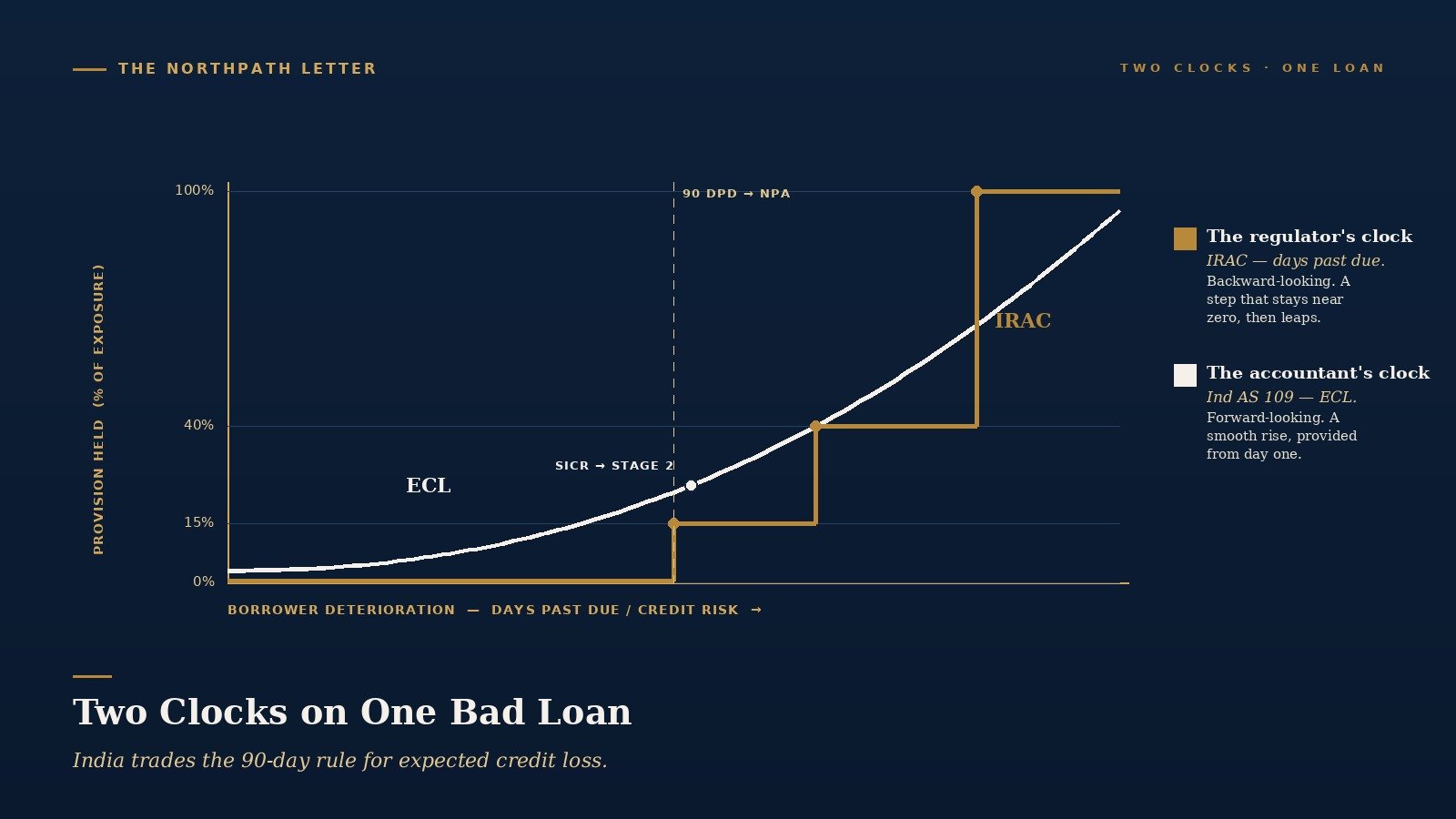
Picture a single working-capital loan to a mid-sized auto-components maker in Pune. The borrower misses a payment. Three months pass with nothing. Now look at how two different lenders, both holding an identical slice of that exposure, will write it down in their books.
A scheduled commercial bank does something almost mechanical. It counts the days. At ninety days overdue the loan becomes a non-performing asset, drops into the “sub-standard” bucket, and attracts a provision of fifteen per cent of the outstanding amount. The number is not a judgement. It is a lookup.
A large non-banking financial company holding the same paper does something quite different. It asks a forward-looking question — what fraction of this exposure do we now expect to lose over its remaining life, weighted by probability — and books a provision that might be eight per cent, or thirty, depending on collateral, recovery history, and where the analyst thinks the economy is heading. The number is not a lookup. It is a model.
Two lenders, one borrower, one delinquency, two completely different losses on the page. This is not an error or an arbitrage. It is the single most important structural fact about how credit losses are measured in India today, and most readers of an Indian financial statement have never had it explained to them. India runs two clocks on every bad loan: the regulator’s days-past-due clock, and the accountant’s expected-loss clock. Knowing which clock you are reading — and how the two are bolted together — is the difference between understanding an Indian lender’s balance sheet and merely looking at it.
This letter is about those two clocks, why India ended up with both, the curious decade in which its shadow banks ran ahead of its banks, and the reform that takes effect on 1 April 2027 — when the bank, having dodged the accountant’s clock for years, finally has to wind it up and let it run.
The regulator’s clock: IRAC and the tyranny of the calendar
The older clock is the regulator’s, and it is the one most people mean when they talk about “NPAs”. Its formal name is the Income Recognition, Asset Classification and Provisioning framework — IRAC, or sometimes IRACP — and it is a creature of the Reserve Bank of India, codified after the Narasimham Committee reforms of the early 1990s and refined through a Master Circular that the RBI reissues almost every year.
IRAC’s governing idea is delinquency measured in days. A loan is “standard” until the borrower falls behind. The moment a payment of interest or principal is overdue, the RBI’s early-warning taxonomy kicks in: the account becomes a Special Mention Account. SMA-0 flags an account overdue up to thirty days but already showing signs of incipient stress; SMA-1 captures overdues of thirty-one to sixty days; SMA-2, sixty-one to ninety. These are not yet bad loans. They are the yellow lights.
At ninety-one days past due the light turns red. The loan becomes a non-performing asset. From there the IRAC ladder descends through three rungs. A sub-standard asset is one that has been an NPA for up to twelve months. A doubtful asset has been an NPA for more than twelve months, and is itself sub-divided by vintage — up to one year, one to three years, and beyond three years. A loss asset is one that the bank or its auditors or the RBI inspection has identified as uncollectible, even if some token value remains on the books.
Each rung carries a prescribed provision, and the percentages are worth committing to memory because they are the arithmetic of every Indian bank’s profit-and-loss account. A standard asset carries only a thin general provision — 0.25 per cent for direct agriculture and small enterprise, 0.40 per cent for most other loans, and a punitive one per cent for commercial real estate. A sub-standard asset attracts fifteen per cent on the secured portion, with an extra ten points — twenty-five per cent in total — where the exposure is unsecured. A doubtful asset attracts one hundred per cent provisioning on the unsecured portion immediately, and on the secured portion a rising scale of twenty-five, forty, and finally one hundred per cent as the loan ages through its doubtful years. A loss asset is written down in full.
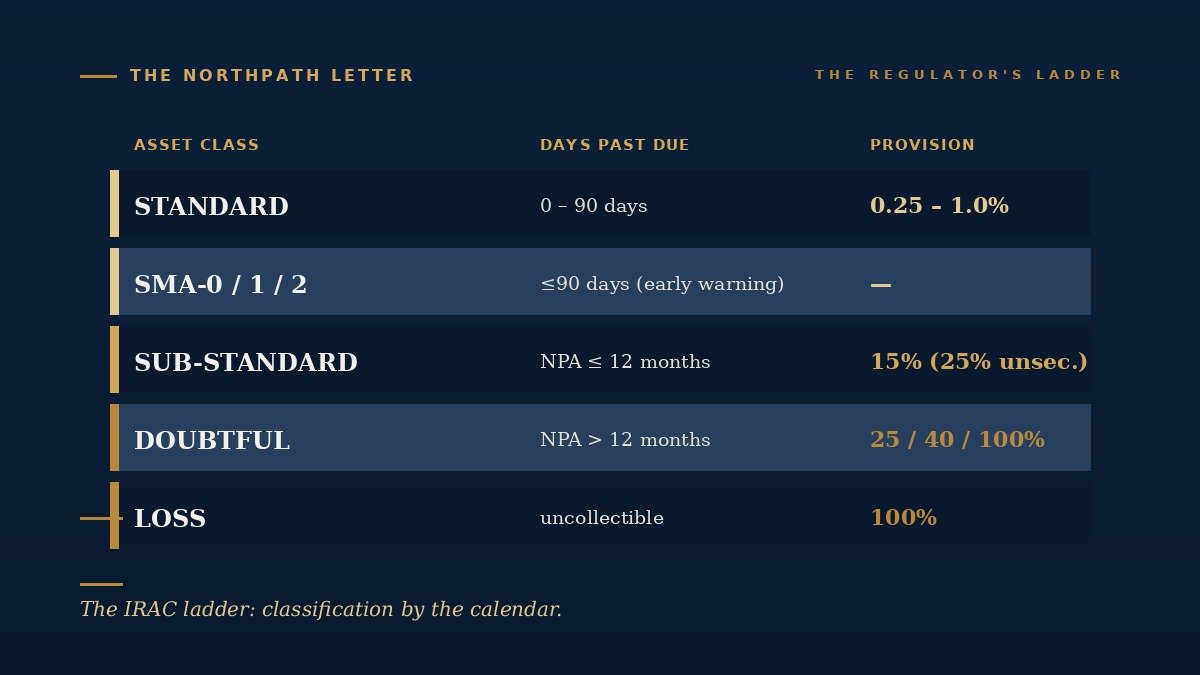
The philosophy here is worth naming, because it explains both IRAC’s durability and its limits. IRAC is rule-based, backward-looking, and uniform. It does not care what you think will happen; it cares what has already happened, measured to the day. Its great virtue is that it is auditable and almost impossible to argue with — a loan is ninety days overdue or it is not, and two honest accountants will classify it identically. Its great vice is that it is a rear-view mirror. It recognises loss only after the borrower has already stopped paying, and it recognises the same loss for a blue-chip term loan and a speculative one so long as their calendars match. The 2014–2018 asset-quality review that forced Indian banks to disclose hundreds of billions of rupees of hidden bad loans was, in essence, the RBI insisting that banks actually obey their own clock instead of “evergreening” loans to keep the calendar from advancing.
The accountant’s clock: Ind AS 109 and expected credit loss
The second clock arrived from a very different direction. After the 2008 financial crisis, the global accounting community concluded that the old model of recognising loan losses only once they had been “incurred” had let banks sit on obviously deteriorating books while reporting them as healthy. The response was IFRS 9, the international financial-instruments standard, and its centrepiece: the Expected Credit Loss model. India adopted IFRS 9 almost word-for-word as Indian Accounting Standard 109.
Where IRAC counts days, Ind AS 109 estimates the future. It requires the holder of a loan to book, from the very first day, a provision equal to the credit losses it expects — a probability-weighted estimate, not a worst case and not a best case, discounted to present value. The standard organises this into a three-stage model that is the heart of any ECL disclosure.
A loan begins life in Stage 1: performing, with no significant deterioration since it was made. Here the lender provides for twelve months of expected loss — the slice of lifetime loss that would arise from defaults in the coming year — and accrues interest on the gross carrying amount. If credit risk then increases significantly, the loan migrates to Stage 2. Note what triggers the move: not default, not even a missed payment necessarily, but a significant increase in credit risk — the famous SICR test. A Stage 2 loan is still performing, still paying, but the lender must now provide for losses expected over the entire remaining life of the exposure. The provision can leap several-fold the day a loan crosses into Stage 2, even though not a rupee is yet overdue. Finally, Stage 3 is the credit-impaired loan — broadly the accountant’s analogue of the NPA — where lifetime loss is again provided, but interest is now accrued only on the net carrying amount, after deducting the provision.
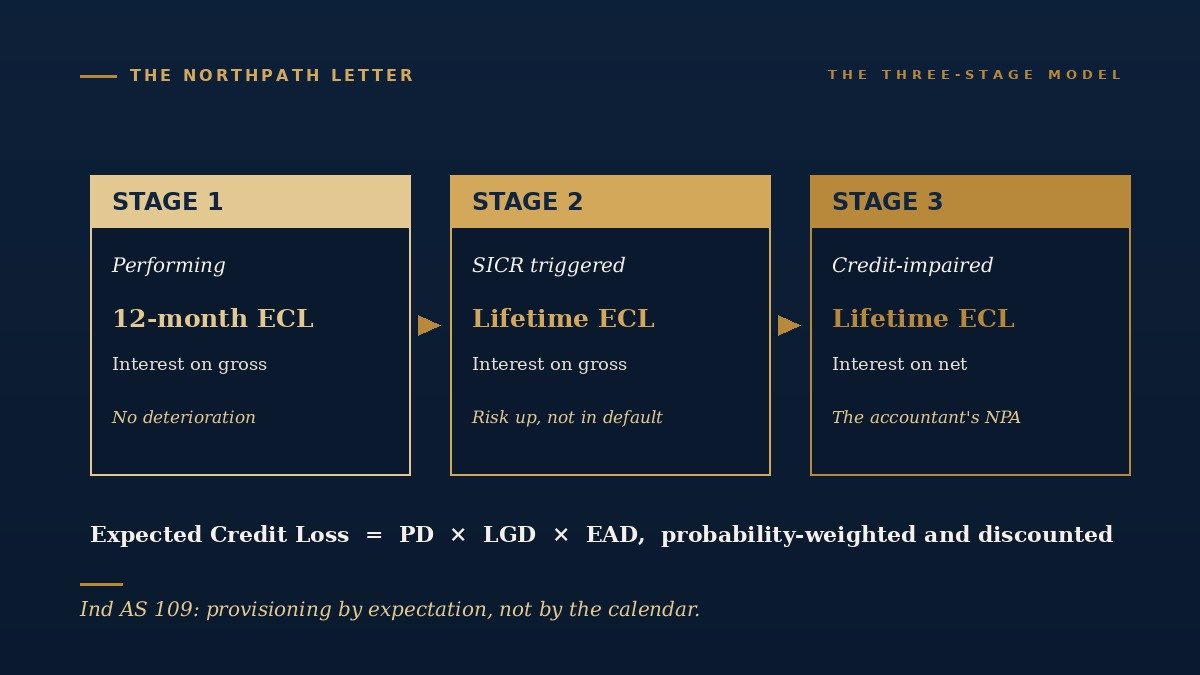
The engine underneath all this is a triplet familiar to any credit-risk modeller: probability of default, loss given default, and exposure at default. Multiply the chance the borrower defaults by the fraction you would lose if they did by the amount outstanding when they do, discount it, and you have your expected credit loss. The numbers are not handed down by a regulator; they are built by the lender from its own data, its own recovery experience, and — crucially — its own forward-looking view of the economy, since IFRS 9 demands that ECL incorporate reasonable forecasts of future conditions.
The contrast with IRAC could hardly be sharper. ECL is principle-based, forward-looking, and entity-specific. Its virtue is that it recognises trouble early, scales the provision to the actual riskiness of the loan, and forces management to put a number on its own credit judgement. Its vice is the mirror image: it is judgement-heavy, model-dependent, and — to put it plainly — gameable in ways IRAC is not. An optimistic assumption about loss-given-default, a generous reading of “significant increase”, a benign macro scenario, and the same loan can carry a far lighter provision. The discipline of ECL is real, but it is the discipline of a well-governed model, not of an unarguable calendar.
Where the two clocks already collide: the NBFC and its impairment reserve
Here is the fact that surprises most foreign readers of Indian finance: the cutting-edge, forward-looking ECL model is not yet used by India’s banks. It is used by its non-banking financial companies — the shadow lenders, the housing-finance firms, the gold-loan and consumer-finance specialists. The banks, the supposed core of the system, still run the old IRAC calendar.
The reason is a roadmap. When India phased in Ind AS, NBFCs were brought under it in two waves: those with net worth of five hundred crore rupees or more from the financial year 2018–19, and listed NBFCs together with unlisted ones above two hundred and fifty crore from 2019–20. Smaller NBFCs stay on the older Indian GAAP, and — a detail that often catches people out — voluntary early adoption is not permitted. Banks, by contrast, had their Ind AS transition deferred by the RBI, repeatedly and indefinitely, on the grounds that the legal and prudential groundwork was not ready. So a large NBFC reports under Ind AS 109 and computes ECL; a bank reports under the older standards and computes IRAC. Same country, same borrowers, two different clocks — sorted not by who is riskier but by what kind of licence the lender holds.
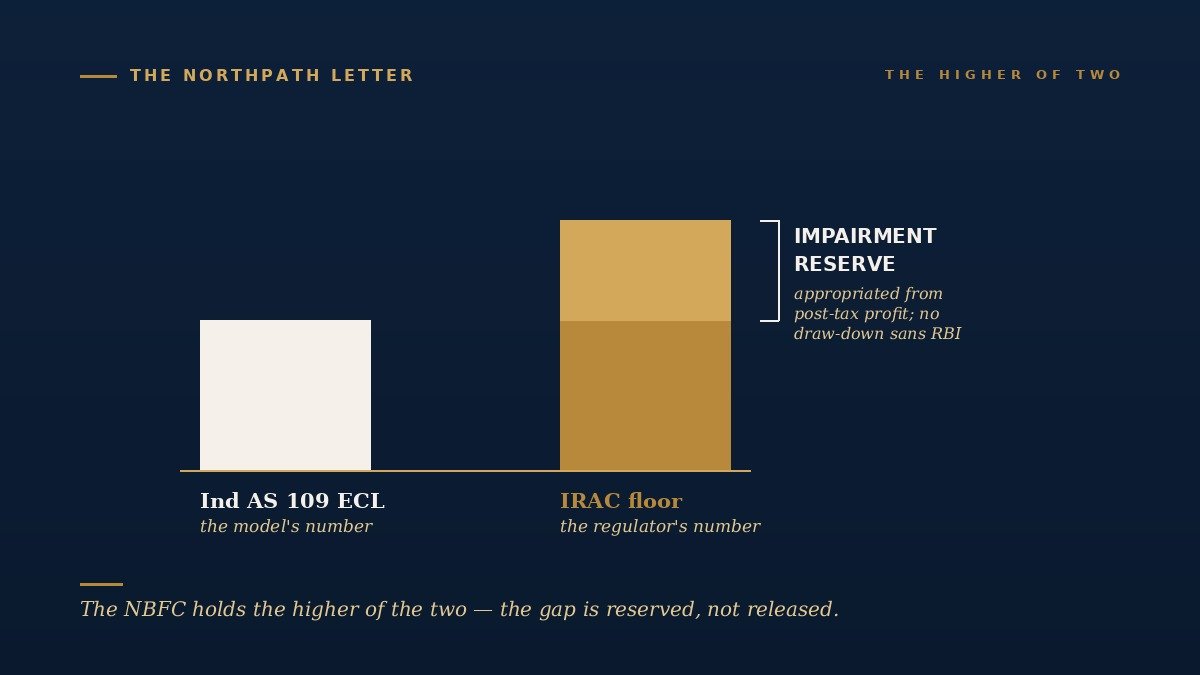
But the RBI is a prudential regulator, and it was not prepared to let an NBFC’s own model set the floor on its provisions. So in a circular dated 13 March 2020 — “Implementation of Indian Accounting Standards” — it built the bridge that every reader of an NBFC balance sheet must understand. An Ind AS-compliant NBFC must compute both numbers: the expected credit loss under Ind AS 109, and the provision it would have held under IRAC. It then holds the higher of the two. Where the accountant’s ECL comes out lower than the regulator’s IRAC floor, the NBFC must appropriate the shortfall — out of post-tax profits — into a separate line on the balance sheet called the Impairment Reserve. And it may not draw that reserve back down without the RBI’s express approval.
This single mechanism is the most elegant expression of the two-clock system. The profit-and-loss account runs on the accountant’s clock — ECL drives the impairment charge that hits earnings. But the balance sheet is floored by the regulator’s clock — the Impairment Reserve quietly tops up the cushion whenever the model is gentler than the calendar. When you read an Ind AS-compliant NBFC’s accounts, the Impairment Reserve line is one of the most informative numbers in the document: a large or growing reserve tells you the firm’s own ECL model is consistently coming out below what the old rulebook would have demanded — which is either a sign of genuinely better risk selection, or a hint that the model is leaning optimistic. Either way, the regulator has made sure the question is asked on the face of the accounts.
Why the bank was exempt — and what changes on 1 April 2027
For a decade this asymmetry sat uneasily. It is genuinely strange for a financial system to run its most sophisticated loss-measurement model in its less-regulated sector while its banks rely on a days-past-due rule designed in the 1990s. The RBI knew it, floated a discussion paper on moving banks to ECL back in 2023, and collected industry comment. The reform has now landed.
On 7 October 2025 the RBI issued draft directions to migrate scheduled commercial banks to an expected-credit-loss framework, and in April 2026 it finalised them. The new regime takes effect on 1 April 2027. From that date, scheduled commercial banks — though not, for now, regional rural banks, small finance banks, or payments banks — must estimate expected credit loss across their financial assets using the same machinery the NBFCs already use: probability of default, loss given default, exposure at default, and the three-stage staging model with its significant-increase-in-credit-risk trigger.
Three features of the Indian design deserve attention, because they show a regulator determined not to surrender its clock entirely even as it adopts the accountant’s.
First, the RBI is retaining the existing NPA classification norms. The ninety-day rule does not die. Loans will still be classified as non-performing on the old days-past-due basis for regulatory purposes; what changes is the provisioning arithmetic that sits on top of that classification. Both clocks keep running — the calendar still tells you when a loan is “bad”, the model now tells you how much to set aside.
Second, the framework comes with calibrated prudential floors under each of the three stages. Just as the NBFC’s Impairment Reserve prevents the model from undercutting the regulator, the bank’s ECL will be subject to stage-wise minimum provisions so that an optimistic model cannot drive the cushion below a regulatory backstop. Indian banks, predictably, have already begun lobbying the RBI for a lower Stage-2 floor, which tells you exactly where the contested money is — in the lifetime-loss provisions on loans that are deteriorating but not yet in default.
Third, the RBI has built in a long, deliberate glide path. Banks have until 31 March 2031 to fully absorb the additional provisioning on their existing book, with the day-one capital hit spread through transitional add-backs to Common Equity Tier 1 over roughly five years. The rating agencies that have studied the draft — ICRA and CARE among them — concluded that the system-wide capital impact will be manageable precisely because of this phasing. This is a regulator that has watched IFRS 9’s abrupt 2018 arrival in Europe and decided to introduce the same idea in slow motion.
The international mirror
It helps to place India on the global map, because the two-clock problem is not uniquely Indian — India is simply resolving it late, and in its own sequence.
The rest of the world made this transition years ago. Banks in the United Kingdom and the European Union moved to IFRS 9’s three-stage ECL model on 1 January 2018; the UK Annual Report and the EU bank disclosure a global reader is used to reading have carried Stage 1 / Stage 2 / Stage 3 tables for the better part of a decade. The United States went further still. Under its CECL standard — Current Expected Credit Loss, effective for large filers from 2020 — American banks must book lifetime expected loss on every loan from the day it is originated, with no Stage 1 twelve-month grace and no staging at all. CECL is, in a sense, the most conservative version of the idea: the whole expected loss, up front, always.
Seen against that backdrop, India’s Ind AS 109 is a faithful copy of IFRS 9, which means its banks — once 2027 arrives — will report on broadly the same basis as their British and European peers, one notch less front-loaded than the Americans. What remains distinctively Indian is the overlay: the retained NPA calendar, the stage-wise regulatory floors, and, for the NBFCs, the Impairment Reserve. Other systems largely chose one clock. India, characteristically, kept both and engineered the gearing between them.
How to read it
For the practitioner, the two-clock system resolves into a short set of habits.
When you read an NBFC today, go straight to the credit-loss note and find three things. First, the headline ECL provision as a percentage of gross loans, and how it splits across Stages 1, 2 and 3 — the share sitting in Stage 2 is your early-warning gauge, because it captures loans that are deteriorating before they default. Second, the stage migration year on year: loans sliding from Stage 1 into Stage 2 are the story the income statement will tell next year. Third, the Impairment Reserve line and its movement. A reserve that keeps growing means the firm’s own model is persistently softer than the IRAC floor — note it, and ask why.
When you read a bank, you are reading IRAC for now: the gross and net NPA ratios, the provision coverage ratio, and the slippage from standard to NPA. But from the 2026–27 reporting year onward, watch the transition disclosures. The numbers to track will be the day-one ECL uplift on adoption, the size of the Stage-2 book the bank chooses to recognise, and how close its modelled provisions sit to the regulatory floors. A bank that books a thin Stage-2 provision and hugs the floor is telling you something about its risk appetite — and about how much discretion it intends to take with its new clock.
And whichever lender you are reading, hold the central distinction in your head. A provision built on the calendar tells you what has already gone wrong. A provision built on the model tells you what management expects to go wrong. The first is harder to argue with; the second is more honest when it is done well and more dangerous when it is not. The skill of reading an Indian lender, for the next several years, is knowing which clock produced the number in front of you — and, increasingly, learning to read both at once.
The one-line takeaway: In India a loan loss is never a single number — it is the higher of what the calendar says has already happened and what the model says is coming, and from 1 April 2027 even the banks must keep both clocks wound.
Important. This letter is journalism and education for a general audience. Nothing in it constitutes investment advice or a recommendation in respect of any specific financial instrument, nor an offer or solicitation to buy or sell any security. Companies and sectors are named only as historical and descriptive illustration, and the author holds no position in any security mentioned. Readers should consult an authorised financial adviser regulated in their own jurisdiction before making any investment decision.