Afternoon Edition — Mental Models
Most investors are taught to forecast. They build a model, feed it their best guess for revenue growth, margins and the discount rate, and turn the crank to produce a single number: a price, a return, a verdict. The number feels like knowledge. It is, in fact, one arbitrary path drawn from a fog of thousands. The Monte Carlo method is the discipline of refusing the single path. Instead of asking a model to tell you the one thing that will happen, it asks chance to play the future out again and again, and then reads the shape of everything that did. It is the difference between a point and a distribution — and for anyone whose capital must survive the path, not merely the average, that difference is the whole game.
The model: a card game, a coma, and a bomb
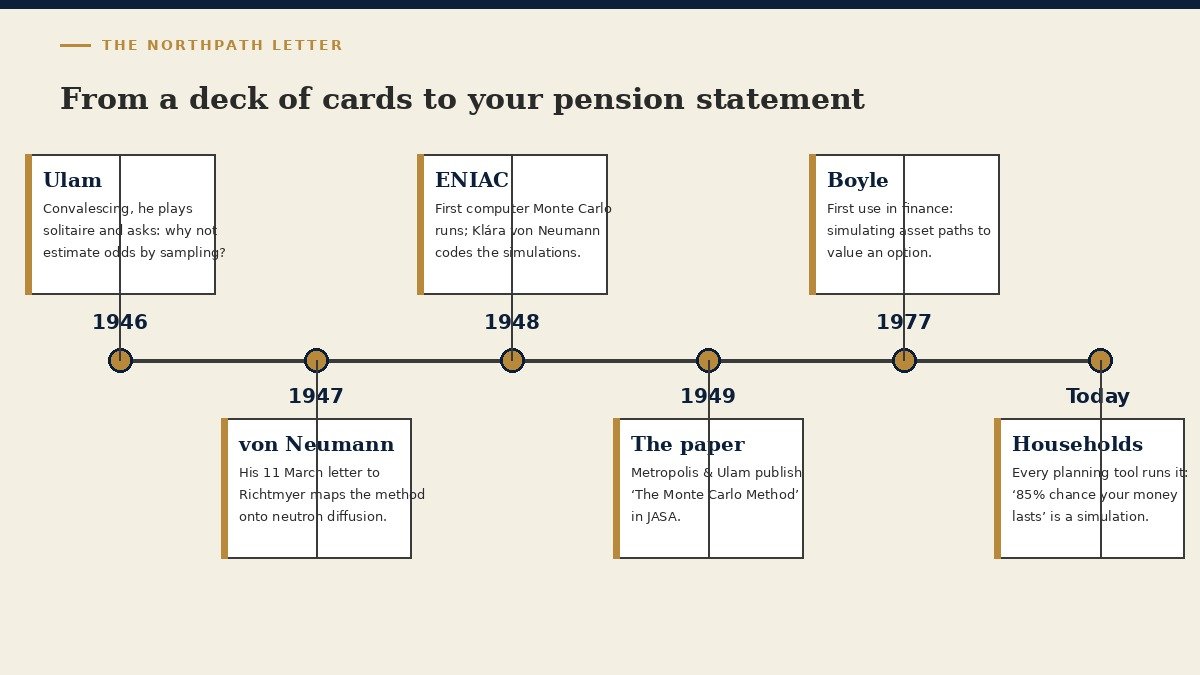
The method was born not at a blackboard but at a sickbed. In 1946 the mathematician Stanisław Ulam, recovering at home from a near-fatal bout of encephalitis that had briefly left him unable to speak, passed the convalescent hours playing solitaire. Idly, he wondered what the chances were of laying out a game of Canfield patience that could actually be won. He began to compute it the orthodox way, through pure combinatorial analysis, and quickly found the arithmetic hopeless. Then a different thought occurred to him. Rather than calculate the probability, why not simply deal a great many hands at random, count how many came out, and read the answer off the tally? As Ulam later recounted in his memoir Adventures of a Mathematician (Scribner, 1976), this “more practical method” of estimating a quantity by repeated random trials was the seed of everything that followed.
Ulam took the idea to John von Neumann, and the two realised at once that the same trick fitted a far more urgent problem. At Los Alamos the question of how neutrons scatter, multiply and diffuse through fissile material was analytically intractable, yet it was exactly the kind of branching, probabilistic process that random sampling could imitate. Von Neumann set out the scheme in a now-famous letter to Robert Richtmyer dated 11 March 1947, proposing a statistical approach to neutron diffusion that a computer could execute. The work was secret, and so it needed a code name. Their colleague Nicholas Metropolis, recalling that Ulam had an uncle who would borrow money because he “just had to go to Monte Carlo,” proposed the name of the Mediterranean casino town. The label stuck, and the method has carried the gambler’s address ever since (Metropolis, “The Beginning of the Monte Carlo Method,” Los Alamos Science, Special Issue, 1987).
The technique was first set before the wider scientific world in a short, dense paper: Nicholas Metropolis and Stanisław Ulam, “The Monte Carlo Method,” Journal of the American Statistical Association, vol. 44, no. 247, pp. 335–341 (1949). The authors described it as “a statistical approach to the study of differential equations, or more generally, of integro-differential equations that occur in various branches of the natural sciences” — a deliberately modest framing for a tool that would go on to reshape physics, engineering, biology and, eventually, finance.
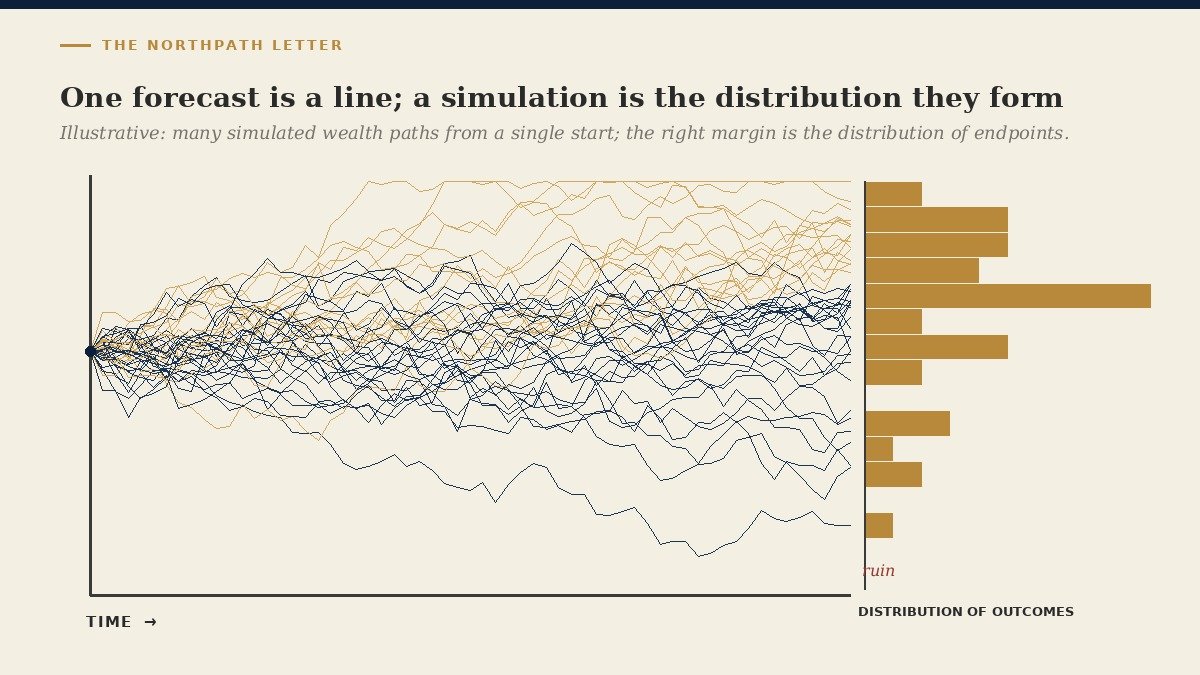
The one-sentence form is this: when a problem is too tangled to solve with a formula, you can still learn its answer by letting chance play it out a great many times and reading the distribution of what happens. You replace the search for an exact solution with the patient accumulation of random trials, and you trust the law of averages to converge on the truth. The output is never a single number handed down with false authority. It is a histogram — a full map of the possible, with the likely and the catastrophic both visible at once.
The mechanism: why throwing darts can compute the unknowable
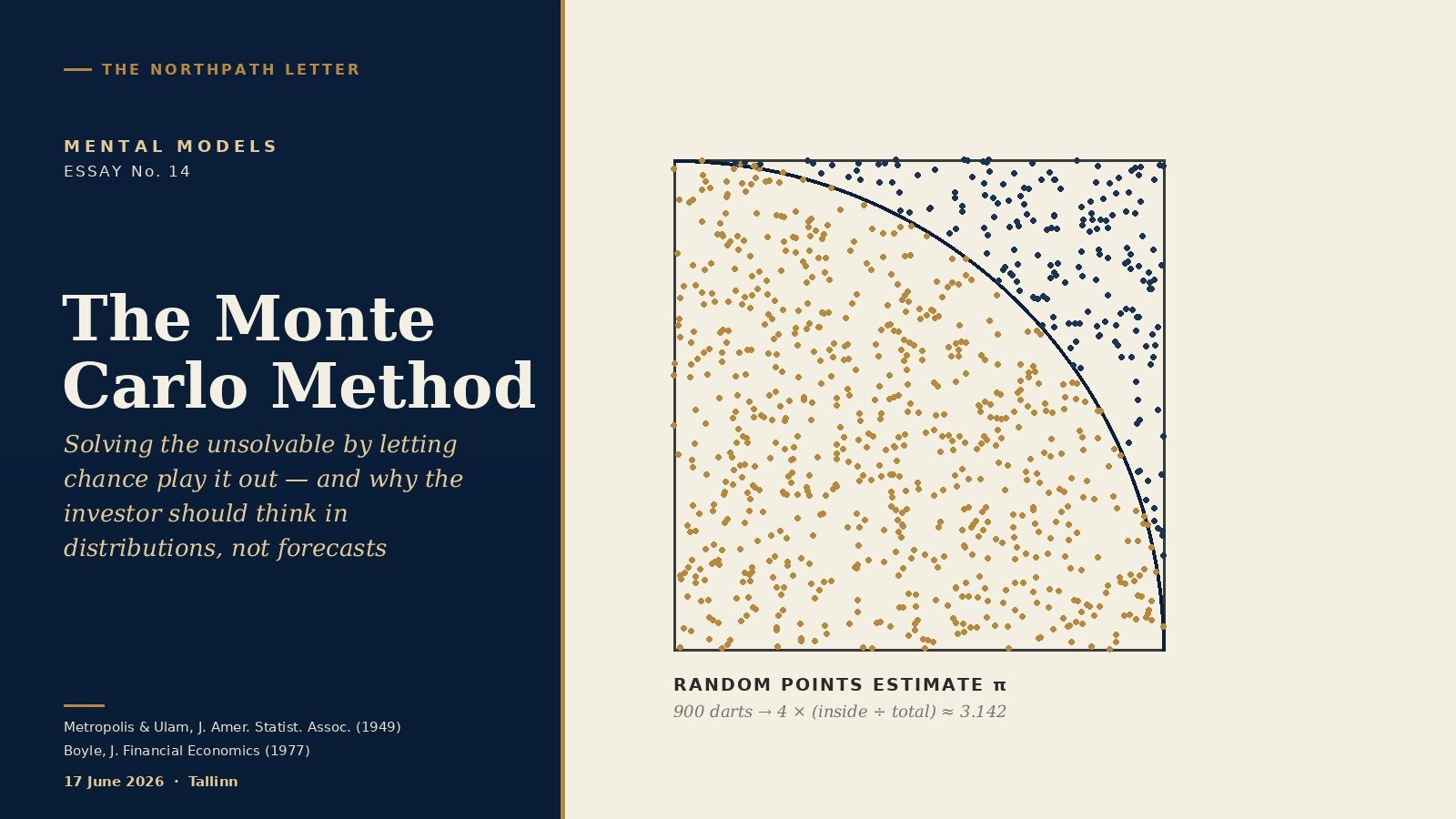
The engine beneath the method is one of the oldest results in probability: the law of large numbers, which guarantees that the average of many independent random trials converges on the true expected value as the number of trials grows. Monte Carlo turns that guarantee into a computational tool. To see how, take the simplest illustration. Suppose you want the area of an irregular blob and have no formula for it. Draw a square of known area around the blob and scatter thousands of points at random inside the square. The fraction that land inside the blob, multiplied by the square’s area, estimates the blob’s area. The same trick estimates the number π: scatter random points in a square enclosing a quarter-circle, and the proportion falling inside the arc approaches π divided by four. No calculus is required. You have computed an exact mathematical quantity by throwing darts and counting.
What makes this more than a parlour trick is that the same procedure scales to problems no formula can touch. A retirement plan depends on the joint behaviour of returns, inflation, spending and longevity over thirty years, compounding in ways that defy a closed-form answer. A derivative’s value may depend on the entire path of an asset price, not just its endpoint. In each case the analyst specifies the rules of the random process — the probability distribution of each input and how the inputs interact — and then lets the computer “play the game” thousands or millions of times. Each run produces one possible history; the ensemble of runs produces a distribution of outcomes. From that distribution one can read not only the average result but the spread, the tails, and the single quantity that matters most to a long-term investor: the probability of ruin.
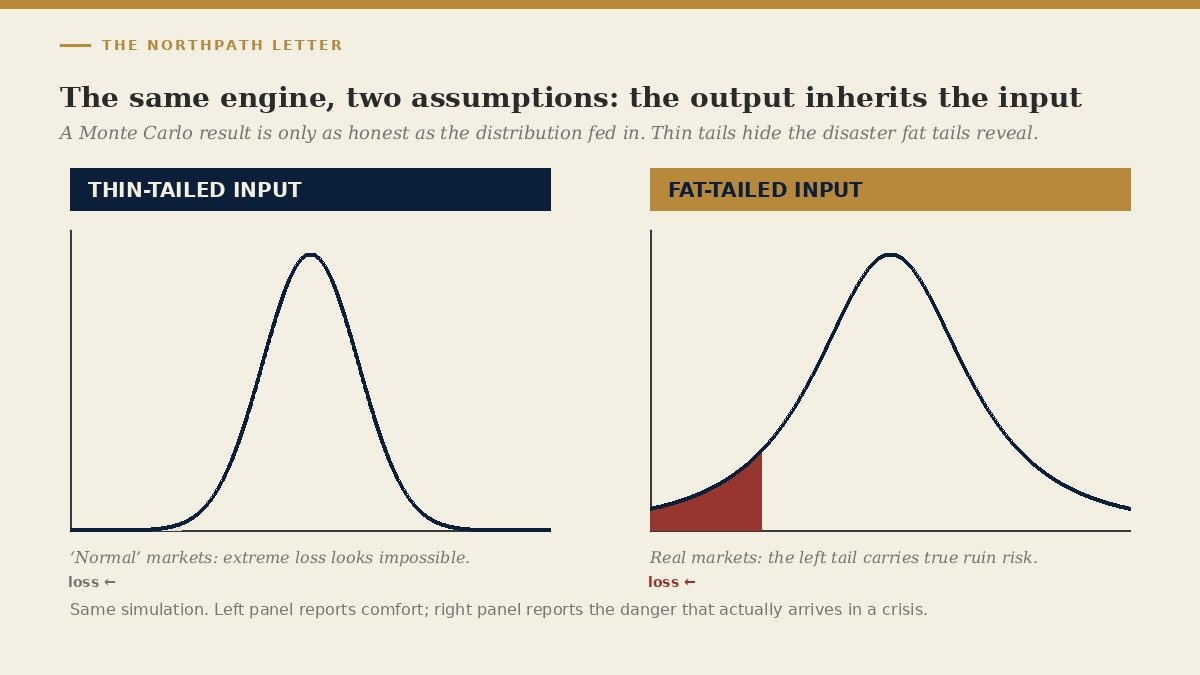
Two features of the method deserve emphasis, because both carry directly into investing. The first is that Monte Carlo accuracy improves with the square root of the number of trials. Quadrupling the simulations roughly halves the sampling error. This is slow, but it is reliable and, crucially, it does not get worse as the problem gains dimensions — which is why the method dominates precisely the high-dimensional, many-variable problems where formula-based approaches collapse. The second, and more important, feature is that the output is only ever as faithful as the assumptions fed in. Monte Carlo does not discover the distribution of the future; it propagates the distribution you give it. Hand it thin-tailed, mild, independent inputs and it will return a reassuring, mild distribution of outcomes — however wild the real world turns out to be. The method is a magnifying glass on your assumptions, not a crystal ball, and the discipline lies entirely in the realism of what you assume.
The empirical record: from the bomb to your pension
The method’s first real test was the most consequential calculation of the age. In April and May of 1948 a team including von Neumann, his wife Klára — who wrote the code, an act of programming that was itself pioneering — and Metropolis ran the first computerised Monte Carlo simulations on the ENIAC, modelling neutron chain reactions for the design of fission and, later, thermonuclear weapons (Haigh, Priestley & Rope, “Los Alamos Bets on ENIAC: Nuclear Monte Carlo Simulations, 1947–1948,” IEEE Annals of the History of Computing, 2014). These were not only the first computer Monte Carlo runs in history; they were among the first programs ever executed in the modern stored-program style. A method conceived over a deck of cards had, within two years, become the computational backbone of the nuclear age.
Its migration into finance came three decades later and is precisely datable. In 1977 the actuary and financial economist Phelim Boyle published “Options: A Monte Carlo Approach” in the Journal of Financial Economics (vol. 4, no. 3, pp. 323–338), the first use of simulation to value a derivative. Boyle’s insight was that if you cannot solve the option’s pricing equation directly, you can simulate thousands of random paths for the underlying asset, value the option on each path, and average the results. The technique is now embedded in the risk systems of every major bank and is the standard tool for pricing the path-dependent and multi-asset instruments that have no tidy formula.
From there it spread to the household. Monte Carlo analysis is today used by virtually every financial-planning software application in existence; when a retirement planner tells a client there is “an 85 percent chance your money lasts,” that number is the output of a Monte Carlo engine running hundreds or thousands of simulated retirements (Kitces, “Why Monte Carlo Analysis Understates Tail Risk,” kitces.com). The convention that a plan should clear an 85-to-95 percent simulated success rate has become an industry default. The empirical record is therefore double-edged, and honestly told it must be. The method is ubiquitous and genuinely powerful — and its very smoothness can lull. Because most planning engines draw returns from mild, well-behaved distributions, they can quietly understate the fat-tailed, sequence-dependent risk that does the real damage in a market crisis. The tool is only as honest as its inputs, a lesson the next two episodes drive home from opposite directions.
Two episodes the model explains
The first episode is the triumph already begun above. By the late 1940s, physicists at Los Alamos faced a problem they could not solve with pen and paper: how a population of neutrons would behave inside a mass of fissile material, where each particle might scatter, be absorbed, or trigger further fissions in a vast branching tree of possibilities. The geometry and the probabilities together defeated analytic solution. Monte Carlo dissolved the impasse by simulating the random life of individual neutrons — one at a time, thousands over — and aggregating their fates into the statistical behaviour of the whole. The simulation succeeded because the modellers genuinely understood the physics: the probability of each event was grounded in measured nuclear cross-sections, not guessed. When the input distributions are faithful to the real process, Monte Carlo is extraordinarily reliable. The atomic programme is the proof of concept that has underwritten the method’s authority ever since.
The second episode is the cautionary mirror image, and it is financial. Long-Term Capital Management, the hedge fund founded in 1994 and staffed with Nobel laureates and elite traders, ran some of the most sophisticated risk models then in existence, including Monte Carlo and value-at-risk engines calibrated on recent market history. Those models told the partners that catastrophic loss was almost unimaginable. The trouble lay not in the simulation but in what it was fed. The fund’s models assumed that the correlations among its many positions, which had run below ten percent over the prior five years, might rise at most to about thirty percent in stress. When Russia defaulted in August 1998 and markets convulsed, correlations across the fund’s supposedly diversified book surged toward seventy percent, and return distributions that the models treated as roughly normal revealed kurtosis far above the Gaussian assumption — fat tails that made “impossible” moves merely rare. The fund lost some forty-four percent of its capital in a single month and required an orchestrated rescue to prevent wider damage (Lowenstein, When Genius Failed: The Rise and Fall of Long-Term Capital Management, Random House, 2000). The simulations had run flawlessly. They had simply simulated the wrong world. Garbage in, gospel out.
Set side by side, the two episodes teach a single lesson with unusual clarity. The same method that computed the behaviour of the atomic bomb also blessed the positions that nearly broke a corner of the financial system. The difference was not the algorithm. It was the fidelity of the input distributions — measured nuclear physics in one case, optimistically thin-tailed market assumptions in the other. Monte Carlo is a faithful servant of whatever picture of the world it is handed, and it will defend a foolish assumption with the same untiring diligence it brings to a wise one.
Application: three operating disciplines
The first discipline is to think in distributions rather than point forecasts. The instinctive question — “what is this worth?” — invites a single answer that conceals its own fragility. The better practice is to replace each key assumption with a range and its likelihoods, and to ask what spread of outcomes results. A long-term equity investor who runs a business through a band of plausible growth rates, margins and exit conditions learns something a single base-case number can never reveal: how much of the upside depends on everything going right, and how wide the gap is between the median outcome and the bad one. The decision then rests not on a forecast but on the shape of the whole distribution — and a position that looks attractive at the median but ugly in the left tail is exposed for what it is.
The second discipline is to stress the inputs before you trust the output. Because a Monte Carlo result is wholly a function of its assumptions, the analytical work belongs in the assumptions, not the arithmetic. Widen the tails beyond what recent calm suggests; raise the correlations to what they become in a crisis, not what they average in good times; and never confuse a smooth simulated distribution with a benign reality. The most dangerous output is the one that has been quietly fed mild, independent, normally distributed inputs, because it will return exactly the comforting picture that LTCM’s models returned in 1998. A useful habit is to deliberately model the bad state — to ask what the simulation says when everything that can correlate, does.
The third discipline is to simulate for survival, not for the average. The single most valuable number a Monte Carlo run can yield is the probability of permanent, unrecoverable loss — the share of paths in which capital is impaired beyond return. A strategy with a dazzling median outcome and a small but real chance of ruin is, over a long enough horizon, a losing strategy, because the ruined paths end the game and the survivor cannot average his way back from zero. This is the distinction between the time-average fate of a single investor living one path and the ensemble average across many. The discipline that follows is to refuse strategies whose simulated distribution contains a non-trivial probability of ruin, however high the mean, and to size every position so that no plausible draw from the distribution can end the journey.
How the long-term equity tradition has used it
Howard Marks, the co-founder of Oaktree Capital, has built much of his investment philosophy on the mental model that underlies Monte Carlo, even when he does not run a single simulation. In his memo “You Can’t Predict. You Can Prepare.” (Oaktree Capital, November 2001) and again in his memo “Risk” (2006), Marks argues that “the future should be viewed not as a fixed outcome that’s destined to happen and capable of being predicted, but as a range of possibilities and … as a probability distribution.” His maxim that “risk means more things can happen than will happen” is, in plain terms, the Monte Carlo intuition: at any moment many histories were possible, only one occurred, and judging a decision by the single history that happened to unfold confuses luck with skill. Marks’s practical counsel — that you cannot prepare simultaneously for every tail, but you can position to survive a wide middle band of the distribution — is precisely how a disciplined investor reads a simulation’s output.
Nassim Nicholas Taleb makes the connection explicit and operational. In Fooled by Randomness (Texere, 2001) he describes building a “Monte Carlo engine” to generate thousands of alternative histories of a market or a career, the better to see how much of any given track record is skill and how much is the residue of luck. His famous thought experiment — ten thousand fictional managers, each with a fair-coin chance of gaining or losing each year — shows how, by chance alone, a handful will compile spotless records that look like genius and are nothing of the sort. Taleb’s central warning sharpens the second discipline above: the value of a simulation hinges entirely on the realism of its generator, and an engine that assumes mild, Gaussian randomness will systematically blind its owner to the fat-tailed events that actually decide outcomes. Used honestly, the engine reveals the role of chance; used carelessly, it launders it.
The same habit of mind runs through the valuation literature that long-term investors draw on. Aswath Damodaran, the New York University finance professor whose work is a fixture in serious equity analysis, devotes a chapter of Strategic Risk Taking (Wharton School Publishing, 2007), “Probabilistic Approaches: Scenario Analysis, Decision Trees and Simulations,” to the case for replacing point estimates in a valuation with full probability distributions, arguing that simulations “provide the most complete assessments of risk” because they carry the uncertainty in every input through to a distribution of values rather than a single deceptive figure. What unites Marks, Taleb and Damodaran is not a software package but a stance: each treats the future as a distribution to be respected rather than a number to be guessed, and each insists that the honesty of the exercise lives in the assumptions, not in the apparent precision of the answer.
Key takeaways
- Monte Carlo replaces a forecast with a distribution. When a problem is too complex for a formula, repeated random trials and the law of large numbers reveal the full shape of possible outcomes (Metropolis & Ulam, 1949).
- The output inherits the inputs. The method propagates the distribution you assume; it does not discover the real one. Thin-tailed, low-correlation assumptions produce reassuring nonsense in a crisis.
- The same engine triumphed and failed. Faithful nuclear-physics inputs let Monte Carlo model the bomb on the ENIAC in 1948; optimistic market inputs let it bless the positions that cost Long-Term Capital Management 44 percent in a month in 1998.
- Simulate for survival, not the average. The most useful number a simulation yields is the probability of permanent loss; a high median with a real chance of ruin is a losing proposition over a long horizon.
- The tradition already thinks this way. Howard Marks’s “range of possibilities,” Taleb’s Monte Carlo engine and Damodaran’s distributions are the same model: treat the future as a distribution, and put the discipline in the assumptions.
— Manish Goel, FCA / NorthPath Advisory OÜ / Tallinn, Estonia
|
Important. |