The NorthPath Letter · Behavioural Finance · Afternoon Edition
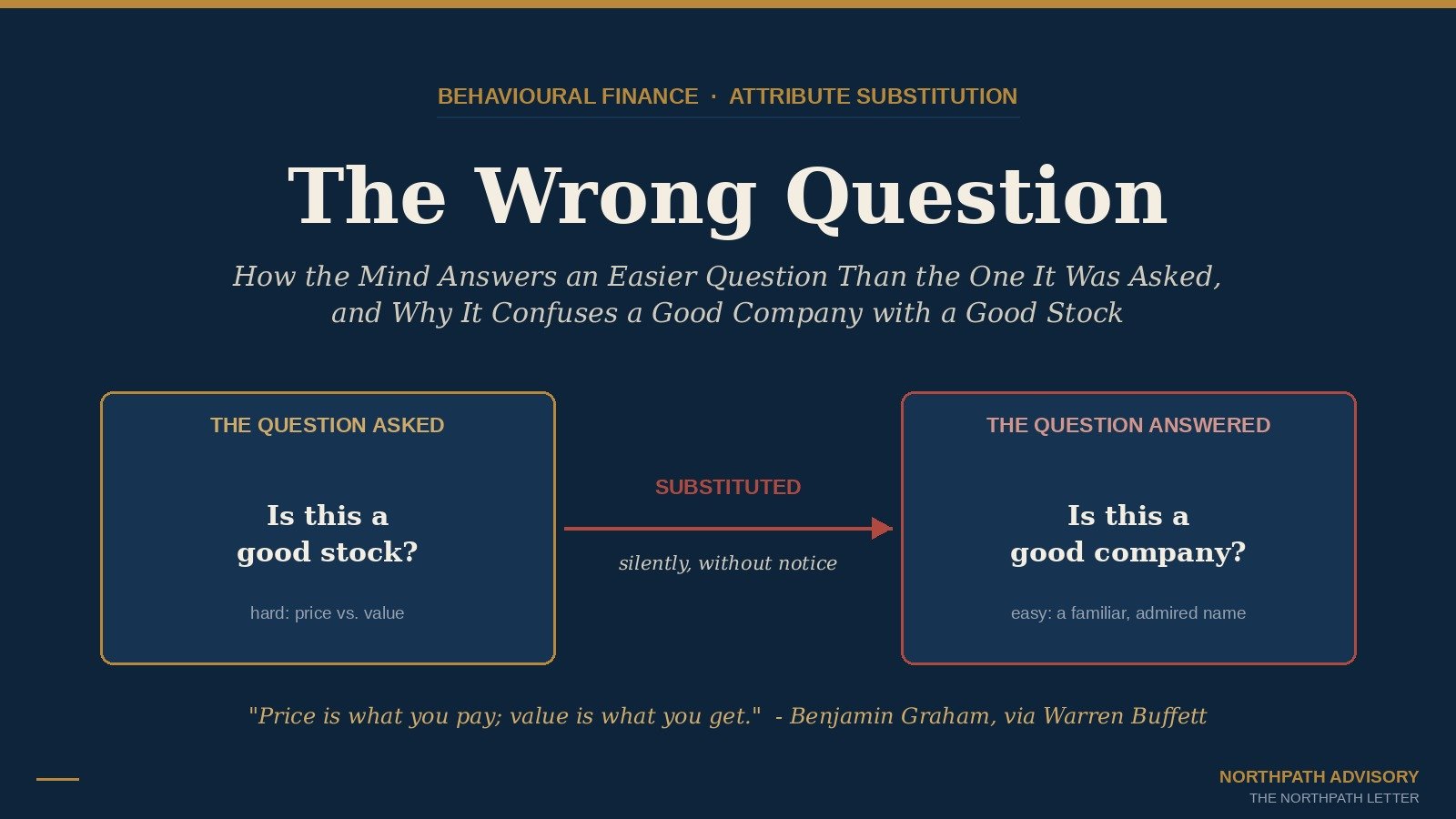
Here is a question that almost everyone answers wrongly, and answers wrongly in the same direction. A bat and a ball cost one dollar and ten cents in total. The bat costs one dollar more than the ball. How much does the ball cost? The answer that springs to mind, fluent and confident, is ten cents. It is also wrong: if the ball were ten cents the bat would be a dollar ten and the total a dollar twenty. The ball costs five cents. What is remarkable is not that people err but how they err. Faced with a problem requiring a moment of arithmetic, the mind quietly swaps it for an easier one. It does not compute “what value of the ball satisfies these two constraints?” It computes something nearer to “what is a dollar ten split into a big part and a small part?” and reports the small part. The hard question is never consciously refused. It is simply replaced, without notice, by a question the mind can answer at a glance.
That silent replacement is the subject of this letter, and it is, I will argue, the single most expensive habit of mind an investor possesses. The bat and ball is a parlour trick. The same machinery, operating on a portfolio, is what persuades intelligent people to confuse a wonderful company with a wonderful investment, a familiar name with a safe one, a thrilling story with a sound price. The error is not ignorance. It is substitution.
The bias: answering the question you were not asked
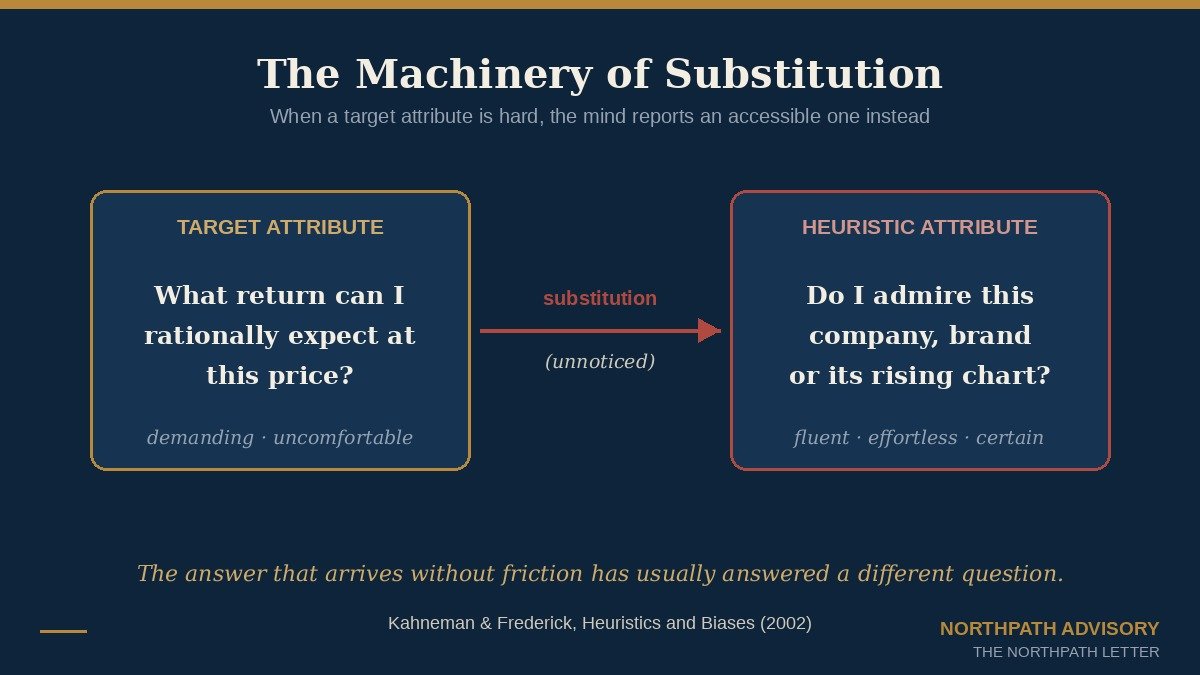
The formal name for the mechanism is attribute substitution, and its canonical statement is Daniel Kahneman and Shane Frederick’s chapter “Representativeness Revisited: Attribute Substitution in Intuitive Judgment,” published in 2002 in Heuristics and Biases: The Psychology of Intuitive Judgment, edited by Thomas Gilovich, Dale Griffin and Kahneman (Cambridge University Press, pages 49 to 81). Their thesis is precise. When a person must judge a “target attribute” that is computationally demanding, the mind often assesses instead a “heuristic attribute” that is more readily accessible, and maps its answer to the target without the substitution ever reaching awareness. The bat-and-ball item is drawn from the work that grew alongside this idea, Shane Frederick’s “Cognitive Reflection and Decision Making” in the Journal of Economic Perspectives (volume 19, 2005, pages 25 to 42), whose three deceptively simple questions measure exactly the disposition to check the intuitive answer before voicing it. Most highly educated respondents do not check, and so they substitute.
Kahneman would later give the idea its most memorable shorthand in Thinking, Fast and Slow (2011): the fast, automatic part of the mind is a machine for jumping to conclusions, and when it cannot quickly find the answer to a hard question, “System 1 will find a related question that is easier and will answer it.” The substitution is not a malfunction. It is the ordinary, efficient operation of a mind built to produce a serviceable answer rather than a correct one, and it is most dangerous precisely when the substituted answer feels effortless and certain. The sense of ease is the symptom. A judgment that arrives without friction is a judgment that should be suspected of having answered the wrong question.
For the investor the target attribute is almost always the same, and it is genuinely hard: what is this security worth relative to its price, and what return can I rationally expect from owning it from here? That question demands an estimate of future cash flows, a discount rate, a comparison with the price the market is asking, and an honest accounting of uncertainty. It is laborious and it is uncomfortable, because the answer is never clean. So the mind substitutes. It reaches for an easier attribute that lies close at hand: is this a good company? Has the price been rising? Do I admire the brand, the founder, the story? Each of these is answerable in seconds, and each is then quietly reported as if it were an answer to the question of value. The substitution feels like analysis. It is its opposite.
The mechanism: the good company and the good stock
The most consequential substitution in all of investing is the swap of “is this a good company?” for “is this a good stock?” The two questions feel like the same question. They are not even close. A company’s quality is a fact about its operations, durable, often visible, pleasant to contemplate. A stock’s merit is a fact about the relationship between that quality and the price a seller is asking for it today, and price is exactly the variable the admiring mind is most inclined to ignore. The good company is the heuristic attribute, accessible and affect-laden. The good stock is the target attribute, and it cannot be assessed without doing the arithmetic the substitution exists to avoid.
That this specific error is systematic, and not a private failing, was documented early in the behavioural-finance literature by Michael Solt and Meir Statman in “Good Companies, Bad Stocks,” published in the Journal of Portfolio Management in 1989 (volume 15, number 4, pages 39 to 44). Surveying how executives, directors and analysts ranked firms, they found that respondents rated companies as good when they were large, profitable and well regarded, and then ranked the stocks of those companies as good for the very same reasons, as though the excellence of the business automatically conferred excellence on its shares at any price. The empirical record, as the authors noted, points the other way: the characteristics that make a company admirable, high valuations and glamour, have historically been associated with lower, not higher, subsequent stock returns. The crowd had substituted the easy attribute for the hard one, en masse, and built its expectations on the answer.
The substitution is powered by what Kahneman called the law of least mental effort and by the affective halo that surrounds a familiar, successful enterprise. A firm whose products we use, whose advertisements we have absorbed, whose chief executive we have seen lionised, generates a warm and immediate impression of goodness, and that impression is the most accessible attribute in the vicinity when a judgment about its stock is demanded. The mind, presented with the difficult question of price and value, gratefully accepts the substitute the feeling offers. This is why the substitution is so resistant to correction by intelligence alone: the smarter and better-informed the investor, the richer the stock of accessible impressions available to stand in for the hard calculation, and the more convincing the wrong answer feels.
The empirical record: admiration is priced
If investors systematically substitute company quality for stock value, then the market’s most admired companies should, on average, make disappointing investments, because their admiration has already been paid for in the price. That is precisely what the data show. Deniz Anginer and Meir Statman, in work circulated from 2008 and published as “Stocks of Admired and Spurned Companies” in the Journal of Portfolio Management in 2010 (volume 36, number 3, pages 71 to 77), examined the stocks of the companies ranked most and least admired in Fortune‘s annual survey over the period from 1983 to 2007. The spurned companies, the ones nobody wanted to own, outperformed the admired ones. Moreover, increases in a company’s admiration were followed, on average, by lower subsequent returns. The affect that draws investors to a beloved name is real, and they pay for it; the very quality that makes the heuristic attribute so appealing is what has already been capitalised into a price that leaves little for the buyer.
Regulators, who see the wreckage of attribute substitution arrive in their complaints inboxes, have responded by attacking one of its commonest forms: the swap of past return for expected return. Rising prices are the easiest attribute of all, vivid, recent and requiring no analysis, and the untrained mind reads a chart that slopes upward as evidence that the stock is good. Two regulators on two continents have concluded that this substitution is dangerous enough to legislate against. In the United Kingdom, the Financial Conduct Authority’s Conduct of Business Sourcebook requires that any communication featuring an investment’s past performance carry a prominent warning that the figures refer to the past and that past performance is “not a reliable indicator of future results” (COBS 4.5A and 4.6). In the United States, the Securities and Exchange Commission’s long-standing anti-fraud guidance on sales literature, Rule 156 under the Securities Act, treats performance claims that imply future results as potentially misleading, which is why the legend “past performance does not guarantee future results” is stamped across American fund advertising. Two legal systems, independently, have written into law a single instruction: do not let the investor substitute the easy attribute of yesterday’s return for the hard attribute of tomorrow’s.
Two historical episodes
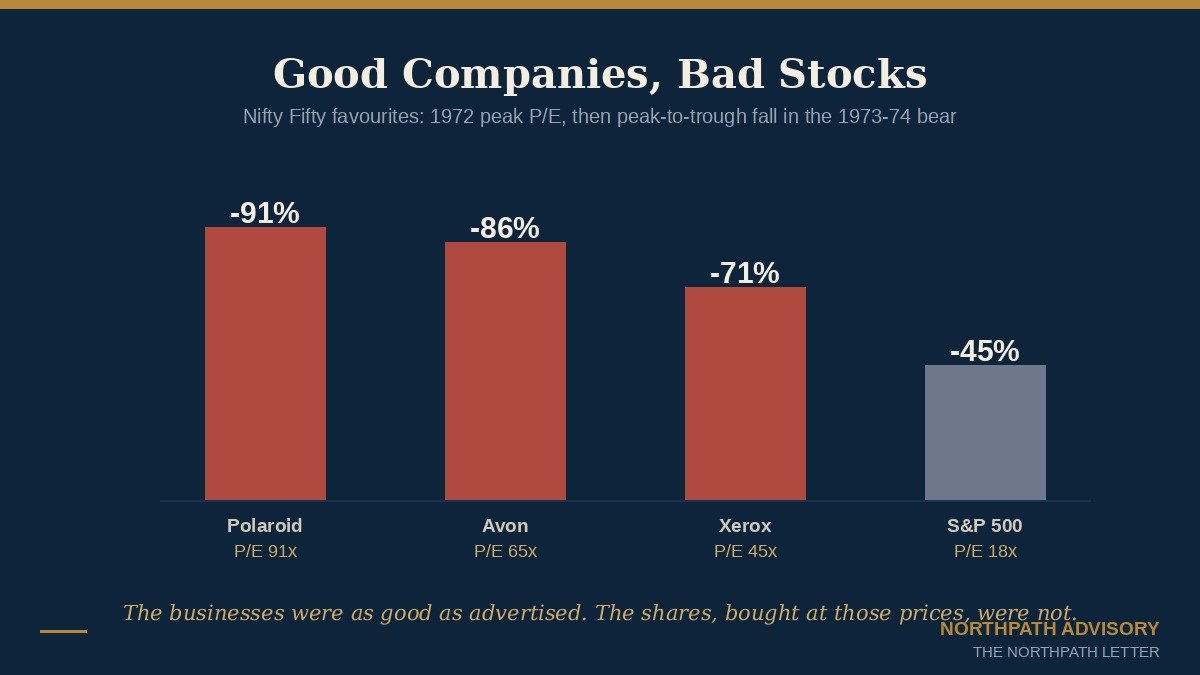
The first and cleanest demonstration is the American “Nifty Fifty” of the early 1970s. A roster of unimpeachably excellent large companies, Polaroid, Avon, Xerox, McDonald’s, Walt Disney, Coca-Cola and their peers, came to be regarded as “one-decision” stocks: businesses so good that an investor need only buy them and never sell, the question of price dismissed as a detail. Here the substitution was institutionalised. The market answered “are these good companies?” with a resounding and entirely correct yes, and treated that answer as if it settled the separate question of whether the shares were good investments at the prices being asked. By 1972 the average price-to-earnings multiple of the group had climbed above forty, against roughly eighteen for the broad market, with the most glamorous names far higher: Polaroid above ninety times earnings, McDonald’s in the mid-eighties, Disney in the low eighties, Avon around sixty-five. Then the 1973 to 1974 bear market did the arithmetic that the buyers had skipped. As the S&P 500 fell about forty-five per cent, the favourites fell further: Polaroid lost roughly ninety per cent of its value, Avon about eighty-six per cent, Xerox some seventy per cent. The companies were, for the most part, exactly as good as advertised. The stocks were a catastrophe, because excellence had been bought at a price that already assumed it.
The second episode is the same error in a digital costume. At the peak of the dot-com boom in March 2000, Cisco Systems briefly became the most valuable company in the world, its shares around eighty dollars and its market capitalisation about five hundred and fifty-five billion. The question investors were implicitly answering was “is the internet a revolutionary technology and Cisco a great company building it?” The answer was yes, and it was the wrong question. The right question, what return can be expected from paying roughly two hundred times earnings for that great company, went unasked, because its answer was unbearable and the substitute was exhilarating. Over the following two years the shares fell by around eighty per cent, to under ten dollars. And here is the detail that makes the episode definitive: Cisco the company went on to thrive, more than doubling its revenue over the next two decades. The business vindicated every admiring word. The stock, bought at that price, never returned to its peak. The good company was real; the good stock was an illusion produced by answering the easier question.
The counter-measure framework: three disciplines
Attribute substitution cannot be defeated by resolving to be smarter, because it operates beneath the level at which resolutions are made. As with most cognitive biases, the practical defence is not greater willpower but a procedure that forces the hard question back to the surface before the easy answer is acted upon.
The first discipline is to name the target attribute out loud. Before any investment decision, write down the precise question that must be answered, “what return can I rationally expect from this security at this price?”, and notice whether the reasons assembling in its favour are answers to that question or to an easier one. “It is a great business,” “the stock has done brilliantly,” “everyone I respect owns it,” and “the founder is a genius” are all answers to questions nobody needed to ask. The act of writing the real question down, and checking each supporting reason against it, is the investor’s version of pausing to verify that the ball really does cost ten cents. It almost never does.
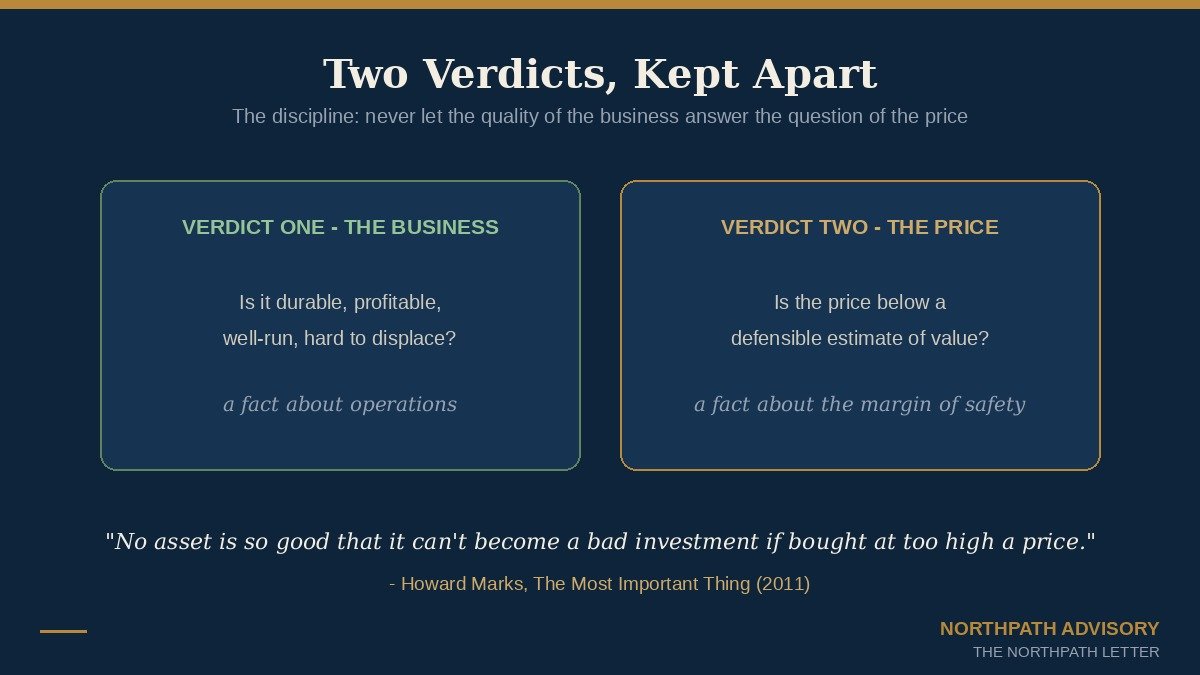
The second discipline is to separate the company from the stock on the page, physically and always. Maintain two distinct verdicts for every holding: a judgment of business quality, and a separate, explicit judgment of the price relative to a defensible estimate of value. The discipline is to forbid the first verdict from contaminating the second. A superb company at a punishing price is a poor stock; a mediocre company at a giveaway price may be a fine one. Forcing the price question to be answered on its own line, in its own words, denies the warm impression of the business its usual route into the valuation. This is the structural reason the great investors insist on a margin of safety: it is a number, and a number cannot be supplied by a feeling.
The third discipline is to interrogate fluency itself. Because the signature of substitution is the ease and confidence of the answer, the investor should treat a frictionless conviction as a warning rather than a green light. When a position feels obviously, comfortably right, that is the moment to ask which question is actually being answered, and to seek out the disconfirming case deliberately, what would have to be true for this to be a poor investment, what is already in the price, who is selling to me and why. Discomfort, in this domain, is a sign that the right question is finally being engaged. The investments that feel hardest to justify in a sentence are often the ones whose value has actually been assessed; the ones that feel effortless are often the ones where an easier question was answered in value’s place.
How long-term-equity practitioners addressed it
The greatest long-term investors are, almost by definition, those who refused the substitution and kept their attention fixed on the hard attribute of price against value. Warren Buffett has spent six decades insisting on the distinction the admiring crowd elides. “Price is what you pay; value is what you get,” he wrote to Berkshire Hathaway’s shareholders in 2008, borrowing the line from his teacher Benjamin Graham, and the whole of his record is an argument that these are two different things that the careless treat as one. Buffett’s celebrated preference for “a wonderful company at a fair price” over “a fair company at a wonderful price” is often misread as indifference to price; it is the opposite, a reminder that even a wonderful company has a fair price above which it stops being a wonderful investment. His repeated warnings, during the Nifty Fifty era and again in the late 1990s, that a sufficiently high purchase price can undo a decade of excellent business performance, are attribute substitution stated as a caution: the goodness of the company is not the answer to the question the buyer must ask.
Howard Marks of Oaktree Capital has made the same point the explicit centre of his philosophy. “No asset is so good that it can’t become a bad investment if bought at too high a price,” he writes in The Most Important Thing (2011), “and there are few assets so bad that they can’t be a good investment when bought cheap enough.” The sentence is a direct repudiation of the substitution: it severs the quality of the asset from the merit of the investment and reinserts the variable, price, that the heuristic attribute conveniently omits. Marks’s repeated insistence that successful investing is “not a matter of buying good things, but of buying things well” is, in the language of this letter, an instruction to answer the target attribute and refuse the substitute. Both men possess formidable analytical capacity, but neither attributes his record to it. They attribute it to a temperamental refusal to let the easy, admiring question stand in for the hard, quantitative one, the same refusal Kahneman’s cognitive-reflection items were built to measure.
Key takeaways
- The error is substitution, not ignorance. When the mind faces a hard question, it silently answers an easier one and reports the result with full confidence. Kahneman and Frederick (2002) named this attribute substitution; the bat-and-ball problem is its harmless demonstration and the misvalued stock its expensive one.
- “Is this a good company?” is not “is this a good stock?” Company quality is the easy, accessible attribute; price relative to value is the hard one that actually determines return. Solt and Statman (1989) showed the swap is systematic, and Anginer and Statman (2010) showed the market’s most admired companies have made, on average, the worse investments.
- Rising prices and famous names are the favourite substitutes. Regulators on two continents, the UK’s FCA and the US SEC, legislate the warning that past performance is no guide to future results precisely because investors so reliably substitute yesterday’s return for tomorrow’s expected one.
- History pays for the substitution in full. The Nifty Fifty of 1972 and Cisco in 2000 were genuinely excellent companies bought at prices that already assumed their excellence; the businesses thrived and the stocks collapsed, because the buyers had answered the wrong question.
- The defence is procedural, not heroic. Name the real question in writing, judge the company and the price on separate lines, and treat a frictionless, confident conviction as a reason for suspicion rather than action. The answer that arrives without effort is the one most likely to belong to a different question.
— Manish Goel, FCA / NorthPath Advisory OÜ / Tallinn, Estonia
|
Important. |