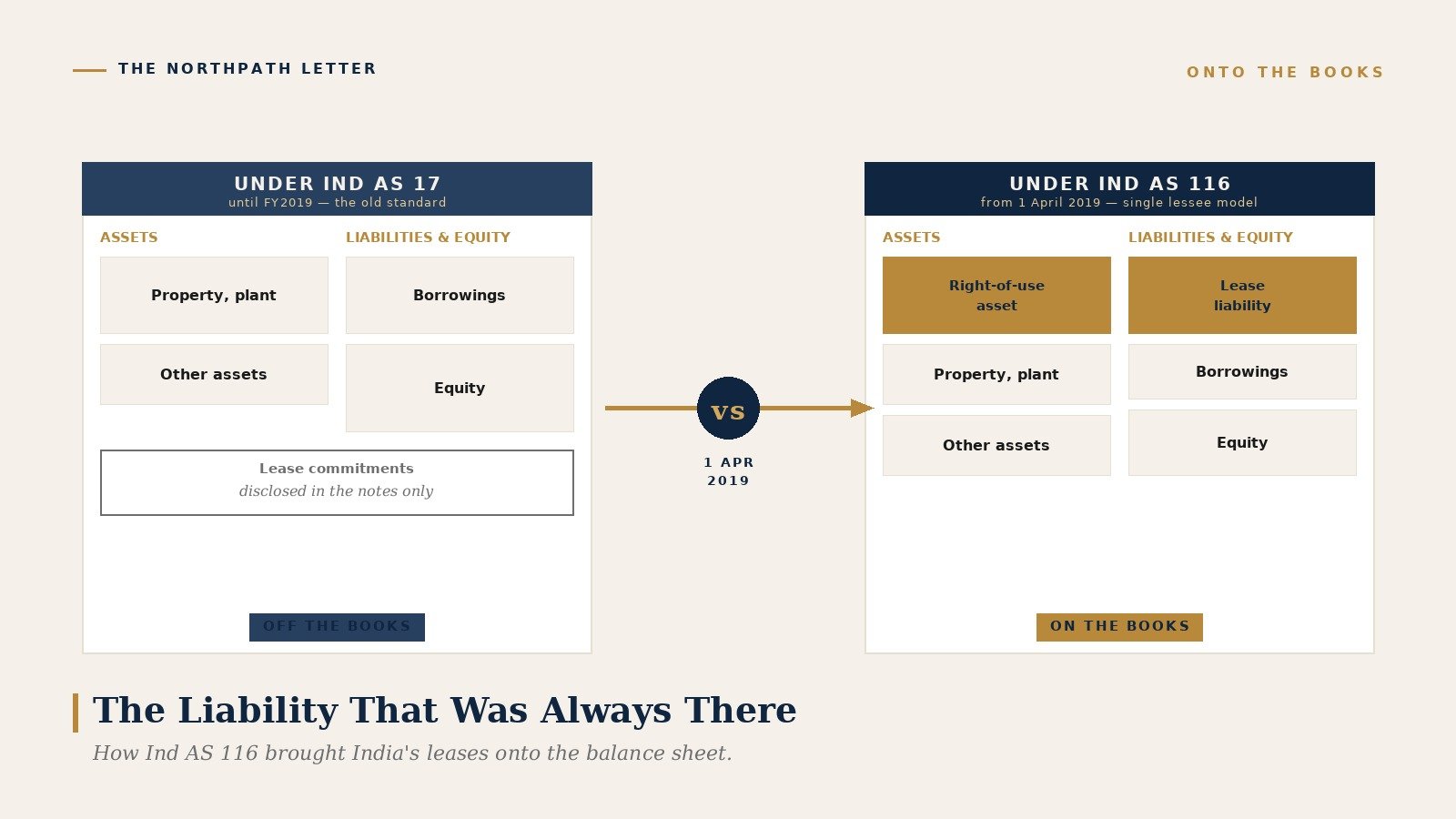
Consider two retailers, identical in every commercial respect. Both run four hundred stores. Both occupy every square foot of them under long leases. Both committed, on the day they signed, to pay rent for the next nine years whether or not a single customer walks in. The only difference between them is the year in which you read their accounts. Read them for the year ended March 2019, and one of these companies carries a modest rent line in its profit and loss account and a paragraph of lease commitments buried in note thirty-something. Read the same company a year later and it has sprouted, seemingly from nowhere, several thousand crore of new assets and a matching mountain of new liabilities. Nothing about the business changed. The leases were always there. What changed was that India’s accountants stopped pretending they were somebody else’s problem.
That change was Ind AS 116, Leases, and it is the closest thing recent Indian financial reporting has produced to a genuine optical illusion: a standard that materially altered how hundreds of companies look without altering a rupee of their cash flows. For the global investor approaching Indian equities, it is essential plumbing. You cannot compare an Indian airline to its American peer, or an Indian retailer to its own past, without understanding what this standard did, what it left untouched, and — most importantly — where it quietly diverges from the rules the rest of the world plays by. This letter is a practitioner’s guide to all three.
The standard, precisely
Ind AS 116 was notified by the Ministry of Corporate Affairs through the Companies (Indian Accounting Standards) Amendment Rules, 2019 — gazetted as G.S.R. 273(E) on 30 March 2019 — and it took effect for annual periods beginning on or after 1 April 2019. It replaced Ind AS 17, the previous leasing standard, in a single step, with no phase-in. There is a deliberate lineage here worth stating plainly: Ind AS 116 is India’s adoption of IFRS 16, the international leasing standard issued by the IASB in 2016, itself the product of a long joint project with the American standard-setter, the FASB. India did not invent a leasing philosophy; it imported the global one, with the carve-outs and local flavour I will come to. That import is the reason an Indian balance sheet today is, on the question of leases, comparable to a European one — and conspicuously not comparable to an American one.
The old world under Ind AS 17 rested on a single, consequential distinction. A lease was either a finance lease — one that transferred substantially all the risks and rewards of ownership, which went onto the balance sheet — or an operating lease, which did not. The overwhelming majority of real-world leases, by careful design, were structured to fall on the operating side of that line. An operating lease produced a tidy straight-line rent expense in the profit and loss account and nothing on the balance sheet at all. The future obligation — often the largest contractual commitment the company had — lived as a disclosure in the notes, where it could be read by the diligent and ignored by everyone else. An entire discipline of “off-balance-sheet financing” grew up around keeping leases on the right side of that line.
Ind AS 116 abolished the line, but only for the tenant. Its central idea is the single lessee model: a company that leases an asset for more than twelve months must, with narrow exceptions, recognise that lease on its balance sheet — full stop. There is no longer an operating-lease hiding place. If you have the right to use an asset and an obligation to pay for it, both the right and the obligation appear on your books.
What actually goes on the books
The mechanics are worth getting exactly right, because every downstream distortion flows from them. On the day a lease commences, the lessee recognises two new items. The first is a lease liability, measured as the present value of the future lease payments, discounted at the rate implicit in the lease or, more commonly because that rate is rarely knowable, at the lessee’s incremental borrowing rate. The second is a right-of-use asset — the “ROU asset” you will now see on the face of every affected Indian balance sheet — initially measured at broadly the same amount as the liability, adjusted for prepayments, initial direct costs and any restoration obligations.
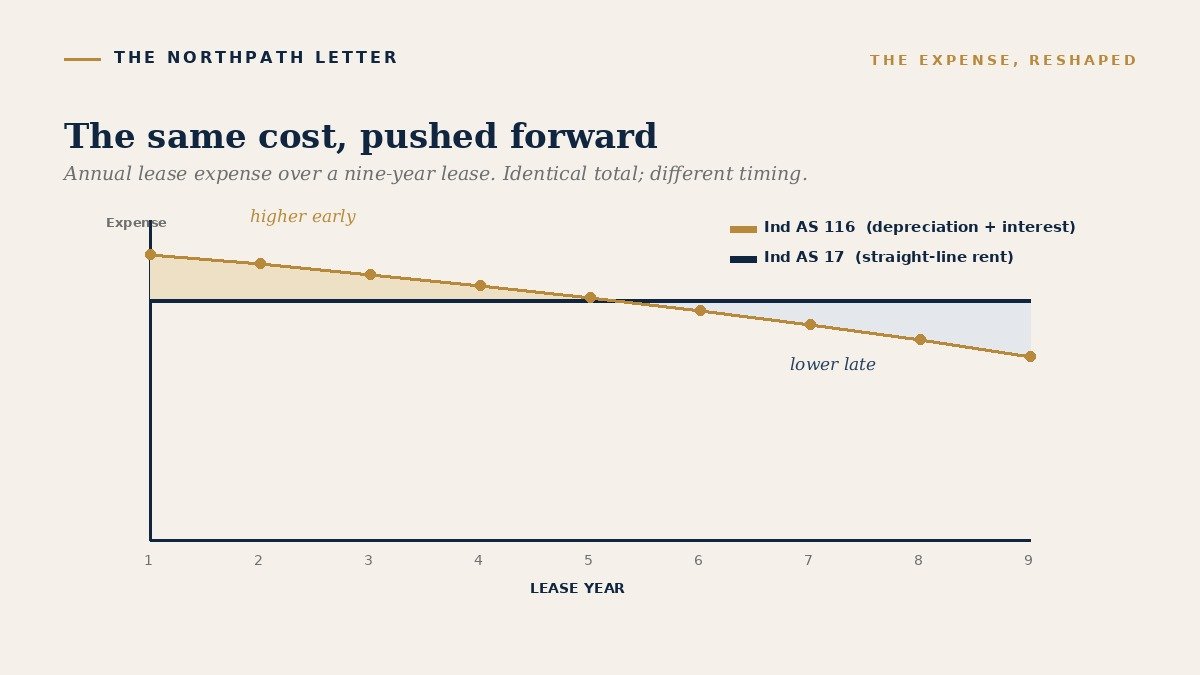
From there the two items lead separate lives, and that separation is the whole story. The right-of-use asset is treated like any other long-lived asset: it is depreciated, usually on a straight-line basis, over the lease term. The lease liability is treated like any other borrowing: it accretes interest, which unwinds as the liability is paid down, exactly as a loan’s interest is heaviest early and lightest late. The standard, in other words, takes what used to be a single, smooth rent expense and splits it into a depreciation charge and a finance charge — the same two ingredients you would find if the company had borrowed money to buy the asset outright.
Two exemptions keep the standard from becoming absurd. A company may elect not to capitalise short-term leases — those of twelve months or less with no purchase option — and leases of low-value assets, judged by reference to the asset’s value when new (the standard’s drafters had in mind items of the order of a few thousand dollars: laptops, office furniture, small equipment). For these, the old straight-line expense survives. Everything else — the store, the warehouse, the aircraft, the tower, the office floor — comes onto the books.
The shape of the new profit and loss account
Here is where readers are most often misled, so it is worth slowing down. Under the old standard, a nine-year lease produced the same rent expense every year: a flat line. Under Ind AS 116, the same lease produces depreciation that is also flat, but interest that is front-loaded — high in the early years when the liability is large, falling away as it is repaid. Add a flat line to a declining one and you get a total expense that is higher than the old rent in the lease’s early years and lower in its later years. Over the full life of the lease the total expense is identical to the rent it replaced — not a rupee more leaves the business — but its timing is pushed forward. A company that signs many new leases each year, as a fast-growing retailer does, therefore carries a permanently front-loaded cost base relative to the old world. Its early-year profits look worse, not because anything is wrong, but because the arithmetic moved the expense forward.
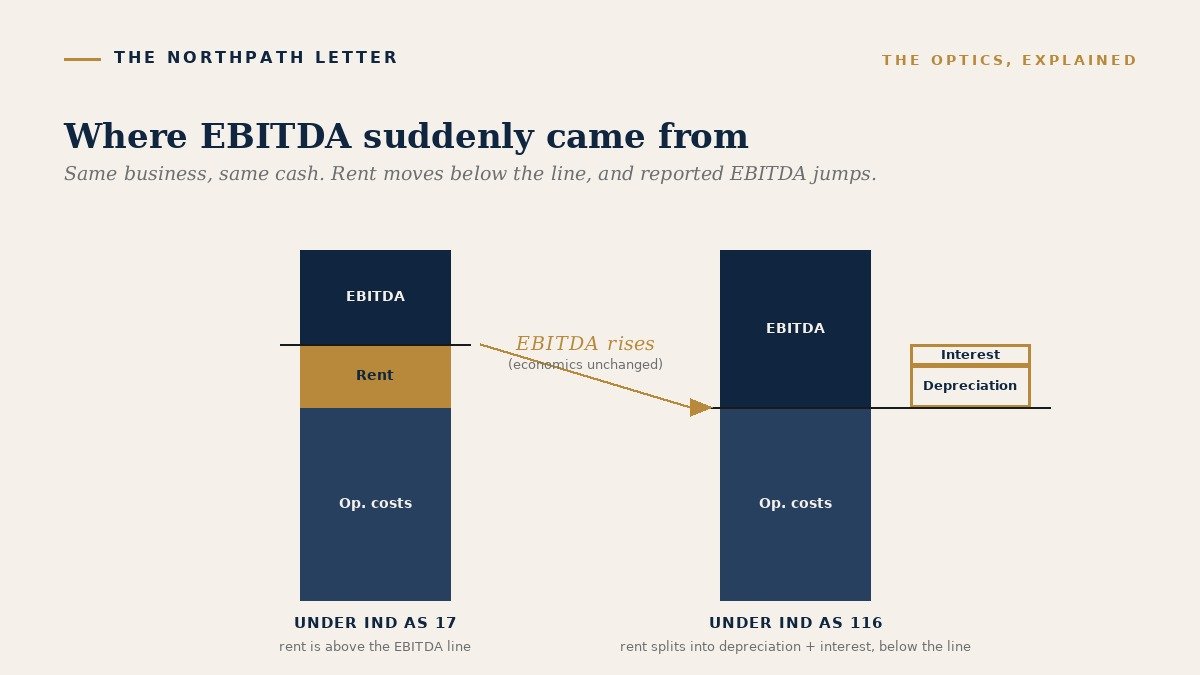
The second distortion is the one that matters most for valuation, and it concerns where in the income statement these costs sit. Rent, under the old standard, was an operating expense — it sat above the EBITDA line and reduced it. Under Ind AS 116, rent has vanished and been replaced by depreciation and interest, both of which sit below EBITDA. The mechanical consequence is that the reported EBITDA of a lease-heavy company jumps the moment the standard is adopted, with zero change in its economics. Any multiple, covenant or comparison built on EBITDA must be recalibrated for the break, and any year-on-year EBITDA growth that straddles the 2019 transition is partly an accounting artefact. An analyst who takes pre- and post-2019 EBITDA at face value is comparing two different rulers.
The cash flow statement shifts too, and flatters the same companies. The cash that used to leave as operating rent now leaves as lease payments split between a principal portion, classified in financing activities, and an interest portion, also typically shown in financing. Operating cash flow, as a result, looks structurally stronger after 2019 than before — again, with no underlying change. The total cash out of the door is unchanged; the standard simply re-shelved it into a more attractive cupboard.
The asymmetry nobody mentions: the landlord didn’t move
There is a quiet inconsistency at the heart of Ind AS 116 that every careful reader should hold in mind. The standard rewrote the world for the lessee but left the lessor almost exactly where Ind AS 17 had left it. A landlord, a leasing company, an aircraft lessor — these still classify each lease as either finance or operating, still keep operating-lease assets on their own books, and still report rental income much as before. The same physical lease is therefore accounted for on two fundamentally different philosophies depending on which side of it you sit. The tenant capitalises; the landlord does not. This asymmetry was a deliberate, pragmatic compromise by the international standard-setters — the lessee side was where the off-balance-sheet abuse lived — but it means there is no longer a neat mirror between the two parties to a lease. For investors in India’s leasing, real-estate and aircraft-financing businesses, the lessor model is the one that still matters, and it is the older one.
Where the Indian balance sheet grew the most
The standard’s effect was not evenly distributed; it fell hardest on the businesses whose entire operating model is “rent, don’t own.” Indian aviation is the starkest case. A carrier such as InterGlobe Aviation, the parent of IndiGo, runs a fleet assembled very substantially through leases and sale-and-leaseback arrangements rather than outright purchase; under the old standard a great deal of that fleet sat off the balance sheet, visible only in commitment notes. Ind AS 116 brought it on, and the right-of-use assets and lease liabilities of India’s listed airlines are now among the largest such balances in the market. The old aviation habit of quoting “EBITDAR” — earnings before interest, tax, depreciation, amortisation and rent — was always an admission that rent behaved like a financing cost; the standard has now formalised that admission in the primary statements.
Organised retail is the second epicentre, and it contains an instructive contrast. A store-based retailer that leases its space — many of India’s apparel and department-store chains, and the lease-led grocery formats — saw its balance sheet expand sharply, since each new store is a multi-year lease that now capitalises on signing. But the contrast within the sector is itself analytically useful: an operator that has chosen to own a high proportion of its real estate, as Avenue Supermarts has historically preferred for its larger stores, was structurally less affected than a pure lease-led peer. The standard, in other words, made visible a strategic choice — own versus rent — that the old accounting had blurred. Quick-service restaurants, with their fleets of leased outlets, telecom operators with leased towers and fibre, and hotel companies operating under management-and-lease structures round out the list of the most reshaped balance sheets. In every case the underlying business is unchanged; what changed is that the commitment is now impossible to overlook.
India and the wider world: the IFRS-versus-American divergence
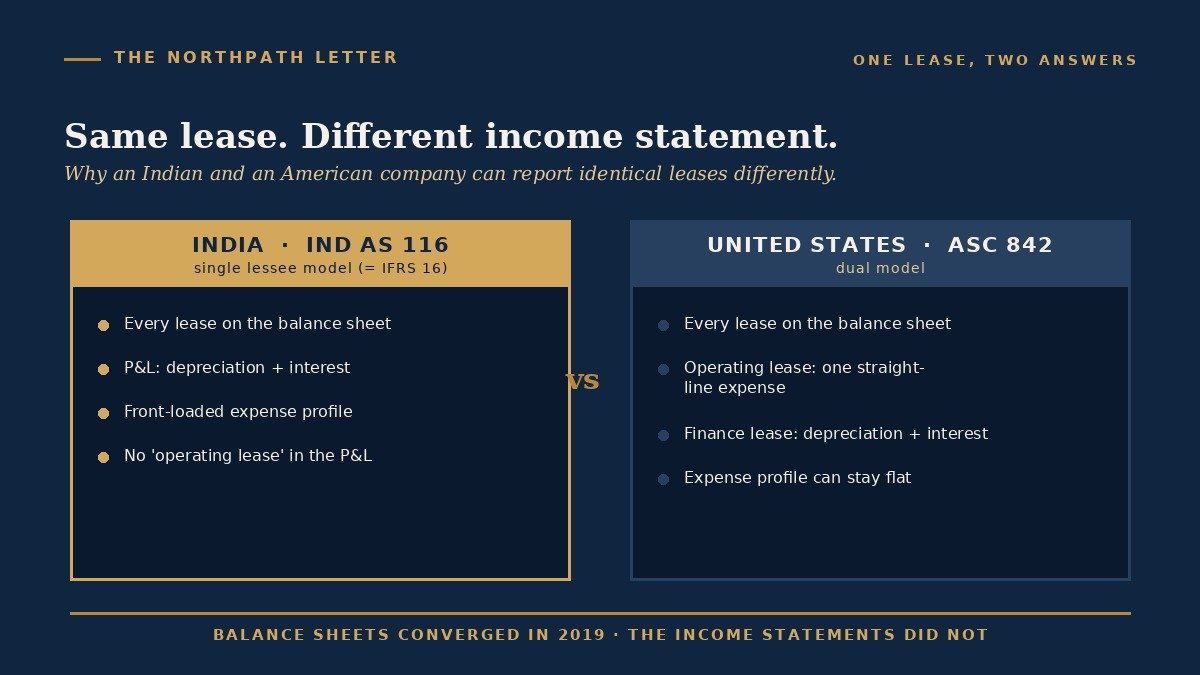
This is the comparison that trips up cross-border investors, and it is worth stating with care because it is a real, durable difference rather than a quirk. Because Ind AS 116 is built on IFRS 16, India belongs to the single-model camp: for the tenant, every capitalised lease is treated, in effect, as a financing — depreciation plus front-loaded interest — and there is no such thing as an operating lease on the income statement. The United States went a different way. American GAAP’s leasing standard, ASC 842, also brought leases onto the balance sheet, so the headline “leases are now on the books” is true on both sides of the Pacific. But the US retained a dual model on the income statement: a lease classified as an operating lease under ASC 842 still produces a single, straight-line lease expense in the P&L, exactly as the old world did, even though the right-of-use asset and liability now appear on the balance sheet.
The practical upshot is that the same lease, signed by an Indian company and an American company on identical terms, will look different in their respective income statements. The Indian company front-loads its cost and reports the expense as depreciation and interest below EBITDA; the American company, if it classifies the lease as operating, reports a flat expense, and a portion of it lands above EBITDA. An investor comparing an Indian retailer’s EBITDA margin to a US retailer’s without adjusting for this is comparing numbers built to different specifications. The balance sheets converged in 2019; the income statements did not. Remembering which side of that divide a company sits on is one of the genuinely high-value habits in cross-border analysis.
A footnote the pandemic wrote
One amendment deserves mention because it appears in the comparative years of many Indian accounts. When COVID-19 forced landlords across the country to grant rent holidays and reductions, the strict logic of Ind AS 116 would have required every such concession to be assessed as a lease modification — a fiddly, judgement-heavy exercise repeated thousands of times. The standard-setters granted relief. The MCA, mirroring an IASB amendment, notified a practical expedient in July 2020 allowing lessees to elect not to treat pandemic-related rent concessions as modifications, provided the relief met defined conditions and affected payments originally due by a cut-off date; that cut-off, initially 30 June 2021, was later extended to 30 June 2022. It is a small thing, but if you are reading Indian accounts for the years through 2022 and find a note explaining the non-modification treatment of rent concessions, this is its origin — not a sign of distress, but of a temporary, sanctioned shortcut.
How to read the lease note now
For the working investor, the standard turned a once-ignorable footnote into one of the more revealing notes in an Indian annual report. Here is how I read it.
First, size the liability against the borrowings. The lease liability is debt in all but name — a fixed, senior, contractual claim ahead of equity. Add it to reported borrowings before you form any view of leverage. A retailer or airline that looks lightly geared on “debt” alone may be heavily committed once leases are included, and the rating agencies and lenders treat it so.
Second, read the maturity analysis. Ind AS 116 requires a maturity profile of the undiscounted lease liabilities, presented under the financial-instruments disclosure rules. This tells you how long the commitments run and how front- or back-ended they are — the difference between a chain locked into a decade of fixed rents and one with flexibility to exit.
Third, separate the depreciation and interest from the rest. The notes disaggregate depreciation of right-of-use assets and interest on lease liabilities. Pull them out, and you can reconstruct the old-style rent — which lets you compare today’s company to its own pre-2019 self, and to American operating-lease peers, on a like-for-like basis.
Fourth, find the cash actually paid. The standard requires disclosure of the total cash outflow for leases. This is the number that did not change in 2019, and it is the honest measure of what the leases cost the business, undisturbed by the accounting geometry around it.
Fifth, watch the additions to right-of-use assets. A large annual addition signals aggressive expansion through leasing — new stores, new aircraft, new floors — and tells you, often before the segment commentary does, how fast the company is committing capital it does not own.
Sixth, check the short-term and low-value election. A company leaning heavily on the short-term-lease exemption may be keeping real, recurring commitments off the balance sheet by structuring them in twelve-month tranches. The expense for short-term and low-value leases is disclosed; if it is large, ask why.
The takeaway
The one-line takeaway: Ind AS 116 did not change what any Indian company pays to rent the assets it runs on — it only stopped letting them hide the commitment, so read the right-of-use asset and the lease liability as the debt-funded operating reality they have always been, and never compare an Indian lease-heavy income statement to an American one without remembering they were built to different rules.
Disclosure
This letter is journalism and education for a general audience. Nothing in it constitutes investment advice or a recommendation in respect of any security or financial instrument, nor an offer or solicitation to buy or sell anything. Companies and events are named only as factual or historical illustration, and the author holds no position in any security mentioned. Regulatory and accounting provisions are summarised for the general reader and are not a substitute for the text of the standards or for professional advice; readers should consult an adviser authorised in their own jurisdiction before making any decision.
— Manish Goel, FCA · The NorthPath Letter · Tallinn