The annual report of an Indian listed company is, on first encounter, a beast. The annual report of HDFC Bank for the financial year ended March 2025 runs to 712 pages. Reliance Industries’ for the same year runs to 768. Even a mid-cap consumer business with a single product line will typically file 280 to 350 pages. By comparison, the 2024 annual report of Procter & Gamble runs to 152 pages; LVMH’s runs to 372.
This is not because Indian companies are more complex. It is because the Indian disclosure regime — primarily the Companies Act, 2013, the SEBI (Listing Obligations and Disclosure Requirements) Regulations, 2015 (universally referred to as “the LODR”), and the accounting standards (Ind AS, India’s IFRS-converged regime) — requires a substantially larger set of disclosures than the US or continental European systems. Some of these disclosures are genuinely useful. A few are extraordinarily useful and have no real counterpart in the 10-K. Some are bureaucratic noise. The competent global analyst learns to navigate from the useful to the very useful efficiently, and to skip the noise.
This essay is that map.
I will assume the reader has experience with US-format 10-Ks or UK-format annual reports, and will write throughout in comparison to those formats where the comparison is informative. I will not assume any knowledge of Indian corporate law beyond what a serious investor would pick up by reading three or four Indian annual reports.
The structure of an Indian annual report, in order
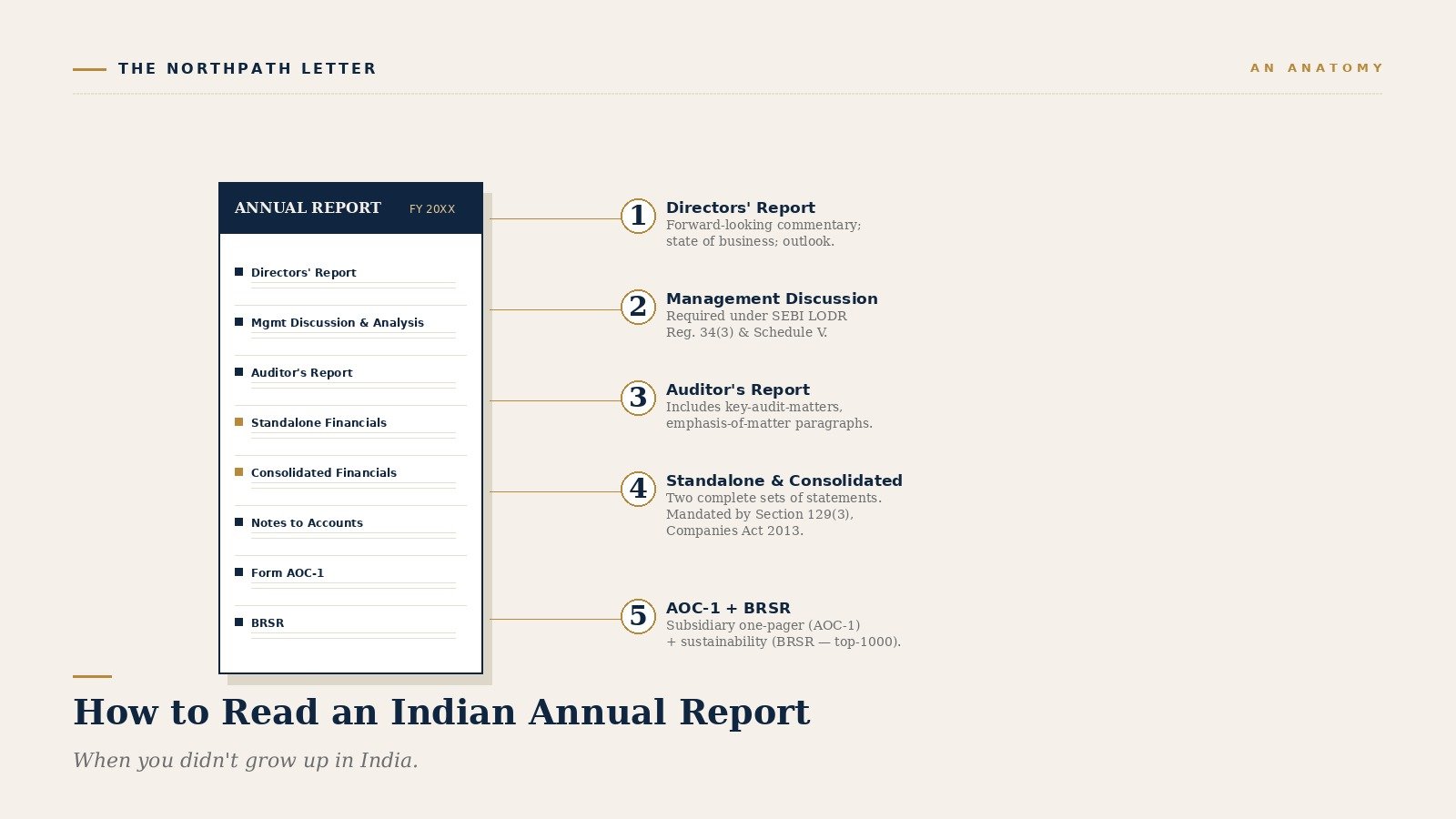
Indian annual reports follow a remarkably consistent structure across companies, because the structure is largely prescribed by law. The order is broadly:
- Notice of Annual General Meeting (mandated under Section 101, Companies Act 2013) — the formal call to shareholders, listing every resolution to be voted on. Often 20–40 pages on its own because each ordinary and special resolution requires a separate “Explanatory Statement” under Section 102.
- Board’s Report (Section 134) — the directors’ formal report to shareholders. Includes financial highlights, dividend recommendation, performance commentary, material changes, subsidiary information, corporate social responsibility report, directors’ responsibility statement, conservation of energy / technology / foreign exchange particulars, and dozens of other mandated items. Typically 30–70 pages.
- Management Discussion and Analysis (LODR Schedule V, Part B) — the qualitative commentary on the business. Nine prescribed sections including industry overview, opportunities and threats, segmental performance, outlook, risks, internal control adequacy, financial performance, HR developments, and key ratios. Typically 15–30 pages.
- Corporate Governance Report (LODR Schedule V, Part C) — board composition, committee composition and attendance, director profiles, remuneration disclosures, related-party transaction policy, whistleblower policy, code-of-conduct compliance, and a CEO / CFO certification. Typically 25–40 pages.
- Business Responsibility and Sustainability Report — BRSR (SEBI circular, mandatory for top-1,000 listed companies from FY 2022–23) — extensive ESG disclosures across nine principles. Typically 30–80 pages.
- Independent Auditor’s Report (Standalone) — the auditor’s opinion on the standalone financials, including Key Audit Matters under SA 701 and an annexure containing the report under the Companies (Auditor’s Report) Order, 2020 — universally called “CARO 2020”. 15–30 pages.
- Standalone Financial Statements — parent company only. Balance sheet, statement of profit and loss, cash flow statement, statement of changes in equity, and notes. 50–100 pages.
- Independent Auditor’s Report (Consolidated) plus Consolidated Financial Statements including subsidiaries, joint ventures, and associates. Same format as standalone but consolidated. Another 70–120 pages.
- Form AOC-1 — a single-table summary of every subsidiary and associate, including each entity’s standalone revenue, profit, total assets, and the parent’s investment in it. Typically 2–5 pages but contains a high density of information.
- Secretarial Audit Report — Form MR-3 (Section 204, mandatory for listed and certain unlisted companies). Independent secretarial auditor’s opinion on the company’s compliance with the Companies Act, SEBI regulations, depository regulations, and other applicable laws. 5–10 pages.
The total — Notice + Board Report + MDA + CG + BRSR + Audit + Standalone FS + Consolidated FS + AOC-1 + MR-3 — is the 250–700 page object that arrives in the investor’s inbox each summer.
A practical 30-minute reading sequence
I will assume the typical use case: you have a finite amount of time, you want to understand a company quickly, and you are reading the annual report either as initial diligence or as part of a periodic re-review. In that order of priority — and explicitly skipping things in this first pass — here is what I would read.
Minutes 0–5: Form AOC-1 (the one-table subsidiary summary). This is the single most information-dense page in the report. It gives you, in one table, every subsidiary’s revenue, profit after tax, total assets, total liabilities, and the parent’s investment. For a consolidated business, this tells you immediately which subsidiaries actually matter, where consolidated revenue is coming from, which subsidiaries are loss-making and need to be capitalised by the parent, and whether there are large subsidiaries that nobody talks about. AOC-1 is often the fastest way to discover that a company you thought was a domestic Indian business has a Mauritius subsidiary, a Cyprus subsidiary, and three step-down LLPs in Singapore — and to ask why.
Minutes 5–10: Related Party Transactions note in the financial statements. This is usually Note 30-something in the standalone financials and a slightly different number in the consolidated. It lists every transaction with promoter-related parties: sales, purchases, loans given and taken, guarantees, leases, services. Two questions matter: are the RPT volumes large relative to revenue or profit? A consumer business that sells 30% of its output to a promoter-owned distribution company is structurally different from one that sells nothing to its promoter. And are RPT volumes trending up or down over years? The trend matters more than the absolute level. A small number of historical Indian corporate failures — Satyam in 2009, the IL&FS group in 2018, DHFL in 2019 — were visible in the RPT note years before they blew up. Not always specifically, but as patterns of expanding intra-group lending or expanding promoter-entity exposure.
Minutes 10–15: Auditor’s CARO 2020 annexure. The 21-clause CARO checklist is the auditor’s formal attestation on a series of operational and compliance matters. Read the auditor’s responses to clauses (vii), (ix), (xi), (xv), and (xxi):
- Clause (vii) — whether the company has been regular in paying undisputed statutory dues (GST, income tax, provident fund, professional tax, and so on). Any “not regular” answer is a working-capital red flag.
- Clause (ix) — whether the company has defaulted in repayment of loans or borrowings, and whether it has been declared a “wilful defaulter” by any bank or financial institution. Self-explanatory.
- Clause (xi) — any fraud by or on the company reported to the auditor or noticed by the auditor during the year. A “yes” answer here, even if small in financial impact, demands further reading.
- Clause (xv) — whether the company has entered into non-cash transactions with directors or persons connected with them under Section 192 of the Companies Act. Indirect related-party signal.
- Clause (xxi) — auditor’s view on going concern, particularly relevant for loss-making or working-capital-stressed businesses.
A clean CARO is the absence of an answer to any of these clauses. A CARO with affirmative answers to (vii), (ix), (xi), or (xxi) merits opening the annual report a second time.
Minutes 15–20: Key Audit Matters in the auditor’s report. Since the 2018 adoption of SA 701 in India, the auditor’s report on listed companies must disclose “Key Audit Matters” — the items the auditor considered most significant in the current period’s audit. Each KAM has two sections: a description of the matter and a description of how the audit addressed it.
KAMs are interesting because they tell you what the auditor was worried about. If the KAM is “revenue recognition for long-cycle projects”, the auditor is signalling that revenue may be aggressive. If the KAM is “impairment of goodwill on the X subsidiary”, the auditor is signalling that the subsidiary may be in trouble. If the KAM is “valuation of derivatives” and the company is an FMCG business, the auditor is signalling something unusual. KAMs do not generally constitute an adverse opinion, but they are the auditor’s polite way of telling you what to dig into.
Minutes 20–25: Shareholding pattern and promoter pledge disclosure. Found near the start of the Corporate Governance Report. Look at:
- Total promoter holding. What percentage of the company do the founding family or controlling shareholders own? In Indian listed companies the range is from roughly 5% (Infosys, professionally managed, founders gradually sold down over decades) to roughly 75% (the upper SEBI ceiling for promoter holding in a listed company before it must dilute). Most owner-operated Indian companies sit at 40–65%.
- Pledged shares of the promoter group. This is critical. Promoter shares pledged to lenders are economically a quasi-debt at the promoter level, often used to fund non-listed group ventures. A high pledge percentage — typically anything above 30% of promoter holding pledged — is a serious yellow flag, and a rising pledge percentage is a serious red one. The IL&FS, DHFL, Zee, and Anil Ambani group crises were all preceded by escalating promoter pledge levels.
- FII holding and DII holding — institutional ownership levels and their trend.
Minutes 25–30: Contingent liabilities note in the financial statements. Usually a sub-note within “Commitments and Contingencies”. Lists tax demands disputed by the company (income tax, GST, customs, excise) — often substantial for older Indian companies — ongoing legal proceedings, guarantees given to subsidiaries or third parties, and pending lawsuits and arbitrations. For old industrial companies, the contingent-liability schedule can run to a billion dollars in disputed tax demands. Most do not crystallise, but some do, and the trajectory year-over-year is informative.
If your half-hour budget allows extra time, the next thing I would read is the auditor’s report on Internal Financial Controls (a separate report mandated by Section 143(3)(i) of the Companies Act), and after that the MD&A. Both are useful but in my experience never the most informative items in the file.
Five Indian-specific disclosures the global analyst routinely overlooks
I want to spend more time on each of five disclosures that exist in Indian annual reports and either do not exist in US/European reports or exist in a much less developed form. These five, in my experience, are where genuinely new information lives.
1. The Standalone–versus–Consolidated split
In the US, listed companies file consolidated financials only. Indian companies are required to file both standalone (parent-only) and consolidated (with subsidiaries, joint ventures, and associates) financials, and both are usually presented in the same annual report, one after the other.
The standalone financials show what the parent company itself does — its own revenue, its own costs, its own assets, its own liabilities. The consolidated financials show the group as a whole. Where the two differ significantly, there is a story.
A pharma company whose standalone shows ₹2,000 crore of revenue and whose consolidated shows ₹18,000 crore is a company whose business sits 90% in subsidiaries — typically the US generic operations in a Delaware LLC, the European operations in a German GmbH, and so on. The standalone is interesting only as a holding-company P&L. The consolidated is the real business.
Conversely, an Indian conglomerate whose standalone profit is ₹3,500 crore and whose consolidated is ₹1,200 crore is a company where subsidiary losses are eating most of the parent’s profit. That dynamic — where the listed parent is profitable but the consolidated group is barely profitable — is structurally important and easy to miss if you only read consolidated numbers.
When reading an Indian company for the first time, I always look at both. The questions are: where does revenue actually come from? Where do losses actually sit? Which subsidiaries is the parent capitalising? Are dividends from subsidiaries flowing up to the parent or being trapped offshore?
2. The promoter concept and promoter shareholding
“Promoter” has no US-law equivalent. The Companies Act 2013, Section 2(69), and the SEBI ICDR Regulations define a promoter as the person who has control over the affairs of the company (directly or indirectly), is named as a promoter in the offer document or the annual report, or in accordance with whose advice the board acts. In practice, “promoter” almost always means the founding family, the controlling shareholder group, or the original entrepreneurs and their successors.
Indian listed companies are required to separately disclose the shareholding of the promoter group, both in the annual report and in the quarterly shareholding pattern filing with the exchanges. The promoter is also treated separately under various securities laws — insider trading restrictions, related-party transaction rules, takeover regulations.
For the global analyst, the analytical implications are: Indian listed equity is largely owner-operated. Roughly 70% of NSE-listed companies are promoter-controlled in the sense that the promoter group holds 25% or more. This is structurally different from the US S&P 500, where dispersed institutional ownership dominates. The promoter’s economic interest is usually substantial in absolute terms and often dominant in relative terms. Promoter wealth is concentrated in the listed entity’s shares. This generally aligns the promoter with public shareholders on share-price outcomes but creates conflicts on cash flows (the promoter may prefer to extract value through related-party transactions rather than dividends). The quality of the promoter, both in business and in governance, is one of the single most important variables in Indian equity returns. There is no analogous variable for a US blue-chip.
3. Related-party transactions, in detail
Because most Indian listed companies are promoter-controlled and promoters typically own multiple group entities, the volume and quality of related-party transactions is a far more important analytical input in India than in the US.
The RPT note in the financial statements lists, for each related party: nature of relationship (subsidiary, associate, key managerial personnel, promoter-affiliated entity); sales to and purchases from the related party; loans and advances given to or received from; guarantees and securities provided; reimbursements; and outstanding receivables and payables at year-end. The annual report also contains an RPT policy (in the Corporate Governance Report) and a section in the Board’s Report on material related-party transactions requiring shareholder approval under Section 188.
What I look for, in order of importance: material related-party sales or purchases. If a meaningful percentage of revenue or COGS goes through promoter-related entities, the analyst needs to understand the pricing mechanism. Is it at arm’s length? Audited? Subject to a transfer-pricing report? Loans and advances to promoter-related parties. This is often where minority value is leaked. The parent lends to a promoter-related entity at concessional rates, the loan never quite gets repaid, and over a decade the parent’s balance sheet is quietly hollowed out. Trend matters more than absolute level. Guarantees given by the parent on behalf of promoter-related entities. These do not show up as debt on the parent’s balance sheet but are a real economic obligation. Trend over years. Stable or shrinking RPT exposure is healthy. Expanding RPT exposure, especially in loans, advances, or guarantees, is a yellow flag turning amber over time.
The single best heuristic I have developed: companies whose related-party exposure shrinks every year tend to outperform companies whose related-party exposure grows every year, holding business quality constant.
4. CARO 2020 — twenty-one clauses you should learn to read
The Companies (Auditor’s Report) Order, 2020 — universally CARO 2020 — is an annex to the auditor’s report. It is, in effect, a 21-question checklist that the auditor must answer for every audited company above certain size thresholds. There is no exact US analogue. The closest US equivalent is the auditor’s report under PCAOB AS 3101, but CARO is far more granular and more operational.
The 21 clauses cover, among other things, title of immovable properties, physical verification of inventory, working capital limits, loans and investments, deposits accepted, statutory dues, defaults on borrowings, application of fund-raising proceeds, frauds, related-party transactions, registration under various Acts, going concern, and resignation of the statutory auditor.
The mechanism: for each clause, the auditor either says nothing of concern (essentially a clean response) or describes a specific observation. The CARO annexure for a clean, well-run business is short, sometimes only two or three pages, and consists largely of “in our opinion, the company is in compliance” responses. The CARO annexure for a stressed business can run to ten or fifteen pages of qualifications.
Specific clauses to read with care, beyond the ones I listed in the 30-minute sequence: Clause (iii) — loans and investments to companies, firms, LLPs, parties covered under Section 189. If the company is making large loans to non-trade parties, that is informative. Clause (iv) — compliance with Sections 185 and 186 (regarding loans to directors and inter-corporate loans). Non-compliance is a serious governance signal. Clause (xiv) — internal audit system and whether the company has an internal audit commensurate with size and nature of business. A “no” answer here for a meaningful-sized company is unusual and informative.
CARO is the single most efficient form of operational due-diligence available in an Indian annual report. It takes ten minutes to read, it covers things US reports never cover, and it occasionally contains the one disclosure that explains why a business is going to trouble.
5. The BRSR ESG framework — flawed but emerging
The Business Responsibility and Sustainability Report, mandatory for the top 1,000 listed Indian companies since FY 2022–23, replaced the older Business Responsibility Report (BRR). It is structured around nine “principles” derived from the National Guidelines on Responsible Business Conduct, covering ethics, product responsibility, employee welfare, stakeholder engagement, human rights, environment, public policy advocacy, inclusive growth, and consumer welfare.
The BRSR is, frankly, of mixed quality. Disclosure standards are still settling, comparability across companies is limited, and a meaningful fraction of disclosures are still self-reported and unverified. However, it is the de facto Indian ESG-disclosure framework, and serious global ESG-aware investors are starting to read it.
Two BRSR sections I have found useful: the principle 6 (environment) quantitative disclosures (greenhouse-gas emissions, water consumption, energy intensity), which are increasingly assured by independent third parties; and the principle 5 (human rights) disclosure of complaints, sexual-harassment cases, and grievance-redressal turnaround. Both have improved markedly in quality between FY23 and FY25 disclosures. I would not yet rely on BRSR for cross-company ESG ranking. I would read it on individual companies for directional signals.
Five things to skip on a first read
To save time, an experienced Indian-annual-report reader skips, on a first pass:
- The conservation-of-energy, technology-absorption, and foreign-exchange particulars (Section 134(3)(m) read with Rule 8(3) of the Companies (Accounts) Rules, 2014). Almost always boilerplate.
- The directors’ responsibility statement (Section 134(5)). A statutory affirmation of compliance, identical in form across companies.
- Director profiles in the Corporate Governance Report. Useful for one-off checks but not for ongoing reading.
- The notice of AGM resolutions and their explanatory statements, unless one of the resolutions is unusual (for example, a material related-party transaction approval or a substantial scheme of arrangement).
- Most of the MD&A. I am aware this is heretical. The MD&A is structurally constrained by the LODR-prescribed nine sections, is written by company management with PR review, and contains very little that you cannot get from a more concise analyst presentation or the earnings call transcript. There are exceptions — the MD&A of well-run owner-operated companies is genuinely good — but as a default, skip.
Where to find what you need quickly
A practical note on logistics. Most Indian annual reports are published as a single PDF and uploaded to: the company’s investor-relations page on its corporate website; the stock exchange filings (BSE: bseindia.com/corporates; NSE: nseindia.com/companies-listing/corporate-filings-annual-reports); and the SEBI’s centralised SCORES / LODR portal, indirectly.
For older reports (five years back and earlier), the company website may have removed them but the exchange archives usually still hold them. For listed companies, all annual reports filed since FY2016 are available on the exchange websites.
I would recommend, when starting work on an unfamiliar Indian company, downloading the last five annual reports and reading them not in chronological order but in reverse — most recent first, then the previous one to see what changed, then the one before that. Patterns in disclosure (RPT trends, contingent liabilities, promoter pledge, KAMs) are visible only in the time-series.
One final practical note
The Indian annual-report disclosure regime is heavy by international standards. It is also genuinely informative if you know what to read. The temptation, when first encountering a 600-page document, is to read it cover to cover or to dismiss it as unreadable. Neither is right. The correct response is to learn the structure, develop an efficient reading sequence, and over time build the habit of looking at the seven or eight things that actually matter.
I will write further essays on individual sub-sections of the annual report in the coming weeks — separate deep-dives on the CARO 2020 framework, on reading Indian segmental disclosures, on Form AOC-1, on Indian contingent-liability schedules, and on the BRSR. Each is a piece of analytical infrastructure that, once internalised, makes every subsequent annual report you read faster and more productive.
For the impatient: thirty minutes per company per year, executed in the sequence above, will catch eighty per cent of what matters.
— M. G.
No spam. Unsubscribe in one click.