If you have arrived here as a result of a forwarded link, a search, or a half-curious click, the simplest way I can explain what you have found is this: The NorthPath Letter is a written publication about Indian businesses, written by a Chartered Accountant who has spent the last twenty-two years thinking about Indian capital markets, for a reader who is not Indian, who does not read Hindi-language broker reports, and who would rather understand an Indian company than be told what to do with one.
There are many places on the internet where you can find an Indian stock tip. There are many more where you can find a “Top Five Multibaggers for 2026” headline. This is neither of those places.
This is a publication about analysis. About businesses. About reading annual reports — and reading them carefully. About the long, unglamorous, compounding work of understanding why a particular Indian company is worth your attention, or, far more often, why it is not. It is published from Tallinn, Estonia, by NorthPath Advisory OÜ. It will arrive in your inbox every morning, seven days a week.
It will, in due course, have a premium subscriber tier. Today, and for the foreseeable future, every issue is free.
Why this publication exists
Indian listed equity is one of the world’s largest and most under-translated capital markets. The Bombay and National Stock Exchanges between them list more than 5,400 companies. Total market capitalisation has crossed five trillion US dollars. Foreign portfolio investors hold, at the time of writing, approximately eighteen per cent of all free-float Indian equity — a fraction that has grown, with interruptions, for two decades.
And yet the volume of high-quality, English-language, long-form written analysis of Indian listed businesses available to a global reader is, by international comparison, thin. There is no Indian-equity equivalent of Stratechery for technology, or Mostly Borrowed Ideas for US/global equities, or The Generalist for venture. The English-language Indian financial press is dominated by daily-news reporting (excellent at what it does, but not analytical); the sell-side research that does cover Indian businesses is locked behind institutional paywalls; and the open Indian financial blogosphere is overwhelmingly retail-oriented, focused on price targets, technical patterns, and short-horizon recommendations.
That gap is the reason this publication exists.
What you will find here
Every morning, you will receive one essay. The essays will rotate, roughly, between five forms:
Business deep-dives. Long-form (three to four thousand word) analytical breakdowns of individual Indian listed companies. The analytical focus will be capital allocation history, competitive position, management track record, accounting quality, and the structural features of the industry. We are interested in what a business has done with shareholder capital over a decade, not in what its stock will do next quarter.
Capital-allocation essays. Frameworks for thinking about how capital flows in and out of Indian businesses — and how a global reader should think about those flows. Indian dividend policy. Indian buyback regulation. Indian rights issues. The Indian preference for retained earnings over distribution. The structural reasons why all of these differ from US and continental European norms.
Sectoral and macro letters. Periodic letters covering Indian sectoral structure — Indian private-sector banking, the Indian capex cycle, the Indian power sector, Indian generic pharmaceuticals — and the macro context that shapes them. Reserve Bank of India policy. The Union Budget cycle. INR movements. The shifting composition of foreign portfolio flows.
Indian-market context for the global reader. Pieces that explain the structural features of Indian listed equity to a reader who did not grow up with them. What “promoter” actually means. How the Companies Act 2013 reshaped governance. Why SEBI’s related-party transaction framework matters. The history and structure of Indian audit. The difference between standalone and consolidated financial statements in the Indian disclosure regime.
Reading the news. Periodic short letters — under fifteen hundred words — that take a particular item from the Indian financial press, strip away the narrative, and read the underlying business or governance development for what it actually is.
What you will not find here
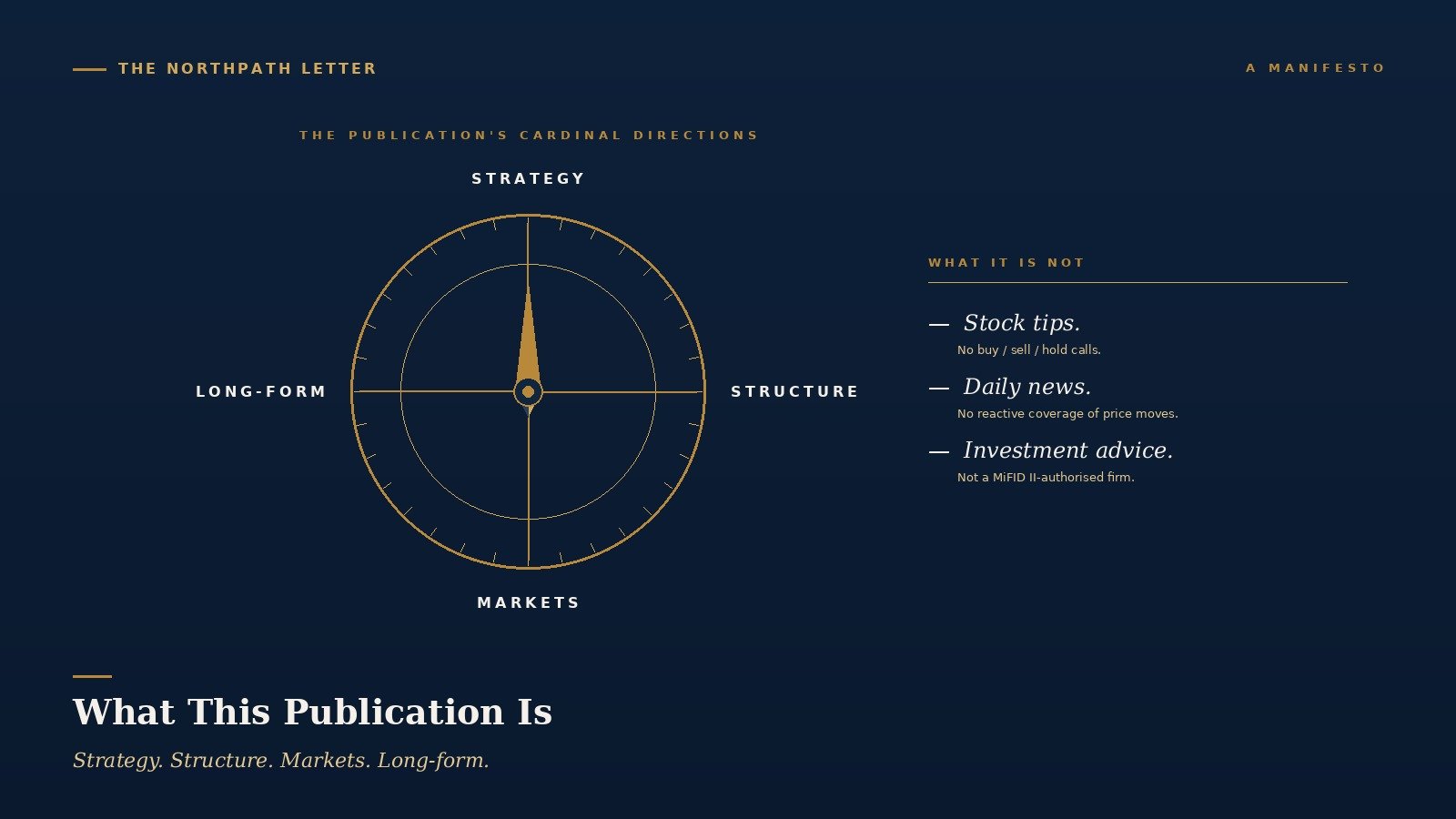
This publication is journalism and education. It is not investment advice. The distinction is regulatory — NorthPath Advisory OÜ is not a MiFID-authorised investment firm under European Union law, and we cannot provide personalised investment advice to European Union retail clients — but it is also editorial. We do not write “buy, sell, hold” calls because we believe such calls are usually counterproductive for both the writer and the reader. The reader who follows a stranger’s stock call without understanding the underlying business has learned nothing and is exposed to risk they cannot evaluate. The writer who issues such calls is incentivised to be loud rather than to be careful.
You will not find:
- “Buy this stock at this price with this target.” Ever.
- Model portfolios you can copy.
- Performance-attribution claims about prior calls.
- Paid promotion of any company. Anywhere I hold a personal position in a security being discussed, the position will be disclosed at the bottom of the essay, in the standard MAR-compliant form.
- Daily price commentary. The Indian market closes at 15:30 IST and a thousand outlets will tell you what it did. We will not.
- Anything that depends on you having access to a Bloomberg Terminal, an institutional Refinitiv account, or paid Indian datasets.
The essays are written so that they are readable by an intelligent person who does not work in finance, and useful to a person who does.
Who is writing this
My name is Manish Goel. I am a Fellow Chartered Accountant of the Institute of Chartered Accountants of India — I qualified in 2004. I began my career in corporate finance at Ranbaxy Laboratories Limited. In 2017, I founded an Indian capital-markets advisory firm, which I continue to operate. In 2026, I incorporated NorthPath Advisory OÜ in Estonia as a fully separate European publishing and advisory practice — the firm under which this Letter is published.
I will sometimes write in the first person and sometimes in the third. When I express an opinion, I will mark it as an opinion. When I hold a position in a company I am writing about, I will say so at the bottom of the essay. When I am uncertain about something, I will say so in the body of the essay rather than at the bottom of it.
Cadence and reliability
The single most important commitment I am making to you is one of cadence. An essay every morning, seven days a week. No skipped days. No “see you in September.” When I am unable to write — which, given health, family, or travel will sometimes be true — there will be a brief note in lieu, and the essay will follow within forty-eight hours.
In a world where many newsletters publish three times in the first month, twice in the second, and silently die in the third, predictable cadence is itself a feature.
Pricing, and the premium tier
Today every issue is free. A premium subscriber tier will launch in the second half of 2026. The premium tier will include all free essays plus longer-form quarterly deep-dive reports, an annual sector-by-sector survey of Indian listed equity, and access to a subscriber-only archive of essays that we choose to retain behind the paywall for legal or commercial reasons (for example, essays containing detailed discussion of small-cap businesses where wider dissemination would be undesirable).
Premium pricing will be announced at launch. As a rough guide for those who like to plan, expect a range comparable to other serious English-language equities publications — approximately twelve to twenty euro per month, or one hundred and fifty to two hundred and forty euro per year. Free subscribers who are on the list before the premium tier launches will receive a meaningful “founding subscriber” discount.
A note for readers in the European Union
Because of European Union law, I want to be explicit about what this publication is, in regulatory terms.
NorthPath Advisory OÜ is an Estonian-domiciled professional services and publishing firm. It is not authorised under Directive 2014/65/EU (MiFID II) to provide investment services. The NorthPath Letter is a journalistic and educational publication. It does not constitute “investment research” within the meaning of Article 36 of Commission Delegated Regulation 2017/565 to the extent that we have framed and disclosed it as personal opinion and educational content. It does not constitute “investment advice” within the meaning of MiFID II Article 4(1)(4), because it is general in nature and not personalised. It does not constitute an “investment recommendation” within the meaning of MAR Article 20 except insofar as any specific opinion on a financial instrument is clearly identified, accompanied by the methodology used, and disclosed alongside any position the author holds.
For readers outside the EU, the substance of these constraints is similar in most major jurisdictions. The short version: nothing in this Letter is a recommendation to buy, sell, or hold any security, and the reader is responsible for their own investment decisions and for engaging a regulated investment adviser in their own jurisdiction.
What I am asking of you
If, after reading this, you think you might want to receive an Indian-equities essay in your inbox every morning, please subscribe using the form below. It is free. The subscription is one click in, one click out, and your email is not for sale.
If, after reading the first few essays, you find that you are reading them all the way through, that you are looking forward to the next one, that you are forwarding particular issues to one or two people you respect — that is the only metric I care about, and it will, in time, be the metric that builds whatever this publication is going to become.
The first business deep-dive will follow tomorrow.
Welcome to NorthPath.
— M. G.
No spam. Unsubscribe in one click.