There is a chart that has appeared, in some version, in nearly every India strategy deck circulated since 2023. It lays India’s gross fixed capital formation over China’s with a twenty-odd-year lag, lines up the two curves at the point where each economy crossed roughly two trillion dollars of output, and lets the eye finish the argument: India in 2026 stands where China stood in 2003, at the foot of the steepest and longest investment boom any large economy has run in the modern record. The bars that follow on the Chinese side — the decade in which one country poured more cement than the rest of the world combined — are offered as India’s future, pre-drawn.
The analogy is doing serious commercial work. It underwrites multi-decade volume narratives for cement, steel, capital goods, power equipment and logistics; it reframes every quarterly wobble as noise against a twenty-year trend; and it travels well, because the one thing every allocator over forty-five remembers is what happened to those who under-owned China after 2003. An accountant’s instinct, when shown a comparison this beautiful, is to ask for the working papers.
So this letter audits the analogy. It sets out what China in 2003 actually was, from the record rather than from memory; what India in 2026 actually is, from the budget documents, the Reserve Bank’s surveys and the lending data; where the rhyme is real; and where it is marketing. It closes, as this publication usually does, at the level of the documents — the five disclosures in an Indian annual report that let a reader track this capex cycle from primary sources, without borrowing anyone’s chart.
China in 2003: what the record actually shows
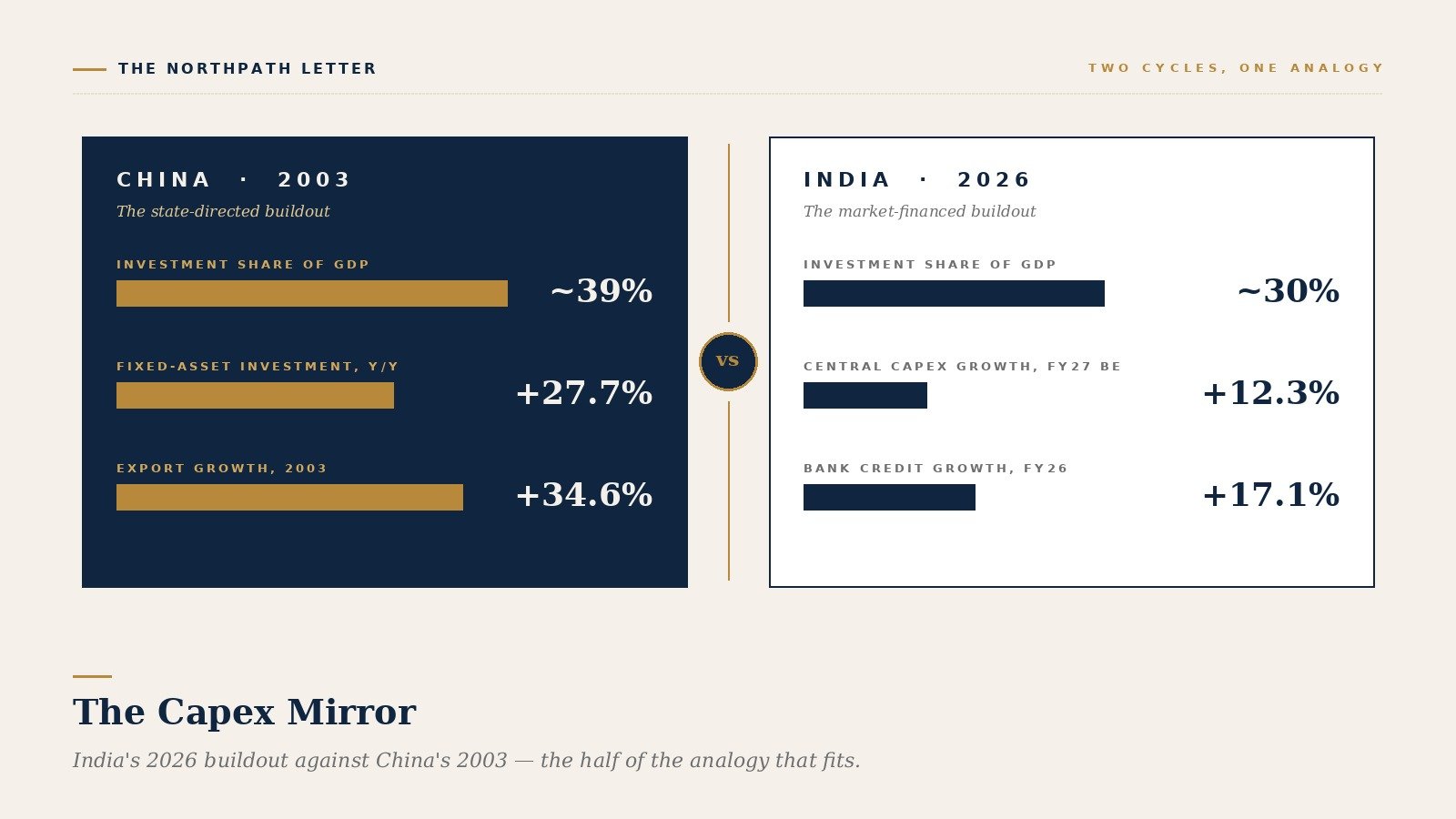
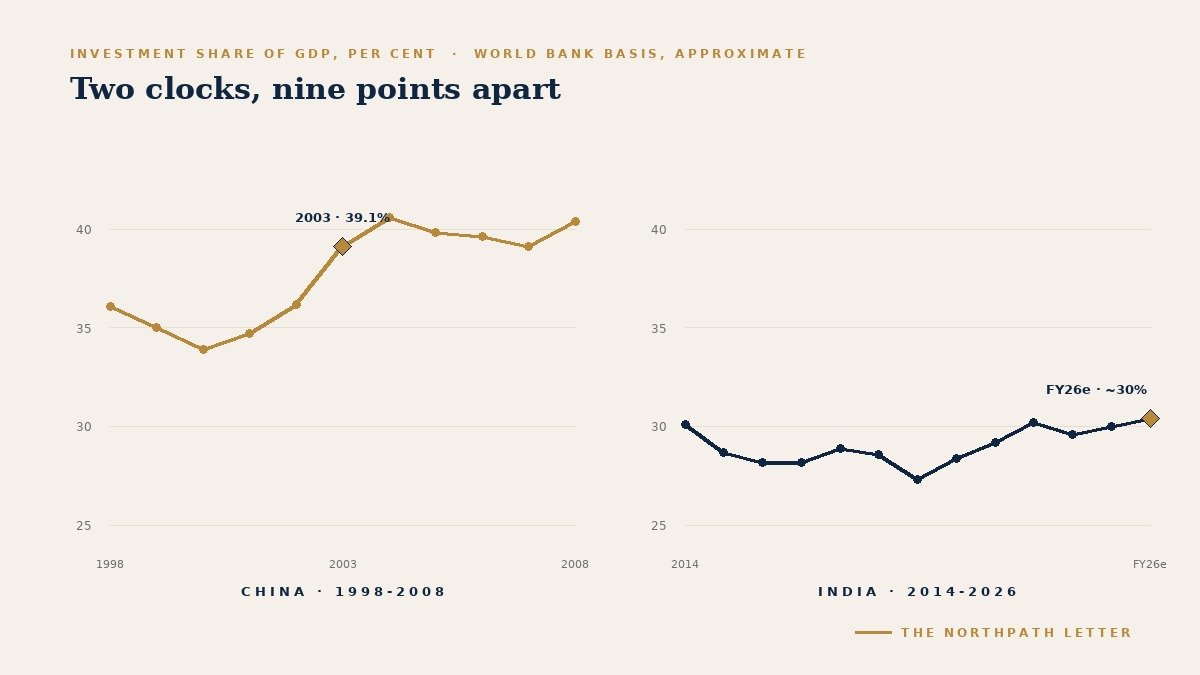
China acceded to the World Trade Organization on 11 December 2001. By 2003 the machine was at full throttle. Fixed-asset investment grew 27.7 per cent in a single year on the official statistics; gross capital formation ran at roughly 41 per cent of GDP, with gross fixed capital formation near 39 per cent and climbing — it would cross 40 the following year and stay in that territory for more than a decade. Hold those numbers; they are the altitude the Indian analogy quietly borrows.
The physical economy told the same story more vividly than the ratios. Crude steel output rose from about 182 million tonnes in 2002 to roughly 222 million tonnes in 2003 — a single-year addition larger than the entire annual output of most steel-producing nations — and was on its way to 353 million tonnes by 2005. Cement production ran above 850 million tonnes, more than two-fifths of world output. Electricity demand outran supply so badly that by 2004 some two dozen of China’s thirty-one provinces were rationing power to industry. Even SARS, which shut much of the country for a quarter in early 2003, barely dented the run-rate.
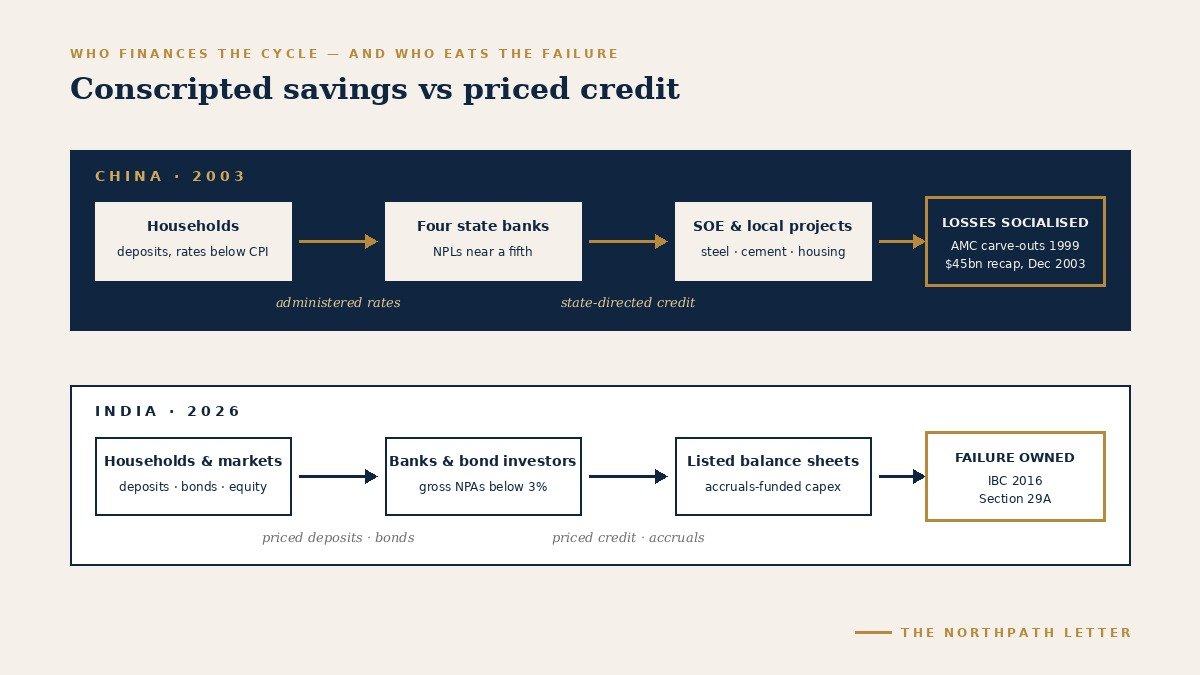
Now look at the financing, because this is where the analogy starts to strain. Renminbi bank lending grew by roughly a fifth in 2003. Deposit rates were administered, and held below inflation: the household sector financed the buildout at negative real rates, whether it wished to or not, through four state-owned banks whose own books were still convalescing — official non-performing ratios at the big four sat near a fifth of loans, after a trillion-renminbi carve-out to asset-management companies in 1999-2000 had already removed the worst of the 1990s vintage. On 30 December 2003, the state injected forty-five billion dollars of foreign-exchange reserves into Bank of China and China Construction Bank to recapitalise them mid-boom. The cycle, in other words, was state-directed credit running through freshly re-plumbed pipes, with the depositor conscripted as the funding source and the taxpayer as the loss-absorber.
The demand side validated all of it, for a while. Exports grew 34.6 per cent in 2003, to around 438 billion dollars, and grew another third in 2004. China was building capacity into the strongest expansion of world trade in the modern era — the American import boom, European outsourcing, the assembly of the global electronics supply chain. The capacity was not speculative; it had a buyer of first resort.
And when the boom overheated, the response was administrative, not financial. In April 2004 the State Council halted Jiangsu Tieben — a private 8.4-million-tonne steel project — mid-construction and detained its founder; capital-requirement ratios for new steel, aluminium and cement projects were raised overnight; lending windows were guided shut. Note carefully what did not happen: no insolvency process, no creditor negotiation, no market repricing of failure. Losses were socialised, the founder was made an example, and the buildout resumed within quarters. That — not merely the growth — is the machine the strategy decks are comparing India to.
India in 2026: what the documents actually show
Start with the state’s ledger, because this cycle did. Central government capital expenditure has risen from about ₹3.4 lakh crore in FY20 to a budgeted ₹12.22 lakh crore for FY27 — an increase of roughly 12 per cent over the FY26 revised estimate, and a three-and-a-half-fold nominal expansion across seven budgets. Counting grants to states for capital assets, “effective capex” is budgeted at ₹17.15 lakh crore, a little over 4 per cent of GDP. Railways, highways, transmission, urban systems: the Indian state has been the cycle’s flywheel while the private sector repaired itself.
The private ledger is now turning — that much the FY26 evidence supports. Industry tallies put private capital expenditure at ₹7.7 lakh crore in the first half of FY26, up 67 per cent year on year; new investment announcements ran above ₹15 lakh crore in the half, with the private sector accounting for nearly nine-tenths of the value and manufacturing for roughly half of it, metals alone above a quarter. Announcement data should be treated as intentions, not invoices — the mortality rate between announcement and commissioning is the entire Indian question, as two decades of project-tracking statistics attest — but the direction is not in dispute.
The credit data agree. Scheduled commercial bank credit grew 17.1 per cent year on year through FY26, against roughly 11 per cent a year earlier; corporate bond issuance more than doubled; external commercial borrowings rose by half as much again. Note the texture, because it matters for the comparison: Indian companies in 2026 borrow in priced markets — from banks pricing against their own capital, from bond investors free to decline, from foreign lenders pricing country risk. The bankers’ own surveys expect credit growth to moderate toward 11-13 per cent through the first half of calendar 2026, with renewed geopolitical stress in West Asia flagged as a dampener. A cycle that answers to prices and events, not to a plan, will always print numbers like these: strong, then hesitant, then strong again.
Against that, the constraint gauges. The Reserve Bank’s quarterly OBICUS survey put manufacturing capacity utilisation at 74.3 per cent in the September 2025 quarter, where it has oscillated — high-73s to high-77s — for two years: respectable, but below the roughly 80 per cent threshold practitioners associate with broad-based brownfield commitments. And the aggregate that the whole analogy rests on: India’s gross fixed capital formation stands near 30 per cent of GDP — 29.6 on the World Bank’s 2024 reading, a shade above 30 on the FY26 national accounts — where it has sat, within a point or two, for a decade. China entered its 2003 at 39, on the way to 41.
India in 2026, read honestly, is mid-cycle: utilisation grinding upward, the state spending heavily, private announcements inflecting from a clean base — and the investment share of GDP still six to ten points below the altitude at which China’s boom began. That is not a criticism. It is a different animal, and the difference is the subject of the rest of this letter.
Where the mirror holds
Four parts of the rhyme are real, and worth conceding in full.
First, both cycles begin with cleaned banking pipes. China entered 2003 behind a trillion-renminbi bad-loan carve-out and a mid-boom recapitalisation. India entered 2026 at the end of the longest balance-sheet repair in its corporate history: the asset-quality review of 2015, the Insolvency and Bankruptcy Code of 2016, gross non-performing assets falling from above 11 per cent of bank loans in 2018 to below 3 per cent today. Investment booms are lending booms; both economies began theirs with lenders newly able to say yes.
Second, both begin with deleveraged borrowers. Listed Indian non-financial leverage sits at multi-decade lows — net debt to operating profit at roughly a third of its mid-2010s level — after nine years in which the corporate sector repaid rather than built. China’s industrial state sector had been through its own clearing in the late 1990s: the mass restructurings of the Zhu Rongji era did for Chinese SOE balance sheets, brutally, what the IBC decade did for Indian promoters.
Third, both ride a manufacturing-policy push with state money behind it. WTO accession was a platform strategy — China offering itself as the world’s assembly floor. India’s version is narrower and subsidy-led but real: production-linked incentive schemes of about ₹1.97 lakh crore across fourteen sectors, semiconductor missions, electronics assembly that has already rebuilt the export mix, defence indigenisation. In both cases the state chose manufacturing and paid for the choice.
Fourth, the headroom argument is legitimate. China in 2003 was about 40 per cent urban with a still-rising working-age share. India in 2026 is a little over a third urban with a median age under thirty. The structural case — that a country at India’s income and urbanisation level has decades of physical building ahead of it — survives every honest audit. The question is never whether India will build; it is who finances the building, at what return, and who eats the failures.
Where the mirror breaks
The first fracture is scale, and it is not small. Thirty per cent of GDP is not thirty-nine. For India to replicate China’s 2003-04 investment share, gross fixed capital formation would have to rise by roughly a third relative to national output — about ten points of GDP of additional annual investment, sustained for years. No instrument in Indian policy can conscript savings at that scale: gross domestic savings run near 30 per cent of GDP against China’s mid-40s in 2003, and none of India’s savings are channelled through administered-rate deposits into state-directed project lending. The analogy borrows China’s slope without China’s altitude — or its hydraulics.
The second fracture is the financing model, and it is the deepest. China’s cycle ran on financial repression: deposit rates held below inflation, four state banks as the conduit, and losses socialised — twice in five years — when the lending went wrong. India’s cycle runs on priced credit and, since 2016, on a regime in which failure has an owner. The Insolvency and Bankruptcy Code did something no Indian capex cycle had ever faced: Section 29A bars a defaulting promoter from buying his own assets back out of insolvency. Overbuild in China in 2003 and the state absorbed it; overbuild in India in 2026 and you lose the company. India deliberately made capital misallocation expensive. A cycle with consequences runs slower — and, for the holder of equity in the survivors, compounds cleaner.
The third fracture is demand validation. China built into hyper-globalisation: world goods trade expanding near double digits, an American import boom, exports growing by a third in consecutive years, exports rising from under a quarter of GDP toward 36 per cent by 2006. India in 2026 builds into managed trade — tariff walls, friend-shoring quotas, industrial policy on every continent — with exports near 22 per cent of GDP and weighted toward services that need no smelters. Indian capacity must therefore be validated by domestic demand: slower and lumpier than an export boom, but not hostage to a single foreign buyer’s politics, and not condemned to export deflation when the music stops — which is precisely what Chinese steel did to the world after 2014.
The fourth fracture is composition. China 2003 was heavy industry plus property — steel, cement, aluminium and the urban housing machine unleashed by the 1998 reform — construction-intensive and commodity-intensive, run by a sector that made up nearly half the economy: industry was above 45 per cent of Chinese GDP, manufacturing alone around a third. India’s announcements skew to public infrastructure, then metals, renewables, electronics assembly and data centres, in an economy where manufacturing is about 17 per cent of gross value added and services about 55. A buildout cannot mechanically replicate another’s intensity when the building sectors are half the relative size. India’s cycle is broader-shouldered and lower-amplitude by construction, not by failure of nerve.
The fifth fracture is the one that matters most to a reader of this letter: the equity arithmetic. China 2003-07 delivered the best growth run any large economy has printed in the modern record — real GDP compounding near 10 per cent, peaking above 14 in 2007. The Shanghai Composite, over the heart of that run, halved: from about 2,245 in June 2001 to 998 in June 2005. The growth was real; it accrued to wages, to consumers via falling goods prices, to the state, and to the new claims created by relentless issuance — not to the incumbent minority shareholder. Nor is China an anomaly. Ritter’s cross-country work (2005, with a 2012 update) found the long-run correlation between real GDP growth and real equity returns across markets is not positive but mildly negative — about minus 0.4 across sixteen countries over the twentieth century. The mechanism is dilution and competition: investment booms create claims on profits faster than they create profits. An allocator cheering for India to “be China 2003” is cheering for the activity and assuming the residual. They are different line items, and the record says they often move in opposite directions.
The better mirror: India’s own 2004-08
If the 2026 cycle needs a precedent, India owns a closer one. Between FY04 and FY08, India ran a private capex boom that took gross fixed capital formation from about 26.5 per cent of GDP to 35.8 — within sight of Chinese altitude — financed by non-food bank credit compounding near 30 per cent for three consecutive years. Infrastructure and metals promoters ended the run at five to eight turns of debt to operating profit, with equity raised against projected rather than achieved cash flows.
The hangover consumed a decade. Stalled projects accumulated into the lakhs of crores; restructuring schemes arrived in alphabet soup — CDR, SDR, S4A — and failed; then came the asset-quality review, the IBC, and an investment drought that took the national investment share back below 28. The 2026 cycle is, in the most literal accounting sense, the balance-sheet survivors of 2008 finally re-investing.
What makes 2004-08 the more useful mirror is that its lessons were visible in the documents years before they reached the headlines. Capital work-in-progress ballooned relative to gross block from FY07; capital commitments outran operating cash flow; interest costs vanished into capitalisation, flattering reported earnings precisely as balance sheets loaded; receivables from government counterparties stretched quietly. A reader tracking those four lines was out of the narrative by FY11. A reader tracking headlines learned in 2015, from the asset-quality review, or in 2018, from IL&FS. Indian capex cycles die of leverage and receivables, not of demand. The right question for 2026 is therefore not “is this China 2003?” but “what time is it on the Indian leverage clock?” — and the honest answer from the FY25-26 documents is: early. Funding remains weighted to internal accruals and equity; leverage is low; the danger signs are well-defined and, for now, absent.
How to read the cycle in the documents
Every signal above is available to a careful reader from primary disclosures, most of them introduced or sharpened in the last five years. Five checks, in working order.
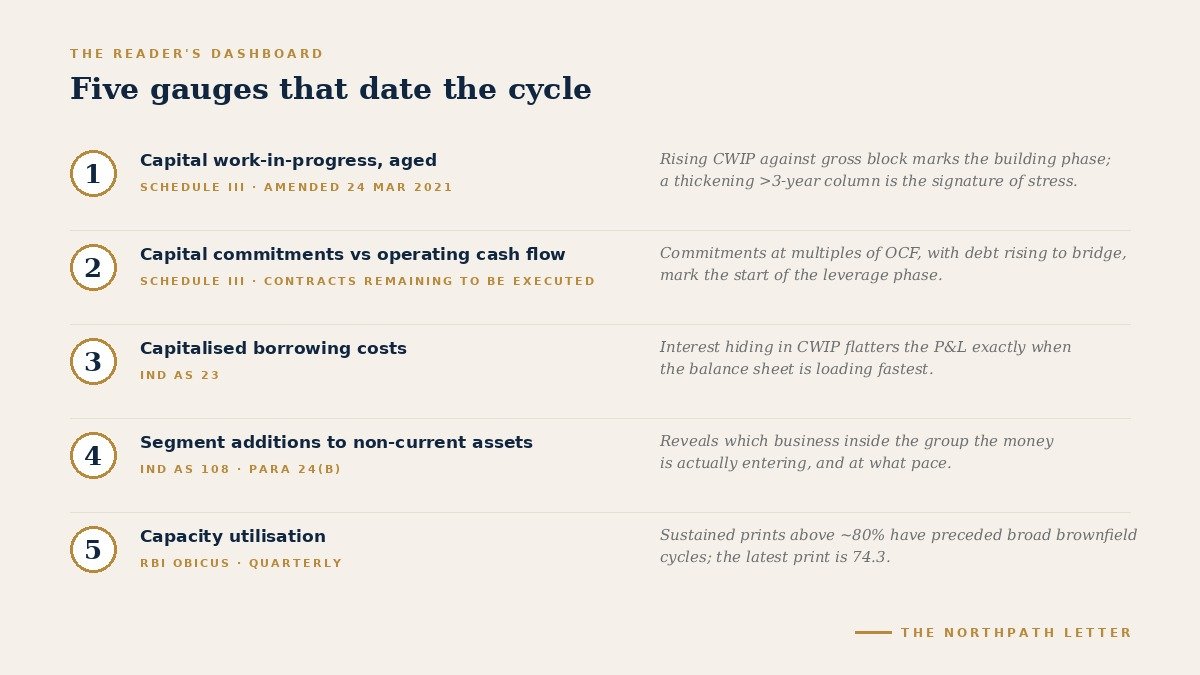
First, capital work-in-progress, and its age. Since the Ministry of Corporate Affairs amended Schedule III of the Companies Act 2013 (notification of 24 March 2021, effective FY22), every company must age its CWIP — less than one year, one to two, two to three, more than three — and separately disclose projects whose completion is overdue or whose cost has exceeded the original plan, including projects “temporarily suspended”. Rising CWIP relative to gross block across a sector is the signature of a cycle in its building phase; a thickening more-than-three-years column is the signature of 2011. The table did not exist during the last boom. It exists now. Use it.
Second, the capital-commitments note. Under Schedule III, every balance sheet discloses the “estimated amount of contracts remaining to be executed on capital account and not provided for” — the forward order book of the balance sheet, signed and contracted. Read it against operating cash flow. Commitments sitting comfortably inside a year’s operating cash generation describe a self-funded cycle; commitments at multiples of operating cash flow, with gross debt rising to bridge them, describe the leverage phase beginning. Aggregated across an industry’s annual reports, this one note reconstructs the private capex pipeline from primary documents — no announcement databases required.
Third, capitalised borrowing costs. Ind AS 23 requires disclosure of the interest capitalised during the year and the capitalisation rate used. During buildouts, interest migrates from the profit-and-loss account into CWIP, so reported earnings look cleanest exactly when the balance sheet is loading fastest. Compare capitalised interest with total interest cost, and the capitalisation rate with the visible cost of the company’s incremental debt; a wide gap in either comparison is a question for the audit committee, and for you.
Fourth, segment additions to non-current assets. Ind AS 108, paragraph 24(b), requires disclosure of additions to non-current assets by reportable segment. Group-level capex hides intent; segment-level additions reveal it — which business inside a conglomerate the money is actually entering, at what pace, and how that pace compares with the segment’s own results. Cross-reference with Form AOC-1 (Issue 11 of this letter) to identify which subsidiary vehicle carries the spend, and on whose borrowings.
Fifth, the macro cross-checks that cost nothing. The Reserve Bank’s quarterly OBICUS gives you the utilisation print (74.3 per cent at last reading; sustained prints above roughly 80 have historically preceded broad brownfield commitments). The RBI’s annual study of sanctioned project finance gives you the phasing of intentions into spend, which runs on one-to-three-year lags. Sectoral deployment data gives you where bank credit is actually flowing, as opposed to where announcements say it will. When these three agree with the company-level notes, believe the cycle. When the decks run ahead of the notes, believe the notes.
And one behavioural tell, free of charge: management discussion and analysis — required of every listed company under Regulation 34(2)(e) and Schedule V of the LODR — is written in the language of utilisation rates and project returns early in a cycle, and in the language of total addressable markets late in one. When the MD&A stops quoting capacity and starts quoting destiny, the cycle has left accounting and entered faith. That was as true of Mumbai in FY08 as it was of Shanghai in 2003.
The takeaway
India 2026 is not China 2003, and the difference is the investable part: a third less investment intensity, priced credit instead of conscripted savings, consequences for failure instead of socialised losses — so borrow the optimism if you must, but audit the cycle in the CWIP ageing tables and the commitments notes, where Indian booms have always confessed first, and not in the mirror of someone else’s miracle.
Important. All content on this site and in this email is journalism and education for a general audience. Nothing here constitutes investment advice or a recommendation in respect of any specific financial instrument, nor an offer or solicitation to buy or sell any security. Readers should consult an authorised financial adviser regulated in their own jurisdiction before making any investment decision.