Behavioural Finance · Afternoon Edition · No. 15
The NorthPath Letter · 10 June 2026 · Tallinn
Every textbook promises that mispriced securities are corrected by arbitrage: cold-eyed professionals spot the error, trade against it, and price snaps back to value. In 1997, Andrei Shleifer and Robert Vishny dismantled that promise in twenty pages. Real arbitrage is conducted with other people’s money, and other people lose their nerve at precisely the wrong moment. The consequence is one of the most useful facts in behavioural finance: mispricings can survive, and widen, exactly because the professionals paid to correct them cannot afford to stay in the trade.
The Idea: The Theory That Smart Money Always Wins
The intellectual foundation of efficient markets was never that every investor is rational. It was that the irrational ones do not matter. Milton Friedman put the case in 1953: traders who push prices away from value lose money to traders who push them back, so the destabilisers are gradually relieved of their capital and the stabilisers inherit the market. Arbitrage, in this telling, is the enforcement arm of efficiency. It requires no capital, carries no risk, and works instantly — the arbitrageur simultaneously buys the cheap asset and sells the identical dear one, pockets the difference, and waits, indifferent, for the gap to close.
The first crack in this edifice appeared in 1990, when Bradford De Long, Andrei Shleifer, Lawrence Summers and Robert Waldmann published “Noise Trader Risk in Financial Markets” in the Journal of Political Economy. Their observation was disarmingly simple: if prices are set partly by sentiment-driven “noise traders,” then a security that is cheap today can become cheaper tomorrow, because the sentiment that mispriced it can deepen before it reverses. An arbitrageur with an infinite horizon can shrug. An arbitrageur who can be forced out of the position before convergence cannot. Mispricing itself becomes a source of risk — and rational, risk-averse professionals will therefore attack it only timidly.
Shleifer and Vishny’s “The Limits of Arbitrage,” published in the Journal of Finance in March 1997 (vol. 52, no. 1, pp. 35–55), supplied the institutional half of the argument, and it is the half that matters most for the working investor. Textbook arbitrage is performed by anonymous atomistic traders risking their own wealth. Real arbitrage, they pointed out, is performed by a small number of highly specialised professionals — hedge funds, proprietary desks, dedicated value managers — deploying other people’s capital. Between the brains and the money sits an agency relationship. The clients who supply the capital cannot fully evaluate the manager’s reasoning; what they can observe is recent performance. And so they do what observable performance invites: they give money to managers who have just made money, and they take it away from managers who have just lost it.
The Mechanism: When Losses Confiscate the Ammunition
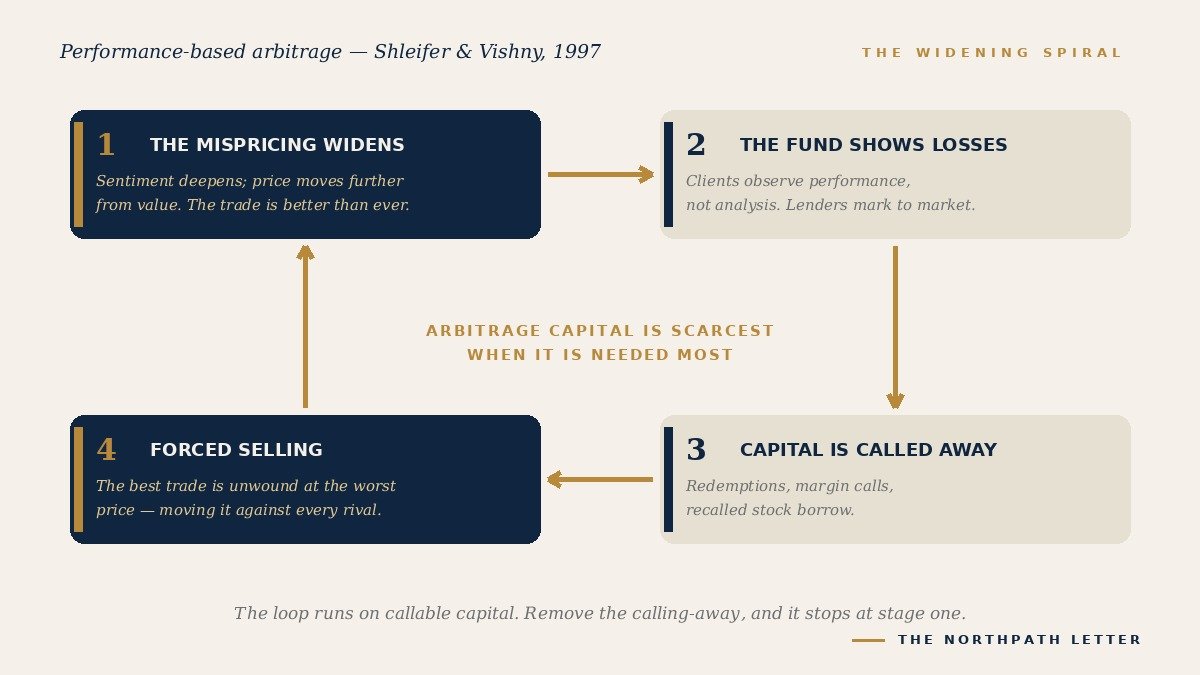
Shleifer and Vishny gave this dynamic a name — performance-based arbitrage — and traced its consequence with merciless clarity. Suppose a fund identifies a genuine mispricing and positions against it. Suppose the mispricing then widens, as noise-trader sentiment deepens. On the manager’s own analysis the trade is now better than ever: the same eventual convergence, bought at a larger discount. But the client does not see the analysis; the client sees a loss. Inferring that the manager may be less skilled than hoped, the client redeems. The fund must liquidate its best positions at the worst prices to return the money. The arbitrageur is at his weakest — commanding the least capital, facing the most redemptions — precisely when the opportunity is at its strongest.
Leverage tightens the same vice from a second direction. Most arbitrage is financed: positions are carried on margin, against collateral that is marked to market daily. A widening spread produces collateral calls, and collateral calls force the fund to shrink the very position whose expansion would be most profitable. Add the mundane frictions of short selling — borrow that can be recalled, fees that escalate exactly when a security becomes hard to borrow — and the textbook’s riskless, capital-free, instantaneous machine is revealed as risky, capital-hungry and slow.
Worse, the mechanism is self-reinforcing across firms. The professionals attracted to a genuine mispricing tend to find it at the same time, with the same models, financed by the same lenders. When the first fund is forced to unwind, its selling moves the price against every remaining holder of the trade, transmitting the margin call down the queue. The mispricing does not merely persist; the attempt to correct it, conducted with fragile capital, makes it temporarily worse. A saying long attributed to John Maynard Keynes — though no scholar has ever located it in his writings — summarises the result: the market can stay irrational longer than you can stay solvent. Shleifer and Vishny supplied the formal proof of the folk wisdom, and located its cause not in the madness of crowds but in the liability structure of the professionals betting against the madness.
The Empirical Record: Gaps That Refused to Close
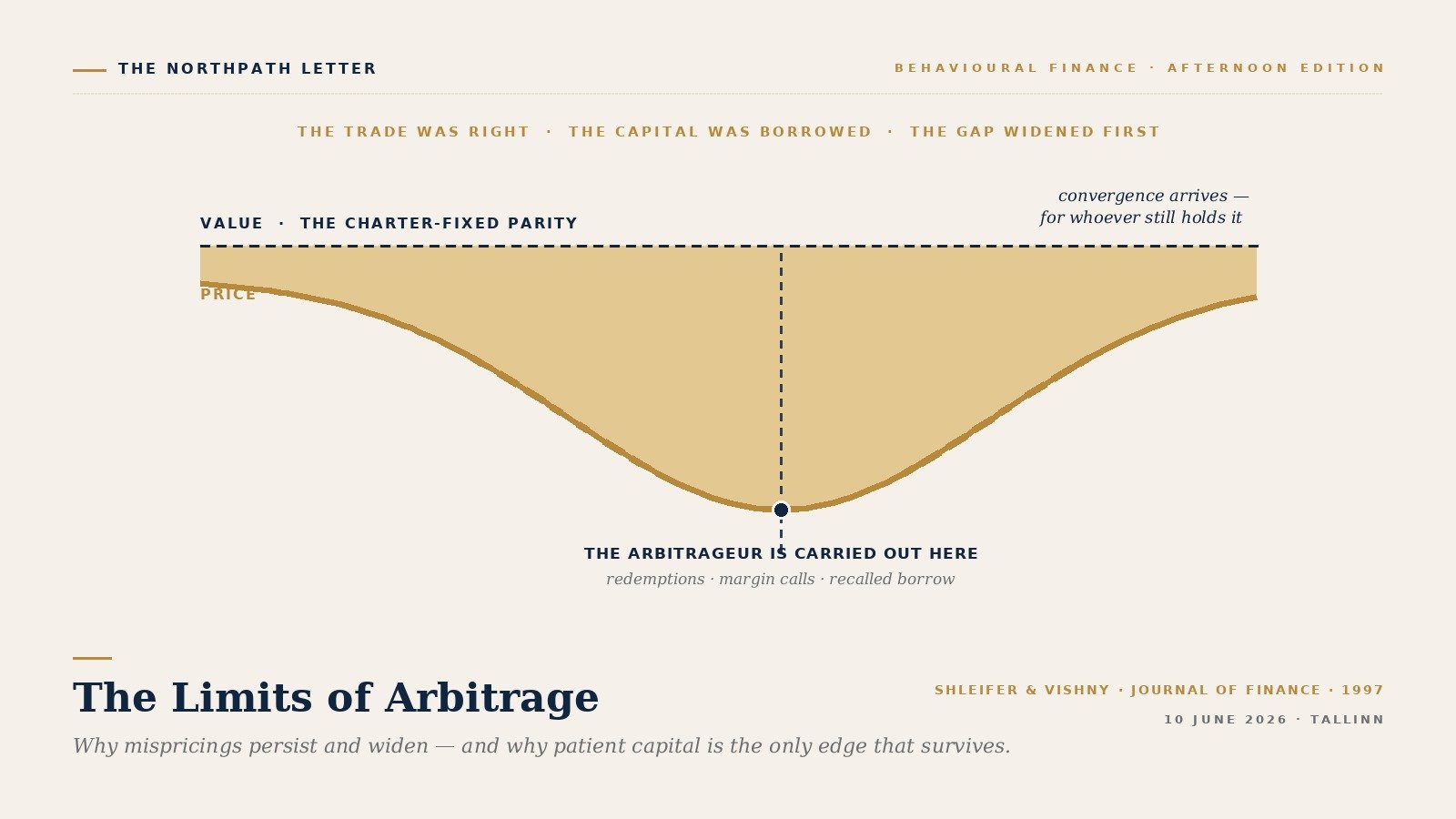
If arbitrage worked as the textbook promises, identical claims on identical cash flows could never trade at materially different prices. The record says otherwise. The cleanest laboratory is the corporate “twin.” From 1907 until 2005, Royal Dutch Petroleum and Shell Transport & Trading were two listed shells over one underlying enterprise, entitled by charter to a fixed 60:40 split of the group’s cash flows. The relative price of the two shares was therefore set by arithmetic, not opinion. Yet Kenneth Froot and Emil Dabora, in a 1999 Journal of Financial Economics study, documented that the pair deviated from 60:40 parity for decades — swinging from roughly 35 per cent too cheap to roughly 15 per cent too dear — with the deviation tracking the relative mood of the markets where each twin was most heavily traded. The gap outlived every fund that bet against it and disappeared only when the group unified into a single share class in July 2005.
The same lesson recurs across structures. Charles Lee, Shleifer and Richard Thaler showed in 1991 that American closed-end funds — portfolios whose contents are published daily — habitually trade well below the value of what they verifiably hold, with the discount widening and narrowing on retail sentiment. Mark Mitchell, Todd Pulvino and Erik Stafford, in “Limited Arbitrage in Equity Markets” (Journal of Finance, 2002), examined eighty-two situations between 1985 and 2000 in which a listed parent’s stake in a listed subsidiary exceeded the parent’s own market value — an apparent free lunch — and found that in roughly a third of them the link between the two securities was severed before prices ever converged. The free lunch could poison the diner.
Regulators have twice written the limits of arbitrage into the official record. In the United States, the President’s Working Group on Financial Markets — Treasury, Federal Reserve, SEC and CFTC jointly — published Hedge Funds, Leverage, and the Lessons of Long-Term Capital Management in April 1999, an autopsy of how a leveraged convergence portfolio can be destroyed by the widening of spreads it had correctly identified as anomalous, and of how the unwinding can endanger the system around it. In the United Kingdom, the Financial Services Authority on 18 September 2008 banned the short selling of financial-sector shares outright, with the American SEC following a day later for 799 financial stocks — an emergency demonstration that the freedom to arbitrage is itself a regulatory variable, withdrawable at the stroke of a pen in exactly the conditions when mispricing is most extreme. SEC chairman Christopher Cox conceded within months that, with hindsight, the agency would not impose the ban again; six European authorities nonetheless repeated the experiment, in coordination under ESMA, in March 2020. An investor who assumes the correction machinery will always be switched on has not read its operating licence.
Episode One: Long-Term Capital Management, 1998
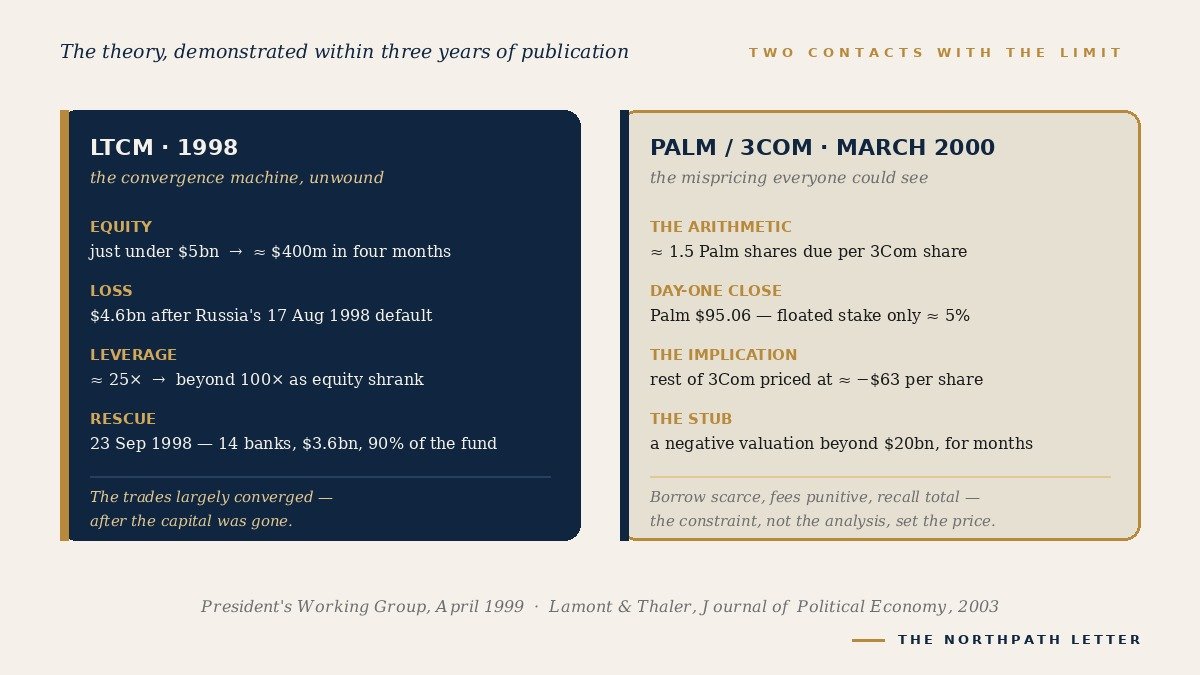
No episode illustrates the theory so completely as the fund that collapsed the year after the paper appeared. Long-Term Capital Management, founded in 1994 by the Salomon Brothers bond-arbitrage chief John Meriwether and counting the Nobel laureates Myron Scholes and Robert Merton among its partners, was the purest industrial expression of textbook arbitrage ever assembled: convergence trades across bond markets, equity pairs — including the Royal Dutch/Shell twin — and volatility, financed with extraordinary leverage. For four years it worked magnificently: returns after fees of roughly 20, 43, 41 and 17 per cent. At the start of 1998 the fund commanded just under $5 billion of equity against roughly $125 billion of assets — leverage of about twenty-five times — and so confident was the partnership that it had returned $2.7 billion of client capital at the end of 1997, concentrating the remaining bets on a smaller equity base.
On 17 August 1998 Russia defaulted on its domestic debt, and the world’s holders of risky spreads ran for shelter at once. Every spread LTCM had bet would converge widened instead — not because the trades were wrong, but because the other holders of those trades were being forced out, in the cascading sequence Shleifer and Vishny had described the year before. The fund lost $1.9 billion in August alone. As equity shrank, the leverage ratio exploded past one hundred times, collateral calls multiplied, and the fund could neither hold its positions nor sell them into a market emptied of arbitrage capital. By late September the equity was down to roughly $400 million — a loss of $4.6 billion in under four months. On 23 September 1998 the Federal Reserve Bank of New York convened fourteen of the fund’s counterparty banks, which injected $3.6 billion in exchange for 90 per cent of the fund, an orderly burial in place of a disorderly one. The bitterest detail is well documented: many of LTCM’s positions did eventually converge, in time to profit the consortium that had seized them. The analysis was largely right. The liability structure made the analysis irrelevant.
Episode Two: Palm and 3Com, March 2000
Eighteen months later the market staged a comedy on the same theme. On 2 March 2000, the networking company 3Com sold about 5 per cent of its handheld-computer subsidiary, Palm, to the public, announcing that each 3Com share would in due course receive roughly 1.5 shares of Palm in a spin-off. Arithmetic therefore set a floor: one share of 3Com was a claim on 1.5 shares of Palm plus the rest of 3Com’s profitable business and cash. By the close of Palm’s first trading day, Palm’s price implied that the rest of 3Com — the “stub” — was worth roughly minus $63 per share, a negative valuation of more than $20 billion for a profitable company. Owen Lamont and Richard Thaler dissected the case in a paper whose title asks the only necessary question: “Can the Market Add and Subtract?” (Journal of Political Economy, 2003).
The trade correcting it was obvious to every professional alive: short the dear Palm, hold the cheap 3Com. But Palm shares were nearly impossible to borrow — only 5 per cent of the company floated — borrow fees consumed much of the expected profit, and any borrow obtained could be recalled at the lender’s whim, forcing the arbitrageur to buy back into a frenzy. The mispricing was perfectly visible, perfectly measurable and perfectly defended, and it persisted for months rather than minutes. No exotic behavioural theory is needed to explain the buyers of Palm at those prices; extrapolative enthusiasm — a bias this series has examined before — supplies them in every boom. What requires explanation is why the professionals could not correct it, and the answer is Shleifer and Vishny’s: the correction machinery ran on constrained borrowing and callable capital, and the constraint, not the insight, set the price.
The Counter-Measure Framework: Three Disciplines
The limits of arbitrage are usually taught as a caution. Read carefully, they are an endowment — but only for the investor who builds three specific disciplines into the structure of his investing rather than into his intentions.
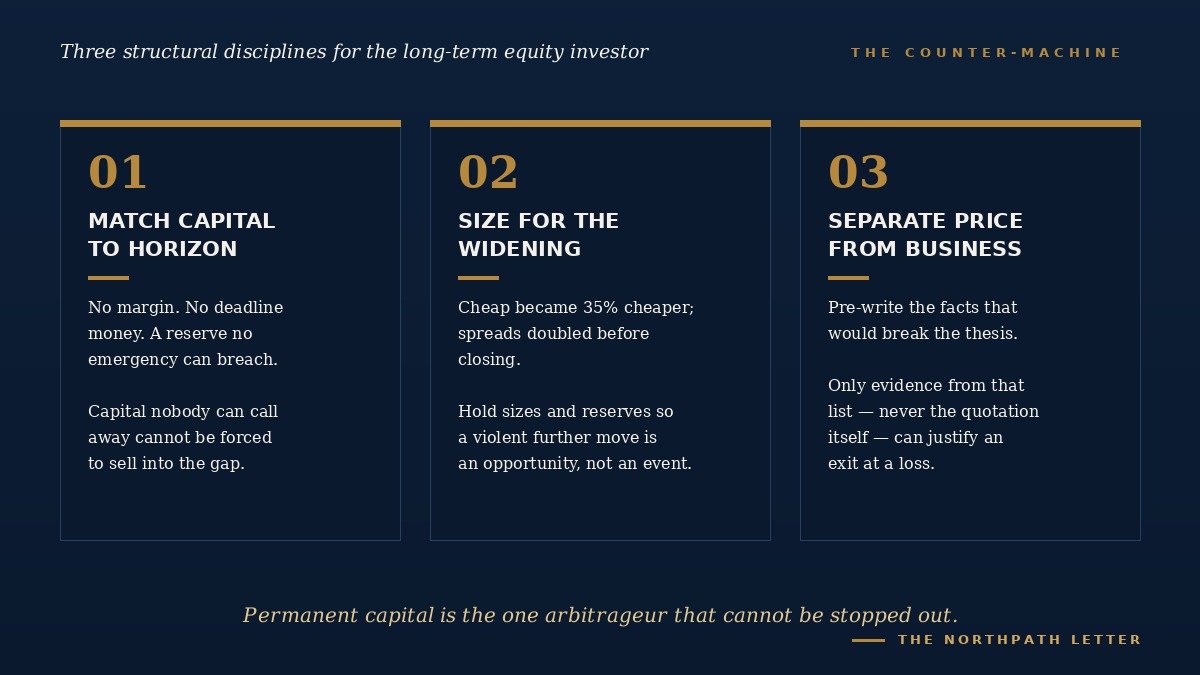
First: match your capital to your horizon, ruthlessly. Everything in Shleifer and Vishny’s machine runs on capital that can be called away — by clients, by margin clerks, by stock lenders. The private long-term investor holds the one structural advantage the greatest funds of the age did not: capital that answers to no one. But the advantage is forfeited the moment it is borrowed against, or committed to money needed on a deadline. An investor in quoted equities with a genuine ten-year horizon, no leverage and no obligation to report monthly cannot be forced to sell into a widening gap; he has amputated the transmission mechanism. The discipline is to treat that structure as sacred: no margin, no investing of funds with a known near-term claim on them, and a cash reserve sized so that no plausible emergency can ever reach the portfolio.
Second: size every position for the widening, not the thesis. The evidence above teaches a precise quantitative humility: cheap routinely became 35 per cent cheaper, and “anomalous” spreads doubled before they closed. The position size that is correct under the assumption “I have found the bottom” is reckless under the assumption “this discount can double and take years.” Sizing for the widening means holding positions small enough, and reserves large enough, that a further violent move against you is an opportunity rather than an event — the posture this letter examined in Seth Klarman’s doctrine of cash as a residual. The test of a position’s size is not whether it is justified by the analysis, but whether you could watch it halve without being forced, financially or psychologically, to act.
Third: separate price risk from business risk, in writing. The arbitrageur’s clients redeemed because they could not distinguish a manager who was wrong from a manager who was early; the same confusion operates inside a private investor’s own head. The counter-measure is to write down, at purchase, the facts that would actually impair the investment case — falling unit economics, balance-sheet deterioration, a competitor’s verified breakthrough — and to pre-commit that only evidence from that list, never the quotation itself, can justify an exit at a loss. A widening discount between price and your appraisal of value is, on its own, the Shleifer-Vishny signature: the look of other people’s capital being called away. This letter has examined where forced sellers come from; the present essay is the other half of that argument — why nobody with borrowed time and borrowed money will step in front of them for you.
How the Long-Term Practitioners Lived It
The clearest practitioner demonstration was running in real time while the academic ink dried. From mid-1998 to March 2000, Warren Buffett’s Berkshire Hathaway declined by nearly half while the Nasdaq more than doubled; Barron’s greeted the new millennium with a cover story titled “What’s Wrong, Warren?” (27 December 1999), suggesting the era had passed him by. Buffett’s structural position, however, was the precise inverse of LTCM’s: permanent capital inside a corporation, no redeemable units, no margin, and an insurance float that supplied liquidity rather than demanded it. Nobody could call his capital away, so the widening gap between price and value was, for him, merely weather. He had seen the other side of the trade at close range — Berkshire had been among the bidders for LTCM’s portfolio in September 1998 — and his letters from those years repeat the structural lesson in plain English: the market is there to serve the investor, not to instruct him, and borrowed money is how investors who are right go broke anyway.
Jeremy Grantham’s version cost more and proves more, because his capital was callable. His firm, GMO, refused to hold the great growth stocks of the late 1990s at the prices then prevailing, and underperformed for three consecutive years. Clients behaved exactly as performance-based arbitrage predicts: by Grantham’s own telling, roughly half the firm’s book of business in its core strategies walked out the door before the 2000–2002 bear market vindicated the position. Grantham’s subsequent writings made “career risk” — his name for the Shleifer-Vishny mechanism — the centrepiece of his explanation of why markets overshoot: the professional’s dominant incentive is never to be wrong alone, so the professional herds, and the investor who is structurally able to be wrong alone, for years, collects the premium the herd leaves behind. Seth Klarman compressed the same conclusion into a sentence that serves as this essay’s moral: the single greatest edge an investor can have is a long-term orientation.
Key Takeaways
- Arbitrage is a profession, not a law of physics. Shleifer and Vishny (1997) showed that real-world arbitrage runs on other people’s callable capital, and therefore weakens exactly when mispricing is greatest. Prices can be visibly, measurably wrong for years — Royal Dutch/Shell deviated from charter-fixed parity by up to 35 per cent for decades.
- Cheap can get cheaper before it gets corrected. Noise-trader risk (De Long et al. 1990) means a widening gap is the normal path of a closing one. LTCM lost $4.6 billion on trades that largely converged — after its capital was gone.
- The constraint sets the price. Palm/3Com’s negative stub persisted for months because borrow, fees and recall risk — not analysis — were the binding variables. Even regulators can switch the correction machinery off, as the 2008 UK and US short-selling bans showed.
- The private investor’s edge is structural, not intellectual. Permanent, unleveraged, patient capital cannot be redeemed at the bottom. That single fact — not superior forecasting — is what allowed Buffett and Grantham to hold positions through years of being “wrong.”
- Build the structure before you need it. No margin and no deadline money; positions sized to survive a doubling of the discount; a pre-written list of facts, never prices, that would end the thesis.
— Manish Goel, FCA / NorthPath Advisory OÜ / Tallinn, Estonia
|
Important. |