NorthPath Advisory · The NorthPath Letter · Behavioural Finance · Afternoon Edition
The Expected and the Realised: Kőszegi and Rabin’s 2006 Reference-Dependent Preferences, and Why a Long-Term Investor Feels a Gain He Hoped Would Be Larger as a Loss
Consider an investor who bought a business at a fair price, held it for three years, and watched it return nine per cent a year while the broad index returned six. On any objective ledger this is a success: real capital was preserved, the business compounded, the position beat its benchmark. Yet the investor is faintly disappointed, because when he bought he had quietly told himself the holding would compound at fifteen. The nine per cent he earned is measured, in the only court that sits inside his head, against the fifteen he expected. A gain has been recorded as a loss. Nothing about the company changed to produce that feeling; the reference point did. Understanding why the reference point — and not the outcome — governs how an investment feels is the subject of one of the most important papers in modern behavioural economics, and the discipline it demands is one of the least practised.
The bias: from the status quo to the expectation
The intuition that people judge outcomes as gains and losses rather than as final states of wealth is old. Harry Markowitz, a year after his foundational portfolio paper, argued in “The Utility of Wealth” (1952) that utility should be defined over changes from one’s customary level of wealth rather than over total wealth, anticipating by a generation the idea that a reference point matters. The idea acquired its modern architecture when Daniel Kahneman and Amos Tversky published prospect theory in “Prospect Theory: An Analysis of Decision under Risk” (Econometrica, 1979), proposing that the carrier of value is the deviation from a reference point, that the value function is steeper for losses than for equivalent gains — loss aversion — and that it is concave in gains and convex in losses. Prospect theory told us that the reference point is decisive. It was conspicuously silent on what the reference point actually is.
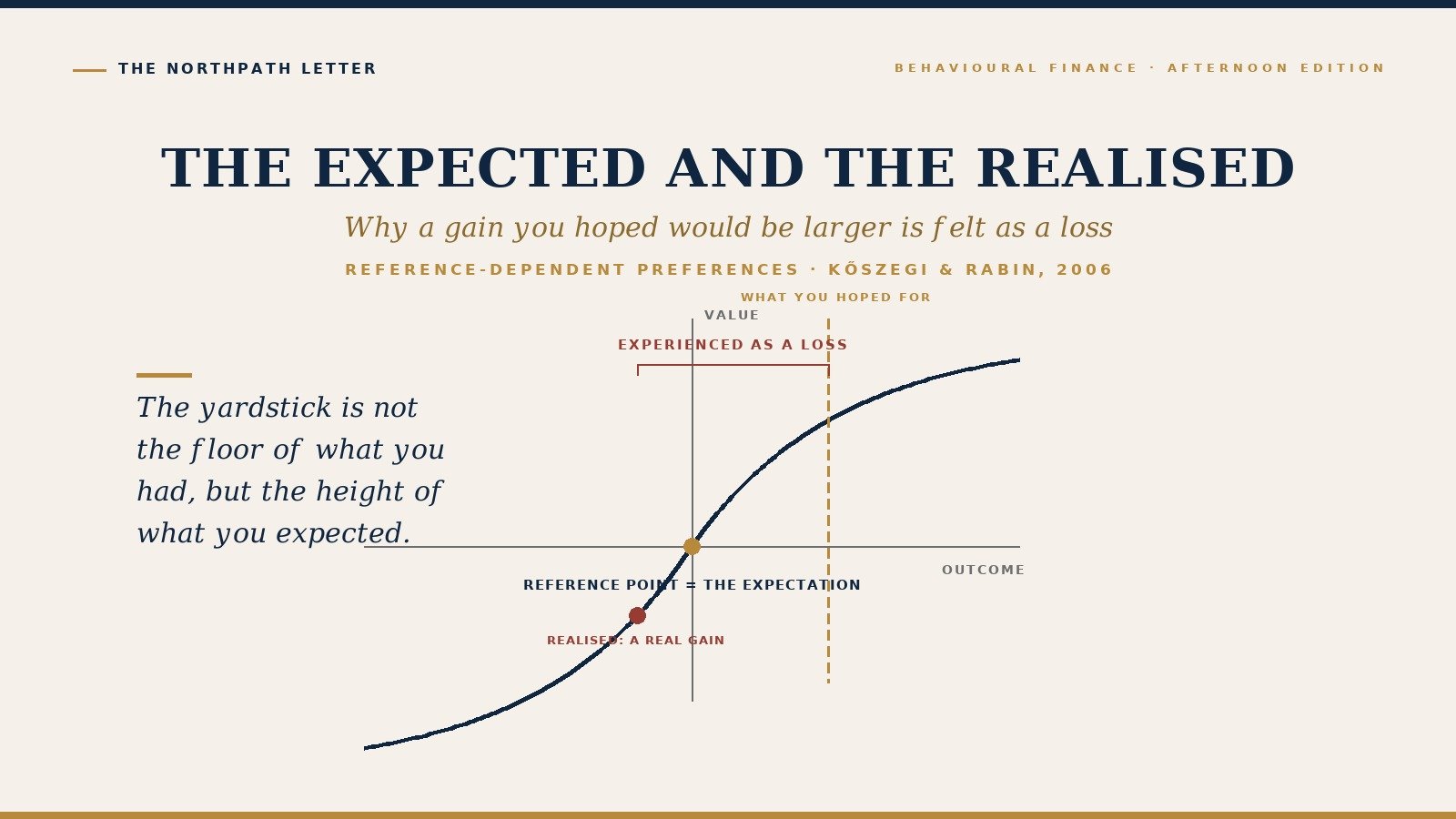
That silence is the gap Botond Kőszegi and Matthew Rabin closed in “A Model of Reference-Dependent Preferences,” published in the Quarterly Journal of Economics in November 2006 (volume 121, issue 4, pages 1133–1165). Their contribution is deceptively simple and quietly radical: the reference point is a person’s recent rational expectations about outcomes. It is not the status quo, not the purchase price, not yesterday’s closing quote — it is what the person, in the recent past, expected to happen. A decision-maker derives ordinary “consumption utility” from final outcomes and, layered on top, a “gain–loss utility” measured against the expectations he held a short while before. Because those expectations are themselves shaped by the choices he plans to make, Kőszegi and Rabin require the reference point to be fixed in what they call a personal equilibrium: expectations must be consistent with the behaviour they rationalise. The reference point, in other words, is endogenous. It moves.
For an investor this reframing is profound. If the reference point were the status quo, an asset that rose would always feel like a gain. If the reference point is the expectation, an asset can rise — genuinely, in cash, in real terms — and still register as a loss, provided it rose by less than was hoped. The disappointment of the nine-per-cent compounder is not irrational confusion; it is the precise prediction of a model in which the yardstick is the forecast, not the floor.
The mechanism: a moving yardstick
The cognitive architecture has three moving parts, and each carries an investing consequence. The first is that total experienced utility is the sum of consumption utility and gain–loss utility. The dollars an investment delivers are real and they matter; but bolted onto them is a second, comparative term that can swamp the first. A portfolio up modestly against a soaring expectation can feel worse than a portfolio flat against a modest one.
The second part is loss aversion within the gain–loss term, inherited intact from prospect theory: the pain of falling a given distance below the reference point is roughly twice the pleasure of rising the same distance above it. The United Kingdom’s Financial Conduct Authority, summarising the evidence in its first Occasional Paper, “Applying behavioural economics at the Financial Conduct Authority” (Erta, Hunt, Iscenko and Brambley, April 2013), put the regularity plainly: people “feel the pain of a loss roughly twice as much as they feel the pleasure of an equivalent gain,” and they evaluate outcomes “relative to a reference point.” The asymmetry means that the cost of a disappointed expectation is not symmetric with the benefit of an exceeded one — which is why managing one’s own expectations is not mere temperament but a form of risk control.
The third part — the genuinely new one — is that the reference point is the expectation, and the expectation is endogenous. Because hopes adjust to recent experience, the yardstick chases the outcome. A holding that doubles resets the investor’s expectation upward, so that the next year of merely good performance is measured against the doubled base and feels thin. This is the hedonic treadmill rendered in portfolio terms: the better an investment has done, the higher the bar it must clear merely to avoid registering as a disappointment. The investor is not chasing returns so much as being chased by his own adapting reference point.
Kőszegi and Rabin pressed the idea one step further in a companion paper, “Reference-Dependent Risk Attitudes” (American Economic Review, volume 97, 2007, pages 1047–1073), where they showed that an investor’s appetite for risk is itself a function of his expectations. When a person expects a calm, certain outcome, any dispersion around it is felt as the threat of a loss, and he behaves with exaggerated caution; when he has already braced for a wide range of outcomes, the same dispersion is absorbed without distress. The practical reading is sharp. Two investors holding the identical security can experience its ordinary volatility in opposite ways purely because one expected serenity and the other expected turbulence. The asset’s risk did not change; the reference point against which its swings were scored did. An investor who walks in expecting a smooth ride converts ordinary market noise into a sequence of felt losses, and is therefore most likely to abandon a sound position at exactly the moment its discomfort peaks.

The empirical record: the disposition effect and the regulators
If reference-dependence governed only feelings it would be a curiosity. It governs behaviour, and the cleanest fingerprint in the data is the disposition effect — the documented tendency to sell winners too early and hold losers too long, precisely as a purchase-price reference point and loss aversion would predict. Hersh Shefrin and Meir Statman named and framed it in “The Disposition to Sell Winners Too Early and Ride Losers Too Long” (Journal of Finance, 1985), arguing that investors anchor on the price they paid and are reluctant to “close the mental account” at a loss. Terrance Odean tested it directly in “Are Investors Reluctant to Realize Their Losses?” (Journal of Finance, volume 53, 1998, pages 1775–1798), examining the trading records of 10,000 accounts at a discount brokerage. He found a strong and persistent preference for realising gains over losses; the behaviour was not explained by portfolio rebalancing or by the trading costs of low-priced shares, and, for taxable accounts, it was actively costly, lowering after-tax returns because winners sold attract tax while losers held forgo a deduction. The investor was not following an edge. He was protecting a reference point.
Regulators in different jurisdictions have converged on the same diagnosis from the supervisory side. The FCA paper cited above treats reference-dependence and loss aversion as first-order features of retail decision-making and as levers that firms can exploit — framing a premium against an inflated reference point, for instance, to make a product feel like a saving. From a more international vantage, the International Organization of Securities Commissions, working with the OECD, published “The Application of Behavioural Insights to Financial Literacy and Investor Education Programmes and Initiatives” (Report FR10/2018, 30 May 2018), surveying how securities regulators across member jurisdictions are using behavioural findings — reference points, loss aversion, anchoring — to design investor-education programmes and to test interventions against control groups. When the conduct regulator of one major market and the umbrella body of the world’s securities regulators both build their consumer-protection thinking on the proposition that investors judge outcomes against shifting reference points, the long-term investor is entitled to take the proposition seriously about himself.
Two historical episodes
Markets supply the laboratory. Two episodes, four decades apart, show the same machinery: a price that came to embody an expectation, and the long punishment that followed when reality merely failed to exceed it.
The first is the Nifty Fifty of the early 1970s — a cohort of large, admired American growth companies that institutional investors bought as “one-decision” holdings on the premise that quality justified almost any multiple. By late 1972 the group traded at an average of roughly 41.9 times earnings against about 19 times for the S&P 500, and the most fashionable names carried valuations that priced in flawless expectations: Polaroid near 91 times earnings, Avon near 65, Xerox near 49. The prices were not forecasts of good results; they were forecasts of perfect ones. When the 1973–74 bear market arrived, the S&P 500 fell about 45 per cent, but the stocks that had encoded the highest expectations fell furthest — Polaroid by roughly 91 per cent, Avon by around 86, Xerox by about 71. Several of these were sound businesses that went on earning. What had been destroyed was not, in the main, the companies; it was the expectation embedded in their price. An investor who anchored on the 1972 quote spent years measuring a recovering, profitable enterprise against a reference point set at the moment of maximum optimism, and experienced every intervening year as a loss.
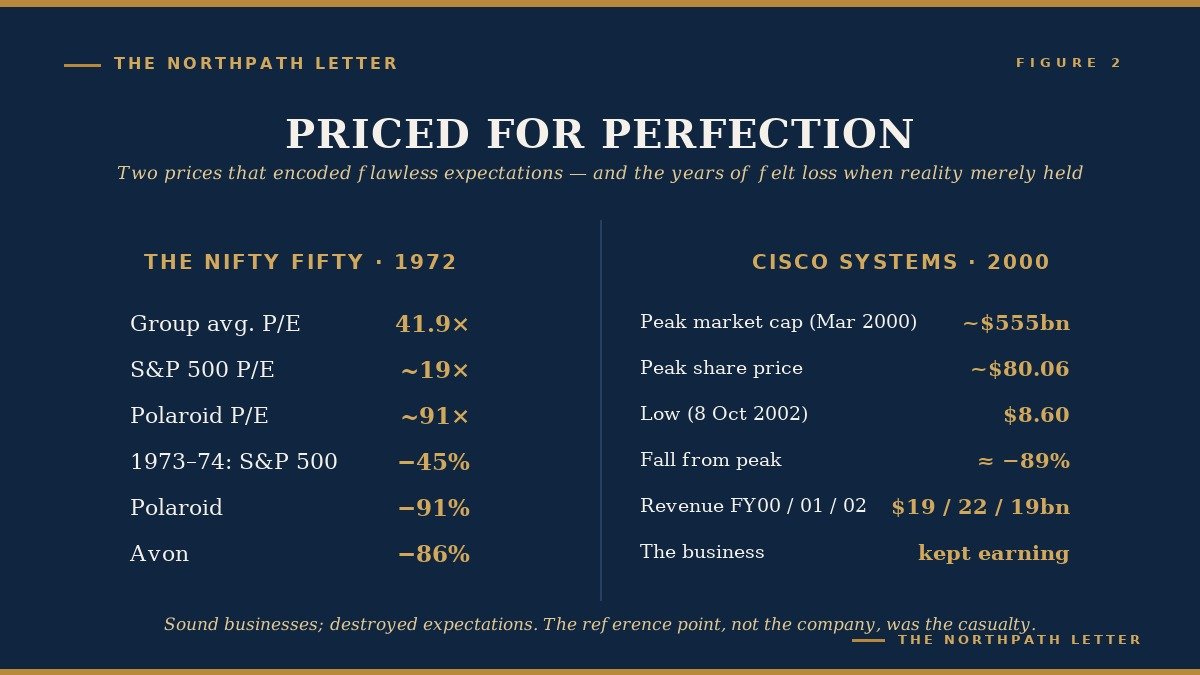
The second episode is Cisco Systems at the crest of the dot-com boom. In March 2000 the company briefly became the most valuable in the world, with a market capitalisation near 555 billion dollars and a share price around 80 dollars, a level that priced in expectations of near-perpetual hyper-growth. The expectation, not the business, then collapsed: the shares fell to 8.60 dollars by 8 October 2002, a decline of roughly 89 per cent from the peak, erasing on the order of 431 billion dollars of market value. The instructive part is what the business did in the same window. Revenue was about 19 billion dollars in fiscal 2000, roughly 22 billion in 2001, and about 19 billion in 2002 — the enterprise did not implode; it kept selling the equipment that ran the internet. The premium evaporated because the expectation that justified it was never attainable. For the shareholder who bought near the top and fixed his reference point at 80 dollars, a company that continued to earn billions delivered, year after year, the felt experience of loss. Reference-dependence is the bridge between those two facts — a durable business and a devastated holder.
The counter-measure framework: three disciplines
If the reference point is the enemy, the defence is to take control of it deliberately rather than let it be set by the last quote, the purchase price, or the hope one happened to be holding. Three disciplines do most of the work.
First, write the expectation down before the outcome is known. Reference-dependence does its damage because the expectation is fuzzy, unrecorded and therefore free to drift upward in memory to whatever level makes the present feel worst. The antidote is to commit, at the moment of purchase, to an explicit and modest base case: the range of business results that would make the investment a success, written and dated. A pre-committed reference point cannot migrate to the peak after the fact. When the holding later compounds at nine against a recorded expectation of eight, the investor reads a success, because the yardstick was fixed before the hedonic treadmill could raise it.
Second, value against intrinsic value, never against cost. The disposition effect is reference-dependence wearing the purchase price as its anchor. The cure is to make every hold-or-sell decision a fresh comparison between today’s price and a current estimate of the business’s worth — a number that knows nothing of what was paid. Whether the position shows a paper gain or a paper loss is information about the past and about tax, not about the future. An investor who can genuinely ask “would I own this at today’s price, ignoring my cost?” has disarmed the single most expensive reference point in the data.

Third, keep two ledgers and never let the price ledger overwrite the business ledger. The Cisco and Nifty Fifty episodes are dangerous precisely because the business result and the price result diverged for years. Recording them separately — what the company earned, distributed and reinvested in one column; what the quote did in another — prevents the comparative gain–loss term from masquerading as fundamental news. The business ledger is where consumption utility lives; the price ledger is where the moving reference point plays its tricks. An investor who reviews the first before glancing at the second has put the durable term ahead of the volatile one.
How long-term-equity practitioners addressed it
The best practitioners arrived at these disciplines without the equations, by treating expectations as the thing to be managed. Howard Marks of Oaktree Capital has argued across his memos that investment outcomes are driven less by what happens than by what happens relative to what was expected, and that price is simply the market’s expectation made numerical; his insistence that “it’s not what you buy, it’s what you pay” is, in the vocabulary of this essay, a warning that the price you pay sets the expectation against which every future result will be judged. Buy at a price that embeds modest expectations and ordinary results feel like gains; buy at a Nifty-Fifty price and only perfection avoids the experience of loss. Marks’s discipline is, in effect, the deliberate purchase of a low reference point.
Seth Klarman of the Baupost Group built the complementary defence on the sell side. In Margin of Safety (1991) he insists that an investment be judged against a conservative estimate of intrinsic value rather than against its quoted price or its cost, and he is explicit that the purchase price is irrelevant to whether one should hold today — the textbook antidote to the disposition effect’s purchase-price anchor. Klarman’s refusal to let a paper loss dictate a sale, or a paper gain provoke one, is reference-independence practised as method. Charlie Munger framed the same idea at the level of temperament, observing that a reliable route to a satisfactory life — and, by extension, a tolerable investing experience — is to hold low expectations, so that reality is forever clearing the bar rather than tripping over it. Three formulations, one insight: own your reference point before it owns you.
Key takeaways
- The reference point is the expectation, not the status quo. Kőszegi and Rabin (2006) showed that we measure outcomes against our recent rational expectations, so a real gain that falls short of what we hoped is experienced as a loss.
- The yardstick moves, and it moves against you. Because expectations adapt upward to recent success, each good year raises the bar the next must clear — a hedonic treadmill that makes disappointment the default for the very holdings that have done best.
- The behaviour is measurable. The disposition effect (Shefrin–Statman 1985; Odean 1998, on 10,000 accounts) is reference-dependence in the trading record — selling winners early, riding losers down — and it lowers after-tax returns.
- History repeats the lesson. The Nifty Fifty (average ~41.9× earnings in 1972) and Cisco (a ~555-billion-dollar peak in 2000 against a business that kept earning) show prices that encoded perfect expectations and the years of felt “loss” that followed when reality merely failed to exceed them.
- The defence is to seize the reference point. Record a modest expectation before the outcome is known; value against intrinsic worth rather than cost; and keep the business ledger separate from the price ledger so the moving yardstick cannot pose as news.
— Manish Goel, FCA / NorthPath Advisory OÜ / Tallinn, Estonia
|
Important. |