Behavioural Finance · Afternoon Edition · No. 17
The NorthPath Letter · 12 June 2026 · Tallinn
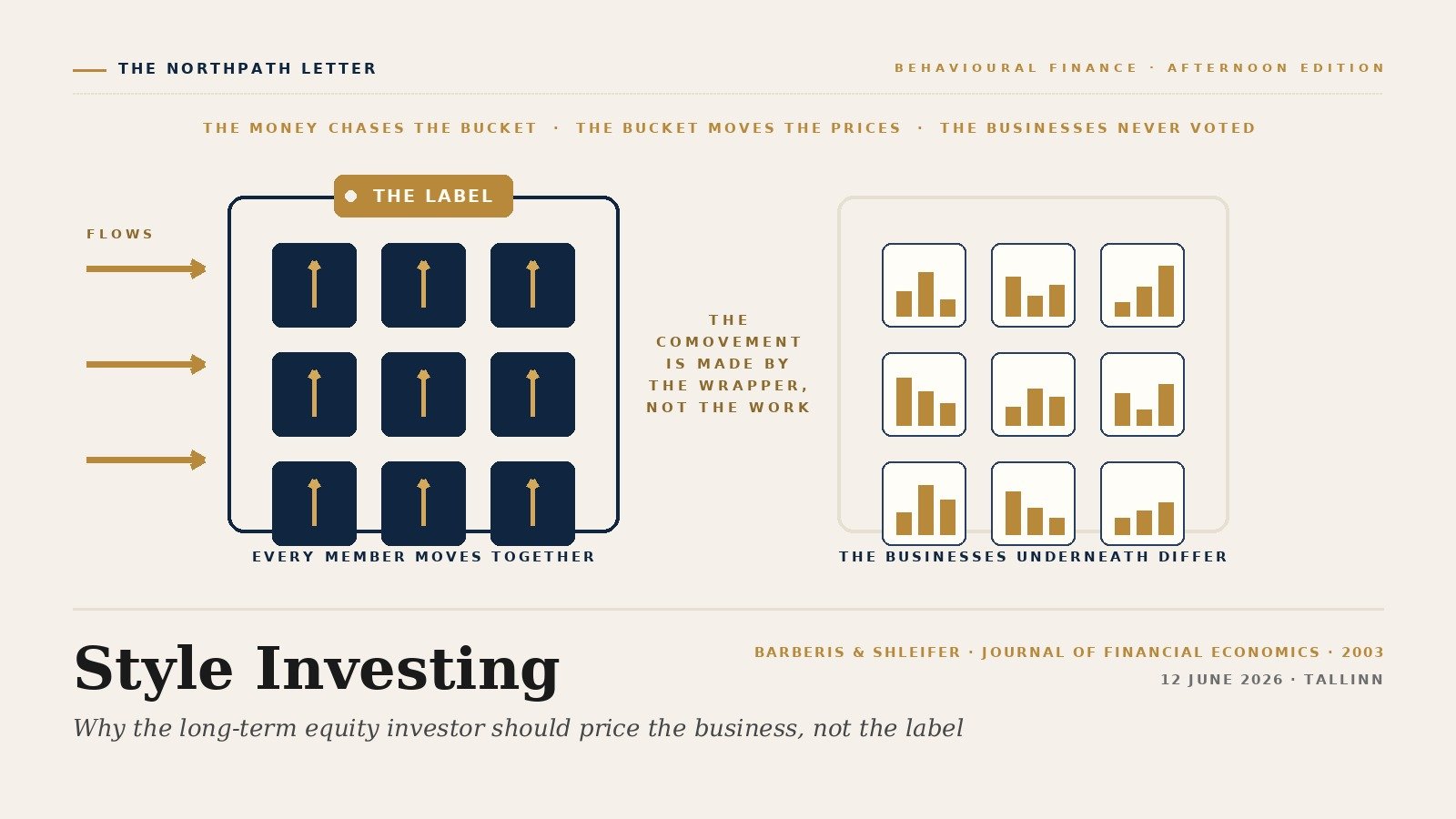
In 2003 Nicholas Barberis and Andrei Shleifer published a model built on an observation so ordinary that most of the industry had stopped noticing it: investors do not allocate money security by security. They allocate it category by category — value and growth, large and small, tech and energy, emerging and developed, and lately whatever theme has a ticker. They called the habit style investing, and they showed that it has a price. When money moves in buckets, the contents of each bucket begin to move together, whether or not the businesses inside have anything in common beyond the label on the outside. The long-term equity investor who has never heard of the paper lives with its consequences daily: positions that reprice because of what they are called rather than what they earn.
The Bias: The Mind That Allocates in Bulk
“Style Investing,” published in the Journal of Financial Economics in 2003, begins with a fact of professional life. Pension consultants carve the equity universe into style boxes. Mandates are written by category. Fund families launch products by category. Performance is reported, ranked, and rewarded by category. None of this is irrational in isolation — categories make an unmanageable universe manageable — but Barberis and Shleifer asked what happens to prices when the categories, rather than the securities, become the unit of choice.
Their model needs only two kinds of participant. The first they call switchers: investors who compare the recent performance of one style against another and move money toward whichever has lately done better. The second are fundamental traders who lean against the resulting distortions. The machinery then runs on its own. A style that has outperformed attracts flows; the flows lift every member of the style, which improves the style’s record, which attracts further flows. Prices of assets that share a label begin to comove far more than their cash flows do, and entire categories overshoot and then retrace in long, slow arcs. The model’s predictions were specific: returns should show style-level momentum at horizons of months and style-level reversal at horizons of years; an asset reclassified from one category to another should change its comovement without any change in its business; and money leaving one style should surface as correlated pressure in its habitual rival rather than everywhere at once.
It is worth fixing what the bias is not, because it has well-documented neighbours in this series. Extrapolation — the habit of forecasting a future that resembles the recent past, treated in its own right in this Letter — supplies the fuel: the switcher is an extrapolator. But the categorical architecture is the pipework, and the pipework is the novelty. Salience is about which attribute of a security seizes attention; categorisation is about which securities get filed together before any attribute is weighed at all. And where the hot-stove effect describes one painful draw poisoning an investor’s private estimate of a whole class, style investing describes the public, mechanical version: flows at the level of the class repricing every member at once, with no experience required.
The Mechanism: Why the Mind Files Before It Thinks
The cognitive machinery underneath is older than finance. In the 1970s the psychologist Eleanor Rosch demonstrated that human beings do not store the world item by item; they store prototypes and file new objects into the nearest category — cognitive economy, her 1975 paper in the Journal of Experimental Psychology called it: the mind declines to pay full attention to each member of a class it has already named. Sendhil Mullainathan’s 2002 working paper “Thinking Through Categories” carried the idea into economics: agents who think in coarse categories transfer information across category members, so news about one member moves beliefs about all of them. Roland Fryer and Matthew Jackson later formalised the same point — categorical thinkers systematically misprice the atypical member, because the category average does its thinking for it.
Equity markets are a near-perfect habitat for this machinery. The investable universe runs to tens of thousands of listed securities; nobody underwrites them one at a time. Compression is not a character flaw — it is the only way the task can be attempted at all. The trouble is that modern market structure has industrialised the compression. Style boxes turn categories into mandates. Benchmarks turn categories into careers. Index funds and exchange-traded funds turn categories into instruments, so that a view on a label can be executed in size, in seconds, without ever meeting the businesses inside. The switcher of 2003 needed patience; today the category trade is the path of least resistance.
One more connection inside this series belongs here. The reader may object that rational arbitrage should iron all of this out: if flows into a bucket lift a business above what its cash flows justify, somebody should take the other side. The Letter’s essay on the limits of arbitrage explains why the ironing is partial. The arbitrageur who leans against a style wave faces the risk that the wave runs for years — style momentum is precisely the evidence that it does — and capital that answers to impatient clients cannot stay short a popular label for years. Categorical mispricing persists for the same reason most mispricing persists: the people best placed to correct it are the people least able to wait.
The Empirical Record: Comovement Without Fundamentals
The cleanest evidence comes from borders — moments when a security crosses into or out of a category while the business stays exactly where it was. Barberis, Shleifer and Jeffrey Wurgler studied additions to the S&P 500 between 1976 and 2000 and published the result in a 2005 paper titled, simply, “Comovement.” Upon inclusion, a stock’s daily beta with the index rises materially — in their post-1988 subsample by roughly a third — and stocks removed from the index show the symmetric decline. Nothing about the business changes on the effective date. What changes is the company the stock keeps: it is now traded in the index’s rhythm, repriced by flows aimed at five hundred names at once.
Brian Boyer sharpened the point in 2011 with an almost comically clean experiment. The S&P/Barra value and growth indices then assigned every stock to one label or the other by a mechanical book-to-market cutoff, so each year a band of nearly identical companies swapped labels for no economic reason whatever. The label-switchers promptly began to comove with their new family and stopped comoving with the old one. Robin Greenwood found the same arithmetic in Japan around the April 2000 redefinition of the Nikkei 225, where stocks’ excess comovement tracked their index weights rather than anything in their accounts. And the effect is not confined to indices. Michael Cooper, Huseyin Gulen and Raghavendra Rau showed in 2005 that mutual funds which simply renamed themselves toward whatever style was hot attracted on the order of 28 per cent of additional inflows over the following year, with no detectable improvement in performance — and the inflows arrived even when the portfolio behind the new name had not changed.
The modern wrapper for the habit is thematic. Itzhak Ben-David, Francesco Franzoni and co-authors documented in the Review of Financial Studies in 2023 that specialised, theme-labelled exchange-traded products tend to launch close to the peak of enthusiasm for their theme and, on the authors’ estimates, deliver something like thirty per cent of risk-adjusted underperformance over their first five years — the price of admission for arriving when the label was loudest.
Regulators on both sides of the Atlantic have concluded that labels move money and therefore need policing. In the United States, the Securities and Exchange Commission amended its fund Names Rule in September 2023, extending the requirement that a fund invest at least 80 per cent of its assets in line with what its name suggests to names invoking growth, value, and sustainability characteristics — a rule whose premise is precisely Barberis and Shleifer’s: investors allocate to the noun. In the European Union, ESMA published guidelines in May 2024 imposing an 80 per cent alignment standard on funds whose names use ESG or sustainability-related terms, with application dates through May 2025; by Morningstar’s running count, several hundred European funds renamed themselves as the deadlines approached — a quiet, continent-wide admission of how much of the asset base had been gathered by vocabulary. The United Kingdom’s FCA reached the same conclusion by another route, with an anti-greenwashing rule in force from May 2024 and prescribed investment labels shortly after — a label that must be earned by regulation is a label previously priced on trust.
Episode One: The Name Game, 1998–2001 — and Its 2017 Encore
The purest natural experiment in category thinking required no index committee at all — only a corporate secretary and a press release. Between June 1998 and July 1999, Michael Cooper, Orlin Dimitrov and Raghavendra Rau tracked 95 listed companies that changed their names to include “.com,” “.net,” or “Internet.” The paper, “A Rose.com by Any Other Name,” appeared in the Journal of Finance in 2001 and reported cumulative abnormal returns on the order of 74 per cent for the ten days around the announcement. The detail that elevates the study from curiosity to indictment is its indifference to substance: companies whose actual involvement with the internet was minimal or nil enjoyed the inflation as fully as the genuine articles. The market was not pricing a business plan. It was pricing a suffix.
The sequel is crueller. After the crash, a companion study in the Journal of Corporate Finance followed firms that deleted the dot-com from their names during 2000 and 2001 — and found abnormal returns on the order of 60 per cent for the deleters. The same word had now been paid for twice: once on the way in, once on the way out. No clearer demonstration exists that the category, not the company, was the thing being traded.
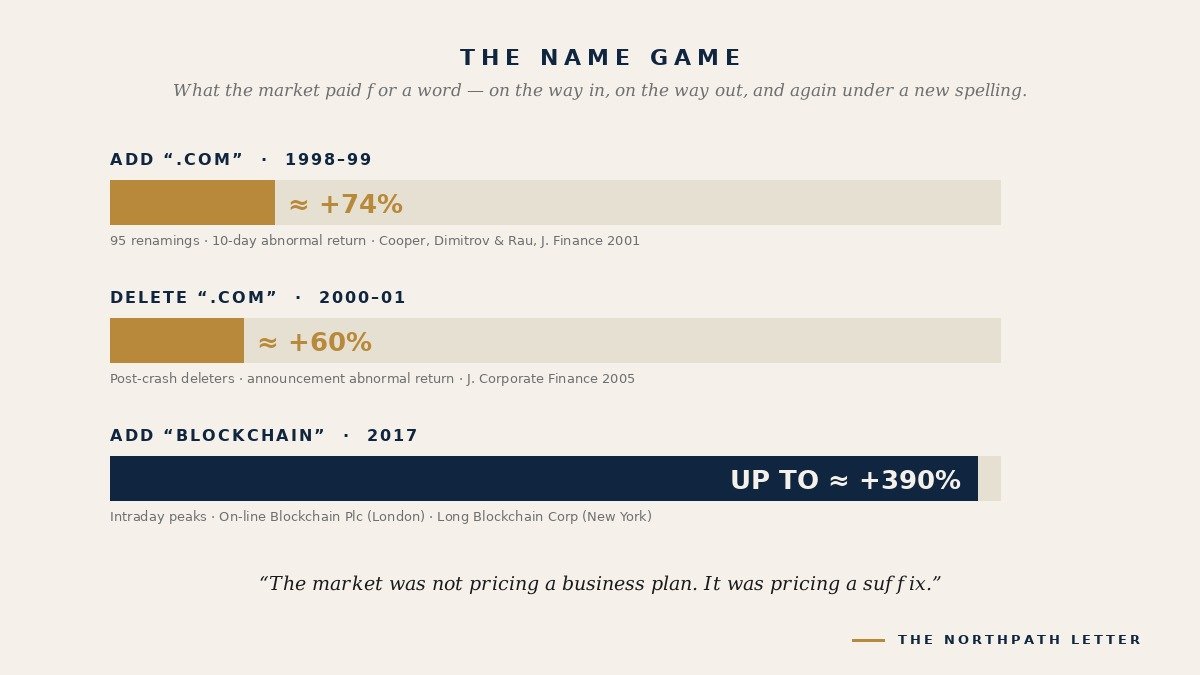
Two decades later the experiment re-ran itself with a new vocabulary. In October 2017 a small London-listed software firm, On-line Plc, announced it would become On-line Blockchain Plc; its shares rose by close to 400 per cent at the intraday peak. In December 2017 the Long Island Iced Tea Corporation — a maker of bottled beverages — announced it would become Long Blockchain Corp; the stock rose nearly 300 per cent intraday on the announcement. It was removed from its exchange within months, and in 2021 the SEC brought insider-trading charges against traders tipped ahead of the announcement. In January 2018 Eastman Kodak announced a blockchain-licensing venture and roughly trebled in two sessions. The response of the American regulator was unusually plain. The SEC suspended trading in The Crypto Company in December 2017 and in UBI Blockchain Internet in January 2018, and Chairman Jay Clayton announced in January 2018 that the Commission was “looking closely at the disclosures of public companies that shift their business models to capitalize on the perceived promise of distributed ledger technology.” A regulator does not police nouns unless nouns are setting prices.
Episode Two: Membership Is Not a Business Event
The second episode is slower, larger, and entirely legal: the index effect, the name game played by committee. On 30 November 1999, Standard & Poor’s announced that Yahoo would join the S&P 500 at the close of 7 December. In the five trading sessions between announcement and effectiveness, the stock rose by roughly 60 per cent. Nothing in Yahoo’s business changed that week. What changed was its category: every dollar indexed to the S&P 500 was now contractually obliged to own it, immediately, at whatever price the transition demanded.
Twenty-one years later the same border crossing produced the largest categorical purchase in market history. S&P Dow Jones announced after the close on 16 November 2020 that Tesla would enter the index on 21 December 2020, in a single tranche. Between announcement and effectiveness the stock rose by roughly 70 per cent, as index-tracking funds prepared to take on stock estimated at the time at around 80 billion dollars — the largest rebalancing trade the index had ever required. Whatever one’s view of the business — and this Letter offers none — the five-week repricing was not about the business. It was about the bucket. The company earned its place under the committee’s rules; the price move was the sound of a category being forced to make room.
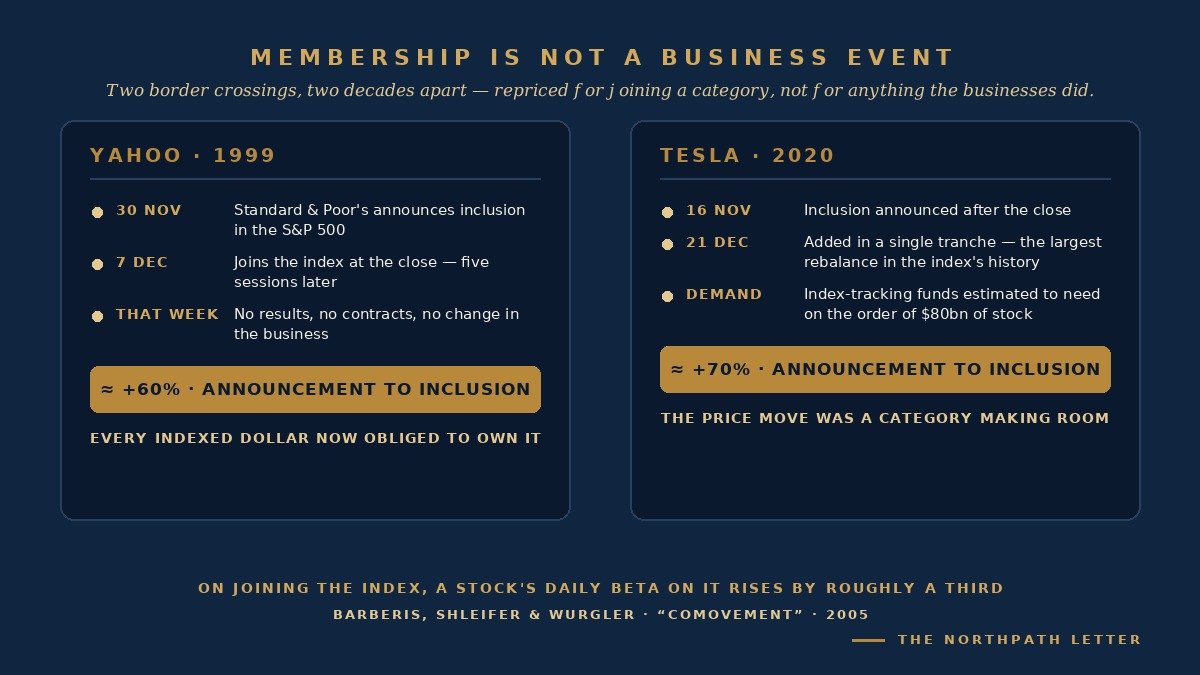
And after the border is crossed, the comovement begins — the Barberis–Shleifer–Wurgler finding that index members move like the index, having moved like themselves before. For the long-term investor the implication cuts in both directions. A position can be lifted or sunk for quarters at a time by flows aimed at its category rather than its accounts; the investor who mistakes that tide for information will be taught an expensive lesson in attribution. But the same tide is, occasionally, a gift: the category in liquidation marks down its dullest, least typical member with the same indiscriminate hand as its poster child, and the investor who underwrites businesses rather than buckets is the natural counterparty — provided, as the limits-of-arbitrage essay insisted, that the capital doing the waiting cannot be called away.
The Counter-Measure: Three Disciplines Against the Label
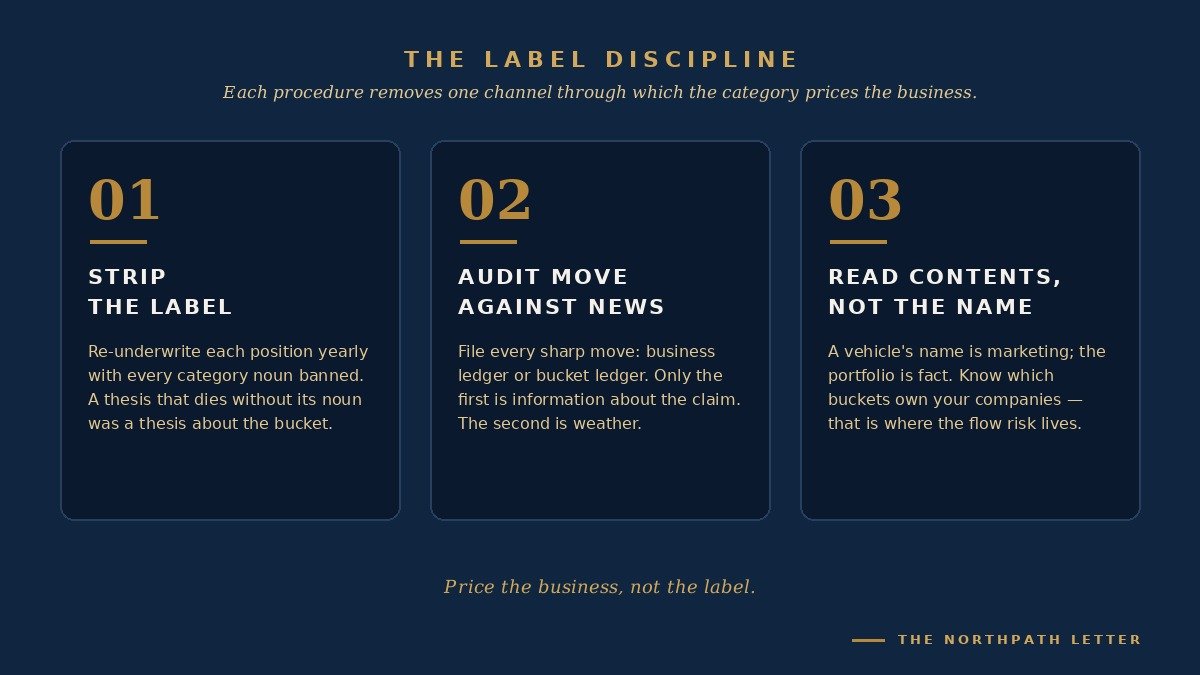
The remedy is not to abolish categories — nobody can underwrite ten thousand securities one at a time — but to refuse to let the category do the pricing. Three procedures, each mechanical enough to survive a busy quarter, take most of the label’s power away.
First: strip the label and re-underwrite what is left. Once a year, for every position, write the case for owning the business without using any category noun — no sector, no style, no theme, no index. What does it earn, on what capital, defended by what, paid to whom, and what is the claim on those cash flows priced at? A thesis that dies when its noun is removed was never a thesis about the business; it was a thesis about the bucket, and buckets are repriced by flows that owe the investor nothing. This is the categorical analogue of the zero-based updating this series has urged elsewhere: the label is the prior, and the prior must be made to pay rent.
Second: audit every large move against the news. When a position reprices sharply, file the cause in one of two ledgers: the business ledger — results, contracts, capital decisions, regulation touching the company itself — or the bucket ledger: index changes, fund flows, theme enthusiasm, a label’s rise or fall. Only the first ledger is information about the value of the claim. The second is weather. The investor who cannot say, in one sentence, which ledger a move belongs to is in no position to act on it — and the discipline of asking turns the market’s loudest noise into a record of how often the category, not the company, was speaking.
Third: read the contents, not the name. For any pooled vehicle, the name is marketing and the portfolio is fact: the 80 per cent rules now written into American and European regulation are a useful floor, but the investor can apply a stricter one in ten minutes by reading what the fund actually owns and asking what fraction of those businesses’ revenues touch the advertised theme. For direct positions, run the inquiry in reverse: know which indices, style baskets and thematic products own the company, and in what size, because that — not the share register’s patience — is where the flow risk lives. A business is not insulated from category weather merely because its owner never thinks in categories.
How the Practitioners Fought the Label
The most quoted refusal of the style box is Warren Buffett’s, in the 1992 Berkshire Hathaway letter: “the two approaches are joined at the hip: Growth is always a component in the calculation of value.” He returned to the point in the letter for 2000, at the precise moment the growth label was burying its faithful: “Market commentators and investment managers who glibly refer to ‘growth’ and ‘value’ styles as contrasting approaches to investment are displaying their ignorance, not their sophistication.” The position is not rhetorical. An investor who prices a business by its future cash flows has no use for the partition; the partition exists for the convenience of people pricing each other.
Bill Miller ran the experiment in public. His Legg Mason Value Trust outperformed the S&P 500 for fifteen consecutive calendar years, from 1991 through 2005, while owning, at various times, AOL, Dell and Amazon — companies the style boxes filed under growth and the commentators therefore filed under heresy for a fund with “Value” in its name. Miller’s answer, repeated for years, was that value investing means asking what a business is worth against the present value of its future free cash flows, and that confining the word to statistically low-multiple stocks mistakes a screening convenience for a definition. The methodological point survives any debate about his particular judgments: the fund’s label and the fund’s method were two different things, and only one of them ever earned a dollar.
Howard Marks, writing the January 2021 memo “Something of Value” with his son Andrew, arrived at the same destination from inside the value tribe itself: the value-growth division, he concluded, should never have been treated as a wall, and an investor’s mandate is to find securities priced below what the underlying business will deliver — wherever the style boxes have filed them. Three practitioners, three eras, one instruction: the label is not the analysis.
Key Takeaways
- Style investing is allocation by category, and it manufactures comovement. Barberis and Shleifer’s 2003 model showed that when money chases relative style performance, assets sharing a label move together far beyond what their cash flows justify — with style momentum over months and reversal over years.
- The borders prove the bias. Index inclusions raise a stock’s comovement with its new family while the business stands still; mechanical value-growth label switches do the same; and companies that merely renamed themselves — dot-com in 1998, blockchain in 2017 — were repriced by double and triple digits for the noun alone.
- Regulators now police nouns because nouns move money. The SEC’s amended Names Rule (2023) and ESMA’s fund-naming guidelines (2024) both rest on the same premise as the academic record: a meaningful share of allocation responds to the label, not the contents.
- Category flows are weather, not information. A sharp move belongs to either the business ledger or the bucket ledger; only the first says anything about the value of the claim, and the second occasionally hands the de-labelled underwriter a counterparty priced for someone else’s exit.
- Procedure beats vocabulary. Re-underwrite each position annually with the category nouns banned, attribute every large move to business or bucket before reacting to it, and read what a vehicle owns rather than what it is called.
— Manish Goel, FCA / NorthPath Advisory OÜ / Tallinn, Estonia
|
Important. |