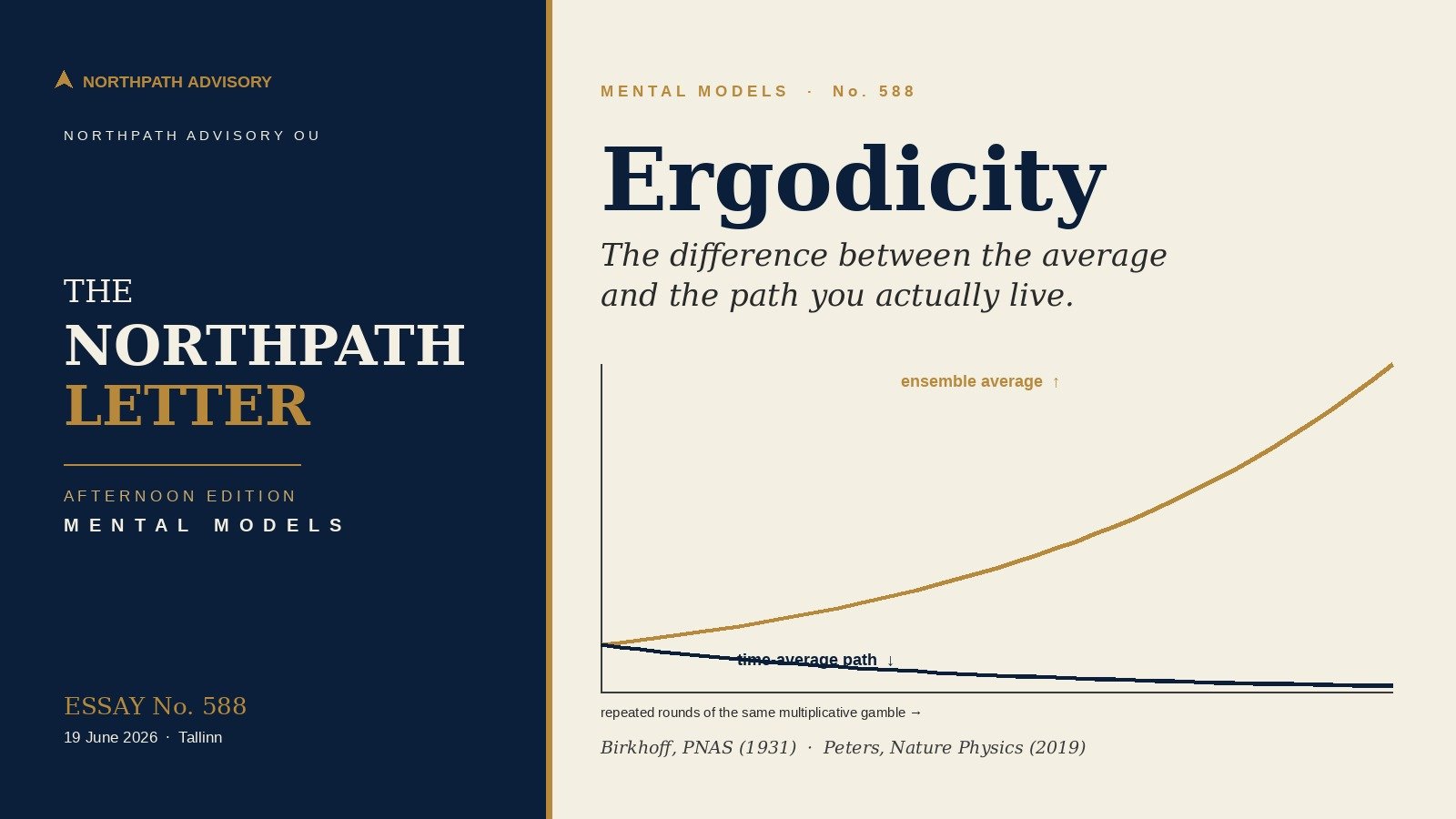
AFTERNOON EDITION — MENTAL MODELS
There is a question hiding inside almost every investment calculation, and most investors never notice they have answered it. The question is this: when you compute an average return, an expected value, a probability of success — are you describing what happens to a great many investors at one moment in time, or are you describing what happens to one investor across the long sweep of their own life? Conventional finance treats these two pictures as interchangeable. They are not. The mental model that explains why, and that quietly governs whether a portfolio compounds or collapses, is ergodicity.
The model
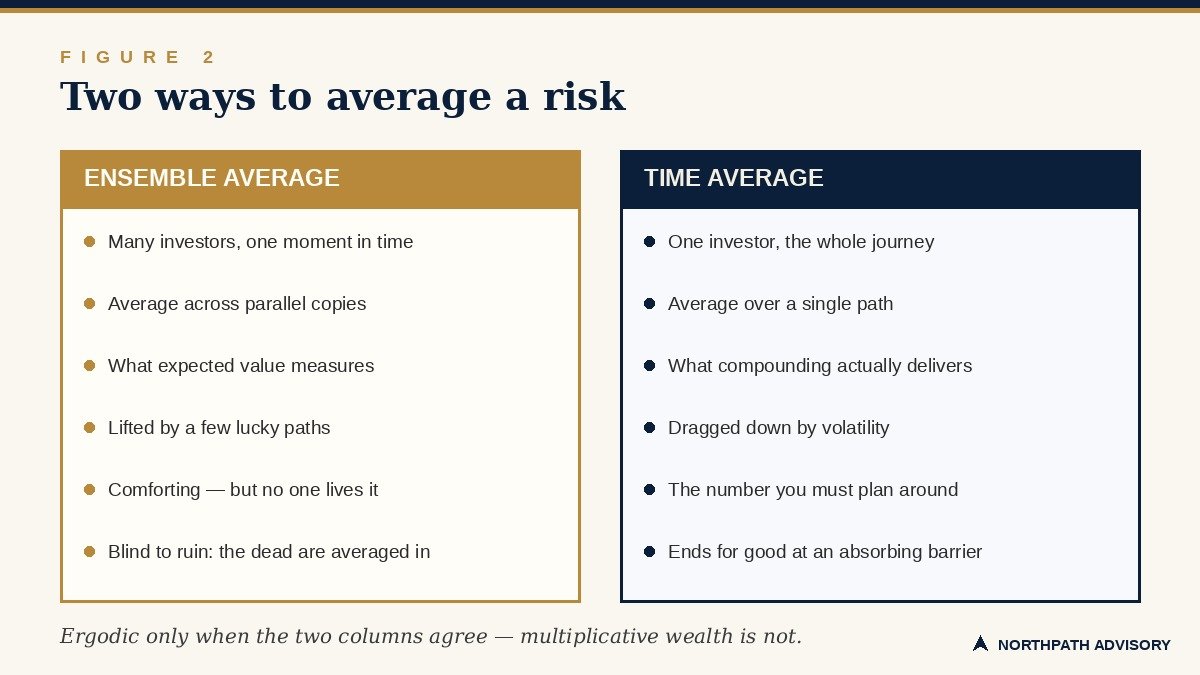
A process is ergodic when its time average equals its ensemble average. The ensemble average is what you get by lining up an enormous number of parallel copies of a system at a single instant and averaging across them. The time average is what you get by following one copy along its own trajectory for a very long time and averaging over the path. For an ergodic process these two numbers coincide; for a non-ergodic process they do not, and the gap between them is the difference between a comforting statistic and your actual fate.
The idea was born not in finance but in nineteenth-century physics. Ludwig Boltzmann, building the kinetic theory of gases in the 1870s, needed to assume that a single molecule, given enough time, would visit every accessible microstate of the system in the same proportions as the whole population of molecules occupied them at one moment. He coined the term from the Greek ergon (work) and hodos (path): the ergodic hypothesis was the assumption that the path of one, over time, samples the space of all. It was a hypothesis — an assumption of convenience — and Boltzmann could not prove it.
The proof, in the form that survives, came from the American mathematician George David Birkhoff. In “Proof of the Ergodic Theorem,” published in the Proceedings of the National Academy of Sciences in December 1931 (vol. 17, pp. 656–660), Birkhoff established what is now called the pointwise ergodic theorem: for a measure-preserving transformation, the time average along almost every individual trajectory exists, and when the system is ergodic — when it cannot be split into separate non-communicating regions — that time average equals the average taken over the whole space. John von Neumann’s mean ergodic theorem, proved slightly earlier and published in 1932, gave a companion result in a different sense of convergence. Together they turned Boltzmann’s hopeful assumption into a precise mathematical condition that a system either satisfies or fails to satisfy.
For most of the twentieth century this remained a result in physics and pure mathematics. Its migration into the study of money is recent and is owed largely to the physicist Ole Peters. In “The ergodicity problem in economics,” published in Nature Physics in 2019 (vol. 15, pp. 1216–1221), Peters argued that mainstream economic theory — expected-utility theory and its descendants — makes an unexamined assumption of ergodicity whenever it evaluates a risky prospect by its expected value. Wealth, however, does not grow by addition; it grows by multiplication, by repeated compounding of gains and losses on a base that itself changes. Multiplicative processes are, in general, not ergodic. The one-sentence form of the model is therefore blunt: when the way your wealth changes is multiplicative, the average outcome across many investors is not the outcome you should expect to live through, and treating the two as the same is the most expensive error in finance.
The mechanism — why the path and the average part ways
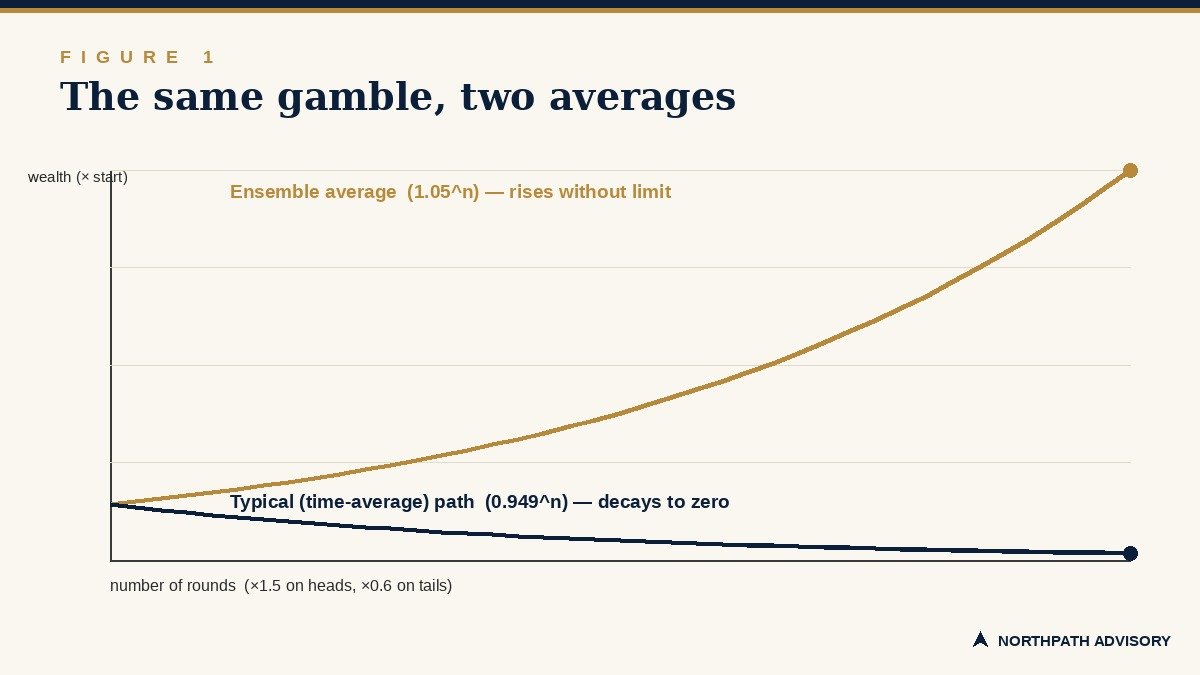
The cleanest demonstration is a coin toss, set out by Peters and Murray Gell-Mann in “Evaluating gambles using dynamics” (Chaos, vol. 26, 2016, article 023103 — the journal’s most-read paper of that year). You start with a sum of money. A fair coin is tossed. On heads your wealth is multiplied by 1.5; on tails it is multiplied by 0.6. The coin is tossed again and again, each toss acting on whatever wealth you now hold.
Compute the expected value of a single round. With equal probability you end on 1.5 or 0.6 times your stake, so the average multiplier is (1.5 + 0.6) ÷ 2 = 1.05. Each round, in expectation, grows your money by five per cent. The ensemble average — the average wealth across a million people each playing once — rises without limit. By the logic of expected value, this is a wonderful game, and you should bet everything, every time.
Now ask what happens to you, playing the same game over and over. Over many rounds your wealth is multiplied by 1.5 about half the time and by 0.6 about half the time, so the relevant multiplier compounded over time is the geometric mean: the square root of (1.5 × 0.6) = the square root of 0.9 ≈ 0.949. The time-average growth rate is therefore roughly minus five per cent per round. Almost every individual trajectory, followed long enough, decays toward zero. The same gamble that is wonderful for the ensemble is ruinous for the individual.
If the asymmetry feels abstract, strip it to a single pair of moves. Suppose your capital first rises fifty per cent and then falls fifty per cent. The arithmetic instinct says you are back where you began — plus fifty, minus fifty, net zero. The multiplicative reality says otherwise: a hundred becomes a hundred and fifty, and then half of a hundred and fifty is seventy-five. You have lost a quarter of your money despite an “average” move of zero. The order does not even matter; reverse the two and you still finish at seventy-five. This is why a fifty per cent loss requires a hundred per cent gain merely to recover, and why every drawdown demands a disproportionately larger advance to undo it. In a multiplicative world, losses and gains of equal size are not equal in consequence, and the longer the chain, the more the symmetric-looking average flatters a path that is quietly sinking.
Both statements are true at once because the rising ensemble average is propped up by a vanishingly small number of extraordinarily lucky paths — the rare players who throw a long unbroken run of heads — while the overwhelming majority, the typical or median path, drifts downward. The mean is a fact about an exploding minority; the median is a fact about your likely life. This is the heart of non-ergodicity: the average across people and the average over time point in opposite directions.
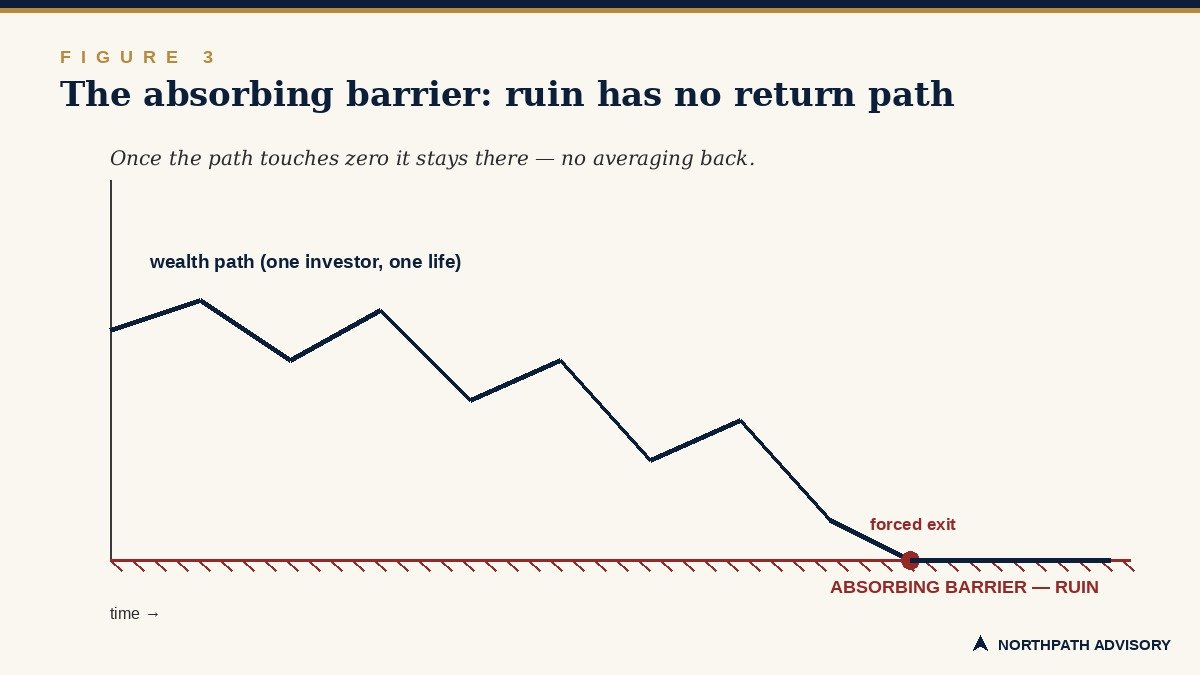
Two features of real markets sharpen the problem. The first is the absorbing barrier. If a trajectory ever touches zero — bankruptcy, a wiped-out account, a forced liquidation — it stays there; there is no averaging back from ruin. A single zero in a multiplicative chain sets the whole product to zero, no matter how impressive the other terms. The second is leverage, which is the machine that manufactures absorbing barriers. Borrowing turns a gentle, almost-additive bet into a steep multiplicative one and installs a trapdoor — the margin call — beneath it. Expected-value reasoning is blind to both, because the expectation is computed over an ensemble in which the unlucky paths are simply averaged away. The investor cannot average themselves away. They get one draw of the path, and they must survive every point along it.
The empirical record
The clearest market-scale evidence that the path and the average diverge is the persistent gap between the returns funds report and the returns their investors actually earn. Morningstar’s Mind the Gap 2024 study found that over the decade ending 31 December 2024 the average dollar invested in US funds and exchange-traded funds earned about 7.0 per cent a year, while the funds themselves returned about 8.2 per cent — a shortfall of roughly 1.2 percentage points annually, meaning investors captured only around 85 per cent of the returns sitting in the very products they owned. A fund’s published total return is an ensemble-style statistic: it assumes one lump invested at the start and held untouched. The dollar-weighted return is closer to the path investors actually walked, and it is worse precisely because their buying and selling decisions cluster at the wrong moments — adding after rises, fleeing after falls. The reported average is not a lie, but it is not anyone’s experience.
The gap also widens exactly where the dynamics are most multiplicative. Morningstar’s data show that investors in steady, broadly diversified vehicles held for the long term — target-date and allocation funds — capture almost all of their funds’ returns, while investors in the most volatile and narrowly focused categories surrender the largest share. Higher volatility is not merely uncomfortable; it is the condition under which the time average falls furthest beneath the ensemble average, and it is also the condition under which investors are most tempted to trade at the wrong moment. The empirical record and the mathematics agree: the more violently a holding swings, the more the path an investor actually lives diverges from the average a calm chart reports, and the more the divergence runs against them.
The mathematics behind the divergence is unforgiving. In the multiplicative coin game, as the number of rounds grows the probability that a randomly chosen player is ahead of where they started shrinks toward zero, even as the average wealth of all players climbs. Volatility, which a textbook treats as a symmetric inconvenience around an expected value, is in a multiplicative world a one-directional tax on the compound rate: it is the wedge that drives the time average below the ensemble average. Nassim Nicholas Taleb, who made the concept central to Skin in the Game (2018) and credits Peters explicitly, puts the same point through a darker image: one person playing Russian roulette six times is in a wholly different situation from six people each playing once, though a naïve ensemble calculation assigns them the same “expected” survival. The ensemble probability is real; it is just not your probability when you are the one who plays repeatedly.
Two historical episodes
The first is Long-Term Capital Management, the hedge fund staffed by two Nobel laureates and a roster of celebrated traders, whose collapse in 1998 Roger Lowenstein chronicled in When Genius Failed (2000). LTCM ran convergence trades — bets that small, well-documented pricing discrepancies would close — and the expected value of those trades was genuinely positive. The fault was not in the average; it was in the path. The fund was leveraged on the order of twenty-five to thirty times its capital, and after Russia defaulted on its debt in August 1998, correlations that the models treated as modest surged together, and losses of several billion dollars accumulated in a matter of weeks. The fund reached the absorbing barrier before its trades could converge and required a Federal-Reserve-organised consortium of banks to wind it down. Ensemble logic said the spreads must close; the time path said you will be liquidated first. Both were right, and only the second one mattered.
The second is the trader Victor Niederhoffer, whose first blow-up came on 27 October 1997. He had sold large quantities of naked put options on the S&P 500 — a strategy that, month after month, collected a small premium and produced a high probability of a small gain against a small probability of a catastrophic loss. Its arithmetic expectation, computed across ordinary months, looked attractive. On 27 October 1997 the Dow Jones Industrial Average fell 554 points, about 7.2 per cent in a single session; the next morning his broker liquidated his positions, roughly $130 million was gone, and the fund shut its doors. Niederhoffer was, by reputation, a brilliant analyst, and he returned to the same family of strategies — only to be wiped out a second time in 2007. The lesson of two ruins is the lesson of ergodicity: a strategy can carry an appealing average and still contain an absorbing barrier that you can strike only once.
Application to long-term equity investing
Ergodicity is not merely a curiosity for physicists; it converts directly into operating discipline for the long-term owner of equities. Three rules follow.
1. Treat ruin as the one truly forbidden outcome
Because an absorbing barrier ends the game permanently, avoiding it is categorically more important than maximising the expected return around it. In practice this means refusing the kinds of leverage that can force a sale at the wrong moment — margin that triggers a call, illiquidity that locks capital when it must be freed, a fund structure that lets others redeem you out of your best positions. The long-term investor’s first job is not to be optimal; it is to still be playing next year and in ten years. Position sizes should be chosen so that the worst plausible path leaves the portfolio intact, not so that the expected path looks impressive.
2. Judge strategies by their compound (time-average) growth, not their arithmetic expectation
Two strategies can share an arithmetic average while differing sharply in their geometric mean — the rate at which one investor’s capital actually compounds. Because wealth grows multiplicatively, the geometric mean is the honest measure, and it is always dragged below the arithmetic mean by volatility. A flashier strategy with a higher expected value but a lower compound growth rate is, for the single investor living a single life, the worse choice. The discipline is to evaluate every prospect as the time average of a path you must personally traverse, never as the ensemble average of paths most of which you will never live.
3. Engineer your realised path to track the ensemble
The Mind-the-Gap shortfall is self-inflicted non-ergodicity: investors turn a benign holding into a damaging one by trading at the worst moments. The remedy is structural — diversification across genuinely uncorrelated exposures so that no single shock is an absorbing barrier; a cash and liquidity reserve so that a drawdown is never a forced sale; and behavioural pre-commitment, decided in calm conditions, not to sell into a panic. These are the mechanisms by which an investor closes the gap between the path they walk and the average the index quietly earns.
How the long-term equity tradition has used it
Long before the word “ergodicity” entered investment writing, the discipline’s best practitioners were enforcing it by instinct. Warren Buffett compressed the whole idea into his first rule of investing — never lose money — and into a lifelong structural refusal to use the kind of leverage that can end the game. In the 2010 Berkshire Hathaway chairman’s letter he warned that leverage is precisely the tool that turns intelligent people into broke ones, and Charlie Munger’s gloss — that the routes to ruin are liquor, ladies and leverage, of which only the last is mandatory to avoid — makes the same point. Buffett’s insistence on never risking what you have and need for what you do not have and do not need is not folksy caution; it is a refusal to install an absorbing barrier in a multiplicative process. Berkshire’s float-funded, debt-light architecture is an ergodicity discipline rendered in a balance sheet.
Howard Marks has made the same argument explicit. In The Most Important Thing (2011) and across the Oaktree memos — notably “Risk” (2006) and “Risk Revisited” (2014) — Marks insists that surviving on average is a useless idea, because an investor must survive all the time, and especially in the worst times. His favourite illustration is the traveller who drowns crossing a river that is, on average, only a few feet deep: the average depth is irrelevant when the single crossing you actually make passes through the one stretch that is over your head. That is the ensemble-versus-time distinction in a sentence, and it is why Marks treats risk control, not return maximisation, as the foundation of durable performance. The tradition reaches its modern, formal statement in Taleb’s work, but its operating content — protect the path, fear the absorbing barrier, compound quietly — is as old as Buffett’s first letter.
Key takeaways
- The average across people is not the average over time. A process is ergodic only when those two coincide; wealth, which compounds multiplicatively, generally is not, so expected value can recommend a path that ruins almost everyone who walks it.
- Volatility is a tax on compounding, not a symmetric inconvenience. The geometric (time-average) growth rate sits below the arithmetic (ensemble) expectation, and the gap widens with risk — which is why a higher expected return can deliver a lower compound result.
- Absorbing barriers are non-negotiable. Ruin, bankruptcy and forced selling end the game permanently; leverage is the machine that builds those trapdoors. Avoiding them outranks optimising around them.
- The investor return gap is non-ergodicity in the wild. Morningstar’s roughly 1.2-point annual shortfall shows investors lose part of the market’s return by trading at the wrong moments — by failing to make their own path resemble the index’s average.
- Survival is the precondition for compounding. Buffett’s no-leverage discipline and Marks’s “survive the deepest point of the river” are the same instruction: protect the single path you actually live, because you only get to draw it once.
— Manish Goel, FCA / NorthPath Advisory OÜ / Tallinn, Estonia
|
Important. |