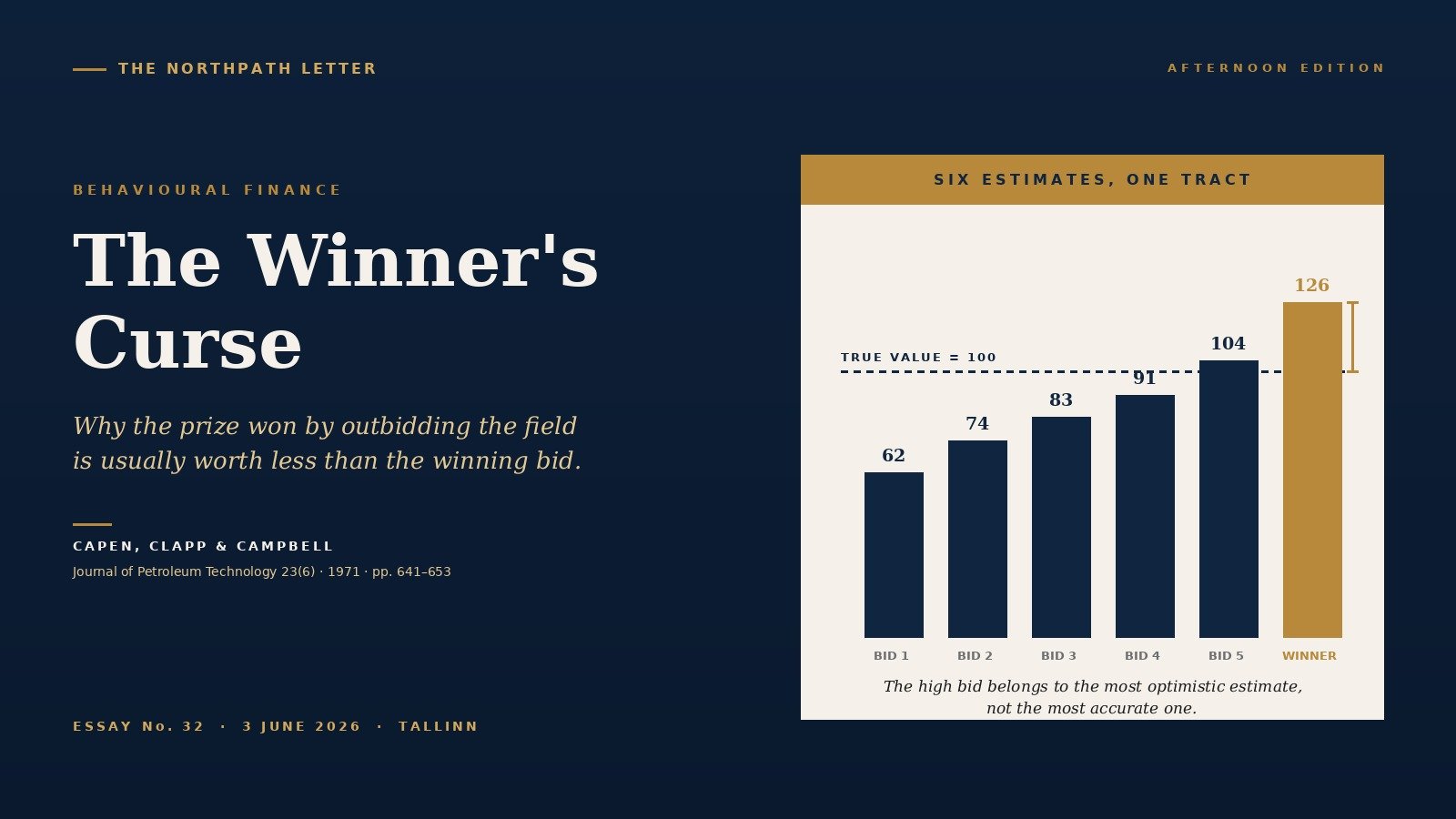
Behavioural Finance · 3 June 2026 · Afternoon Edition
There is one transaction in which the news of your own success should make you wince. In June 1971, three petroleum engineers at Atlantic Richfield — Ed Capen, Robert Clapp and William Campbell — explained why. Their employer had spent years bidding for oil and gas leases in the Gulf of Mexico, sealed-envelope auctions in which a dozen sophisticated companies, each with its own geologists and seismic surveys, estimated what the same tract of seabed was worth and wrote a number. The tracts went to the highest numbers. And year after year, the industry’s returns on the tracts it had won came in below what the estimates had promised — not because the geology was bad, but because of which bids win.
The phenomenon they described now carries the name they gave it: the winner’s curse. When many parties bid for an asset whose value is roughly the same to everyone but precisely known to no one, the winning bid tends to come from whoever most overestimated that value. Each individual appraisal can be honest, careful and unbiased. The highest of many honest appraisals is none of those things. The auction does not average the room’s information; it selects the room’s largest error and hands it the prize.
The long-term equity investor rarely stands in a literal auction room. But every contested takeover, every oversubscribed listing, every crowded theme into which capital races is a common-value contest in which the asset goes to whoever will pay the most. This essay traces the discovery of the curse, the mechanism that produces it, the evidence assembled across oil leases, new listings and mergers, two billion-scale European episodes, and the disciplines by which a patient investor can decline to be the rightmost error.
Three engineers and a tract of seabed
The United States began auctioning offshore drilling rights in the Gulf of Mexico in 1954. By the late 1960s the sales were enormous, and the participants were the most technically capable bidders imaginable: integrated oil majors with proprietary seismic data and decades of drilling records. If any setting should have been safe from a systematic bidding pathology, it was this one. Yet Capen, Clapp and Campbell, writing in the Journal of Petroleum Technology (“Competitive Bidding in High-Risk Situations,” vol. 23(6), 1971, pp. 641–653), reported the opposite: on their reading of the record, the Gulf leases as a class had paid the industry less than the same money would have earned sitting in a bank. The winners had drilled real oil out of real seabed and still failed to earn their capital back at an acceptable rate, because the price of admission had been set, tract by tract, by the most optimistic survey in the room.
Their diagnosis contained the line that founded a literature. A company that wins a tract against two or three rivals may feel fine about its good fortune, they wrote — but how should it feel if it won against fifty? Ill. The more competitors an estimate has beaten, the more extreme that estimate is likely to be, and the worse the news that winning carries. Richard Thaler gave the result its canonical behavioural treatment in the inaugural years of his “Anomalies” series (“The Winner’s Curse,” Journal of Economic Perspectives 2(1), 1988, pp. 191–202), and what makes it an anomaly rather than a curiosity is precisely that it survives experience, expertise and incentives.
The laboratory demonstration is disarmingly simple. Max Bazerman and William Samuelson auctioned jars of coins to M.B.A. students at Boston University (“I Won the Auction But Don’t Want the Prize,” Journal of Conflict Resolution 27(4), 1983, pp. 618–634). Each jar was worth $8.00. The average bid was $5.13 — the room as a whole was conservative, biased downward. The average winning bid was $10.01. The crowd underbid and the winners still overpaid by a quarter of the prize’s value, because the contest does not transact with the crowd; it transacts with the tail. John Kagel and Dan Levin later showed in controlled common-value auctions (American Economic Review 76(5), 1986, pp. 894–920) that the curse persists among experienced subjects, and — the cruellest finding — that bidders respond to more competition by bidding more aggressively, exactly the wrong direction.
The mechanism: selection by maximum
Strip the setting away and the engine underneath is a single statistical fact. Take any asset with a true common value. Let ten bidders each form an unbiased estimate of it — some a little high, some a little low, centred on the truth. Each estimate, taken alone, is a fair appraisal. Now let a contest choose the maximum of the ten. The expected value of the maximum of several unbiased estimates is not the truth; it sits above the truth, and it sits further above the truth the more estimates there are and the noisier each one is. Nobody in the room needs to be a fool. The selection rule does all the damage.
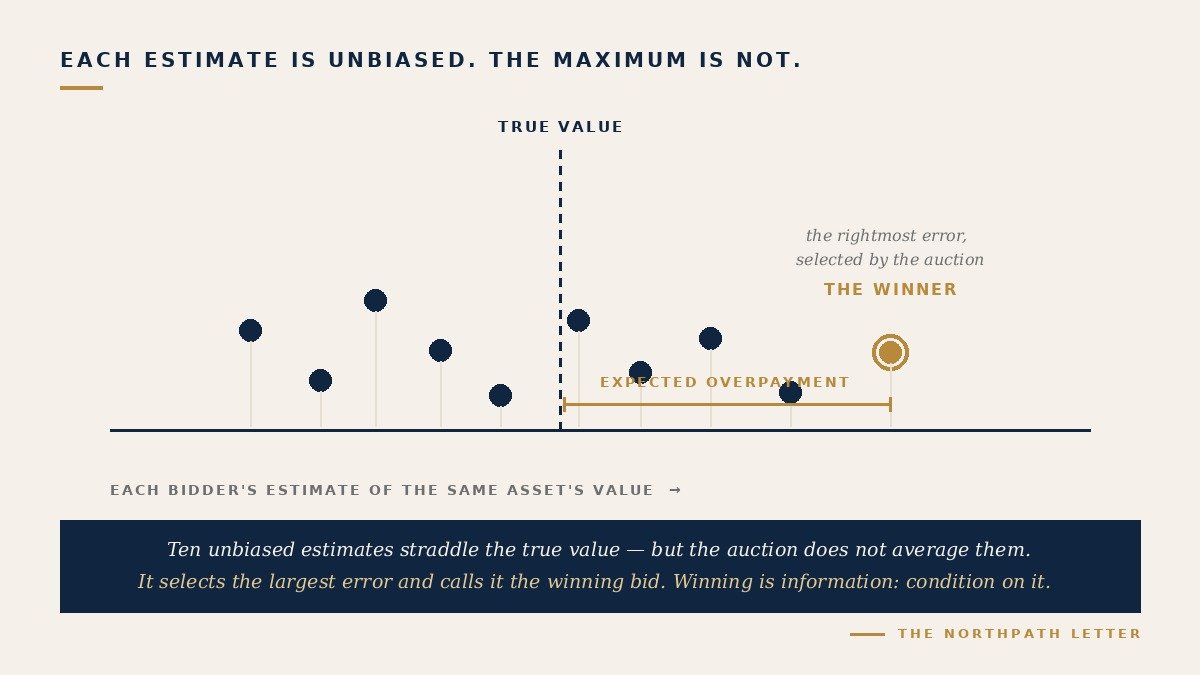
What turns this arithmetic into a behavioural bias is the mental act that bidders systematically fail to perform: conditioning on the win. The estimate that matters is not “what do I think the asset is worth?” but “what would the asset be worth given that nine informed rivals refused to pay more than me?” Winning is not a neutral event; it is information, and almost always adverse information, about your own appraisal. Paul Milgrom and Robert Weber formalised the point in their auction-theory work (Econometrica 50(5), 1982): the rational bidder bids not on her estimate, but on what her estimate would imply if it turned out to be the highest. That conditional discipline is cognitively unnatural — it requires treating a future hypothetical success as evidence against oneself — and the experimental record says even experienced professionals rarely manage it unaided.
Three boundaries keep the concept precise. First, the curse lives in common-value settings. A painting bought purely for your own wall has private value; if you outbid the room, you have merely revealed unusual taste. Oil tracts, takeover targets, spectrum licences and shares of future cash flows are overwhelmingly common-value: the cash a business will generate does not depend on who holds the certificate. Second, the curse is not overconfidence, though overconfidence feeds it. A perfectly calibrated bidder with honest error bars still overpays on average if she fails to shade her bid for the selection effect; an overconfident one simply overpays more. Third, it is a cousin of — not the same animal as — the selection bias this letter examined through Joseph Berkson’s paradox earlier this week. Berkson’s problem is who is missing from your data. The winner’s curse is what the act of winning reveals about your estimate. Both are failures to ask what the observed outcome was conditioned on; the auction version simply sends the invoice faster.
Hence the most counterintuitive prescription in the 1971 paper, the one Capen and his colleagues spent their final pages defending to incredulous colleagues: the more bidders you face, the lower — not higher — your bid must be relative to your own appraisal. Competition raises the selection pressure on the maximum, so it must raise your discount. Every instinct of rivalry says otherwise, which is why the curse has outlived five decades of being named.
The record: leases, listings and mergers
The Gulf itself supplied the first archive. Subsequent econometric work on the federal lease sales — notably Kenneth Hendricks and Robert Porter’s study of drainage tracts (American Economic Review 78(5), 1988) — found returns distributed exactly as the theory predicts: companies bidding on tracts adjacent to their own producing acreage, with genuinely private information, earned rents; outsiders bidding on the same tracts on public information roughly broke even at best. Information asymmetry decided who ate the curse.
The stock market’s clearest institutionalised response is the pricing of new listings. Kevin Rock’s model (“Why New Issues Are Underpriced,” Journal of Financial Economics 15, 1986) is a winner’s-curse argument from start to finish: in an oversubscribed offering the informed crowd out the uninformed, so the uninformed investor receives a full allocation of precisely the issues the informed declined — she “wins” most completely when the prize is worst. To keep uninformed capital participating at all, issues must on average be priced below their aftermarket value, which is why the average first-day pop on United States listings has run near a fifth of the offer price across Jay Ritter’s long-run series. The pop is not generosity; it is the premium the market must pay to offset the curse embedded in allocation. And the longer arc bends the same way: Ritter’s study of the aftermarket (Journal of Finance 46(1), 1991) found that buying at the close of the first day and holding for three years materially underperformed matched seasoned companies. The investor who chases the allocation she was lucky enough to receive in full is often collecting exactly the adverse selection Rock described.
The corporate-control market supplies the costliest evidence. Richard Roll’s hubris hypothesis (Journal of Business 59(2), 1986, pp. 197–216) proposed that takeover premiums largely measure the winning manager’s valuation error — the curse wearing a suit. The aggregate accounting is stark: Sara Moeller, Frederik Schlingemann and René Stulz (“Wealth Destruction on a Massive Scale?,” Journal of Finance 60(2), 2005, pp. 757–782) found that acquiring-firm shareholders lost about 12 cents per dollar spent on acquisitions announced between 1998 and 2001 — some $240 billion in aggregate, against $7 billion, or 1.6 cents per dollar, across the whole of the 1980s. The losses concentrated in the largest, most contested, most confidently priced deals of the cycle’s top.
Regulators have not merely documented the curse; one of them redesigned a market around it. After Salomon Brothers was caught submitting false customer bids to corner Treasury issues in 1991, the United States Treasury, the Securities and Exchange Commission and the Federal Reserve produced the Joint Report on the Government Securities Market (January 1992), which among its reforms revived a proposal Milton Friedman had pressed since the 1960s: replace the multiple-price auction — in which every winner pays its own bid, and the most optimistic dealer pays the most — with a single-price format in which all winners pay the same market-clearing price. The Treasury began experimenting with uniform pricing in its two- and five-year note auctions in September 1992 and extended the format to all marketable Treasury auctions in November 1998. The explicit logic was the winner’s curse: when winning cannot single you out for overpayment, rational bidders bid more aggressively, participation broadens, and the seller funds itself more cheaply. It remains one of the few cognitive biases whose existence is acknowledged in the design of the deepest capital market on earth.
Two episodes: the 3G spring and the ABN AMRO contest
Twice in a single decade, Europe staged winner’s-curse demonstrations measured in tens of billions.
The first ran through the spring and summer of 2000, at the crest of the technology bubble. In April 2000 the United Kingdom concluded its auction of five third-generation mobile licences — paper rights to spectrum for services that did not yet exist, valued off extrapolated data-revenue forecasts that no operator could verify. Thirteen bidders contested five prizes through 150 rounds, and the hammer fell at £22.47 billion, against pre-sale expectations in the low single-digit billions. Four months later Germany auctioned twelve spectrum blocks for DM 98.8 billion — €50.8 billion. The British National Audit Office, reviewing the UK sale (The Auction of Radio Spectrum for the Third Generation of Mobile Telephones, HC 233, October 2001), reasonably judged it a success — for the taxpayer. That is the asymmetry worth tattooing onto the analyst’s wrist: a well-designed auction is a machine built by the seller to harvest the maximum estimate. The curse is not a flaw in such a machine; it is the product. Within two years the buyers were demonstrating the other side of the ledger: 3G licence values were written down across the sector, BT was forced into a £5.9 billion rights issue — then the largest in British history — and continental operators spent the next half-decade working off debt assumed at the very top of the common-value error. The licences were real, as the Gulf tracts were real; the spectrum eventually carried profitable traffic. The winners had simply paid the price set by the most euphoric forecast of 2000.
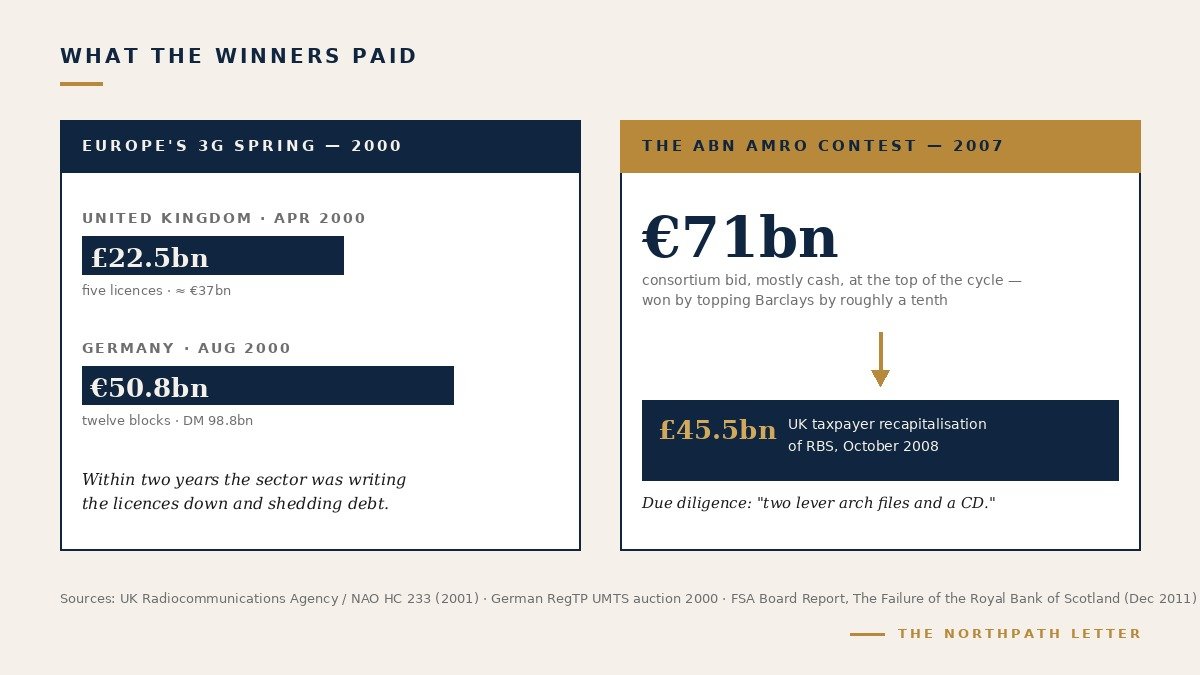
The second episode concluded in October 2007, weeks after the money markets had already begun to seize. ABN AMRO, the largest bank in the Netherlands, had agreed in April to a roughly €67 billion, largely share-based merger with Barclays. A consortium of Royal Bank of Scotland, Fortis and Santander then outbid it: about €71 billion, roughly 93 per cent in cash, at the absolute peak of the credit cycle. Barclays — the rival with every incentive to pay up, and its own extensive knowledge of the asset — stopped. The consortium treated outlasting an informed under-bidder as victory rather than as the data it was. The Financial Services Authority’s post-mortem (The Failure of the Royal Bank of Scotland, FSA Board Report, December 2011) recorded that RBS conducted due diligence on this, the largest bank takeover in history, on the basis of information amounting to — in the report’s phrase — “two lever arch files and a CD.” Within a year RBS required £45.5 billion of capital from the British taxpayer, the largest bank rescue in the country’s history; Fortis was broken up and partly nationalised. Roll’s hubris and Capen’s curse compounded: a cash bid, a contested prize, an uninspectable common value, and a winner who never asked what the loser’s silence was telling him.
The counter-measure framework
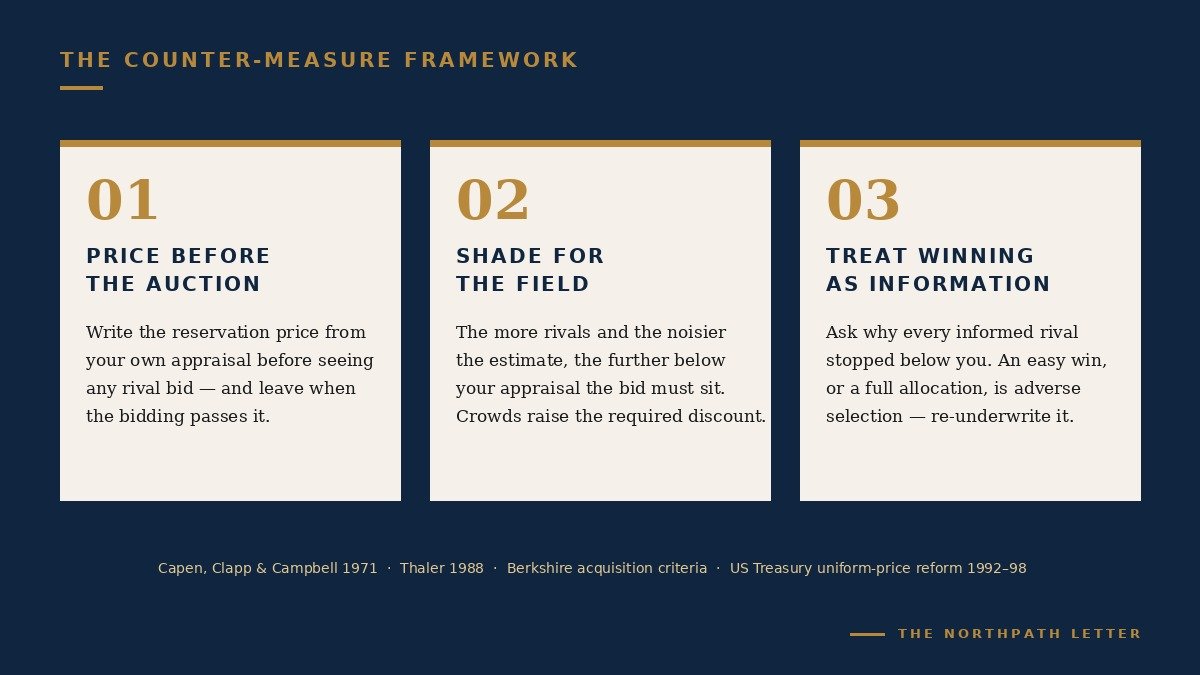
The defences against the curse are unusually concrete, because auction theory supplies them in closed form. Three disciplines carry the substance.
First: price before the auction. The reservation price must be written down from your own appraisal of the asset — cash flows, replacement cost, the record of comparable transactions — before you observe a single rival bid, and it must function as a tripwire rather than an opening position. The moment the contest passes it, you are no longer buying an asset; you are buying the validation of beating someone. In portfolio practice this is the pre-committed valuation memo before a popular listing, the maximum entry price written before a position becomes a theme, the acquisition walk-away price ratified by a board before the banker’s book arrives.
Second: shade for the field. Capen, Clapp and Campbell’s tables made the haircut quantitative: the discount below your own appraisal must grow with the number of rivals and with the noise in the estimate. Fifty bidders demand a deeper discount than five; a pre-revenue asset demands a deeper discount than a toll road. The equity-market translation is direct — an oversubscribed offering is a fifty-bidder auction; a contested takeover is an explicit one; a crowded theme is an implicit auction running continuously. The more company your enthusiasm has, the cheaper you must insist on buying.
Third: treat winning as information. Build the conditioning step into the process itself. Before the bid: “if this wins, what does that imply about my estimate?” After the win: a written audit of why every informed rival stopped below you — what did the under-bidders see, or refuse to assume? A full allocation in a hot issue is Rock’s red flag delivered to your account; an easy win in any contested purchase is adverse selection until re-underwritten. The Treasury’s uniform-price logic can even be run privately: ask what the second-most-optimistic participant believes the asset is worth, and refuse to pay materially more than that number, because that is approximately what the asset will trade at when your marginal enthusiasm is no longer the price-setter.
How the practitioners bid
Warren Buffett’s acquisition record is, among other things, a five-decade refusal to stand in the room Capen described. His 1981 letter to Berkshire Hathaway shareholders diagnosed the manager who pays a “fat takeover premium” as a believer in fairy tales — certain, despite the observable record, that his managerial kiss will transform the profitability of Company T(arget): “we have observed many kisses but very few miracles.” The standing acquisition criteria printed in Berkshire’s annual reports operationalise the immunity: negotiated purchases, a price stated at the outset, and a line from a country song reserved for “new ventures, turnarounds, or auction-like sales” — “when the phone don’t ring, you’ll know it’s me.” The structural insight is that the only reliable way to avoid being the maximum of n estimates is to keep n at one: a bilateral negotiation against a reservation price converts a common-value contest back into an appraisal.
Howard Marks has spent a career describing credit markets as the same machine running in continuous session. His Oaktree memo of February 2007, The Race to the Bottom — written months before the consortium’s cash settled on ABN AMRO’s shareholders — described the auction for the right to deploy capital: when too much money competes to make the same loans and buy the same assets, the “winner” is whoever accepts the lowest return, the thinnest covenant, the slimmest margin for error. His broader formulation, elaborated in The Most Important Thing (2011), is that a market is an auction house in which the asset goes to the most optimistic bidder, so the investor’s task is to let someone else win when winning requires the most optimistic estimate in the room. Patience, in this reading, is not temperament but auction strategy: the disciplined bidder’s edge is the willingness to lose the contest.
Key takeaways
- The curse is arithmetic before it is psychology. When many parties estimate one common value and the highest estimate wins, the winning bid is biased upward even if every individual estimate is honest. The contest selects the largest error — Capen, Clapp and Campbell’s 1971 finding from the Gulf of Mexico lease record.
- Winning is adverse information. The rational question is never “what is it worth?” but “what is it worth given that every informed rival refused to pay more?” Bazerman and Samuelson’s $8 jars drew average bids of $5.13 and average winning bids of $10.01: a conservative crowd still produced cursed winners.
- The evidence spans every market that allocates by contest. Oil-lease returns below the cost of money, the first-day pop that compensates new-issue allocation, $240 billion of acquirer value destroyed in the 1998–2001 merger wave, and a US Treasury that switched every auction to uniform pricing by November 1998 specifically to blunt the curse.
- Competition demands a larger discount, not a higher bid. The more rivals and the noisier the value, the further below your own appraisal the bid must sit. Europe’s 3G licences and the €71 billion ABN AMRO contest are what the opposite instinct costs at scale.
- The defences are procedural. A reservation price written before the contest, a bid shaded for the size of the field, and a standing post-win audit of why the under-bidders stopped. Buffett avoids the room; Marks waits for the room to empty. Both are auction strategies.
— Manish Goel, FCA / NorthPath Advisory OÜ / Tallinn, Estonia
|
Important. |