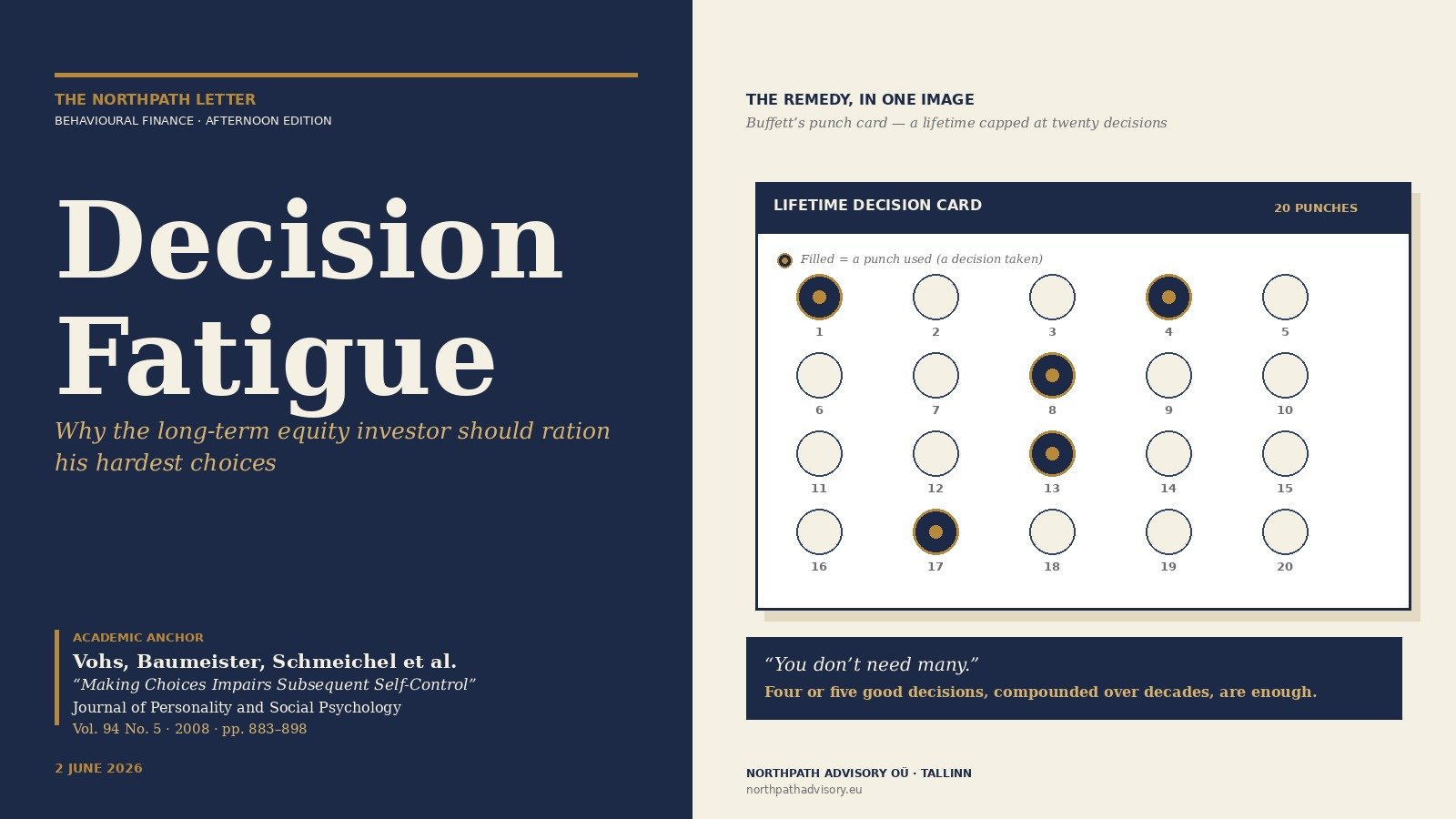
The NorthPath Letter · Behavioural Finance · Afternoon Edition · 2 June 2026
The bias: a tired idea, and what survives of it
Of all the concepts behavioural finance has lent to the popular imagination, few have travelled further, or worn worse, than decision fatigue. The claim is intuitive to the point of feeling obvious: that the capacity for careful, self-controlled choice is a finite resource, drawn down by each successive decision, so that the hundredth judgment of the day is made by a poorer judge than the first. It is the reason, the folklore runs, that supermarkets place confectionery at the checkout, that executives wear the same outfit each morning, and that one should never sign a contract late at night. For the long-term equity investor the implication seems equally plain. An investor who has spent a trading day fielding price alerts, scanning a dozen results announcements and adjusting a watch-list arrives at the one decision that matters — whether to commit capital, or to sell a position held for years — with a depleted faculty, and is the more likely to choose badly.
The idea has a respectable academic pedigree. Its modern form was set out by Kathleen Vohs, Roy Baumeister and colleagues in a 2008 paper in the Journal of Personality and Social Psychology titled “Making Choices Impairs Subsequent Self-Control” (vol. 94, no. 5, pp. 883–898). Across a sequence of laboratory and field experiments, participants who had been made to perform a stretch of choosing — configuring a computer, selecting courses, working through a consumer-goods questionnaire — subsequently gave up sooner on a frustrating task, drank less of a healthy but unpleasant drink, and performed worse on arithmetic than participants who had merely contemplated the same options without choosing between them. The paper sat atop an older and larger literature on “ego depletion,” whose founding text — Baumeister, Bratslavsky, Muraven and Tice, “Ego Depletion: Is the Active Self a Limited Resource?” (JPSP, 1998) — had proposed that acts of self-control draw on a single, depletable store of mental energy.
An essay written for a general readership a decade ago could have stopped there, treated the resource model as established fact, and moved briskly to the investing lesson. That essay would now be wrong in an instructive way. Decision fatigue is one of the most prominent ideas in psychology to have been humbled by the replication crisis of the 2010s, and any honest treatment has to begin by separating what the evidence still supports from what it does not. What follows is an attempt to do exactly that — and to show that the investing discipline the idea recommends turns out to rest on far firmer ground than the idea itself.
The mechanism: from a fuel tank to a question of motivation
The original architecture was mechanical and, partly for that reason, seductive. Self-control was imagined as a muscle drawing on a fuel; the fuel was, for a time, identified quite literally as blood glucose, after experiments reported that sugary drinks restored depleted performance. Decision-making was held to draw on the same reservoir as resisting temptation, suppressing emotion and persisting at hard tasks, which is why choosing was supposed to leave one less able to refrain afterwards. The model made a clean, falsifiable prediction: exert self-control now, and measurable self-control later declines.
That clean prediction is precisely what later work struggled to confirm, and the glucose version in particular did not survive scrutiny — the brain’s metabolic demand does not vary nearly enough between hard and easy cognitive tasks to account for the claimed effects. In the wake of those failures, a second generation of theorists rebuilt the idea on different foundations. Michael Inzlicht and Brandon Schmeichel, in a 2012 paper pointedly subtitled “Toward a Mechanistic Revision,” argued that what looks like depletion is better understood as a shift in motivation and attention: after a stretch of effortful control, people do not run out of fuel so much as become less willing to keep paying the cost, and their attention drifts from “ought” tasks toward gratifying ones. Robert Kurzban and colleagues formalised a related account in which the felt sense of mental fatigue is the mind’s representation of the opportunity cost of continuing — a signal that effort might be better spent elsewhere, not a gauge reading empty.
The distinction matters for the investor because the two models recommend the idea’s discipline for different reasons. If fatigue is a fuel gauge, the remedy is rest and glucose. If it is a motivational signal, the remedy is structural: arrange matters so that the hardest financial decisions do not have to compete for a tired mind’s waning willingness to do unglamorous work. As we will see, the structural remedy is the one that holds regardless of which mechanism — if either — is real.
The empirical record: a reckoning, honestly stated
In 2016 the question was put to a decisive test. A consortium of twenty-three laboratories, coordinated by Martin Hagger and Nikos Chatzisarantis, ran a single pre-registered protocol on more than two thousand participants — a “Registered Replication Report” published in Perspectives on Psychological Science (vol. 11, no. 4, pp. 546–573). Every lab followed an identical, agreed-in-advance design; there was no room to adjust the analysis after seeing the data. The pooled estimate of the ego-depletion effect was close to zero. The phenomenon that had launched hundreds of papers and a popular literature could not be reliably produced when the experiment was run with the discipline that pre-registration imposes.
This did not come without warning. An earlier meta-analysis of the published studies had reported a medium-sized effect, but in 2014 Evan Carter and Michael McCullough showed that the published record bore the fingerprints of small-study bias — the tell-tale pattern in which smaller experiments report implausibly large effects — and that once this was corrected the true effect shrank toward nothing. The most candid summary, and the one this Letter adopts, is that the strong laboratory claim — that performing choices reliably and measurably degrades self-control minutes later in a controlled setting — is not supported by the best current evidence.
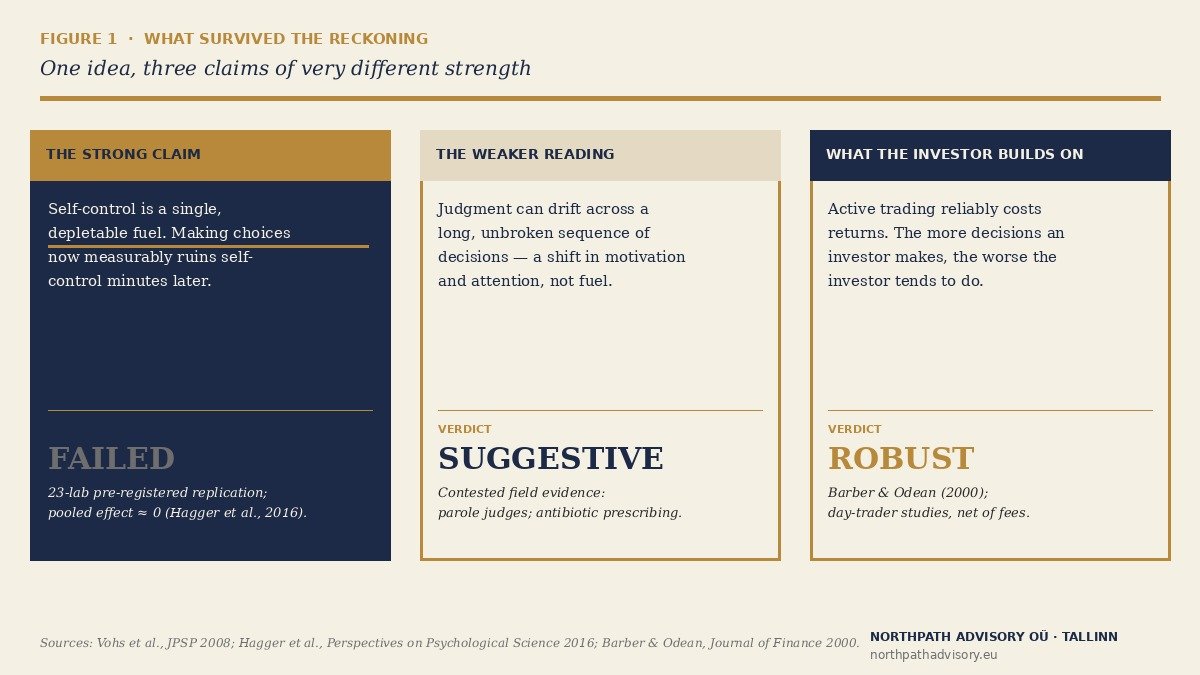
What, then, survives? Three things, and they are enough. First, the weaker proposition — that the quality of judgment can drift over a long, unbroken sequence of consequential decisions — is not the proposition that failed; the laboratory paradigm that failed was a narrow, two-task design. Second, there is suggestive field evidence for that weaker proposition, examined below, even if it too is contested. Third, and most important for the investor, the practical recommendation that the whole literature points toward — make fewer, better-prepared decisions — is independently justified by an entirely separate and far more robust body of evidence on what active trading does to returns. An idea can be a poor laboratory effect and still be pointing at a real and expensive problem.
Two episodes: the field record and the market record
The first episode is the one every popular account of decision fatigue reaches for, and it deserves to be handled with more care than it usually receives. In 2011 Shai Danziger, Jonathan Levav and Liora Avnaim-Pesso published “Extraneous Factors in Judicial Decisions” in the Proceedings of the National Academy of Sciences (vol. 108, pp. 6889–6892). Examining more than a thousand parole rulings by eight experienced Israeli judges, they found that the proportion of favourable decisions stood at roughly sixty-five per cent immediately after a food break and declined steadily toward nearly zero as the session wore on, snapping back to sixty-five per cent after the next break. The image — that justice depends on when the judge last ate — was irresistible, and the study became one of the most cited in the field.
It was also promptly contested. Keren Weinshall-Margel and John Shapard pointed out, in the same journal, that the ordering of cases was not random: prisoners from a given prison were heard in blocks, and unrepresented applicants — who are granted parole far less often for reasons unrelated to fatigue — tended to be scheduled toward the end of each session. Andreas Glöckner later showed through simulation that the sheer size of the reported effect was implausibly large for fatigue alone and could be reproduced by rational case-ordering. The honest verdict is that the judges study is consistent with decision fatigue but does not establish it. A cleaner piece of field evidence comes from medicine: Jeffrey Linder and colleagues, writing in JAMA Internal Medicine in 2014, found that physicians prescribed unnecessary antibiotics for respiratory complaints more often late in a clinic session than early — a pattern that survived the obvious controls and points to the decay of a disciplined “no” under accumulated decision load.
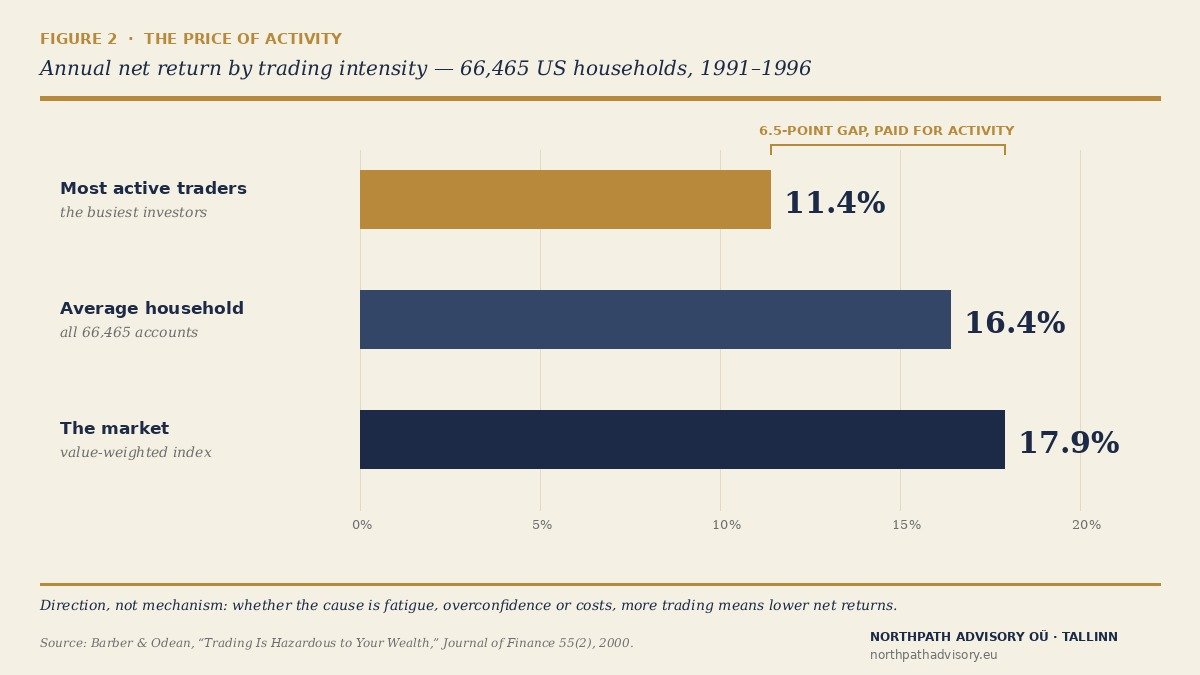
The second episode is the investor’s own, and here the evidence is not contested at all. Brad Barber and Terrance Odean, in “Trading Is Hazardous to Your Wealth” (Journal of Finance, 2000), studied 66,465 households at a discount broker between 1991 and 1996. The average household earned 16.4 per cent a year against a market return of 17.9 per cent; but the households that traded most earned just 11.4 per cent — a penalty of six and a half percentage points a year, paid for activity. In a later study of the entire Taiwanese day-trading population, Barber, Odean and co-authors found that fewer than one per cent of day traders could reliably earn positive returns net of costs. The pattern is the same wherever it is measured: the more decisions an investor makes, the worse the investor tends to do. Whether the mechanism is fatigue, overconfidence or simple transaction costs, the direction is unambiguous.
Those numbers describe two lived episodes a generation apart. The first was the day-trading mania of 1999 and 2000, when discount brokers and the first wave of online trading let tens of thousands of ordinary people trade intraday for the first time; the regulators’ post-mortems — including the North American Securities Administrators Association’s 1999 review of day-trading accounts — concluded that the great majority lost money, and the episode ended in the dot-com collapse. The second arrived two decades later, when zero-commission apps and pandemic lockdowns produced the retail surge of 2020 and 2021, in which the frictions that had slowed earlier investors — commissions, settlement delays, the need to telephone a broker — were engineered away almost entirely. In both episodes the volume and velocity of discretionary decisions rose by an order of magnitude, and in both the aggregate outcome vindicated the older evidence: more trading, worse results. The technology that strips friction out of decision-making strips out, with it, the very pauses in which a tired or excited judgment might otherwise be caught.
It is worth naming the regulatory backdrop, because two jurisdictions have already concluded that the velocity of retail decision-making is itself a hazard. In the United Kingdom, the Financial Conduct Authority’s very first Occasional Paper — “Applying Behavioural Economics at the Financial Conduct Authority,” by Kristine Erta, Stefan Hunt, Zanna Iscenko and Will Brambley (April 2013) — placed limited self-control and present bias at the centre of how retail investors come to harm. In the United States, the Securities and Exchange Commission’s long-standing investor notice “Day Trading: Your Dollars at Risk” warns plainly that most day traders suffer severe losses and many never reach profitability, and the Financial Industry Regulatory Authority for years required pattern day traders to hold at least twenty-five thousand dollars of equity — a structural brake on rapid-fire trading. That brake is, as it happens, being removed: the SEC approved the elimination of the pattern-day-trader designation and its minimum-equity requirement in April 2026, with the change taking effect on 4 June 2026. Whatever one makes of the deregulation, it sharpens the individual investor’s responsibility to impose the discipline that an external rule will no longer impose for him.
The counter-measure framework: three disciplines
The defence against decision fatigue is not willpower, which is the very faculty in question, but architecture — arrangements that reduce the number of consequential choices, settle them in advance, and keep the irreversible ones away from depleted moments. Three disciplines follow.
First, ration the decisions. The single most effective response is to make fewer of them. Most of what fills an investing day — the price alerts, the intraday commentary, the urge to “do something” about a holding that has moved — presents itself as a decision but is, on inspection, noise that the disciplined investor has already pre-decided to ignore. Cutting the count of real decisions from dozens a day to a handful a quarter does two things at once: it removes the fatigue mechanism by removing its inputs, and it directly attacks the overtrading penalty that Barber and Odean measured. A portfolio reviewed deliberately on a fixed cadence is exposed to a small number of considered judgments; a portfolio watched continuously is exposed to a large number of tired ones.
Second, pre-commit the criteria. A decision rule written calmly in advance — the conditions under which a position will be added to, trimmed or sold; the valuation discipline a candidate must pass; the maximum size any single holding may reach — converts an in-the-moment judgment into the mere application of a standing one. The work of thinking is done once, in a high-resource state, and merely executed thereafter. This is why a written investment policy statement, or a checklist run before any commitment of capital, is worth more than its bureaucratic appearance suggests: it is precisely the transfer of the hard part of the decision out of the fatigued moment.
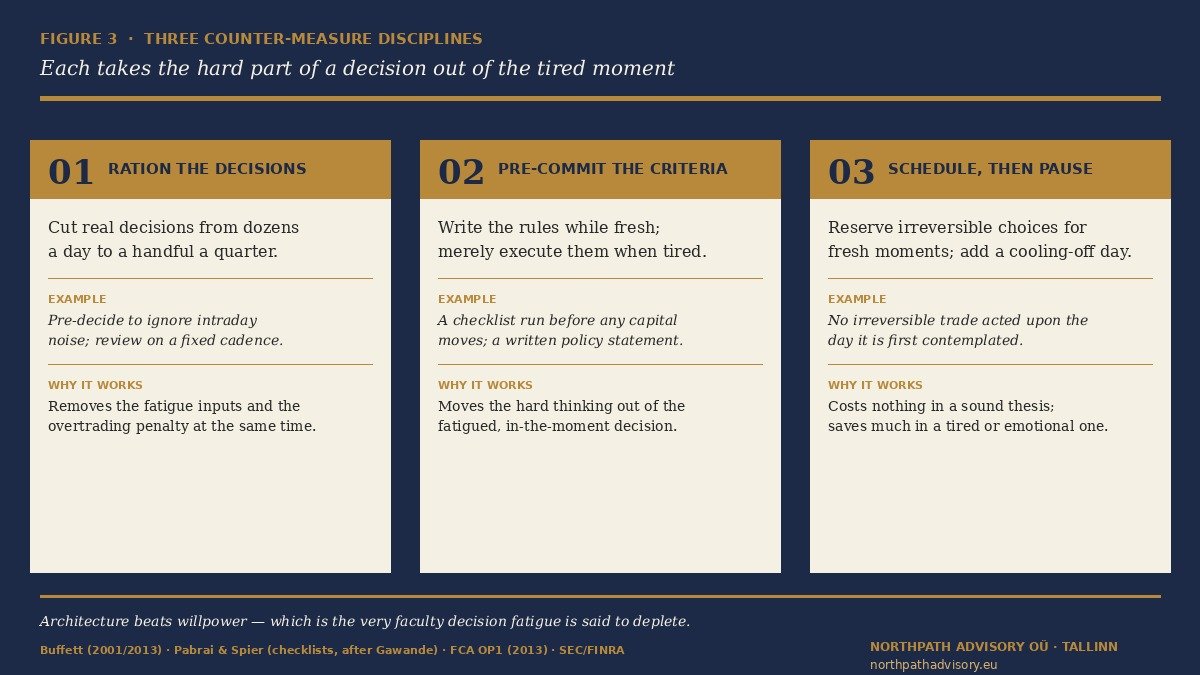
Third, schedule the irreversible choices, and build in a pause. The decisions that cannot be undone — committing a large tranche of capital, exiting a long-held compounder, abandoning a strategy in a drawdown — should be reserved for the start of a session, not its exhausted end, and should be subject to a deliberate cooling-off interval between the impulse and the execution. A self-imposed rule that no irreversible decision is acted upon on the day it is first contemplated costs nothing in a sound thesis, which will look just as sound tomorrow, and saves a great deal in a fatigued or emotional one, which usually will not. The cooling-off period is the retail investor’s private version of the structural friction that regulators have used — and are now, in the United States, partly dismantling.
How long-term-equity practitioners addressed it
The investors most associated with durable compounding have, almost without exception, built their practice around making very few decisions. Warren Buffett has put the point in the form of a thought experiment offered to students — at the University of Georgia in 2001 and again at Georgetown in 2013: imagine you received, on leaving school, a punch card with room for only twenty punches, each representing one investment decision you were permitted to make in your entire life. You would, he argued, think enormously hard about each one, and you would end up far richer for the constraint, because “you don’t need many” — four or five genuinely good decisions, compounded over decades, are sufficient. The punch card is decision-rationing rendered as a parable. His partner Charlie Munger made the same case in his own register, praising the discipline of “sitting on your assets” and observing that the big money is made not in the buying or the selling but in the waiting.
Where Buffett and Munger ration decisions by temperament, a younger generation of value investors has formalised the second discipline — pre-commitment — into explicit procedure. Mohnish Pabrai, after reading the surgeon Atul Gawande’s The Checklist Manifesto, built an investing checklist of roughly a hundred questions, each one distilled from a documented mistake — his own or another investor’s — and runs every prospective commitment through it before any capital moves. Guy Spier, his friend and a fellow adherent of the approach, has described in The Education of a Value Investor an entire personal architecture designed to keep decisions away from his own weaker moments: rules against checking prices during market hours, against acting on a broker’s call, against buying anything the same day he first hears of it. None of this is a claim that checklists confer foresight. It is a claim that the reliable enemy is not ignorance but the degraded in-the-moment judgment that fatigue, emotion and overconfidence produce — and that the enemy is best fought by deciding the rules when one is fresh and obeying them when one is not. Ray Dalio’s practice of writing his judgments down as durable “principles,” to be consulted rather than re-derived under pressure, is the same instinct in another idiom.
Key takeaways
- The strong claim failed; the discipline did not. The laboratory “ego-depletion” effect did not survive a 23-lab pre-registered replication (Hagger et al., 2016), and the glucose mechanism is discredited. Treat dramatic decision-fatigue anecdotes with scepticism.
- A weaker version may well be real. Field evidence — physicians prescribing worse late in a session, and, more cautiously, the contested parole-judge study — is consistent with judgment drifting over long, unbroken decision sequences, now read as a motivational rather than a fuel effect.
- The investor’s real enemy is measured and large. Active trading costs returns: the most active US households underperformed the market by roughly 6.5 points a year (Barber & Odean, 2000), and fewer than one per cent of day traders earn reliable net profits.
- Architecture beats willpower. Ration the number of real decisions; pre-commit the criteria in writing or a checklist; and reserve irreversible choices for fresh moments behind a cooling-off pause.
- The structural brakes are loosening. With the US pattern-day-trader minimum removed from 4 June 2026, the discipline a rule once imposed now falls to the individual investor to impose on himself.
— Manish Goel, FCA / NorthPath Advisory OÜ / Tallinn, Estonia
|
Important. |