The NorthPath Letter — Value Investing — Morning Edition
Most of the money managed in the world is managed against a benchmark. That single fact, more than any insight into business quality or any gift for forecasting, is the structural reason a patient analyst can still find securities priced at a discount to what they are plainly worth. A manager judged against the S&P 500, the Nifty 50 or the MSCI World cannot own what the index does not contain, cannot hold a stub that screens as un-investable, and cannot explain to a consultant why a sliver of a bankrupt company’s equity sits in a portfolio that is supposed to track large-cap blue chips. When a corporate event spits out exactly such a security, the institution does not weigh it and reject it. It never weighs it at all. It sells, mechanically, at whatever price clears — and someone on the other side, free of the benchmark, gets to buy a dollar for sixty cents.
This is the terrain Joel Greenblatt mapped in his 1997 book, You Can Be a Stock Market Genius: Uncover the Secret Hiding Places of Stock Market Profits (Simon & Schuster). The title is unfortunate — it reads like a late-night infomercial — and it has cost the book readers it deserved. What sits underneath is one of the most rigorous practitioner accounts ever written of where mispricing comes from and why it persists. This letter takes Greenblatt’s framework, sets it beside the published evidence, and asks what discipline it actually demands of a long-term equity investor anywhere in the world.
The principle
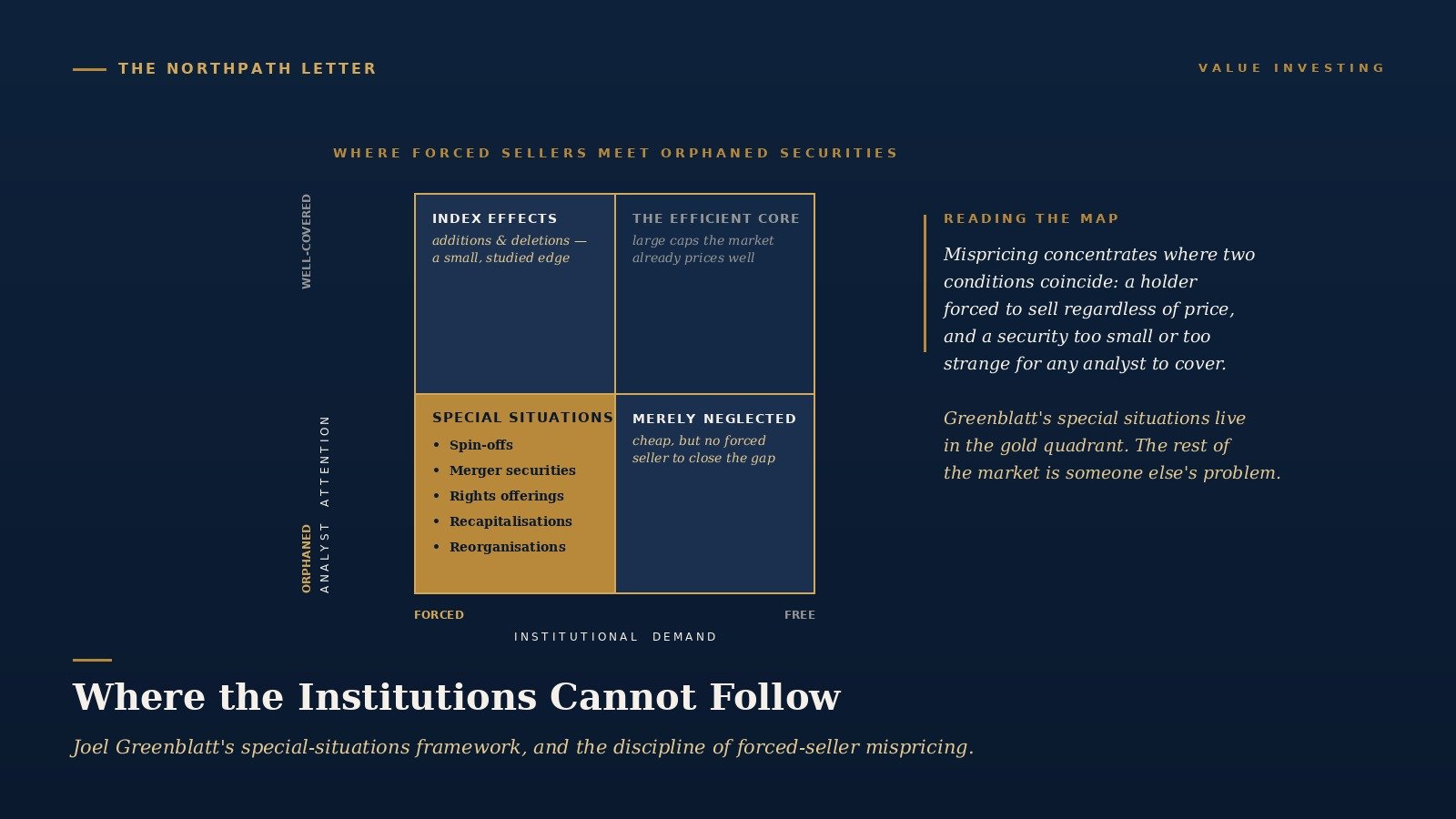
A special situation, in Greenblatt’s sense, is any corporate event that forces a change in the securities an investor holds and, in doing so, manufactures a temporary seller who does not care about price. The taxonomy in the book is precise: spin-offs, merger securities, rights offerings, recapitalisations, restructurings, bankruptcies and reorganisations, and risk arbitrage. Each is a different doorway into the same room. In every case a routine of corporate machinery — a demerger, a cash-and-paper takeover, a balance-sheet recapitalisation, an emergence from Chapter 11 — deposits an awkward, unfamiliar, often tiny security into the laps of holders who never chose it and are frequently mandated not to keep it.
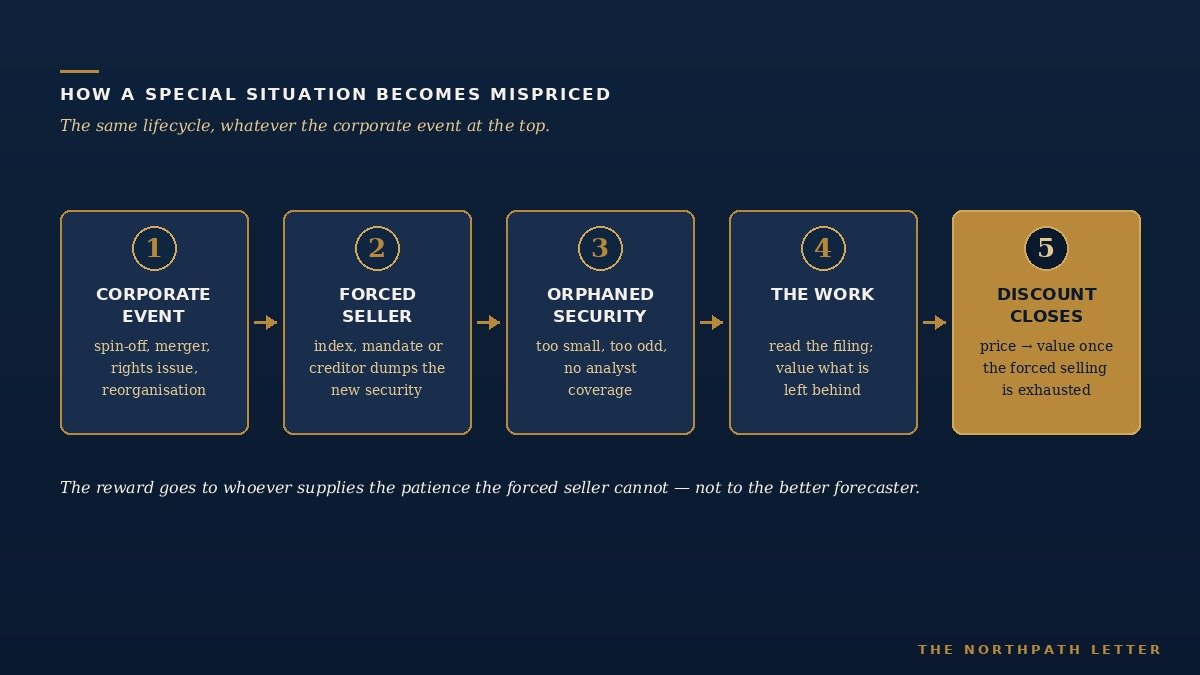
Greenblatt’s claim is not that these securities are mispriced because the market is stupid. It is that they are mispriced because the people who receive them are structurally indifferent to their value. An index fund handed shares it cannot hold will sell them on the reconstitution date regardless of what they are worth. A pension manager benchmarked to a broad index has no career reason to spend a fortnight valuing a complex post-bankruptcy equity that, even if it triples, will move the fund by a basis point. The reward, therefore, does not go to the cleverest forecaster. It goes to whoever is willing to do unglamorous, document-heavy work in a corner too small and too strange for institutional capital to bother with. Greenblatt taught precisely this material for years as an adjunct professor at Columbia Business School, and the discipline it asks for is closer to forensic accounting than to prophecy: read the filing, find the forced seller, and value what is left when the selling stops.
I have devoted a separate letter to spin-offs, the most studied branch of this family, and so I set them aside here. The wider point is the one worth keeping: the edge in a special situation is not informational and it is not predictive. It is behavioural and structural, and it belongs to the investor willing to be where the institutions cannot follow.
The mechanism
Why should a forced seller move a price at all? The efficient-market intuition says that demand for a stock is nearly flat — that if a mandated seller dumps shares, arbitrageurs absorb them at a price barely changed from fair value, because a share of a large company is a near-perfect substitute for cash plus a diversified basket. Andrei Shleifer tested that intuition directly in a 1986 paper in the Journal of Finance, “Do Demand Curves for Stocks Slope Down?” He studied stocks added to the S&P 500 — additions that carry no news about the business, only news about who is now forced to own it — and found that inclusion produced an immediate price jump of roughly three per cent that did not reverse. Robert Harris and Eitan Gurel reported the same effect in the same year. The finding is foundational: demand curves for individual stocks are not flat. Price-insensitive flow moves prices, and it moves them in the direction of the flow.
A special situation is that mechanism running in reverse and at far greater intensity. Index reconstitution merely shuffles a large stock between willing holders. A special situation hands a strange security to holders who are actively repelled by it — too small to matter, too odd to model, sometimes literally prohibited by the fund’s charter. The selling is therefore heavier, more concentrated in time, and less likely to be met by an equal crowd of natural buyers, because the natural buyers must first do the work of understanding an instrument that did not exist a week ago. The gap between the price the forced seller accepts and the value a patient analyst can defend is the special-situation premium. It is widest exactly where the security is most orphaned: the post-reorganisation equity no analyst covers, the merger note no index will hold, the nil-paid right that expires worthless if its owner simply forgets it.
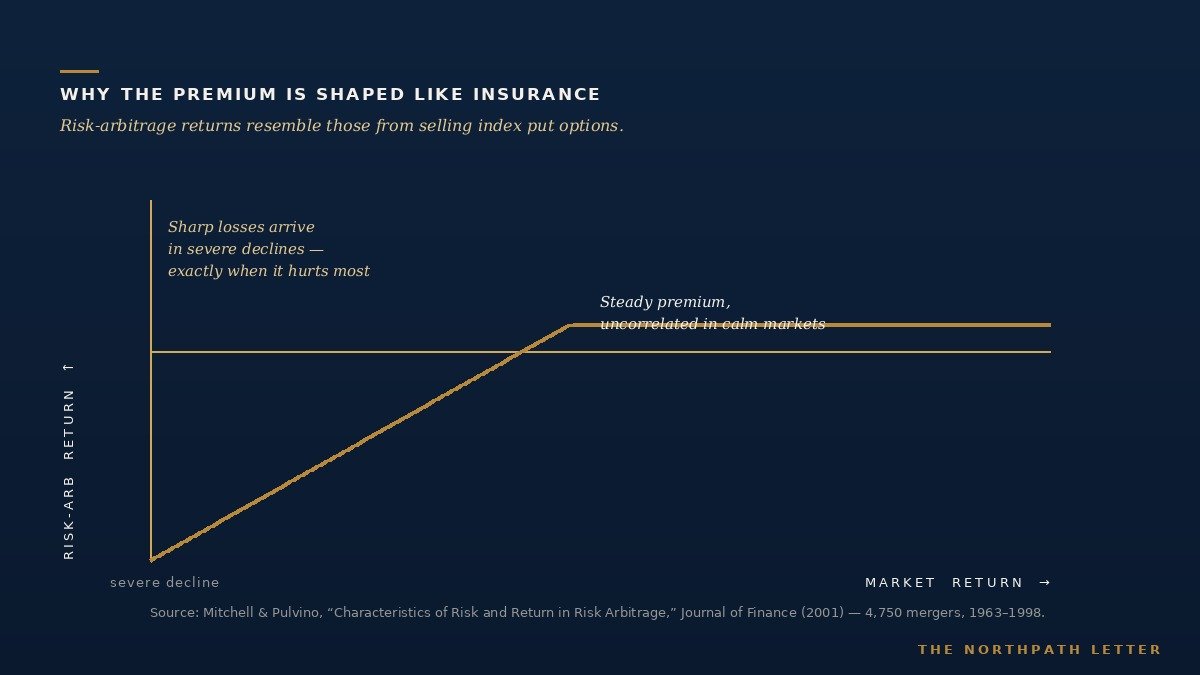
The mechanism also explains the premium’s shape, which matters enormously for how a long-term investor should size these bets. The return is not smooth. It arrives in lumps when a reorganisation completes, a deal closes, or a recapitalisation is digested — and it can reverse violently when a crisis forces even the patient holders to sell. That asymmetry is not a flaw in the strategy. It is the source of the reward.
The empirical record
The strongest published evidence sits in the academic record on merger arbitrage and on post-bankruptcy equity. Mark Mitchell and Todd Pulvino, writing in the Journal of Finance in 2001 (“Characteristics of Risk and Return in Risk Arbitrage”), assembled 4,750 mergers between 1963 and 1998 and measured what a disciplined arbitrageur would actually have earned. Their central finding is the one every practitioner should internalise: the returns to risk arbitrage behave like the returns to selling uncovered index put options. In flat and rising markets the strategy collects a steady premium, uncorrelated with the index. In severely falling markets it suddenly becomes correlated and loses heavily, precisely when deals break and leverage is withdrawn. The excess return is real and it is positive across the full cycle — but it is compensation for bearing a risk that concentrates its pain in the worst states of the world. This is why Greenblatt, tellingly, warns his readers against naked risk arbitrage and steers them toward merger securities, where the non-cash instrument handed to selling shareholders is dumped without regard to value and offers a margin of safety the bare deal spread does not.
Post-bankruptcy equity tells a complementary story. Allan Eberhart, Edward Altman and Reena Aggarwal, again in the Journal of Finance (1999, “The Equity Performance of Firms Emerging from Bankruptcy”), tracked 131 firms emerging from Chapter 11 and found large, positive abnormal returns — on the order of a quarter, relative to the market, in the two hundred trading days after emergence. The reason is the mechanism above: a freshly reorganised company’s shares are issued to former creditors who want cash, not a long-term equity stake in a business that just embarrassed them, and who sell into a market that has stopped paying attention. The selling and the inattention are the opportunity.
Then there is the practitioner record. Greenblatt founded Gotham Capital in 1985 and ran it almost entirely on special situations. Over the decade that followed, by the accounts subsequently published, the fund compounded at roughly fifty per cent a year before fees — and on the order of thirty per cent net of all costs — before he returned outside investors’ capital in the mid-1990s. A single track record proves nothing on its own; survivorship and luck haunt every such number. But it is consistent in direction with the academic evidence, and it was earned in a corner of the market that the academic evidence independently identifies as structurally mispriced. The convergence is what matters.
The natural objection is that any premium documented in a 1986 paper and a 1997 bestseller should long ago have been competed away. It has not been, and the reason is the most important feature of the whole field: the opportunities are too small to absorb the capital that would erase them. A spin-off worth a few hundred million dollars, a tranche of merger notes, the equity of a single reorganised company — none can take in a billion-dollar allocation without the buyer becoming the very forced participant whose presence collapses the discount. The premium survives precisely because it does not scale. That is an uncomfortable truth for an industry that is paid on assets gathered rather than returns earned, and it is the long-term private investor’s structural advantage: the situations that are beneath a large fund’s notice are exactly the right size for a careful individual.

Two historical episodes
Consider first the United States in 2009 and 2010, and the equity of General Growth Properties — at the time the second-largest mall owner in the country. General Growth filed for Chapter 11 in April 2009, the largest real-estate bankruptcy in American history. Its shares, which had traded above forty dollars in 2007, had collapsed to less than a dollar. The conventional reading was that the equity was a zero: a bankrupt company’s stock is the residual claim behind every creditor, and index funds, mandated managers and most retail holders sold it as a matter of course. But a small number of investors who read the filings rather than the headline saw something different. General Growth’s malls were full and cash-generative; the company had failed not because its assets were worthless but because it could not refinance maturing mortgages in a frozen credit market. This was a liquidity failure, not an insolvency. William Ackman’s Pershing Square amassed the equity on that thesis, joined the board, and helped shepherd a recapitalisation. General Growth emerged from bankruptcy in November 2010, financed at fifteen dollars a share by a consortium, with existing shareholders preserved — and the position became one of the most profitable in Pershing Square’s history. The edge was not a forecast about retail or interest rates. It was the willingness to value a security that everyone else was contractually or temperamentally obliged to discard.
Consider next a different doorway, and a different region’s machinery: the takeover of Anheuser-Busch by the Belgian-Brazilian brewer InBev. The two sides signed an all-cash agreement in July 2008 at seventy dollars a share — roughly fifty-two billion dollars, fully negotiated and financed. Then Lehman Brothers failed in September, and the leveraged arbitrage community that normally holds announced-but-unclosed deals was forced to liquidate into the panic. For weeks, Anheuser-Busch shares traded several dollars below a signed, board-approved, financed cash price that was due to be paid that November. In a calm market the spread on such a deal would have been a point or two; the credit crisis blew it far wider, not because the deal had become risky but because the natural holders of the spread were being margin-called out of their positions. The transaction closed on schedule on 18 November 2008. An investor who simply bought the stock and waited a few weeks earned an extraordinary annualised return — not by predicting anything, but by supplying the patience that the forced sellers could no longer afford.
The same logic recurs across markets and instruments. To take one regional example among many: when Reliance Industries carried out the largest rights issue in Indian corporate history in 2020, the partly-paid shares it created traded for more than a year as a separate listed instrument, at a shifting and frequently illogical discount to the fully-paid stock — an orphaned security that rewarded holders who understood the mechanics and penalised those who did not. The geography changes; the structure does not.
The application framework
None of this is useful as inspiration. It is useful only as process, so here are three disciplines that turn the principle into a method.
First, locate the forced seller before you value anything. The first question in any special situation is not “what is this worth?” but “who is being made to sell it, and why don’t they care about the price?” If you cannot name the forced seller — the index that must delete the stock, the creditor who wants cash not equity, the shareholder dumping a merger note he never wanted — then you have not found a special situation; you have found an ordinary stock that is merely cheap, and you have no structural reason to expect the discount to close. The forced seller is the whole thesis. Identify the mandate, the charter rule, or the reconstitution date that is doing the selling, and you have identified your edge.
Second, do the document work, and accept that it does not scale. These opportunities live in the proxy statement, the reorganisation plan, the rights-issue prospectus, the merger agreement’s treatment of stub securities. They are small by construction — that is why the institutions cannot be bothered — which means they will never absorb large capital and will never reward a casual skim. The work is forensic and the position sizes are modest. A long-term investor should treat special situations as a deliberate, separately-budgeted sleeve of a portfolio, not as a replacement for owning good businesses for a decade. The two disciplines coexist; they do not compete.
Third, size for the shape of the payoff, not the average. Mitchell and Pulvino’s lesson is that these returns resemble premiums collected from selling insurance: many small, steady gains and the occasional severe loss that arrives exactly when markets are already falling and your other holdings are down too. The correct response is not to avoid the strategy but to size each position so that the worst-state loss is survivable, to prefer the situations with a hard asset or a defined catalyst underneath them, and never to fund them with leverage — because leverage is the precise mechanism that turned 2008’s arbitrageurs into forced sellers in the first place. The investor who is never forced to sell is the one who gets to buy from those who are.
How practitioners actually applied it
Greenblatt is the obvious first witness, and his 1997 book remains the cleanest primary source: it walks through real merger securities, recapitalisations and rights offerings he traded at Gotham, showing the filings and the arithmetic rather than offering aphorisms. His core instruction — that you need only understand a handful of situations well, because “you only have to be right a few times in your life” if the asymmetry is steep enough — is the special-situation creed in a sentence.
Ackman’s General Growth investment, documented in Pershing Square’s investor letters and in the public bankruptcy record, is the modern textbook case of the bankruptcy-and-reorganisation branch: a security everyone was structurally obliged to sell, valued from first principles by someone who was not. He has described it as among the best risk-reward decisions of his career, and the description is accurate precisely because the reward came from structure, not from a macro call.
The discipline runs deeper into the value tradition than Greenblatt alone. Seth Klarman devotes substantial passages of Margin of Safety (1991) to corporate events — spin-offs, liquidations, bankruptcies, and complex securities — as the natural habitat of the value investor, precisely because the analytical work is hard and the holders are motivated by something other than value; Baupost has compounded for four decades with special situations as a core lane. Michael Price built Mutual Series on bankruptcy, restructuring and merger-arbitrage workouts, training a generation of distressed and event-driven investors in the process. Across all of them the through-line is identical, and it is not a knack for prediction. It is a temperament: a willingness to do tedious work in unglamorous corners, and the financial and psychological independence never to be the one who is forced to sell.
Key takeaways
- The edge is structural, not predictive. Special situations are mispriced because corporate events hand awkward securities to holders who are mandated or motivated to sell without regard to value — not because the market is foolish. Find the forced seller first; the valuation comes second.
- The published evidence is real but shaped like insurance. Mitchell and Pulvino (2001) show risk-arbitrage returns resemble selling index puts: a steady premium punctuated by severe losses in crises. Eberhart, Altman and Aggarwal (1999) document large abnormal returns in post-bankruptcy equity. Size for the bad state, not the average.
- Greenblatt steered away from naked risk arbitrage. His 1997 framework prefers merger securities and other orphaned instruments, where a margin of safety sits beneath the catalyst, over bare deal spreads that pay you to bear tail risk.
- It does not scale, and that is the point. These opportunities are small by construction. Treat them as a deliberate, document-heavy, unlevered sleeve alongside long-term ownership of good businesses — never as a substitute for it.
- Independence is the prerequisite. The investor who is never a forced seller is the one positioned to buy from those who are. Leverage and benchmark-hugging are the two things that turn an opportunist into a victim.
The deepest lesson in Greenblatt’s framework is almost anti-climactic. The secret hiding places are not secret because they are hidden; they are in plain sight, in public filings, on the exchange. They are hiding only from capital that is not allowed to look. For an investor with the patience to read and the independence to wait, that is not a market failure to lament. It is a standing invitation.
The author holds no position in any security named in this letter, which are discussed solely as historical illustrations of the principle under examination.
— Manish Goel, FCA / NorthPath Advisory OÜ / Tallinn, Estonia
|
Important. |