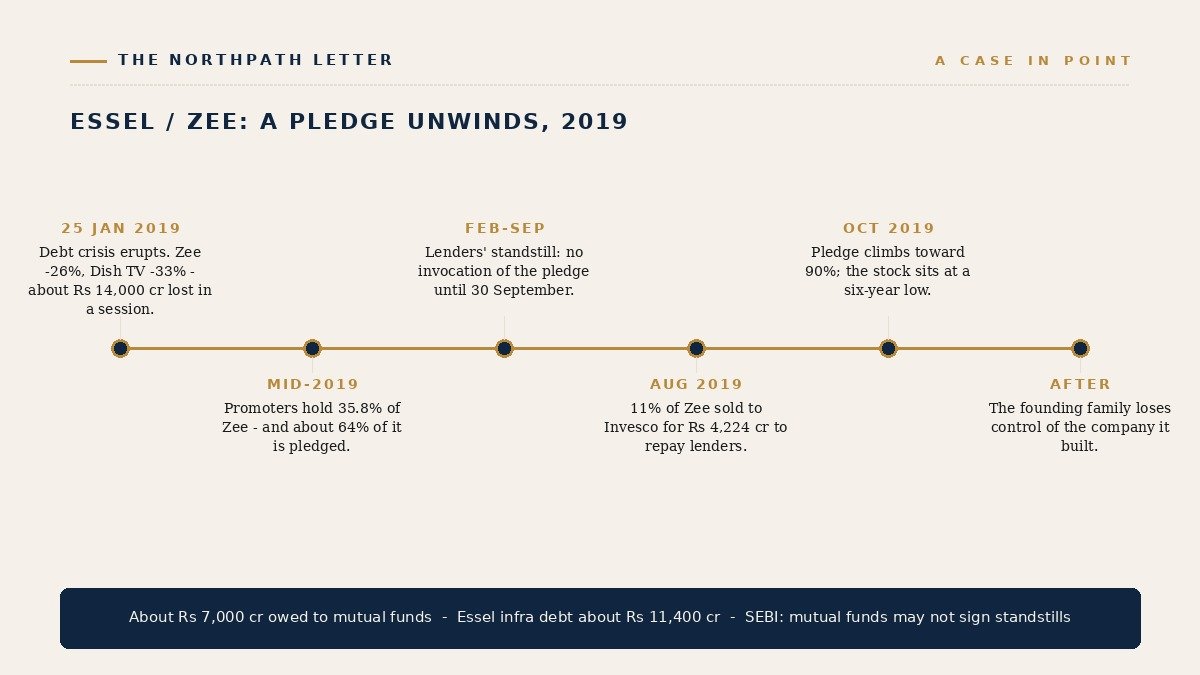
On the morning of 25 January 2019, the equity of Zee Entertainment Enterprises — one of India’s largest listed media companies, with cash flows, profits and a recognisable consumer franchise entirely intact — fell by about a quarter in a single session. Its affiliate Dish TV fell by roughly a third. Nothing had changed in either business overnight. No factory had burned, no product had failed, no quarter had been missed. What had changed was a perception about the promoter’s balance sheet, not the company’s: a press report linking an Essel Group entity to an investigative probe spooked the lenders who had financed the founding family against its own shareholding. The market understood instantly what many minority shareholders did not — that a large fraction of the promoter’s stake was pledged, that pledged stock can be sold by the lender, and that a falling price and a borrowed share form a chain reaction. By October that year the promoters’ pledge against Zee had climbed to around ninety per cent, the stock sat at a six-year low, and the family that built the company was on its way to losing control of it.
This letter is about that chain reaction, and about the disclosure regime India built to make it visible in advance. The mechanism is not exotic and the data is not hidden: every listed Indian company reports, every quarter, the number of promoter shares that are “pledged or otherwise encumbered.” The problem is that most readers — especially those trained on Western filings, where this line barely exists — do not know to look, do not know what the percentage means, and do not appreciate that the figure is a lag indicator that can move violently between filings. For the global reader, promoter pledging is the single clearest example of a risk that is structurally larger in India than in the markets they came from, for reasons that have nothing to do with governance failings and everything to do with who owns the shares.
(For the meaning of “promoter” itself — the controlling-shareholder construct that has no clean Western analogue — see the earlier NorthPath primer. This letter takes the concept as given and goes one level deeper, into what happens when the promoter borrows against it.)
What a pledge actually is
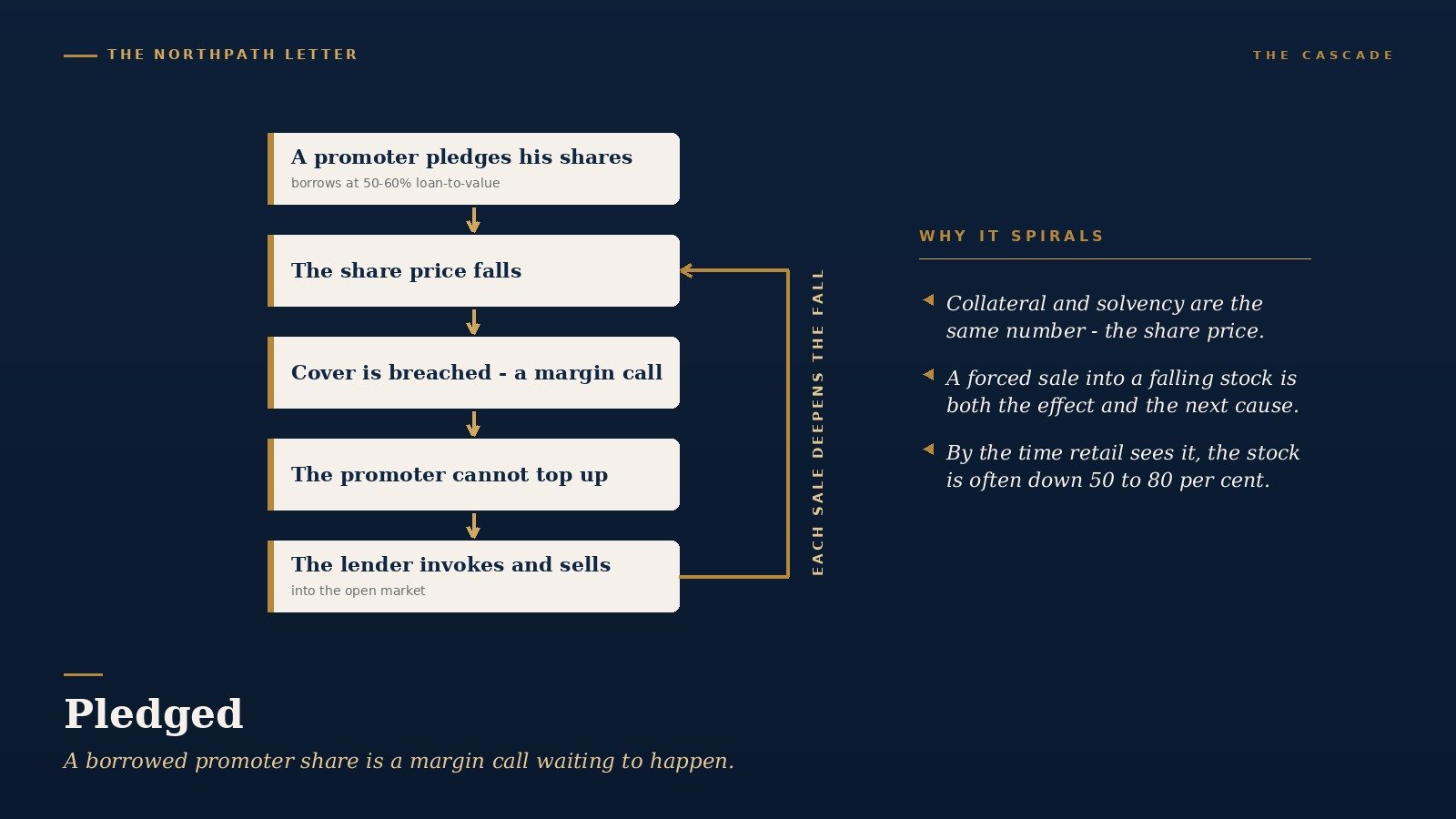
A promoter pledge is a loan against listed equity. The promoter takes his own shares in the listed company, deposits them as collateral with a lender, and borrows cash against them. Lenders typically advance somewhere between fifty and sixty per cent of the market value of the pledged shares — a loan-to-value ratio that leaves a cover, or margin, of roughly 1.5 to 2 times. The promoter keeps the economic upside and the voting rights while the loan performs; the lender holds the right to sell the collateral if it does not.
Two features make this structure consequential, and both are easy to miss. The first is that the borrowing usually has nothing to do with the listed company whose shares are pledged. Promoters pledge to fund something else — an unlisted group venture, an acquisition, a capital call elsewhere, a personal commitment, or, at the dangerous end, to service older debt. The listed company receives none of the money and carries none of the liability on its own balance sheet, yet its share register now contains a block of stock that a third party can be forced to sell into the open market. The risk lives at the promoter level and lands at the company level.
The second feature is that a pledge is quasi-debt secured on a volatile, marked-to-market asset. Ordinary corporate borrowing is secured against plant, receivables or cash flows whose value does not reprice every ninety seconds. Pledged shares do. That difference is the whole story, because it means the value of the collateral and the solvency of the borrower are wired to the same screen — the share price — and they move together, downward, at exactly the moment cover is most needed.
The cascade
Consider what happens when the price of a heavily pledged stock starts to fall. The market value of the collateral drops. The cover ratio the lender requires is breached. The lender issues a margin call: top up the collateral with more shares or more cash, or the loan is in default. A promoter who pledged because he was short of liquidity in the first place frequently cannot top up. The lender then invokes the pledge — it takes title to the shares and sells them in the open market to recover its money.
Now the reflexive loop closes. A large block of stock sold into an already-falling, often thinly-traded share pushes the price down further. The lower price breaches the cover on whatever pledged shares remain, with the same lender or with others. Fresh margin calls follow, fresh invocations, fresh forced sales. Each sale is both a consequence of the last price fall and a cause of the next. This is why practitioners call it a death spiral: it is self-reinforcing, it is mechanical rather than discretionary, and it runs faster than the fundamentals it is supposedly about. By the time the typical retail holder understands what is happening, the stock is frequently down fifty to eighty per cent and the explanation arrives in the newspaper after the fact.
The cruelty of the structure is that it is indifferent to whether the underlying business is any good. A profitable, well-run company with a heavily pledged promoter can be cut in half by a forced unwind, while the operating numbers it reports three weeks later are perfectly healthy. The share price is reacting to the promoter’s financing, not the firm’s earnings. That decoupling — solvent company, insolvent owner — is precisely what the disclosure regime exists to surface.
Where it is written down
India discloses pledging through three overlapping rails, all administered by the Securities and Exchange Board of India (SEBI), and a reader who knows the three can reconstruct a promoter’s leverage with some precision.
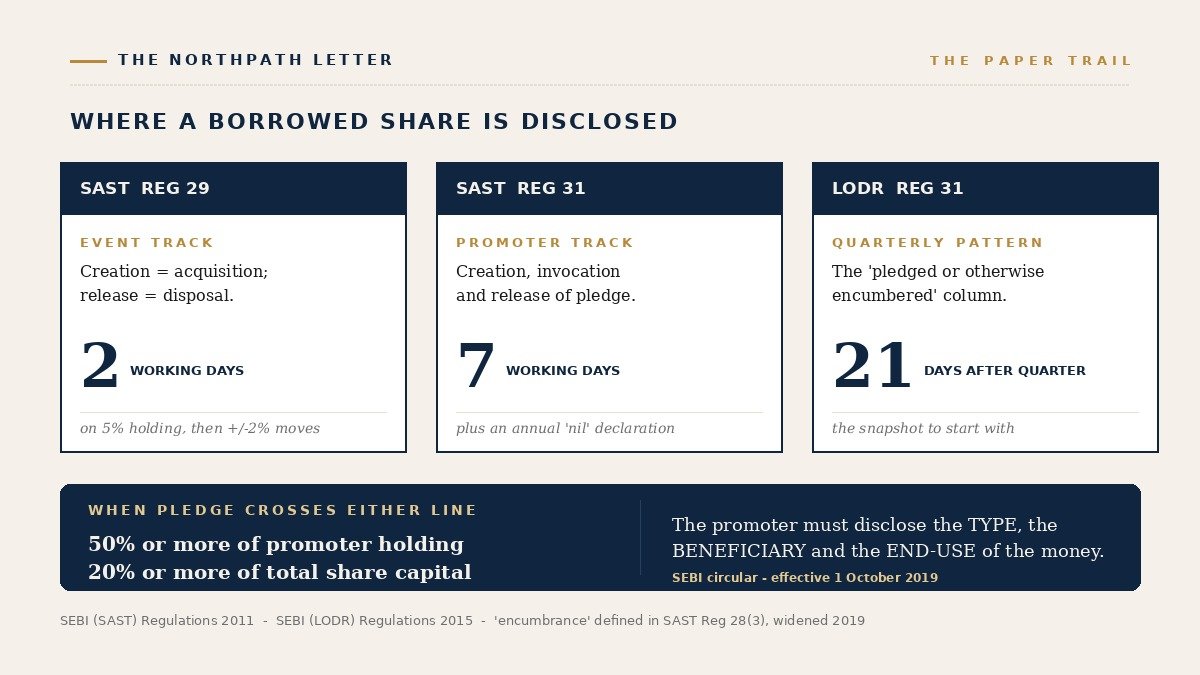
The first rail is the event-based track under Regulation 29 of the SEBI (Substantial Acquisition of Shares and Takeovers) Regulations, 2011 — the “Takeover Code.” Acquisitions and disposals crossing five per cent, and incremental changes of two per cent thereafter, must be disclosed to the exchanges within two working days. Crucially, the creation of an encumbrance is treated as an acquisition and its release as a disposal, so a pledge event itself trips the wire. (There is a carve-out: a scheduled commercial bank, public financial institution, housing-finance company or systemically important non-banking finance company acting as pledgee in the ordinary course is exempted from this particular disclosure, because it is the lender, not the owner.)
The second rail is the promoter-specific track under Regulation 31 of the same Code. Every promoter must disclose the details of shares he or his persons acting in concert have encumbered, and any creation, invocation or release of that encumbrance, to all the stock exchanges within seven working days. Promoters must also file an annual declaration, within seven working days of the financial year-end, that no undisclosed encumbrance was created during the year. This is the rail that catches the slow accumulation of pledges that no single event-based filing would flag.
The third rail is the quarterly shareholding pattern under Regulation 31 of the SEBI (Listing Obligations and Disclosure Requirements) Regulations, 2015 — “LODR” — filed within twenty-one days of each quarter-end. It is here, in the promoter and promoter-group rows, that the reader finds the plain-language column: “number of shares pledged or otherwise encumbered,” with the percentage. For most investors this quarterly snapshot is the entry point, and it is the one to start with.
A word on “or otherwise encumbered,” because that phrase is the scar tissue of an earlier failure. Before 2019, the definition of encumbrance was narrow enough that promoters could achieve the economic effect of a pledge — committing their shares to a lender’s recovery — through structures that escaped the pledge column: negative liens, non-disposal undertakings, and assorted “non-pledge” arrangements. The shares looked unencumbered in the filings while behaving like collateral in private. After the 2018–19 episode laid the cost of that gap bare, SEBI’s board, in June 2019, broadened the definition in Regulation 28(3) to capture “any restriction on the free and marketable title to shares, by whatever name called, whether executed directly or indirectly” — explicitly sweeping in non-disposal undertakings and covenant-based restrictions. LODR borrows that same definition, so the quarterly column now means what a reader hopes it means.
SEBI went further the same season. By a circular dated 7 August 2019, effective 1 October 2019, it required promoters to disclose the detailed reasons for encumbrance — the type, the entity in whose favour it was created, and the end-use of the borrowed money — whenever the combined encumbrance crosses either of two thresholds: fifty per cent of the promoter group’s holding, or twenty per cent of the company’s total share capital. Those two numbers are the diligence thresholds worth memorising, because above them the filing tells you not just how much is pledged but why, and the “why” is where the difference between funding the listed business and funding a personal bet becomes visible. Most recently, a SEBI circular of 20 March 2025, applicable from the quarter ending 30 June 2025, revised the shareholding-pattern format again to break out non-disposal undertakings and “other encumbrances” separately and to add a fully-diluted-basis column — a further tightening of the same screw.
The 2018–19 unwind
The regime reads like an abstraction until you watch it fail to be consulted in real time. The autumn of 2018 supplied the case study. In September, the infrastructure conglomerate IL&FS defaulted across commercial paper, bonds and bank loans — a credit event examined in an earlier NorthPath letter — and the short-term debt market on which non-bank lenders depended seized. The very institutions that financed promoter pledges, the non-banking finance companies and the debt schemes of mutual funds, suddenly could neither roll over their own funding nor extend fresh credit. Housing-finance lender DHFL lost roughly sixty per cent of its value in a single session that month after a mutual fund sold a parcel of its commercial paper at a discount, and the contagion spread along precisely the wiring described above: when the lenders to promoters are themselves under a run, every pledged book faces a simultaneous margin call.
Zee was the set-piece. As of mid-2019, the Essel Group promoters held about 35.8 per cent of Zee, of which nearly sixty-four per cent was pledged with banks, NBFCs and — fatefully — mutual funds. When the share price cracked on 25 January, the lenders held the power to invoke and dump the collateral, which would have detonated the cascade. Instead, an unusual thing happened: the lenders signed a “standstill,” agreeing not to declare default or sell the pledged shares until 30 September 2019, to give the group room to sell assets in an orderly way rather than a fire sale. It bought time, but it also exposed a regulatory seam. SEBI’s chairman publicly observed that September that mutual funds were not supposed to be entering standstill agreements at all — a fund manager’s duty runs to his unit-holders, not to the rescue of a borrower — and the episode hardened the rules against exactly that.
The arithmetic of the unwind is the lesson. The promoters owed something on the order of seven thousand crore rupees to mutual funds alone, against a wider group infrastructure debt of roughly eleven and a half thousand crore. To begin repaying it, they sold about eleven per cent of Zee to Invesco’s Oppenheimer Developing Markets Fund for 4,224 crore rupees in August 2019 — diluting the very control the pledge was meant to preserve. The founder issued an open letter of apology to his lenders. And the pledge, far from shrinking, rose toward ninety per cent as the stock fell, because a smaller market value against the same loan mechanically raises the encumbered fraction. Every number in that sequence was visible, in the filings, before the crash. The pledged-shares column had been printing the warning for quarters. The market read it on 25 January; most minority holders read it afterwards.
The pattern was not new. A decade earlier, the collapse of Satyam Computer Services carried the same signature in cruder form: a founder who had pledged a large part of his holding, a falling price, and forced sales of pledged stock that accelerated the descent from over five hundred rupees to single digits — though in Satyam’s case an accounting fraud was the proximate trigger and the pledge the amplifier. It was episodes like Satyam that prompted SEBI to mandate pledge disclosure in the first place; it was episodes like Essel that prompted SEBI to make the disclosure mean what it says.
How to read it: a practitioner’s checklist
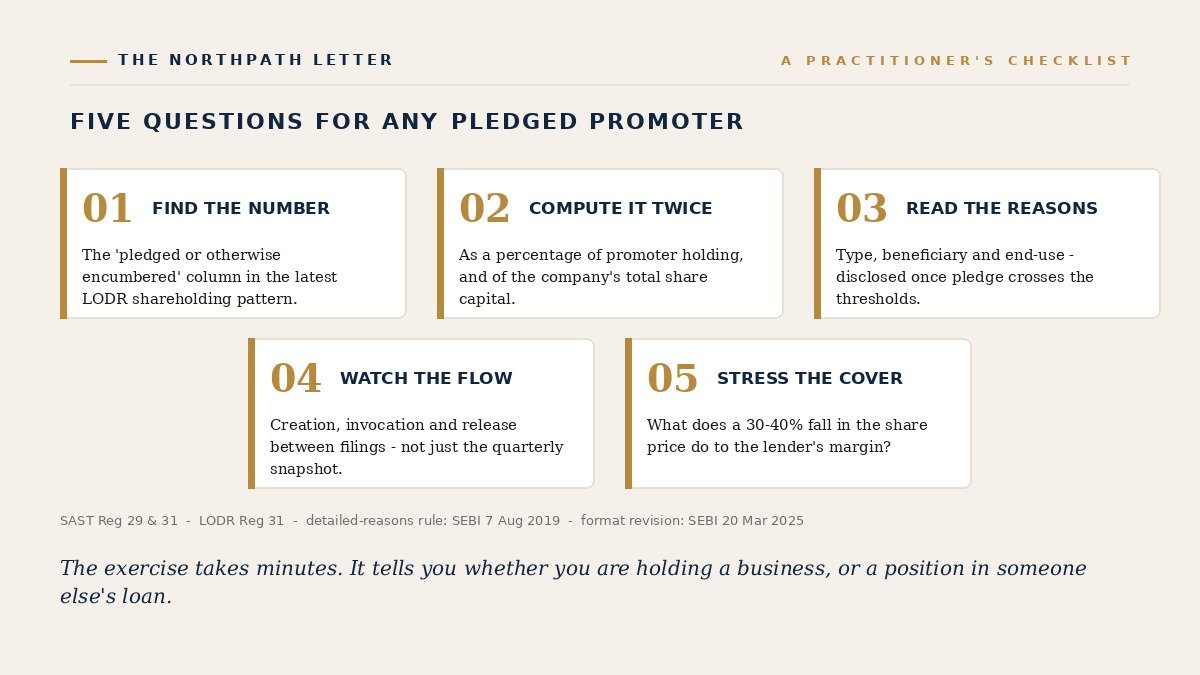
The disclosure is only useful to a reader who knows the five questions to put to it. None requires special access; all can be answered from public filings and the pledge data the exchanges and depositories publish.
First, find the number. Open the most recent quarterly shareholding pattern under LODR Regulation 31 and locate the promoter and promoter-group rows. Read the “shares pledged or otherwise encumbered” column and its percentage. This is the snapshot.
Second, compute it two ways. The headline percentage is usually expressed against the promoter’s own holding, but the more revealing figures are the two SEBI thresholds: pledge as a percentage of the promoter’s holding, and pledge as a percentage of the company’s total share capital. The first tells you how exposed the controlling family is; the second tells you how much stock could, in extremis, be forced into the public float. A promoter who has pledged eighty per cent of a thirty per cent stake has put nearly a quarter of the company on a lender’s hair-trigger.
Third, read the reasons. Where encumbrance crosses fifty per cent of promoter holding or twenty per cent of capital, the filing must state the type, the beneficiary and the end-use. Ask what the money funded. Pledging to inject growth capital into the listed company is a different animal from pledging to prop up an unrelated group entity or to refinance maturing personal debt. The end-use disclosure is the closest thing the reader has to the promoter’s intent.
Fourth, watch the flow, not just the stock. The quarterly snapshot is a lag; encumbrance can be created, invoked or released between filings. The event-based Regulation 29 and Regulation 31 disclosures, and the daily pledge data published by the exchanges and by specialist databases, capture the changes. A rising pledge into a falling price is the most dangerous configuration there is, and it is observable in close to real time if one looks at the flow.
Fifth, stress the cover. Ask the only question the lender is asking: what does a thirty or forty per cent fall in the share price do to the margin? If a modest decline would breach cover on a large pledged block held against an illiquid stock, the company carries a structural fragility that no amount of operating quality offsets. The exercise takes minutes and tells you whether you are holding a business or a position in someone else’s loan.
What the global reader should take from this
To an investor raised on American or British filings, the granularity of India’s pledge disclosure can look like an over-reaction. It is the opposite: it is a proportionate response to a different ownership structure. Promoter pledging scales with concentrated founder ownership, and India has that in abundance — a large majority of listed companies have promoter holdings above a quarter of capital, and the typical large-cap promoter stake sits near half. Where a controlling family owns half the company, there is half a company’s worth of stock available to be borrowed against. In the dispersed Anglo-American market, where very few of the largest companies have any single family or individual holding above ten per cent, there is simply far less insider stock to pledge at scale, and the disclosure regimes reflect that.
They do exist, however, and the comparison is instructive. In the United States, margin lending against stock is governed by the Federal Reserve’s Regulation U, which has capped the loan value of such credit at half the market value since 1974; resale of an insider’s stock after a lender forecloses runs through Rule 144; and Item 403(b) of Regulation S-K requires companies to disclose, in the beneficial-ownership table, the shares pledged by directors and officers. That disclosure has teeth: in 2023 the SEC penalised Carl Icahn and his holding company for failing to disclose that billions of dollars of company stock had been pledged as collateral for personal margin loans. Many US boards, prompted by proxy advisers who treat insider pledging as a governance negative, prohibit the practice outright. The United Kingdom surfaces large positions through the FCA’s transparency rules and managers’-transactions disclosure under the market-abuse regime, but has no equivalent of India’s quarterly line-item pledge column — because it has little of the concentrated pledging that would justify one.
The data offers a closing reassurance and a warning in the same breath. As of the December 2024 quarter, promoter pledging across the BSE 500 had fallen to about 0.84 per cent of promoter holdings — roughly 1.63 lakh crore rupees, or about 0.4 per cent of those companies’ market value — its sixth consecutive quarterly decline, with only sixty-nine of five hundred companies carrying any promoter pledge at all. In aggregate, then, this is a small and shrinking risk, deflated by a long bull market that has let promoters refinance and sell rather than borrow. But the aggregate is the wrong lens. Pledging has always been concentrated in a minority of names, often smaller and more leveraged, where the encumbered fraction runs not at one per cent but at forty, sixty or ninety. The market-wide average tells you the system is sound; it tells you nothing about the single company in front of you. That is why pledging is a name-level diligence item, not a macro one — a column to be read, company by company, before the lender reads it for you.
The takeaway is a single sentence: in a market built on concentrated promoter ownership, a borrowed share is a margin call waiting to happen, and the only protection is to read the encumbrance column before the price does the reading for you.
Manish Goel, FCA, writes The NorthPath Letter from Tallinn. This letter is journalism and education, not investment advice; the companies named appear only as historical illustration, and the author holds no position in any security mentioned.