Value Investing · The NorthPath Letter · Morning Edition
Between the fund that owns the index and the fund that earns its fee sits a third creature: the fund that owns the index and charges as if it did not. Murray Stahl of Horizon Kinetics has spent years arguing that much of what is sold as active management is this creature — and the academic record, three European regulators and one Nordic supreme court now agree. This letter is about the closet indexer: how to detect it, why it exists, and the discipline of paying only for genuine difference.
The principle: a fee is a promise of difference
An active management fee is a promise. The promise is not outperformance — no honest manager can promise that — but difference: a portfolio built from judgment rather than from the benchmark’s weights, one that is at least capable of an outcome the index cannot deliver. A closet indexer is a fund that breaks this promise quietly. Its factsheet speaks of conviction and selection; its holdings reproduce the benchmark with cosmetic deviations; its fee is ten to thirty times that of the index fund it functionally is.
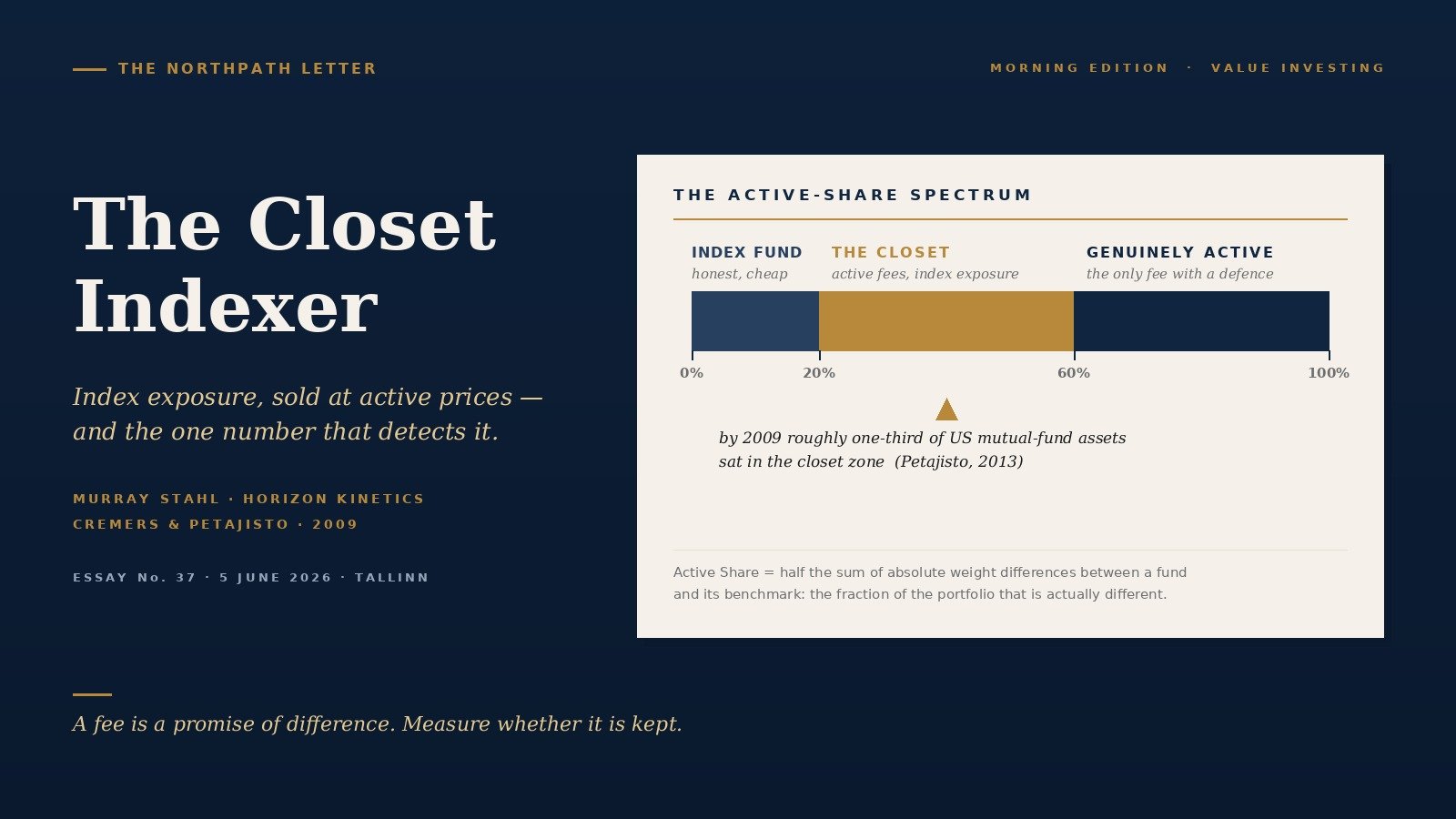
The instrument that exposed the practice is Active Share, introduced by Martijn Cremers and Antti Petajisto in their 2009 study “How Active Is Your Fund Manager? A New Measure That Predicts Performance” (Review of Financial Studies, 22(9)). The measure is disarmingly simple: take the absolute difference between the fund’s weight and the benchmark’s weight in every security, sum them, divide by two. A pure index fund scores zero; a portfolio with no overlap at all scores 100 per cent. The number answers, in one figure, the only question a fee payer needs answered first: what fraction of this portfolio is actually different from the thing I could own for a few basis points? Cremers and Petajisto drew the closet’s threshold at an Active Share below roughly 60 per cent for a fund that nonetheless markets itself, and charges, as active.
The measure also reprices the fee. A fund charging 1.5 per cent a year with an Active Share of 40 per cent is, functionally, 60 per cent index fund and 40 per cent active portfolio — so the whole fee is being earned, if it is earned at all, by the active sliver. Spread 1.5 per cent across the 40 per cent that is doing the work and the true price of the active component approaches 4 per cent a year, an arithmetic Ross Miller formalised in 2007 as the “active expense ratio.” Few strategies in the history of markets have added 4 per cent a year before the manager was paid; almost none after. Stated fees flatter the closet; effective fees condemn it.
Murray Stahl’s contribution — developed across Horizon Kinetics’ quarterly commentaries and the firm’s “Under the Hood: What’s in Your Index?” series, begun in June 2015 — is to insist that the mislabelling runs in both directions. The index investor rarely knows what the index actually contains, how concentrated it has become, or how its composition drifts toward whatever has already grown large; and the nominally active investor too often owns precisely that index, decorated. In Stahl’s framing, a capitalisation-weighted benchmark is not a neutral resting place. It is a momentum-weighted list, assembled by committee rules, in which a company’s weight is set by its size rather than by any appraisal of value. To hug it is not to abstain from a decision; it is to make a large, unexamined one — while billing the client for examination.
The principle this letter takes from Stahl, Cremers and Petajisto is therefore symmetrical and personal. Every basis point of cost in an equity portfolio must purchase one of two things: genuine difference from the market, or the market at the market’s price. The middle — index exposure at active prices — is a standing transfer from the investor to the manager, and the discipline it demands of the long-term investor is unglamorous: measure the difference, and refuse to pay for the version that does not exist.
The mechanism: why the closet fills
Closet indexing is not a conspiracy. It is the rational equilibrium of the fund manager’s own incentives, and it was described before it had a name. “Worldly wisdom teaches,” Keynes wrote in chapter 12 of The General Theory (1936), “that it is better for reputation to fail conventionally than to succeed unconventionally.” The manager’s revenue is a percentage of assets under management. Assets leave fastest after periods of sharp relative underperformance — looking wrong alone — and arrive only slowly after relative success. The payoff to the manager is therefore concave in tracking error: deviation from the benchmark is the client’s only possible source of net value, but it is the manager’s principal business risk. The asymmetry is documented, not conjectured: Chevalier and Ellison’s study of manager careers (Quarterly Journal of Economics, 1999) found that dismissal risk is tied to unconventional portfolios as much as to poor results, and that managers — the younger ones especially — respond exactly as Keynes predicted, herding into benchmark-like holdings because conventional failure is survivable and unconventional failure is not. A profit-maximising firm facing that career schedule shades toward the index, keeps a thin overlay of visible activity for the marketing documents, and harvests the fee.
The institutional plumbing then formalises what incentive began. Mandates are written against benchmarks; consultants monitor monthly relative returns; style boxes penalise drift; an internal risk department caps sector and single-name deviations. Each control is individually defensible. Their sum is a portfolio that cannot, structurally, be very different from the index — whatever the conviction of the people running it.
The arithmetic completes the trap. William Sharpe’s one-page demonstration, “The Arithmetic of Active Management” (Financial Analysts Journal, 1991), established that before costs the average actively managed dollar must earn exactly the market return, and after costs must trail it. Genuine activity at least buys a position in the distribution — a chance of being in the tail that pays. The closet indexer buys the arithmetic with the variance removed: index return, minus an active fee, with near certainty. It is the only product in asset management whose net shortfall is almost guaranteed by construction.
There is a further cost, externalised to the market itself. Grossman and Stiglitz showed in 1980 that prices stay informative only because somebody is paid to do real research. The genuinely active manager performs that civic function, however imperfectly; the index fund honestly declines to perform it and charges accordingly. The closet indexer free-rides on everyone else’s price discovery while invoicing clients as if conducting its own.
The empirical record
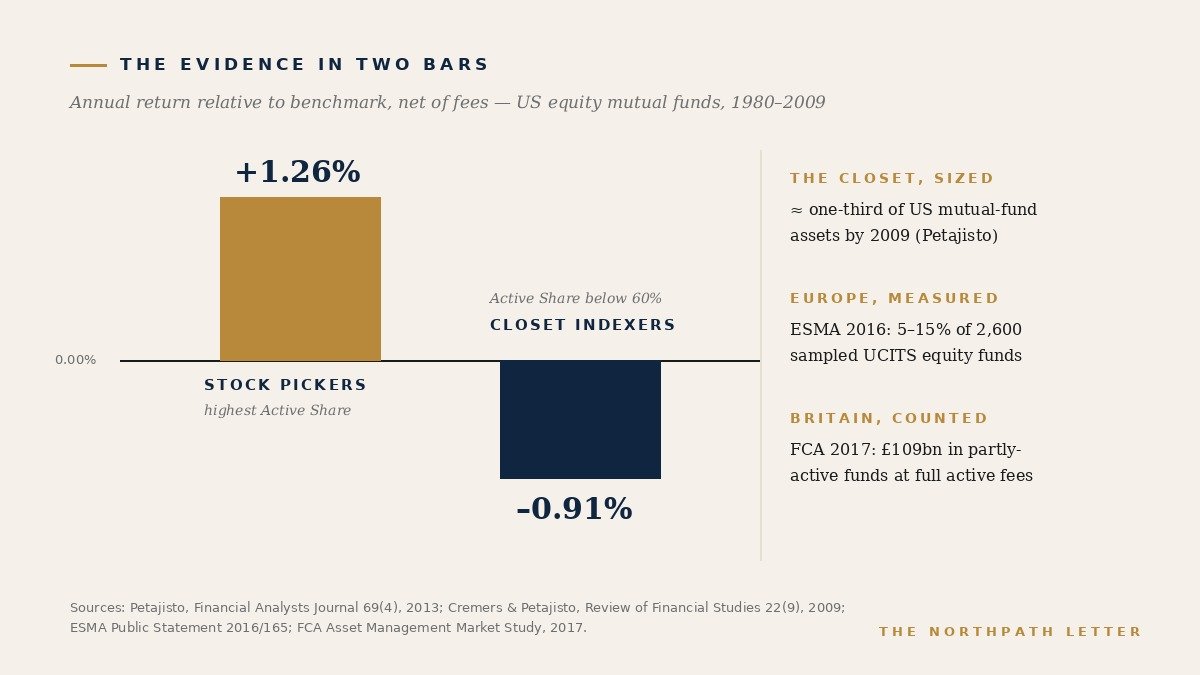
The evidence assembled over the past two decades is unusually one-directional. Cremers and Petajisto, computing Active Share for US equity mutual funds from 1980 to 2003, found that the funds most different from their benchmarks outperformed those benchmarks both before and after expenses, with persistence, while the low-Active-Share group — the closet — underperformed. Petajisto’s extension through 2009 (“Active Share and Mutual Fund Performance,” Financial Analysts Journal, 69(4), 2013) put numbers on the two ends of the spectrum: the most active stock pickers beat their benchmarks by about 1.26 per cent a year net of fees, while closet indexers trailed by about 0.91 per cent a year — almost exactly their fee. He also documented the closet’s growth: in 1980 assets in funds with Active Share below 60 per cent were negligible; by 2009 roughly a third of US mutual fund assets sat there, and the share rose in volatile and bear markets, when career risk bites hardest.
Europe replicated the finding with a regulator’s instruments. In February 2016 the European Securities and Markets Authority published the results of a sweep of 2,600 UCITS equity funds over 2012–2014, using Active Share, tracking error and R² as its dials, and concluded that between 5 and 15 per cent of funds marketed as active were potential closet indexers — a finding the funds’ own disclosure documents tended to confirm. The UK Financial Conduct Authority’s Asset Management Market Study (final report, June 2017) estimated around £109 billion sitting in “partly active” UK funds charging fully active fees. And the long-horizon scoreboards frame the base rate: the S&P SPIVA scorecards routinely find on the order of 85 to 90 per cent of US large-cap funds behind the index over 15-year windows — a population average dragged down, in meaningful part, by funds that never tried to be different. Kenneth French’s 2008 presidential address to the American Finance Association estimated the aggregate cost of active investing at roughly 0.67 per cent of total market value every year; the closet’s share of that bill purchases nothing at all.
The honest reading of this record is not that activity fails. It is that undelivered activity fails by construction, and that the delivered kind — concentrated, patient, structurally free to diverge — is the only kind whose fee has ever had an empirical defence.
Two episodes: the price of difference, and the price of sameness
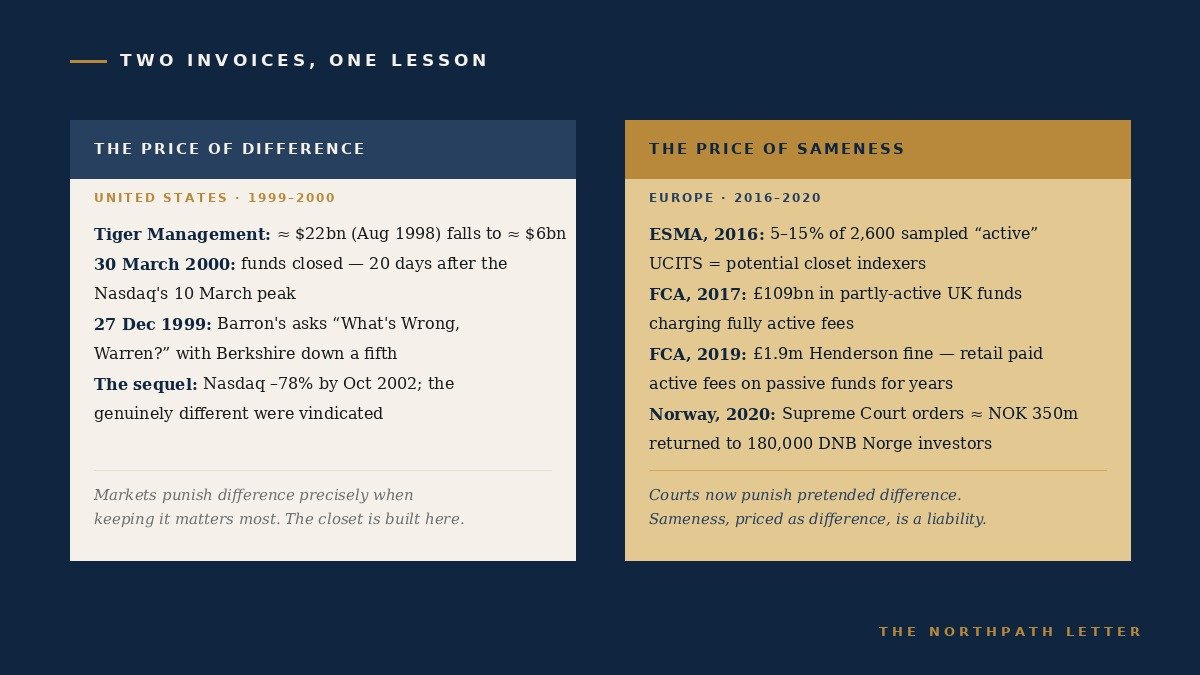
The first episode explains why the closet exists. In the eighteen months to March 2000, the US market punished genuine difference as brutally as it ever has. Julian Robertson’s Tiger Management, one of the most successful genuinely active records of the era, refused to hold the technology complex it could not appraise; assets fell from roughly $22 billion in August 1998 to about $6 billion, and Robertson announced the funds’ closure on 30 March 2000 — twenty days after the Nasdaq’s 10 March peak. “There is no point,” his final letter conceded, “in subjecting our investors to risk in a market which I frankly do not understand.” That December, with Berkshire Hathaway’s shares down about a fifth in a year in which the S&P 500 rose 21 per cent, Barron’s ran its now-famous cover asking “What’s Wrong, Warren?” The answer arrived over the following thirty months: the Nasdaq fell roughly 78 per cent from peak to its October 2002 trough, Berkshire’s shares roughly doubled from their March 2000 low over the next four years, and the surviving genuinely-different records were repaired in full. But every fund manager watching drew the operational lesson long before the vindication: difference can end a career faster than mediocrity ever will. The closet of the 2000s was built by managers who had survived 1999 and resolved never to risk it again — Petajisto’s data show closet indexing rising precisely from 2007’s turbulence onward.
The second episode shows the other invoice arriving. Beginning around 2014, consumer bodies in Scandinavia began asking publicly whether several of the region’s largest “active” equity funds were active in anything but price. ESMA’s 2016 sweep made the question continental. In November 2019 the FCA fined Henderson Investment Funds Limited £1.9 million: the firm had decided in November 2011 to drop active management on its Japan and North American Enhanced Equity funds, told its institutional clients and stopped charging them for it — while around 4,500 retail investors went on paying active fees for nearly five years, some £1.78 million more than passive pricing would have cost them. Four months later, in February 2020, Norway’s Supreme Court closed the loop that matters most: in a class action brought by the Norwegian Consumer Council on behalf of 180,000 retail investors in the DNB Norge fund, the court found the fund had been run so close to its benchmark that customers had not received the service they paid for, and ordered roughly NOK 350 million returned — a forced rebate of 0.8 percentage points a year of the 1.8 per cent fee. Sameness, priced as difference, had become not merely poor value but a legal liability. The two episodes are one lesson read from opposite ends: markets intermittently punish managers for being different, and courts have now begun punishing them for only pretending to be.
The application framework: three disciplines
The closet indexer is unusually detectable, because the deception is quantitative and the data are public. The discipline is procedural, not motivational, and it has three parts.
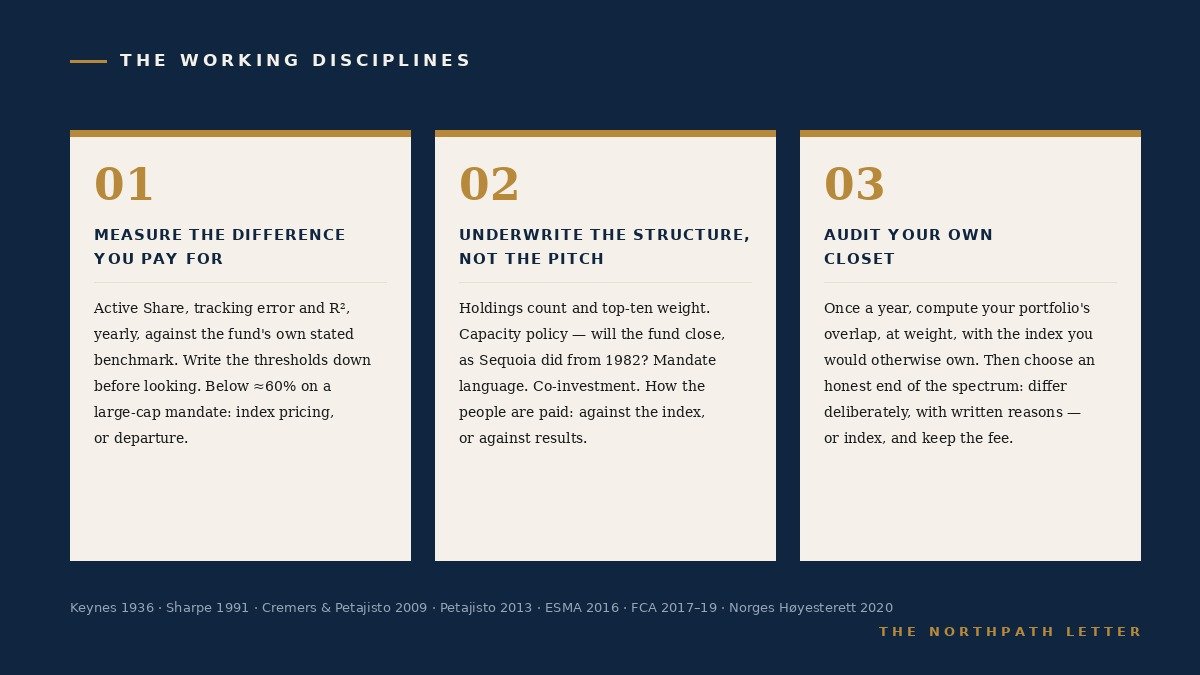
First: measure the difference you are paying for. Once a year, for every fund in the portfolio that charges an active fee, obtain the holdings and compute — or simply look up — the three dials ESMA used: Active Share against the fund’s own stated benchmark, tracking error, and R². Write the thresholds down before looking. On a large-cap mandate, an Active Share persistently below about 60 per cent, a tracking error of a percentage point or two and an R² near one describe index exposure, whatever the brochure describes. The two coherent responses are index pricing or departure; renegotiating adjectives is not one of them.
Second: underwrite the structure, not the pitch. Every manager claims conviction; only structure can deliver it. The questions that predict difference are answerable from documents: How many holdings, and what weight sits in the ten largest? Does the mandate’s own language tie the manager to benchmark weights? Is there a stated capacity at which the fund will close — as Ruane, Cunniff’s Sequoia Fund actually did from 1982, for twenty-six years — or is asset gathering unbounded? Do the principals have their own capital in the strategy, and are the analysts paid against absolute results or against the index? A firm structurally unable to look wrong for three consecutive years cannot maintain a high Active Share, whatever its people believe about themselves.
Third: audit your own closet. The self-directed investor is not exempt; portfolios assembled from large, familiar, much-discussed names drift toward the index by gravity. Once a year, compute the overlap between your holdings, at weight, and the index you would otherwise own. If the overlap is high, draw the honest conclusion in either direction: own the index outright, harvesting the saving in costs, dealing and attention; or concentrate deliberately, with a written, dated, non-consensus reason for every position that survives. What the exercise forbids is the middle state — paying yourself an active manager’s toll, in effort and transaction costs, to hold the market with extra steps.
How practitioners applied it
Stahl’s own firm is the critique enacted. Horizon Kinetics — founded as Horizon Asset Management in 1994, with Stahl as chairman and chief investment officer — runs concentrated, benchmark-agnostic portfolios with multi-year holding periods, weighted toward securities that capitalisation-weighted indexes structurally ignore or cannot hold in size: owner-operated companies, small and unconventional listings, assets outside the major benchmarks altogether. The firm’s commentaries make the reasoning explicit: if capital now flows by index weight rather than by appraisal, then the persistent mispricings must accumulate in whatever the index machinery cannot see, and a manager paid for difference should live there. The cost, which the firm accepts in print, is long stretches of looking nothing like the market — the exact exposure the closet indexer’s career logic refuses.
Buffett has argued both halves of the principle across four decades. “The Superinvestors of Graham-and-Doddsville” (Columbia Business School, Hermes, 1984) presented nine audited long-term records — Schloss, Knapp, his own partnership, Munger, Ruane and others — whose common property was portfolios assembled entirely from gaps between price and appraised worth, with no reference to benchmark composition: Active Share near 100 before the measure existed. Thirty years later he prosecuted the complementary case: the ten-year wager recorded in his 2017 Berkshire Hathaway shareholder letter, in which a plain S&P 500 index fund returned 125.8 per cent against five professionally selected fund-of-funds portfolios that managed between 2.8 and 87.7 per cent — “Performance comes, performance goes. Fees never falter.” The synthesis is the whole of this letter: be genuinely different, or be honestly cheap. Buffett has only ever attacked the seat between the stools.
And Bill Ruane’s Sequoia Fund supplies the structural footnote: a genuinely different portfolio was made sustainable by closing the fund to new money for a generation, accepting bounded fees as the price of unbounded patience. Difference, all three records suggest, is not a slogan but a set of renunciations — of capacity, of comfort, and of the benchmark’s shelter.
Key takeaways
- An active fee is a promise of difference. Active Share (Cremers & Petajisto, 2009) measures whether the promise is being kept: below roughly 60 per cent on a diversified mandate, the investor is buying index exposure at active prices.
- The closet is rational for the manager and ruinous for the client. Career risk (Keynes, 1936) and fee-on-assets economics make benchmark-hugging the safe business decision; Sharpe’s 1991 arithmetic makes its net shortfall close to mechanical.
- The record is one-directional. The most active stock pickers beat their benchmarks by about 1.26 per cent a year after fees; closet indexers trailed by about 0.91 per cent (Petajisto, 2013). ESMA found 5–15 per cent of European “active” funds potentially in the closet; the FCA counted £109 billion.
- Pretended difference is now a legal liability. The FCA’s £1.9 million Henderson fine (2019) and Norway’s Supreme Court ordering NOK 350 million returned to 180,000 DNB Norge investors (2020) converted the academic measure into enforceable consumer protection.
- The discipline is symmetrical. Measure every fund’s Active Share, tracking error and R² annually; underwrite structures, not pitches; and audit your own portfolio’s overlap with the index — then either differ deliberately or index honestly. Only the middle is forbidden.
— Manish Goel, FCA / NorthPath Advisory OÜ / Tallinn, Estonia
|
Important. |