There is a particular footnote in every Indian annual report that the reader trained on Western filings tends to glance at and move past. It carries an unpromising title — “Contingent Liabilities and Commitments (to the extent not provided for)” — and it is written in the flat, defensive prose that accountants reserve for things they would rather you did not dwell on. Yet for a large class of Indian companies it is the single most consequential disclosure in the document, because it is where the obligations that have not yet hardened into liabilities are kept. A tax demand the company is contesting through four tiers of appeal. A guarantee given to a bank on behalf of a subsidiary that is itself in trouble. A letter of credit, a customs bond, a bill discounted with recourse. None of these sit on the balance sheet. Any of them can, in the wrong year, become the only number that matters.
The instinct to skip it is understandable. The note has no total that flows anywhere; it does not reduce reported equity; it is, by construction, a list of things that have not happened. But “have not happened yet” is doing a great deal of work in that sentence. The discipline of reading an Indian company well is, to a surprising degree, the discipline of reading this footnote slowly — of asking which of these latent obligations is genuinely remote, which is merely being described as remote, and which is a fuse already lit. This letter is about how to do that: what the Indian rules require a company to disclose, what the accounting standard is actually testing when it decides whether an obligation belongs on the balance sheet or in the notes, why the Indian version of this footnote runs so much heavier than its American or European equivalent, and how a careful reader should size and stress what it contains.
The grammar of uncertainty
Behind the footnote sits a single accounting standard: Ind AS 37, Provisions, Contingent Liabilities and Contingent Assets, which is India’s effectively word-for-word adoption of the international standard IAS 37. Its entire architecture is an attempt to sort uncertain obligations along one spectrum — the spectrum of likelihood — and to assign each band a different accounting consequence.
At one end is the provision. A provision is a liability of uncertain timing or amount, and Ind AS 37 says you must recognise one — put it on the balance sheet, with a matching expense — when three conditions are met together: there is a present obligation (legal or constructive) arising from a past event; it is probable that an outflow of resources will be required to settle it; and a reliable estimate of the amount can be made. Meet all three and the obligation stops being a footnote and becomes a number in the accounts.
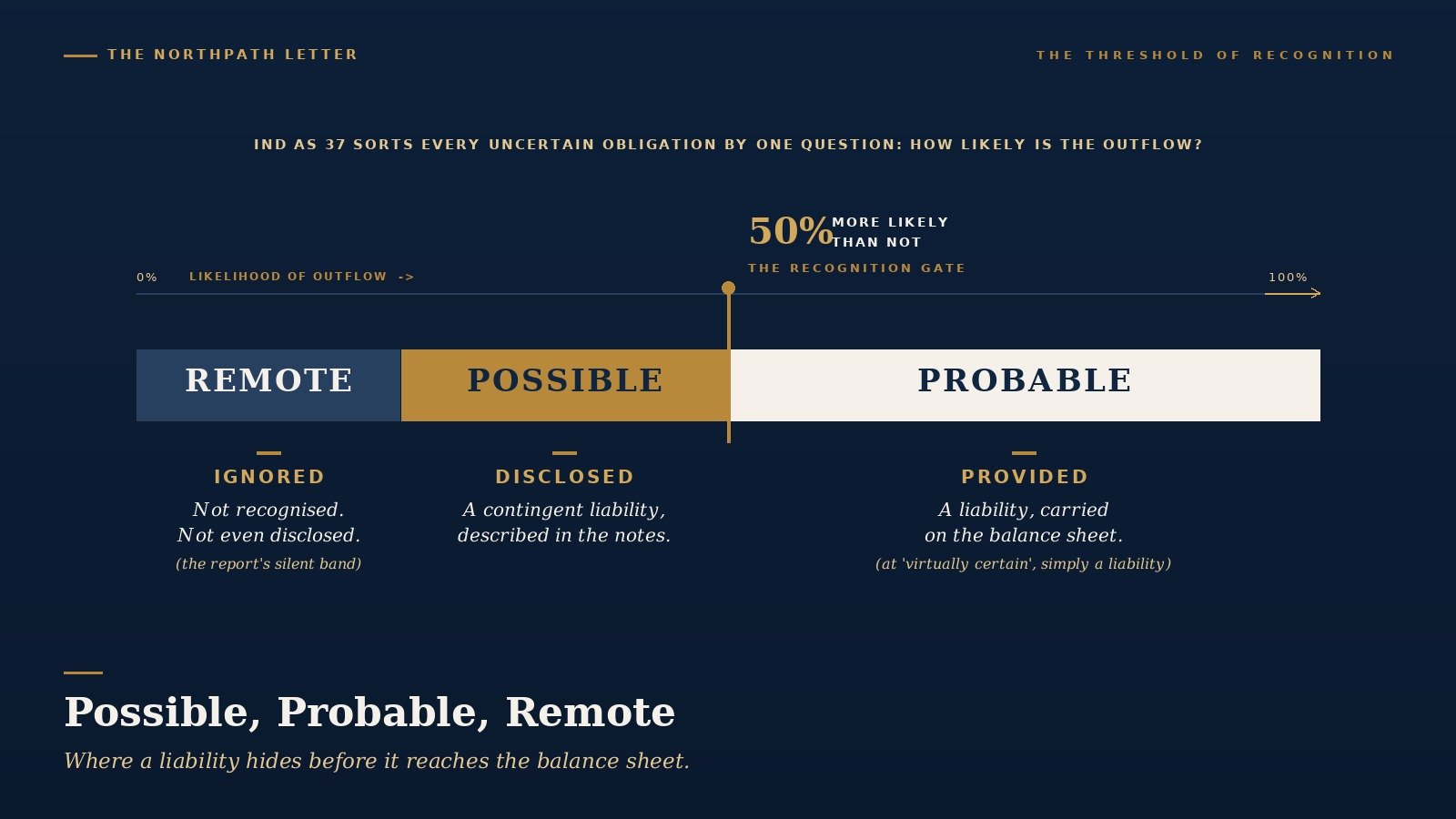
One band along is the contingent liability. The standard defines it two ways, and the distinction matters. It is either (a) a possible obligation, arising from past events, whose existence will be confirmed only by some uncertain future event not wholly within the entity’s control; or (b) a present obligation that fails the recognition test — because an outflow is not probable, or because the amount cannot be measured reliably. A contingent liability is not recognised. It is disclosed in the notes — unless the possibility of an outflow is remote, in which case even disclosure falls away and the obligation vanishes from the report entirely.
At the mirror end sits the contingent asset — a possible asset whose existence depends on uncertain future events. Here the standard turns deliberately asymmetric, in the conservative spirit that runs through all of accrual accounting. A contingent asset is never recognised while it is merely contingent; it is disclosed only where an inflow of benefits is probable; and it is brought onto the balance sheet only when realisation becomes virtually certain. A company may shout about a tax refund it expects to win only once winning is all but assured; it must whisper about a tax demand it expects to lose well before losing is assured.
The hinge word in all of this is probable, and its meaning is precise. Under Ind AS 37, as under IAS 37, “probable” means more likely than not — a probability greater than fifty per cent. That single threshold is the gate between the footnote and the balance sheet. An obligation the directors judge 49% likely is a disclosed contingency; the same obligation re-judged at 51% becomes a recognised provision and a charge against profit. The reader’s first job is therefore to understand that the contingent-liability note is, by definition, populated by obligations management has judged less than more-likely-than-not — or has judged unmeasurable. That is a statement about management’s judgement as much as about the obligations themselves.
What Schedule III actually asks for
Ind AS 37 governs the accounting. The format — what must appear in the footnote, and under which sub-headings — comes from a different instrument: Schedule III to the Companies Act, 2013, the schedule that dictates the face and notes of every Indian company’s financial statements. Schedule III has two divisions; Division II applies to companies that report under Ind AS, and it requires, within the notes, a heading you will find in essentially every report: “Contingent Liabilities and Commitments (to the extent not provided for).”
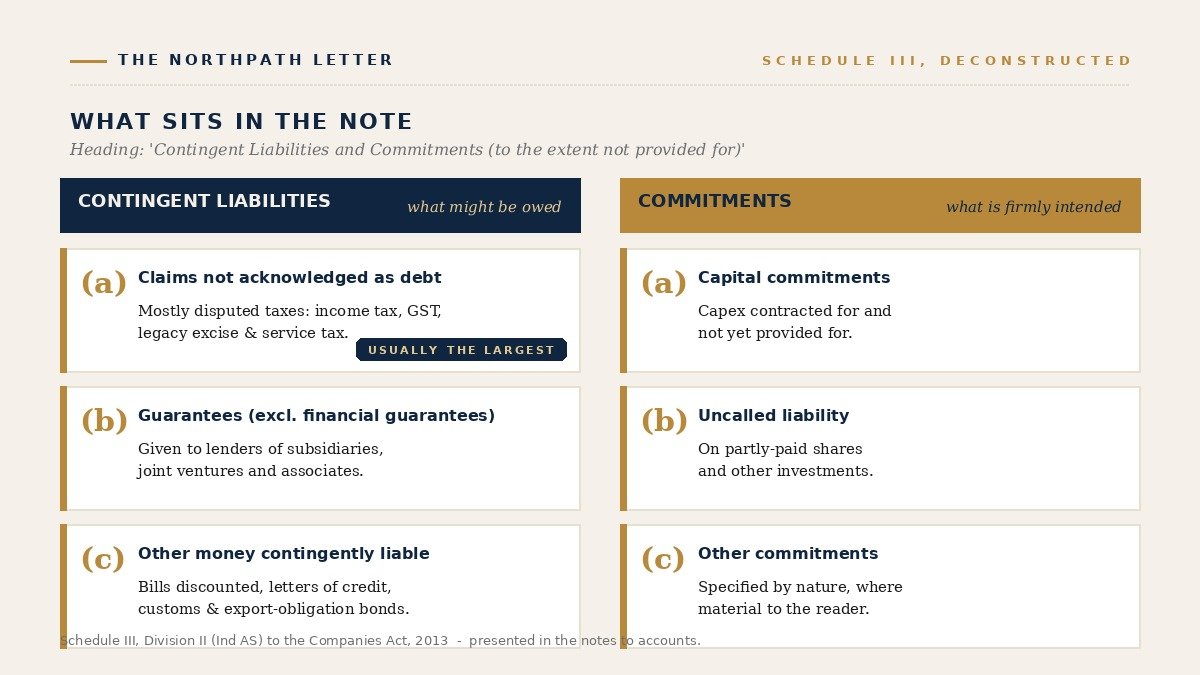
Under it, contingent liabilities are broken into three buckets:
(a) claims against the company not acknowledged as debt;
(b) guarantees excluding financial guarantees; and
(c) other money for which the company is contingently liable.
The first bucket is the one to watch, because in India it is overwhelmingly composed of disputed taxes — demands raised by the income-tax department or the indirect-tax authorities that the company is contesting and therefore declines to “acknowledge as debt.” The second bucket, guarantees, carries a quiet but important Ind AS refinement: it reads “excluding financial guarantees,” because a financial guarantee contract is measured as a financial instrument under Ind AS 109 and is accounted for elsewhere, not parked in this disclosure. (Companies still on the older Indian GAAP, reported under Division I, simply show “guarantees,” with no such carve-out — a small reminder that the two regimes do not present this footnote identically.) The third bucket is the miscellany: bills discounted with recourse, letters of credit and bank guarantees in the ordinary course, customs and excise bonds, export-obligation bonds under schemes such as EPCG, and the residue of contingent exposures that fit nowhere else.
The same heading then carries a second list — commitments — which readers routinely conflate with contingent liabilities but which are conceptually distinct. A commitment is not an uncertain obligation; it is a firm one the company has entered into but not yet executed or provided for. Schedule III asks for three:
(a) estimated amount of contracts remaining to be executed on capital account and not provided for — the capital-expenditure order book, money the company has contractually committed to spend on plant, property and equipment;
(b) uncalled liability on shares and other investments partly paid — amounts the company may yet be called to pay on partly-paid securities it holds; and
(c) other commitments.
The distinction is worth holding onto. Capital commitments tell you about a company’s intended investment intensity; a large and rising capital-commitment line is a statement about the future, and in a capital-hungry economy it can be a more reliable signal of conviction than any management narrative. Contingent liabilities tell you about latent risk. They live under the same heading and they are not the same thing.
The recognition test, step by step
To read the footnote critically you have to be able to run, in your own head, the test the company ran to decide what went into it. Ind AS 37 sets that test out as a sequence, and it is worth tracing because the interesting items are the ones that sit close to a boundary.
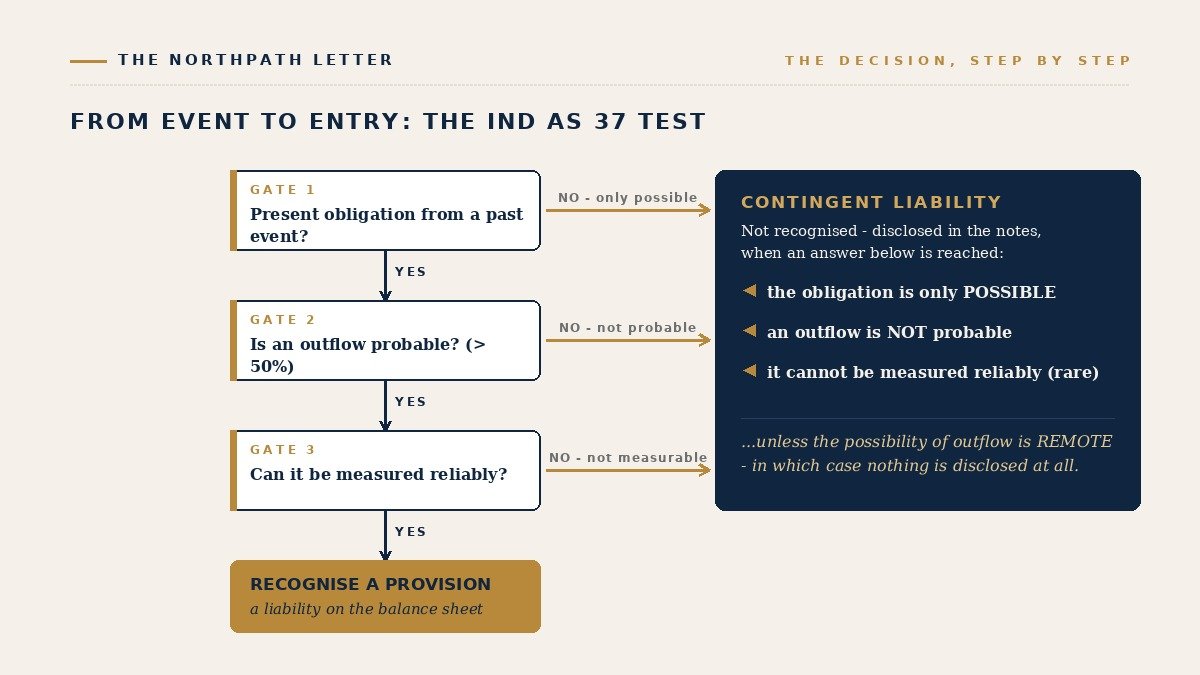
Start with the threshold question: is there a present obligation as a result of a past event? The obligation can be legal — a contract, a statute, a court ruling — or constructive, arising where the entity’s established pattern of conduct has created a valid expectation in others that it will discharge a responsibility. If there is no obligating past event, there is nothing to account for and nothing to disclose; a board’s intention to incur future expenditure, however firm, is not an obligation, because the entity can still avoid it by changing its conduct.
If an obligation of some kind exists but it is only possible — its very existence turns on a future event outside the company’s control — it is a contingent liability and is disclosed, unless remote. If a present obligation exists, the test moves to the second gate: is an outflow of economic benefits probable — more likely than not? If no, it is again a disclosed contingent liability. If yes, the test moves to the third gate: can the amount be measured reliably? In all but extremely rare cases it can, and the obligation becomes a recognised provision. In the genuinely rare case where even a range cannot be estimated, the standard holds it back as a disclosed contingent liability — and requires the company to say so.
Two refinements deserve the reader’s attention, because they are where judgement — and the occasional evasion — lives. The first is the remote exemption. Once an outflow is judged remote, the obligation disappears from the report; there is no audit trail for the things deemed too unlikely to mention. A reader cannot see what was excluded, only infer it. The second is the prejudicial exemption in Ind AS 37: in extremely rare cases, where disclosing the detail of a dispute would seriously prejudice the company’s position in that dispute, it may give a reduced disclosure — but it must state that it has done so, and explain the general nature of the matter and why the detail is withheld. When you see that hedge in a footnote, read it as a flag, not as boilerplate; it tells you the company believes the matter is live enough to damage it.
Measurement, where a provision is taken, follows its own logic that informs how to read the boundary cases. Ind AS 37 requires the best estimate of the expenditure required to settle the obligation: for a large population of similar items (warranty claims, say) that means an expected-value calculation across the distribution of outcomes; for a single obligation it usually means the most likely outcome. Where the time value of money is material, the provision is discounted to present value, and the unwinding of that discount appears as a finance cost in later years. None of this applies to the items that remain in the footnote — contingent liabilities are not measured, only described — but understanding it tells you how thin the wall is between a described contingency and a quantified charge.
Why the Indian footnote runs so heavy
A reader who comes to Indian accounts from the American or European market is usually struck by the sheer size of the contingent-liability note — for some companies a multiple of net worth, dwarfing anything in the recognised liabilities. There are three structural reasons, and each tells you something about the country’s corporate plumbing.
The first and largest is tax litigation. India runs one of the most litigious tax systems in the world. A company’s assessments are routinely disputed across many years at once and contested up a ladder of forums — the Commissioner (Appeals), the Income Tax Appellate Tribunal, the High Court and, ultimately, the Supreme Court for direct taxes; the corresponding appellate tribunals, and now the GST appellate machinery, for indirect taxes, layered on top of a long tail of legacy excise and service-tax matters that predate the 2017 GST transition. Each disputed demand the company believes it will eventually defeat — or that is not yet probable enough to provide for — lands in “claims against the company not acknowledged as debt.” It is entirely normal for a large Indian group’s tax-dispute disclosures to run to tens of pages and to aggregate into thousands of crores. The canonical illustration is the Vodafone retrospective-tax saga: a capital-gains demand arising from the 2007 acquisition of Hutchison’s Indian telecom business that, with interest and penalty, exceeded ₹22,000 crore; that the Supreme Court struck down in 2012; that Parliament then revived through a retrospective amendment to the Income-tax Act in the same year; that an international arbitral tribunal at The Hague ruled against India on in 2020; and that India finally extinguished by repealing the retrospective tax in 2021. For more than a decade that obligation lived, correctly, as a contingent liability — present in the notes, absent from the balance sheet — and the entire arc of its existence could be tracked by a reader who simply followed the footnote year to year. (Cairn Energy’s parallel retrospective-tax dispute, also resolved through arbitration and the 2021 repeal, ran the same course.)
The second reason is the guarantee, and it is the more dangerous of the two for an equity holder. Indian groups are typically organised as a parent atop a lattice of subsidiaries, associates and joint ventures, and it is common for the listed parent to guarantee the borrowings of those entities to their lenders. While the group is healthy, the guarantee is a footnote. But a guarantee crystallises precisely when the guaranteed entity cannot pay — which is to say, exactly when the group is under the most stress and least able to absorb the call. Guarantees to group companies are therefore correlated risk, not diversified risk, and they should be read alongside the related-party-transactions note, where the web of inter-company support is laid out, and alongside any promoter-pledging disclosure, since the same stress event tends to trigger several latent obligations at once.
The third reason is the way disputed obligations crystallise — moving from the footnote to the balance sheet in a single event. The clearest recent case is the telecom industry’s adjusted-gross-revenue dispute, where in October 2019 the Supreme Court upheld the government’s expansive definition of the revenue on which licence and spectrum dues are computed, converting what had for years been a disclosed contingency into hard, immediate liabilities aggregating to roughly ₹1.47 lakh crore across the sector. Nothing about the operators’ businesses changed on the day of the ruling; what changed was the probability assessment, from “disputed” to “owed,” and with it the side of the report the number lived on. A reader who had been watching the contingency had years of warning; a reader who only read the balance sheet learned about it on the day it arrived.
Two further points of Indian technique complete the picture. The first is a subtlety introduced when India adopted the international interpretation on uncertain tax positions — Appendix C to Ind AS 12, India’s version of IFRIC 23, effective from April 2019. Where it is not probable that the tax authority will accept a position the company has taken, the company must now reflect that uncertainty inside its tax accounting — using the most likely amount or an expected value — rather than leaving it entirely to the contingent-liability note. The practical consequence for the reader is that the footnote and the current/deferred-tax lines must be read together: a contingent-liability note that shrinks is not necessarily good news, because the exposure may simply have migrated into the tax provision. The second is that India gives you a cross-check the West does not. The auditor’s report under the Companies (Auditor’s Report) Order, 2020 — CARO 2020 — requires, at clause 3(vii)(b), a separate statement of statutory dues (income tax, GST, customs, excise and the rest) that have not been deposited on account of a dispute, naming the amount and the forum where the dispute is pending. That is a second, independently prepared list of the same tax disputes, often more granular than the company’s own note, and the two should reconcile. Add to that the auditor’s procedures on litigation and claims under SA 501, and the frequency with which tax and litigation contingencies appear as a Key Audit Matter under SA 701, and the Indian reader is unusually well served — provided they read past the balance sheet.
India, IFRS and the United States: one footnote, three bars
Because Ind AS 37 is converged with IAS 37, an Indian company and a London-listed one are, in this respect, speaking the same language: the recognition gate is “probable” at greater than fifty per cent, measurement is a best estimate with discounting where material, and contingent assets are held back until virtually certain. The instructive contrast is with the United States, where the equivalent standard — ASC 450, Contingencies — draws the lines in different places, with consequences for anyone comparing across the two regimes.
The most important difference is the height of the recognition bar. US GAAP also uses the word “probable,” but it defines it as “likely” — a materially higher hurdle than the IFRS more-likely-than-not, commonly read in practice as something in the region of seventy to seventy-five per cent. The effect is structural: an obligation judged sixty per cent likely is a recognised provision under Ind AS and IFRS, but only a disclosed loss contingency under US GAAP. The American balance sheet therefore recognises fewer such obligations and pushes more of them into the footnotes than the Indian one does, for identical underlying facts. US GAAP layers in an intermediate band — “reasonably possible,” meaning more than remote but less than likely — which must be disclosed but not accrued, and a “remote” band which, as under IFRS, generally requires neither.
Measurement diverges too. Where a US company faces a range of possible loss and no single figure within it is a better estimate than any other, ASC 450 directs it to accrue the low end of the range; IFRS, by contrast, would point to an expected value across the range or, for a single obligation, the most likely amount. US GAAP also generally does not discount loss-contingency accruals, whereas Ind AS 37 requires discounting where the effect is material. And on the asset side, US GAAP is, if anything, even more conservative than IFRS: gain contingencies are generally not recognised until realised, and disclosure is deliberately restrained to avoid implying a recovery that may not come. One genuinely tighter American rule is worth noting — under ASC 460, guarantees must be disclosed regardless of how remote the call is judged to be, so the “remote” escape hatch that empties an IFRS guarantee disclosure does not fully apply in the United States.
The reader’s takeaway is not that one regime is more honest than the other, but that the line between balance sheet and footnote sits in a different place in each. Comparing an Indian company’s recognised provisions with an American peer’s accrued liabilities, without also comparing the footnotes, is comparing two different cuts of the same risk.
How to read it in practice
The footnote rewards a short, repeatable routine. Eight habits separate the reader who extracts signal from it from the reader who merely notes its existence.
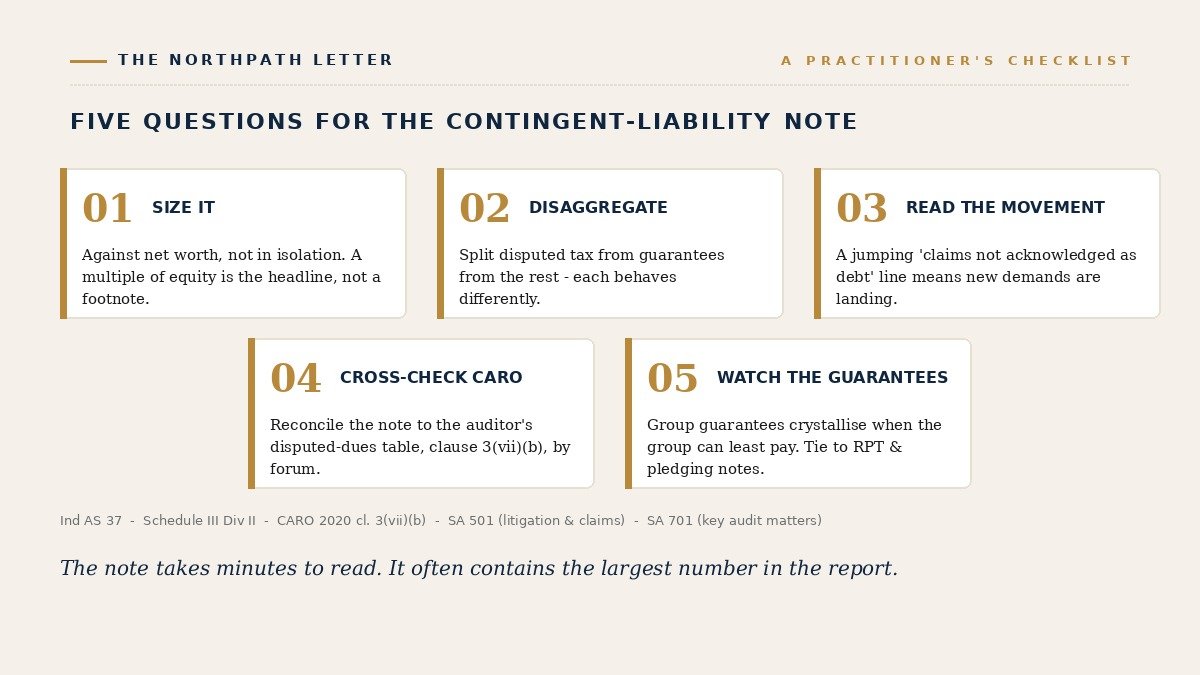
First, size it against net worth, not in isolation. A contingent-liability total equal to a few per cent of equity is ordinary housekeeping; a total that is a multiple of equity is the most important fact in the report, and it deserves to lead your analysis rather than close it.
Second, disaggregate it. Separate disputed tax from guarantees from the rest, because they behave differently. Disputed tax is typically multi-year, partially winnable, and accrues interest while it runs; a guarantee to a group entity is closer to binary and is correlated with that entity’s distress. A single headline number blends risks that should be weighed separately.
Third, read the movement, not just the level. A “claims not acknowledged as debt” line that jumps year on year is telling you that new demands are landing, regardless of the company’s confidence about eventually defeating them. The trend is often more informative than the absolute figure.
Fourth, reconcile it to the CARO 3(vii)(b) table. The auditor’s separate statement of disputed statutory dues, broken down by forum, is your independent check on the company’s own narrative; material gaps between the two lists are worth a question.
Fifth, read the footnote and the tax lines together. After IFRIC 23 / Appendix C to Ind AS 12, exposure can sit in the tax provision rather than the contingency note. A shrinking note is not automatically de-risking; confirm where the risk went.
Sixth, mine the auditor’s Key Audit Matters and any emphasis-of-matter paragraph. Auditors flag the contingencies that genuinely worried them, and a litigation or tax matter elevated to a KAM is the profession telling you, in measured language, where the judgement was hardest.
Seventh, ask what is not there. The remote band leaves no trace; the prejudicial-exemption hedge and phrases like “amount not ascertainable” mark obligations the company would rather not quantify. Absence and vagueness are themselves information.
Eighth, and above all, treat guarantees to related parties as the line most likely to hurt, because it crystallises in precisely the scenario — group-wide distress — in which the company can least afford it. Cross-reference it to the related-party note and to any pledging disclosure, and assume those fuses are connected.
The one-line takeaway
The balance sheet tells you what a company owes; the contingent-liability note tells you what it might owe — and in India, where tax litigation and inter-company guarantees run deep, that footnote is not where the reading ends but where the serious reading begins.
Written from Tallinn by Manish Goel, FCA — Fellow of the Institute of Chartered Accountants of India, in professional practice for 22 years. The NorthPath Letter is long-form commentary and education on Indian and emerging-market equities. It is journalism, not investment advice, and nothing in it is a recommendation to buy, sell or hold any security.