What “Promoter” Means in Indian Listed Equity — and Why It Changes Everything

northpath artifact issue3

Indian Market Context

In Indian corporate law there is a word that has no precise counterpart in the US, UK, or continental European systems, and yet a foreign analyst trying to understand any Indian listed company will encounter it within the first thirty seconds of opening the annual report. The word is “promoter”. It appears, by my count, between 60 and 200 times in a typical Indian annual report. It defines a separate category of shareholder, a separate category of disclosure obligation, a separate category of regulatory restraint, and, in practice, a separate category of economic actor.

The closest English-language word is “founder”, and in many cases promoter and founder refer to the same person. But the two are not synonyms. Founder is descriptive; promoter is legal. A founder may have died forty years ago and yet the company will still have a promoter group, listed by name in every quarterly filing, with disclosed shareholdings, pledge positions, and inter-se relationships. A company can have no founder and yet still have a promoter, created by a change of control. And a person who is plainly the founder may, by formal application, cease to be a promoter and be reclassified as a public shareholder — an event that has no US equivalent.

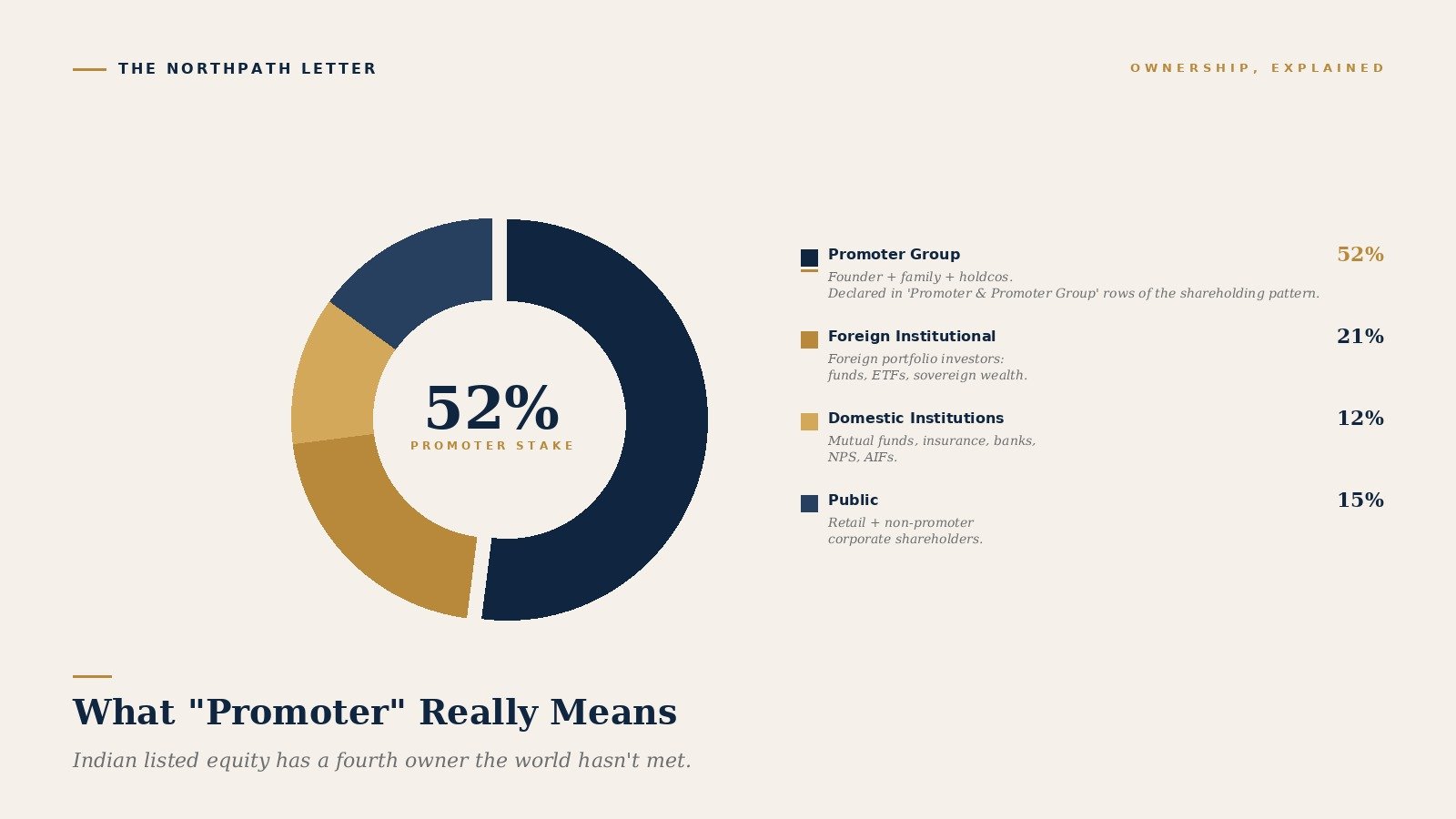
The category matters because, in the Indian context, the promoter is the gravitational centre of the company. Promoters typically hold between 25% and 75% of the equity. They are usually represented on the board. They generally exercise day-to-day control of management. They are subject to a separate set of legal restraints and a separate set of disclosure obligations. And the analytical questions that determine returns from Indian listed equity — capital allocation, related-party exposure, succession, governance quality, alignment between controlling shareholder and minority — flow downstream from the identity, capability, and integrity of the promoter.

This essay is the global analyst’s working primer on the concept. I will define the term precisely, walk through how the disclosure regime treats it, set out the structural shape of Indian listed-equity ownership it has produced, compare the result to the US and continental European models, and then describe seven concrete analytical implications. A reader who internalises this essay will, I hope, find every subsequent Indian annual report a more legible document.

The legal definition, in three layers

The term is defined in three separate statutes, each for its own purposes, and the three definitions are deliberately compatible but not identical.

First, the Companies Act, 2013, Section 2(69), defines a “promoter” as a person:

  • (a) who has been named as such in the prospectus or is identified by the company in the annual return referred to in Section 92; or
  • (b) who has control over the affairs of the company, directly or indirectly, whether as a shareholder, director, or otherwise; or
  • (c) in accordance with whose advice, directions, or instructions the Board of Directors of the company is accustomed to act.

The proviso clarifies that sub-clause (c) does not apply to a person acting merely in a professional capacity. So a Big-Four audit partner whose advice the board generally follows is not, by virtue of that fact, a promoter. The founder who controls 38% of the equity, whose son sits on the board, and whose advice the board habitually follows, is.

The Companies Act definition is the parent. It is broad, principles-based, and worded around control rather than around any specific shareholding threshold. The two operative tests are: named in a public filing, and actually in control. Either is sufficient.

Second, the SEBI (Issue of Capital and Disclosure Requirements) Regulations, 2018 — universally called “the ICDR” — provide the operative definition used in primary-market filings and in continuing disclosures. Regulation 2(1)(oo) of the ICDR adopts the Companies Act test and adds two further qualifications: the promoter must have been identified as such by the company in its annual returns or prospectus, and the term includes a person who, alone or together with others, is named as a promoter in any document filed for listing.

Crucially, the ICDR also defines, at Regulation 2(1)(pp), the “promoter group”. The promoter group includes: the promoter; the immediate relatives of the promoter (spouse, parents, children, siblings); HUFs in which the promoter is a member; firms in which the promoter or his relatives are partners; companies in which the promoter, his relatives, or his HUF holds 20% or more; companies that hold 20% or more in the promoter; and, in the case of a corporate promoter, its subsidiaries and holding companies. The promoter group is therefore a wider concept than the promoter himself, and is the unit on which most disclosure obligations actually operate. When you see “promoter group holding 53.7%” in a quarterly filing, that 53.7% is the aggregated holding of every entity within this widely-drawn family-and-affiliate net, not the holding of any one individual.

Third, the SEBI (Substantial Acquisition of Shares and Takeovers) Regulations, 2011 — the Takeover Code, or SAST — uses a substantially similar definition for the purpose of takeover obligations and pledge disclosures. The SAST is the regime under which any acquisition that takes a person across 25% of voting capital triggers a mandatory open offer to public shareholders for at least an additional 26% (Regulations 3 and 7), and under which promoter pledges of more than 50,000 shares or 5% of holding (whichever is lower) must be disclosed within seven working days (Regulation 31).

The three statutes are coherent but operate in different domains: the Companies Act governs corporate-law relations, the ICDR governs primary-market issuances and continuing disclosures, and the SAST governs change-of-control events. A person is a promoter for all three purposes only if all three definitions are satisfied, which in practice is almost always the case.

The disclosure regime — what an analyst can actually see

The Indian disclosure regime treats the promoter as a separate disclosable category, distinct from public shareholders, with five specific reporting obligations.

Shareholding pattern, quarterly. Under Regulation 31 of the SEBI (Listing Obligations and Disclosure Requirements) Regulations, 2015 — “the LODR” — every listed company must file, within 21 days of the end of each calendar quarter, a detailed shareholding pattern in a prescribed format. The pattern separately discloses, for each named promoter and each named promoter-group entity: the number of shares held, the percentage of total equity, the percentage on a fully-diluted basis, the number of shares pledged or otherwise encumbered, and any locked-in shares. This filing is public, downloadable in machine-readable format from the BSE and NSE corporate-filings sections, and is — for the diligent analyst — the single most valuable governance disclosure that exists in Indian listed equity. By contrast, the US 13D and 13G filings disclose only beneficial owners above 5%, on a much rougher and slower cadence, and with no equivalent of the line-item pledge disclosure.

Pledge disclosure, event-based. Regulation 31 of the SAST, supplemented by Regulation 31A of the LODR for material events, requires the promoter group to disclose any creation, modification, or release of an encumbrance on shares within seven working days. Encumbrance is defined broadly: pledges, mortgages, non-disposal undertakings, negative liens, even certain inter-se promoter arrangements. The aggregate effect is that pledge information for any listed Indian company is essentially live, available on the exchange websites, and accurate to within a week.

Related-party transactions, half-yearly and annual. Under Regulation 23 of the LODR and Section 188 of the Companies Act, all transactions with related parties — a category that includes the promoter, his relatives, and the entire promoter group — must be disclosed in financial statements (under Indian Accounting Standard 24, which is converged with IFRS IAS 24), in the Board’s Report (under Section 134 read with AOC-2), and in a separately filed half-yearly RPT disclosure to the exchanges. Material RPTs — defined as transactions exceeding ten per cent of consolidated turnover for the immediately preceding financial year — require prior shareholder approval, in which the promoter group itself is barred from voting (Regulation 23(4) of the LODR). This is the “majority of minority” vote; it is one of the most important governance protections in the Indian regime, and has no exact US analogue.

Insider-trading disclosures. Under the SEBI (Prohibition of Insider Trading) Regulations, 2015, the promoter and his immediate relatives are automatically classified as “designated persons” (Regulation 9), subject to trading-window restrictions around results announcements, mandatory pre-clearance of trades above prescribed thresholds, and the post-facto disclosure of any trade in the company’s securities within two trading days. These disclosures are public and queryable on the exchange websites. The cumulative effect is that promoter trading activity in the listed entity is far more visible to outsiders in India than insider activity is in the US.

Lock-in obligations. The ICDR requires, in any initial public offering, that promoters collectively hold at least 20% of the post-issue paid-up capital, and that this contribution be locked in for a defined period — recently shortened from three years to eighteen months by amendments effective in 2021 and 2022. The remainder of pre-issue promoter capital is locked in for six months. The function is to ensure that promoters cannot exit a freshly-listed company immediately; in practice it also creates a useful natural laboratory in which lock-in expiries are observable corporate events and the supply of shares from promoter sell-downs is forecastable.

The five disclosure streams — shareholding pattern, pledge, RPT, insider trading, lock-in — together produce an information environment about controlling shareholders that is, in my professional view, more transparent than the United States and broadly comparable to or richer than the United Kingdom. The Indian regime is heavy-handed on disclosure precisely because the underlying ownership structure is concentrated; the disclosure regime is a deliberate counterweight to that concentration.

The economic reality — what promoter ownership looks like at scale

The legal category has produced a market that is structurally owner-operated. Some round-number facts about the Indian listed universe as of the most recent full-year disclosures:

Roughly 70 per cent of NSE-listed companies have a promoter group holding of 25 per cent or more. The simple median promoter holding across the NSE 500 is in the high 40s. The Nifty 50, weighted by market capitalisation, has an average promoter holding of approximately 45 per cent. Even within the Nifty 50, the dispersion is wide: at one end, a small number of professionally-managed Indian companies have promoter holding in single digits (Infosys, which has had no controlling promoter group since the founders progressively sold down over twenty years, sits below 13 per cent) and at the other end, several large companies have promoter holding at or near the SEBI ceiling of 75 per cent (above which a listed Indian company must dilute under minimum-public-shareholding rules).

The structure is therefore neither the dispersed-shareholder model that dominates the US large-cap universe, nor the family-controlled model with a small free float that exists in some emerging markets. It is a hybrid: a controlling-shareholder model with a substantial public float, in which the controlling shareholder is by law subject to ongoing disclosure obligations, in which minority shareholders enjoy a set of statutory protections (the majority-of-minority RPT vote, mandatory open offers above 25 per cent, equal-treatment principles under the takeover code) that do not always exist in the same form elsewhere.

The comparison points are instructive. In the S&P 500, on the most recent rolling estimates, fewer than 10 per cent of companies have any individual or family group holding above 10 per cent of equity. Among the FTSE 100, the figure is somewhat higher but still under 20 per cent, with the exceptions concentrated in companies founded post-1990 (Wolfson, Ocado, IAG) and in dual-class structures grandfathered from earlier eras. In the CAC 40, France has a long tradition of family ownership (LVMH, Pernod Ricard, L’Oréal, Hermes), but the average controlling-shareholder concentration is lower than India. The German DAX has the Quandts at BMW and the Porsche-Piëch families at VW, and the Italian FTSE MIB has the Agnellis at Stellantis-Exor and the Del Vecchios at EssilorLuxottica, but these are individual high-profile cases against a broader backdrop of dispersed ownership.

India is closer to the European family-controlled tradition than to the American dispersed model, but with two important differences: first, the controlling families are more numerous and more economically diverse (because the underlying economy is younger, more entrepreneur-led, and structurally less consolidated); and second, the disclosure regime is more granular than in continental Europe, particularly on pledge and related-party transactions.

Seven analytical implications for the global reader

Having defined what a promoter is and described the disclosure architecture, I want to spend the remainder of this essay on the seven concrete analytical implications. These are the things the global analyst should change about how he reads an Indian company, once he understands the promoter concept.

1. Capital allocation is, in most cases, a single mind

In a dispersed-ownership US large-cap, capital-allocation decisions are made by the chief executive within the bounds of a strategy approved by the board, in turn appointed by institutional shareholders who hold short tenures and rotate the chief executive every five to seven years. Capital-allocation outcomes are therefore aggregated across multiple executive regimes, mediated by the board, and constrained by the institutional shareholder base.

In a promoter-controlled Indian company, capital-allocation decisions are, for practical purposes, made by one person or one family, over decades, with the board functioning as an oversight and compliance body rather than as an autonomous strategic actor. This has two important analytical consequences.

First, the relevant biographical unit is the promoter, not the chief executive. To understand how an Indian listed company will allocate the next ten years of free cash flow, one studies what the promoter has done with the last twenty. Has he reinvested in the core business? Diversified well or poorly? Acquired competently? Distributed cash to shareholders? Compounded book value per share? The historical track record of the controlling individual is, in my experience, the single most predictive variable.

Second, founder-led capital allocation tends to be either much better or much worse than professionally-managed capital allocation; it is rarely average. Long compounding records in Indian equity, when they occur, almost always trace to a thoughtful, conservative, return-on-capital-conscious promoter operating over twenty or thirty years. The handful of three-hundred-bagger outcomes in Indian listed equity since liberalisation in 1991 — Bajaj Finance, Eicher Motors, Asian Paints, Pidilite, Titan, HDFC Bank, and a few others — share this feature.

2. Related-party transactions are the primary minority-shareholder risk vector

I covered RPTs in some detail in last week’s primer on Indian annual reports. The key point is worth restating in the promoter context: because the promoter typically holds substantial economic interests outside the listed entity — in unlisted family businesses, in real-estate holdings, in financial-services ventures, in subsidiaries that did not list — the temptation to use the listed entity as a source of resource for non-listed promoter activities is structural rather than personal. It exists in every promoter-controlled company. The question is not whether the temptation exists; the question is what the historical record shows the promoter to have done with it.

A clean RPT trajectory — small absolute levels, declining over time, no escalation in promoter-entity loans or guarantees — is, in my professional view, the single most positive governance signal an Indian listed company can present. A trajectory of growing RPT exposure, particularly in loans and advances to promoter-related parties, is the single most worrying one. The relevant unit of observation is the five-year time series. Looking at one year tells you nothing; looking at five years tells you almost everything.

3. Pledge is quasi-debt at the promoter level

Promoter share pledges to lenders are economically a loan against the listed equity, taken by the promoter personally or through promoter-group entities, usually to fund non-listed ventures or to plug funding gaps in promoter-affiliated activities. The economics are: the promoter retains the upside on the pledged shares but the lender has recourse to them in default. The lender will typically maintain a margin (loan-to-value ratios of 50–60 per cent are typical) and is contractually entitled to sell pledged shares if the LTV breaks, often with very short cure periods.

The analytical reading is twofold. First, the pledge level is a window into the promoter’s personal balance sheet: a promoter with substantial unlisted commitments needing pledge financing is one whose attention is fragmented and whose financial position is leveraged. Second, the pledge creates a tail-risk in the share price: a forced sale of pledged promoter shares in a stressed market is one of the most acute downside-asymmetric events in Indian equity. The crises around IL&FS in 2018, DHFL in 2019, Zee Entertainment in 2019–20, and the Anil Ambani group through 2018–22 were each preceded by sharply rising promoter pledge percentages, in some cases approaching 100 per cent of promoter holding.

The simple operating threshold I use: a promoter pledge level above 30 per cent of promoter holding is a yellow flag. Above 50 per cent is a red one. A rising trajectory at any level is informative regardless of the absolute number.

4. Succession is a discrete event, not a continuous process

In a dispersed-ownership US company, the chief executive succession is a continuous board-managed process, with internal candidates groomed over decades and external searches conducted publicly. The market prices it accordingly: the equity does not normally re-rate sharply on a CEO transition.

In a promoter-controlled Indian company, the equivalent event is a generational transition within the founding family — the founder retiring, the son or daughter taking over, an outsider being appointed to operating leadership while the family retains ownership. These transitions are discrete, often poorly telegraphed, and historically have been very mixed in outcome. A first-generation founder who built the business out of an industry vacuum may have produced excellent compounding for twenty-five years; the second generation may or may not have inherited the capability.

The analytical lens: when working on an Indian listed company with a first-generation promoter aged above sixty-five, the succession question is a primary one, not a peripheral one. Has the next generation been involved in the business for at least a decade? Has a non-family chief executive been progressively given operating authority? What is the documented separation of family wealth and listed-company resources? Where the answers are affirmative, succession risk has been priced in. Where they are not, the eventual transition is a material discontinuity.

5. Skin in the game is unusually high — in both directions

A promoter who holds 50 per cent of a listed company has an alignment with public shareholders on share-price outcomes that is, in pure economic terms, far stronger than any US public-company executive on a stock-option grant. He owns a quarter of his net worth, frequently, in this single equity. The capital appreciation of the company is, for him, the dominant variable in his lifetime wealth.

The flip side is that this very concentration creates an incentive to maintain control even when independent capital allocation would dilute control. Equity raises that would be growth-positive but ownership-dilutive get postponed; debt is preferred over equity in funding decisions; cash is preferred over capital return because it preserves optionality at the parent level. The well-run promoter operates against these incentives. The less well-run one does not. The difference is observable in financing decisions over a decade.

6. Reclassification of promoter is a corporate event in its own right

Regulation 31A of the LODR, introduced in 2018 and revised in 2021 and 2024, sets out the framework under which a person can cease to be a promoter and be reclassified as a public shareholder. The conditions are stringent: the applicant and his immediate relatives must hold less than 10 per cent of voting capital; they must have no representation on the board; they must hold no key managerial positions; they must not have any veto rights or special information rights; and the reclassification must be approved by ordinary resolution of public shareholders, with the existing promoter group barred from voting.

When a reclassification occurs — not common, but not rare; a typical year sees twenty to thirty reclassification approvals across listed Indian companies — it has substantive economic consequences. The reclassified person’s holding moves from “promoter” to “public”, free float computations change, index inclusion eligibility can change, and the dynamics of the shareholder register shift. For an outside analyst, the reclassification announcement is also one of the rare windows into intra-promoter dynamics: it usually signals a family split, a disengagement of one branch from operations, or the conclusion of a long inheritance dispute. The associated stock-exchange filings, taken with the supporting Form MGT-15 disclosures, often contain unusually candid commentary on what is happening within the controlling group.

7. The promoter concept may itself be on its way out

In 2021 SEBI’s Primary Market Advisory Committee issued a consultation paper proposing that the term “promoter” be phased out over time and replaced with “person in control”, on the reasoning that the existing framework has become operationally complex, that mature Indian companies increasingly resemble dispersed-ownership companies, and that retaining a separate promoter category creates inflexibility around capital raises and corporate transactions. The 2024 amendments to the ICDR moved partially in this direction by reducing the minimum promoter contribution and lock-in obligations in several scenarios, and by liberalising the treatment of professional venture-capital and private-equity shareholders post-IPO.

A complete transition has not occurred. As of mid-2026 the promoter category remains the operative legal concept across the Companies Act, ICDR, LODR, and SAST. The five-year direction of travel, however, is towards a regime more like the European or UK norms, in which controlling shareholders exist as a matter of economic fact but not as a separate legal-disclosure category. The analyst should be aware that the regulatory architecture I have described in this essay is in a slow transition, and that some of the disclosure obligations may be diluted or repackaged in the next five to ten years. None of this changes the underlying economic reality of concentrated ownership; it changes only the disclosure framework around it.

A step-by-step process for reading promoter information on any Indian listed company

Practical application. Here is the sequence I follow, in order, when I want to understand the promoter situation of an unfamiliar Indian listed company. Total time investment: about forty-five minutes.

  1. Step 1 (5 minutes) — Download the most recent quarterly shareholding pattern. Go to the BSE or NSE corporate-filings page for the company and download the latest quarterly shareholding pattern filing. Note the total promoter group holding, the number of distinct named entities in the promoter group, and the total pledged shares as a percentage of promoter holding.
  2. Step 2 (10 minutes) — Pull the same data for the past five years. Either from the exchange archives or from any of the standard data aggregators. Plot promoter holding and promoter pledge over the past twenty quarters. Two trends are informative: is promoter holding stable, rising (through creeping acquisitions), or falling (through sell-downs or dilution)? And is promoter pledge stable, rising, or falling? Each pattern means something different.
  3. Step 3 (10 minutes) — Read the related-party-transaction note in the last three annual reports. Tabulate: total RPT volume (sales + purchases + loans + guarantees + reimbursements), aggregate loans and advances to promoter-related entities, aggregate guarantees given on behalf of promoter-related entities. Note the trend year-over-year.
  4. Step 4 (5 minutes) — Read the “Promoter Group” section of the corporate-governance report. Identify the named individuals and the names of all promoter-group entities. Cross-check whether any of those named entities also appear in the RPT note. A promoter-group entity that appears in the RPT note as a counterparty for material loans or services is the analytical centre of gravity.
  5. Step 5 (5 minutes) — Search for any reclassification, open-offer, or material-event filings. The exchange websites maintain a chronological log of material filings. Search for the words “reclassification”, “open offer”, “change in promoter”, or “intimation under Regulation 31A” in the company’s filings over the past five years. Any positive hit is an event of analytical importance.
  6. Step 6 (5 minutes) — Read the insider-trading disclosures for the past twelve months. All trades by designated persons in the company’s securities are filed within two trading days. Significant promoter buying is a positive signal. Significant promoter selling, particularly within the trading-window restrictions or shortly before adverse results announcements, is the opposite. Aggregate the net buying and selling across the most recent twelve months and against historical patterns.
  7. Step 7 (5 minutes) — Form a written one-paragraph summary. Who is the promoter, what is the holding, what is the pledge position, what is the RPT trajectory, what was the most recent material promoter-related event, and what was the net insider activity. This paragraph is the basis on which all subsequent fundamental work on the company should be evaluated.

Forty-five minutes of this work, before any income-statement analysis, will tell the global analyst more about the structural risk-and-return profile of an Indian listed company than two days spent on a discounted cash flow model. The income-statement analysis still has to be done, of course. But it should be done in the context of an understanding of who controls the company and what they have historically done with the controlling position.

Closing

The Indian system has, in the “promoter” category, codified into law a fact about its economy that is true but largely informal in most other places: that listed companies in emerging economies are usually controlled by identifiable individuals or families with substantial personal economic exposure to the listed entity. The codification has consequences. It produces a richer disclosure environment than exists in most comparable jurisdictions. It creates a separate analytical layer that cannot be skipped. And it generates a specific set of risks — related-party leakage, pledge stress, succession discontinuity — that map directly to the structure.

The global analyst who learns to read this layer competently has, in my experience, a real and durable analytical advantage. The one who tries to apply a 10-K-trained framework to an Indian annual report without understanding the promoter dimension is repeatedly surprised by outcomes that, with thirty minutes of additional reading, would have been entirely foreseeable.

I will write further essays in this Indian Market Context series on related sub-topics: a separate deep-dive on the CARO 2020 framework, on standalone-versus-consolidated reading, on the Indian segmental-disclosure regime under Ind AS 108, on Form AOC-1 as a one-page x-ray of a group, on the BRSR, and on the specific accounting and audit norms that diverge between Ind AS and IFRS. Each is a piece of analytical infrastructure that, once internalised, makes every subsequent Indian annual report a faster and more productive read.

The single Indian-law term that most reshapes how to read Indian listed equity is “promoter”. Learn it, learn the disclosure architecture around it, and the entire Indian listed universe becomes legible.

— M. G.

No spam. Unsubscribe in one click.

More posts