Value Investing · The NorthPath Letter · Morning Edition
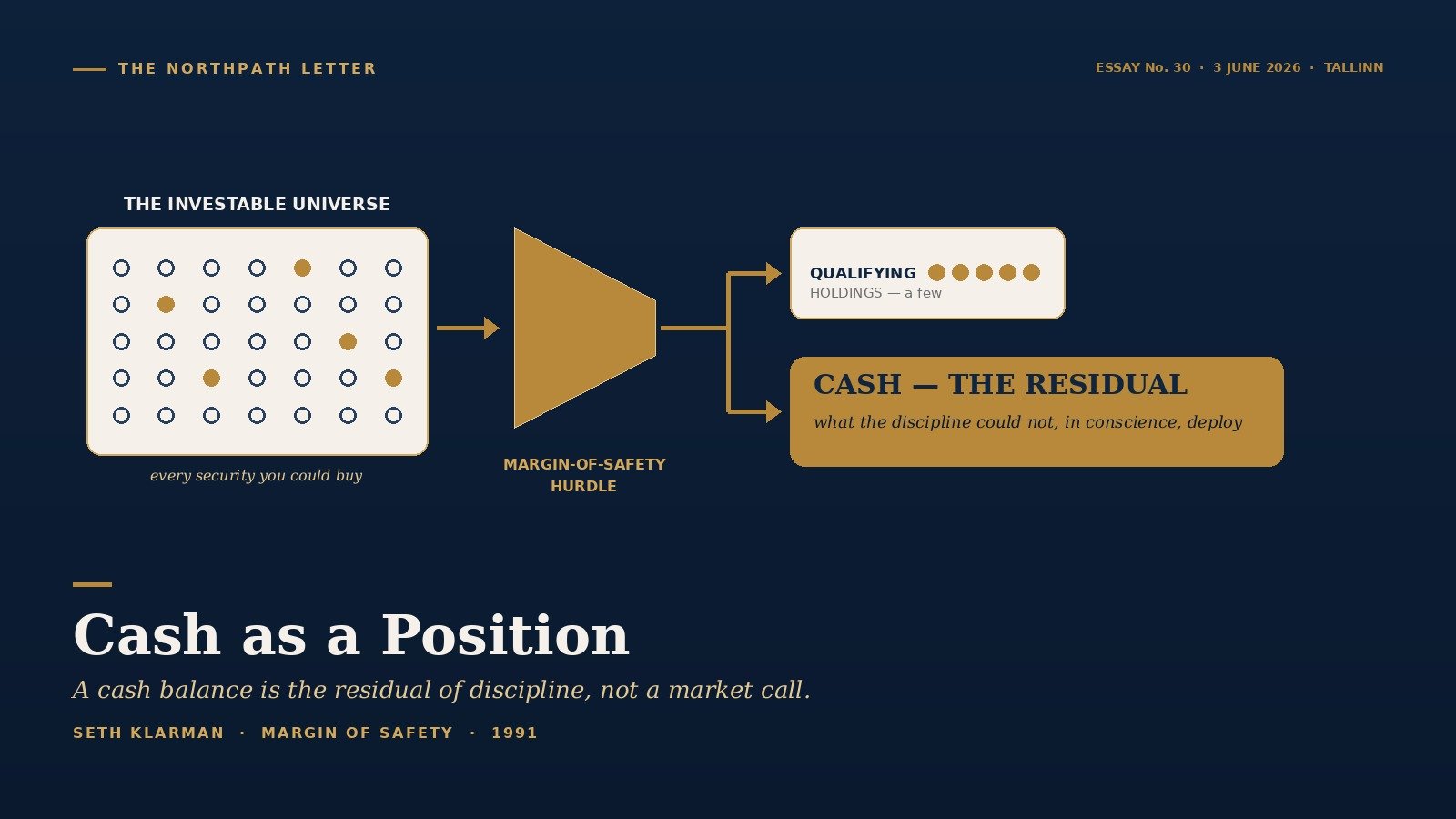
Most investors treat a cash balance as a confession — a failure of nerve, or a bet that the market is about to fall. Seth Klarman’s argument, made in 1991 and refined over four decades at the Baupost Group, is that it is neither. A cash balance is the arithmetic residual of refusing to buy anything that does not offer a margin of safety. This letter is about the discipline of letting the opportunity set, rather than the index, decide how much cash you hold.
The principle: cash as a residual, not a forecast
There is a question that quietly governs every portfolio, and most investors never consciously answer it: how much of my capital should be invested right now? The default answer, almost everywhere in professional finance, is “all of it.” To hold cash is to admit you could not find something better to do with the money, and that admission feels like an indictment. So the cash gets spent, the portfolio stays full, and the question is never really asked.
Seth Klarman built a different answer into the foundations of Margin of Safety: Risk-Averse Value Investing Strategies for the Thoughtful Investor (1991). His formulation is deceptively plain. A bottom-up investor, he wrote, holds cash whenever there are not enough attractively priced opportunities to absorb it — and does so with no intention whatsoever of using cash to time the market. The cash is a leftover. It is what remains after a security-by-security search has run its course and rejected everything that did not clear the bar. It is an output of the process, never an input to it.
That distinction — residual versus forecast — is the whole of the discipline, and it is the source of most of the confusion around it. To hold cash because you have decided the market is too dear and due to fall is a macro forecast: a bet on the level of the index, on timing, on the moods of millions of strangers. Klarman wants none of that, and the historical record gives him good reason to want none of it. To hold cash because the individual businesses on offer are priced too richly to promise a satisfactory return is something entirely different. You are not predicting when the crowd will change its mind. You are simply declining to overpay, one security at a time, and accepting whatever cash level that refusal produces. The first is speculation about price. The second is the consequence of valuation discipline.
The discipline this asks of the investor is harder than it sounds, because it runs against a powerful current. It requires you to sit, sometimes for years, holding a meaningful cash balance while a rising market rewards everyone who is fully invested and appears to punish your caution daily. It requires you to be wrong-looking for long stretches in exchange for being right when it counts. Klarman’s point is that this discomfort is the price of admission to absolute returns — and that the investor who cannot tolerate it will, sooner or later, be forced to lower his standards at exactly the wrong moment.
The mechanism: why the residual works
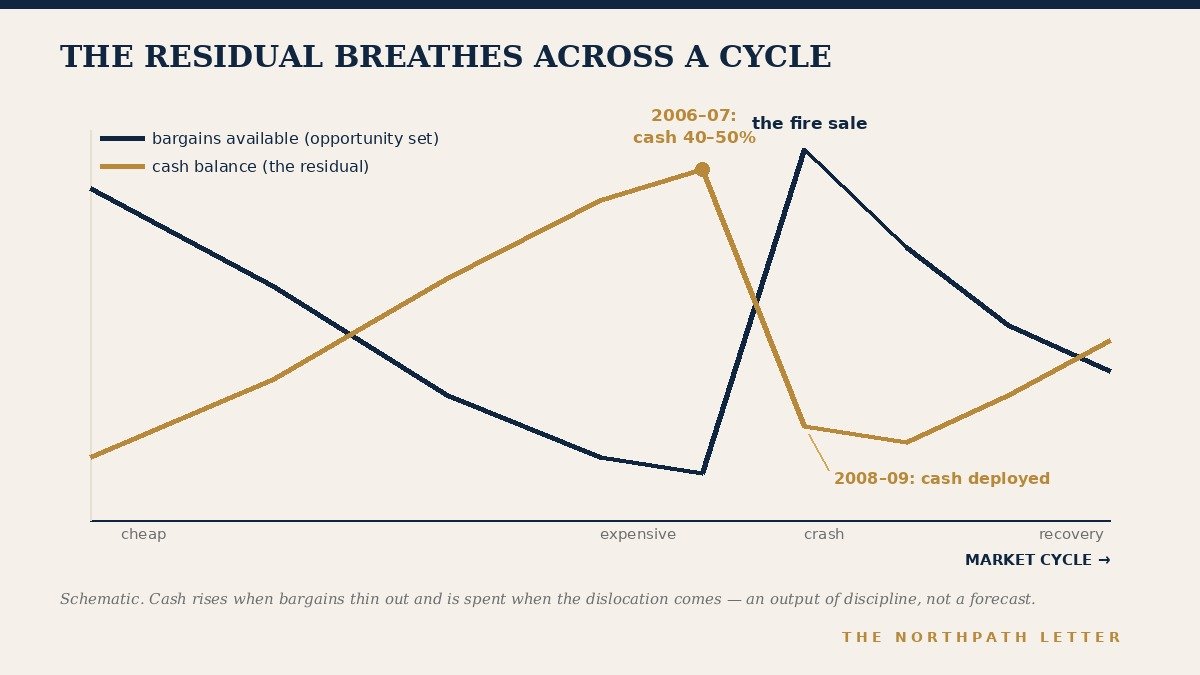
Begin with the arithmetic, because it is the cleanest part. Suppose you will only buy a security at a sufficient discount to a conservative estimate of its worth — a genuine margin of safety. In a cheap, frightened market, many securities clear that hurdle, and your cash is quickly absorbed; you find yourself nearly fully invested without ever deciding to be. In an expensive, euphoric market, almost nothing clears it, and cash piles up — again, without a single top-down decision. Your cash balance, under this rule, becomes a thermometer of the opportunity set. It rises and falls with the breadth of available bargains, not with your opinion of where the index is headed. The forecast has been removed from the system; what remains is a mechanical consequence of insisting on price.
The second layer is behavioural, and here the compulsion to be fully invested reveals itself. Warren Buffett named the force in his 1989 letter to Berkshire Hathaway shareholders: the institutional imperative, “an unseen force” before which, he wrote, rationality frequently wilts. Institutions resist changes in direction, support foolish initiatives, and — the relevant clause — imitate the behaviour of their peers, however unwise. An institution that holds cash while its competitors are riding a bull market will underperform the benchmark, lose clients, and watch its assets walk out the door. The career-safe choice is to stay fully invested and be wrong in good company. Klarman drew the same line a different way: most institutional investors, he observed, feel compelled to be fully invested at all times, because remaining one hundred per cent invested is consistent with a relative-performance orientation — the goal of not falling behind the index over the short run. The investor who measures himself in absolute terms, against the simple standard of not losing money, is freed from that compulsion. He is allowed to hold cash, because no benchmark is whispering that he must not.
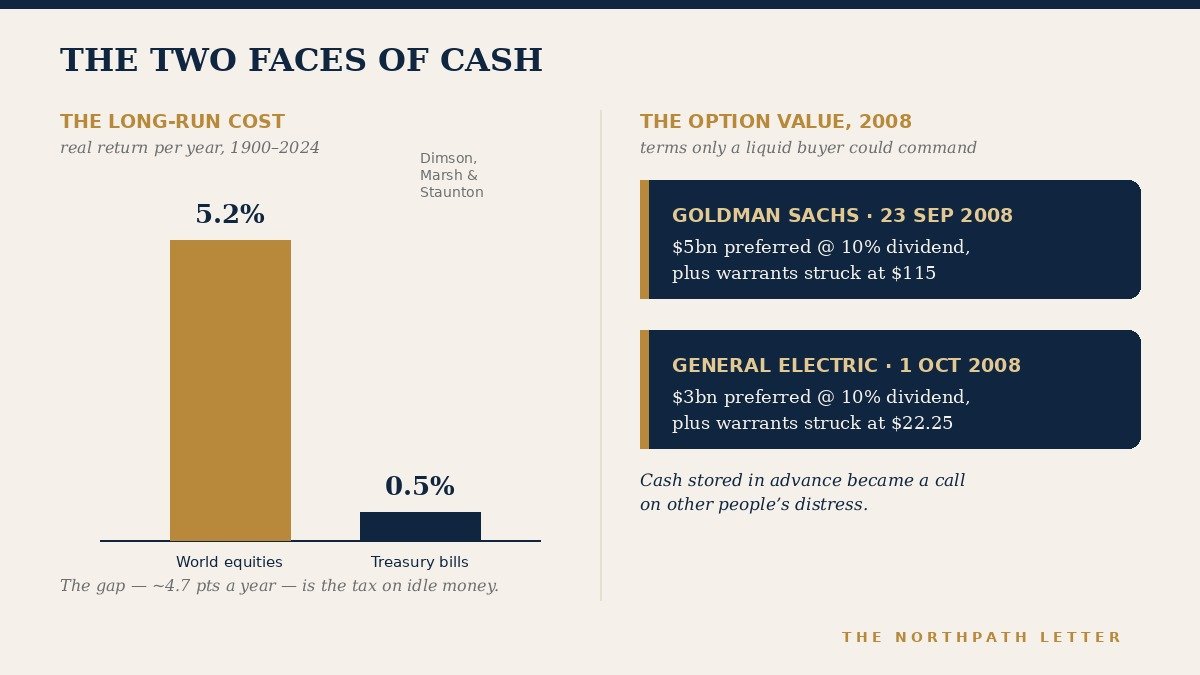
The third layer is structural, and it is where the residual stops being merely defensive and becomes a weapon. Cash is liquidity, and liquidity is optionality. Andrei Shleifer and Robert Vishny, in “Fire Sales in Finance and Macroeconomics” (Journal of Economic Perspectives, 2011), set out the mechanism precisely. A fire sale is a forced sale at a dislocated price — dislocated because the natural buyers, the people who would ordinarily pay the most for the asset, are themselves in the same trade, equally indebted, and unable to borrow to step in. The buyers vanish exactly when the sellers are most desperate. Into that vacuum walks whoever still has uncommitted cash, and he sets the price. A cash residual, on this reading, is a call option on other people’s distress: it has no expiry date, it costs only its modest carry, and its strike falls as panic rises. You cannot manufacture that option in the middle of a crash, when everything is cheap and your portfolio is already full. You can only have stored it in advance, as cash.
The empirical record: the cost, and the records of those who paid it
Honesty requires starting with the cost, because cash is not free to hold and any letter that pretends otherwise is selling something. Over the 125-year history compiled by Elroy Dimson, Paul Marsh and Mike Staunton in the Global Investment Returns Yearbook, world equities have returned roughly 5.2 per cent a year in real terms; treasury bills, the closest thing to cash, have returned about 0.5 per cent. That gap — some four and a half percentage points a year, compounding — is the tax the market levies on idle money. An investor who holds forty per cent of his capital in cash for a decade out of habit, rather than for a reason, is not being prudent; he is quietly destroying a great deal of wealth. This is the strongest argument against cash, and it is decisive against one version of the idea: the standing, permanent, strategic cash allocation. There is no evidence that such a thing compounds. The drag is real and the drag is large.
Which is exactly why the discipline is so specific. Cash earns its keep only under two conditions, both of which must hold. First, it must be a true residual — held because bargains are genuinely absent, not because of a vague unease about valuations. Second, it must be deployed decisively when bargains reappear. Residual cash plus decisive deployment is optionality; standing cash without deployment is merely the drag with extra steps. The practitioner records that matter are the records of investors who satisfied both conditions, and they should be read as results rather than as a controlled experiment — there is no clean academic study proving that “holding cash beats being fully invested,” because the answer depends entirely on the opportunity set and on the skill of deployment.
With that caveat stated plainly, the records are striking. The Buffett Partnership compounded at roughly twenty-nine per cent a year before fees across its thirteen-year life, turning an index gain of about 153 per cent into a cumulative partnership gain near 2,795 per cent — and it did so while Buffett refused, repeatedly, to relax his standards to stay invested, culminating in his decision to wind the partnership down in 1969 rather than chase a market in which, as he put it, the quantitative bargains had all but disappeared. The Baupost Group, by various accounts, has compounded at a high-teens-to-roughly-twenty-per-cent annual rate since its founding in 1982 — a record built not in spite of large cash balances but alongside them, with cash routinely running at thirty per cent of assets and reaching forty to fifty per cent in the frothy years of 2006 and 2007. These are not the returns of investors who feared being in the market. They are the returns of investors who refused to be in it on bad terms, and who kept their powder dry for the terms that eventually came.
Two episodes where the discipline was visible
The first is the American technology bubble of 1998 to 2002, and it is best understood as a test of the willingness to look foolish. As the Nasdaq doubled and redoubled, the disciplined value investor faced a question that cash made unavoidable: fully invested in what, exactly? There was little on offer at a margin of safety, so the honest answer was to hold securities one could justify and let the rest sit in cash — and to underperform, visibly and painfully, while the crowd grew rich on paper. Jean-Marie Eveillard, running global value money at what became First Eagle, lived this in its sharpest form. Told near the peak how quickly redemptions would empty his funds if he kept refusing to own technology, he replied: “I would rather lose half my shareholders than lose half my shareholders’ money.” He lagged through 1997, 1998 and 1999. “We were used to lagging now and then,” he later said, “but this cycle was deeper and longer than any other.” Then the Nasdaq Composite fell roughly seventy-eight per cent from its March 2000 peak near 5,048 to its October 2002 trough near 1,114, and the discipline of abstention — of holding cash rather than owning what could not be justified — turned out to have been the least risky position in the market, not the most.
The second is the global financial crisis of 2007 to 2009, and it is the mirror image: the episode in which the stored option was exercised. The investors who had let cash build up as bargains vanished in 2005, 2006 and 2007 — Baupost among them, with its forty-to-fifty-per-cent cash — arrived at the panic not as forced sellers but as buyers of first resort. Berkshire Hathaway, sitting on a large cash pile, became a lender of last resort to blue-chip companies that suddenly could not raise money on any ordinary terms. On 23 September 2008 it agreed to buy five billion dollars of Goldman Sachs perpetual preferred stock paying a ten-per-cent dividend, with warrants to buy a further five billion of common stock at $115 a share; on 1 October it announced three billion dollars of General Electric preferred on the same ten-per-cent terms, with warrants struck at $22.25. Two weeks later Buffett told the readers of The New York Times that he was buying American stocks for his own account. These were not the deals of a man who had been fully invested in September. They were the deals of a man who had stored cash precisely so that, when the natural buyers disappeared into Shleifer and Vishny’s vacuum, he could name his price. The same lesson played out across regions — an investor who had refused to overpay into the 2007 euphoria, whether in New York, London or Mumbai, found in late 2008 that his abstinence had quietly become the dearest asset he owned.
The application framework: three disciplines
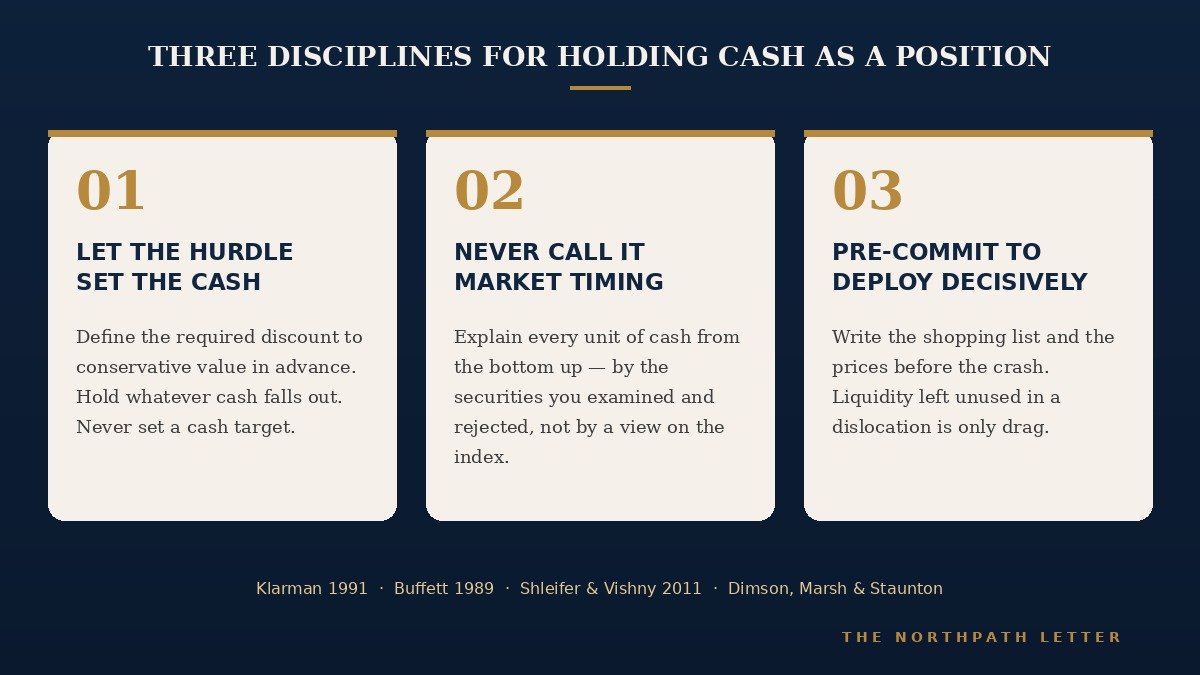
The idea is simple to state and genuinely difficult to live, so it is worth reducing to process. Three disciplines, stated as rules rather than as encouragement, do most of the work.
First, let the hurdle set the cash. Define, in advance and in writing, the bar a new investment must clear — a required discount to a conservative estimate of value, or a minimum prospective return below which you will not commit capital. Then hold whatever cash falls out of applying that bar honestly. The critical discipline here is a negative one: never set a cash target. The moment you decide to hold “twenty per cent in cash,” you have made a forecast and reintroduced the very market-timing you were trying to avoid. Cash is the dependent variable. The hurdle is the independent one. You control the hurdle and accept the cash.
Second, never call it market timing — and be sure you are not doing it. The test is whether you can explain your cash balance entirely from the bottom up, by reference to the securities you examined and rejected, without once mentioning the level of the index, the business cycle, or what you think the central bank will do next. If your cash exists because individual businesses are too dear, it is a residual and it is defensible. If it exists because you have a view on the macro future, it is a tactical bet, and the evidence on tactical bets is not kind. Keep the residual cash productive while it waits — in treasury bills or the shortest, safest government instruments — so that you blunt the drag without reaching for yield, and size it to your own liabilities and temperament rather than to anyone else’s.
Third, pre-commit to deploy decisively. The hardest moment in this entire discipline is not holding the cash; it is spending it. In a true fire sale, every instinct and every headline argues for waiting just a little longer, and the investor who has been patient for years can freeze at the exact instant his patience was supposed to pay. The antidote is to write the buying rules before the crash arrives — a standing shopping list of businesses you would want to own, with the prices at which you would want them — so that the dislocation triggers a pre-made decision rather than a fresh act of courage. Liquidity that is never deployed in a dislocation is not prudence. It is drag that merely looked like prudence.
How long-term practitioners actually applied it
Seth Klarman has run the residual as a live discipline for more than four decades, and his investor letters show it breathing in real time. Cash at the Baupost Group has averaged around thirty per cent of assets and has touched forty and fifty per cent when the firm could not find enough to buy. In November 2010, with markets recovered and bargains scarcer, he wrote that the firm’s opportunity set had become smaller than it had been in years while its cash balances had grown — and, rather than collect a fee on capital he could not deploy well, he returned roughly five per cent of the fund’s assets to its investors at year-end. That last act is the purest expression of the principle: when you cannot find a use for capital that meets your standard, the honest response is not to lower the standard but to hold the cash, and, if you are a fiduciary, to hand it back.
Warren Buffett applied the same logic across a longer arc and at three distinct moments. In 1969 he refused to keep his partners’ money in a market he could no longer justify, and wound the partnership down rather than relax the discipline that had built it. In 1989 he named the institutional imperative that pushes almost everyone else to stay fully invested regardless of price. And in 2008 he exercised the option that decades of refusal had stored, deploying billions into Goldman Sachs and General Electric on terms no fully invested investor could have commanded. Refuse, wait, strike: the cash residual is the thread that runs through all three. Jean-Marie Eveillard supplies the emotional truth that the records leave out — that the discipline is not principally an intellectual problem but a problem of endurance, of being willing to lose half your shareholders rather than half their money, and of holding that line through a stretch “deeper and longer than any other” before the market finally agrees with you.
None of these practitioners held cash because they were bearish. Each held it because, at the price on offer, they could not in conscience be anything else — and each was therefore liquid when liquidity was the only thing worth owning. The author holds no position in any company named in this letter; Goldman Sachs, General Electric and Berkshire Hathaway appear here only as historical illustrations of a discipline, not as suggestions of any kind.
Key takeaways
- Cash is a residual, not a forecast. Held as the leftover of a security-by-security refusal to overpay, a cash balance carries no view on the index; it is the mechanical output of insisting on a margin of safety (Klarman, 1991).
- The compulsion to be fully invested is a benchmark artefact. It serves the relative-return manager who fears falling behind the index, and the institutional imperative that rewards conforming with peers (Buffett, 1989). The absolute-return investor is freed from it.
- Cash has a real, large carrying cost. Since 1900, bills have returned about 0.5% real a year against roughly 5.2% for equities (Dimson, Marsh & Staunton). A permanent cash allocation destroys wealth; only a true residual, decisively deployed, earns its keep.
- Liquidity is a call option on distress. When forced sellers meet absent buyers, price dislocates and the holder of cash sets it (Shleifer & Vishny, 2011). Berkshire’s 2008 terms were that option being exercised.
- The discipline is endurance, not analysis. The hard part is looking wrong for years and then acting decisively in the panic. Write the hurdle and the shopping list in advance, so cash is a consequence and deployment is a pre-made decision.
— Manish Goel, FCA / NorthPath Advisory OÜ / Tallinn, Estonia
|
Important. |