Behavioural Finance · Afternoon Edition · No. 16
The NorthPath Letter · 11 June 2026 · Tallinn
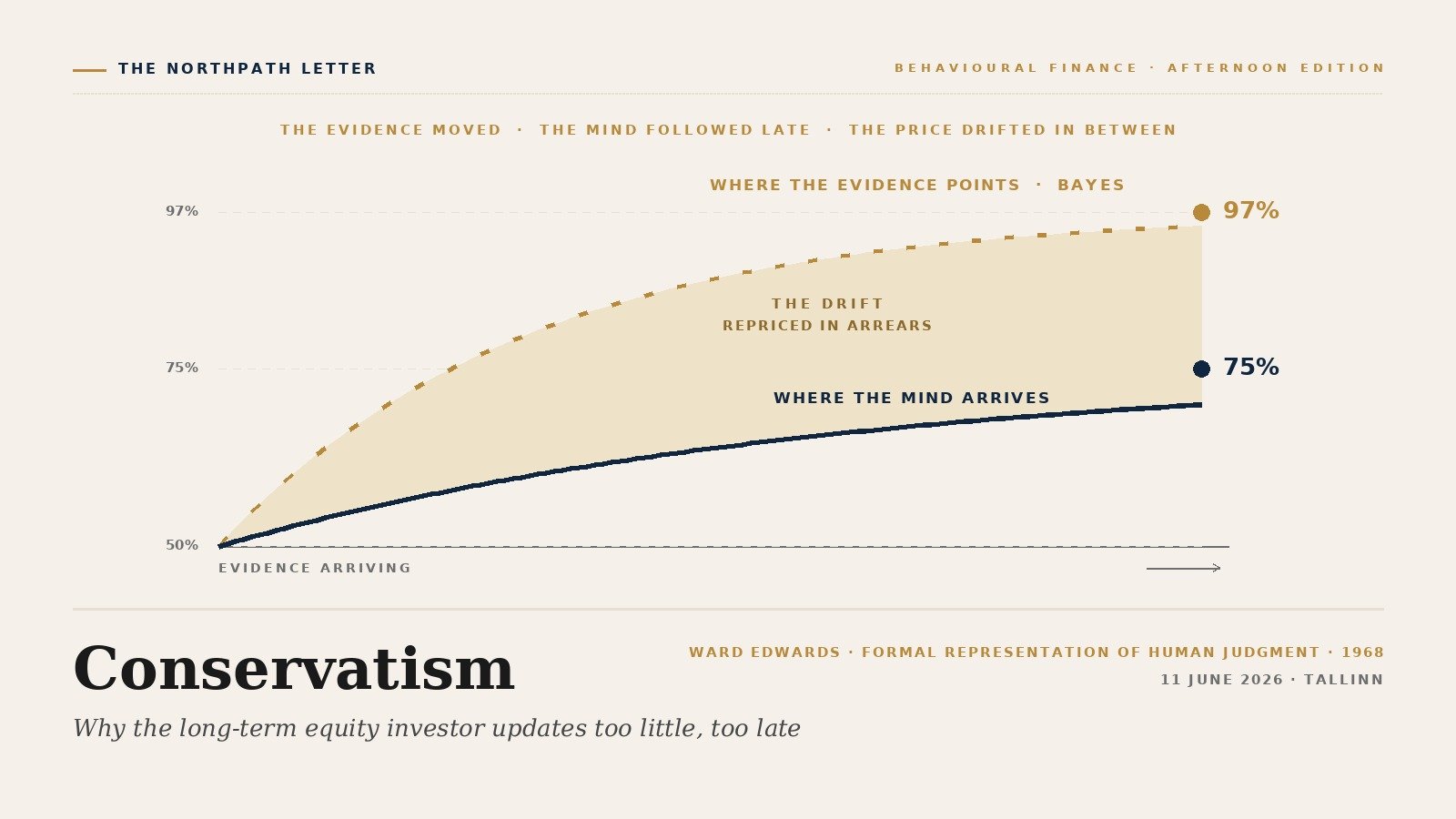
In 1968 the psychologist Ward Edwards reported a finding so plain it barely sounds like science: when people receive new evidence, they move their beliefs in the right direction — and not nearly far enough. He called the failure conservatism, and he measured it with bags of poker chips. The flaw he documented in a Michigan laboratory now has a market-sized shadow: prices that drift for weeks after earnings news, indices that make record highs while the credit system burns beneath them, and portfolios that are still priced for a world the evidence has already retired. The long-term equity investor’s most expensive habit is not changing his mind too often. It is changing it too little, too late.
The Bias: A Bag of Chips and a Stubborn Posterior
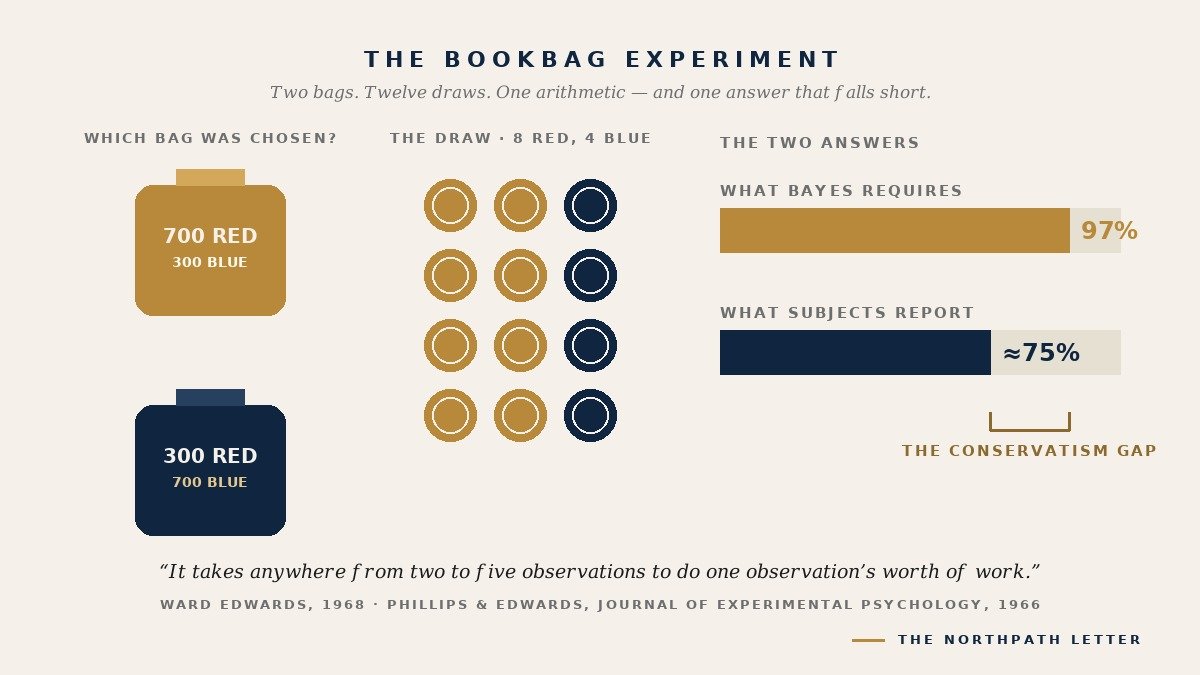
The experiment that founded the field could be run at a kitchen table. Edwards and his collaborators at the University of Michigan showed subjects two cloth bookbags. One contained 700 red poker chips and 300 blue; the other, 300 red and 700 blue. The experimenter picked a bag at random, drew twelve chips with replacement, and revealed the sample: eight red, four blue. The subject’s task was to state the probability that the predominantly red bag had been chosen.
The arithmetic of the Reverend Bayes, which the NorthPath Letter has treated in its own right, gives an exact answer: the odds are about thirty to one, a probability of roughly 97 per cent. Typical subjects answered somewhere between 70 and 80 per cent. They had moved in the correct direction — nobody thought the blue bag more likely — but they had extracted only a fraction of the information the sample carried. Edwards summarised the regularity in the chapter that gave the bias its name, “Conservatism in Human Information Processing,” published in 1968 in Benjamin Kleinmuntz’s collection Formal Representation of Human Judgment: opinion change is orderly, proportional to what Bayes’ theorem prescribes, and reliably insufficient — in his estimate, it took “anywhere from two to five observations to do one observation’s worth of work” in moving a subject’s beliefs. Lawrence Phillips and Edwards had documented the same deficit two years earlier in the Journal of Experimental Psychology, and varied the experiment every way they could think of: the payoffs, the proportions, the mode of response. The conservatism survived. Man, Edwards concluded, is a Bayesian — but a conservative one, who buys information dearly and then declines to spend it.
It is worth fixing precisely what the bias is, because it travels under names that belong to its cousins. Conservatism is not confirmation bias, the tilted search that goes looking for agreeable evidence; the bookbag subject does not choose the sample, and underweights agreeable and disagreeable chips alike. Nor is it stubbornness of temperament: the subjects revised willingly, just feebly. Conservatism is a deficit in the amount of revision — a tax levied on every update, whichever direction the evidence points. The prior sits on the belief like a heavy anchor on a short chain, and each new fact drags it a few feet when the arithmetic says it should be hauled across the harbour.
The Mechanism: Why the Prior Holds the High Ground
Why should a mind that updates at all update too little? The most useful answer in the literature belongs to Dale Griffin and Amos Tversky, whose 1992 paper in Cognitive Psychology, “The Weighing of Evidence and the Determinants of Confidence,” split every piece of evidence into two properties. The first is strength: how extreme, vivid, or dramatic the evidence is. The second is weight: how statistically reliable it is — the size of the sample, the credibility of the source. A rational Bayesian combines both. Humans, Griffin and Tversky showed, attend to strength and merely glance at weight. A flamboyant story from a tiny sample produces wild overreaction. And the mirror image, which is conservatism’s natural habitat: evidence of high weight but low strength — a large, dull, statistically impeccable body of fact that arrives without drama — is systematically underweighted. The bookbag sample is exactly that: eight red chips out of twelve is not vivid. It is merely conclusive.
Beneath the strength–weight error sit plainer frictions. Aggregating evidence is computationally expensive, and the mind economises: Edwards himself located the failure not in misperceiving individual data but in misaggregation — each chip is read correctly, and the running total is kept badly. Abandoning a prior also carries a psychic cost that updating arithmetic does not capture: the prior is usually somebody’s previous conclusion, publicly stated, acted upon, and woven into a position — and beliefs with sunk reputational capital are revised the way listed companies restate accounts, reluctantly and in arrears. The investor should notice that both frictions scale with expertise. The deeper the research file, the heavier the prior; the more public the thesis, the dearer the revision. Conservatism is not a beginner’s disease. It is a professional’s.
In 1998, Nicholas Barberis, Andrei Shleifer and Robert Vishny built the canonical bridge from the laboratory to the exchange. Their Journal of Financial Economics model of investor sentiment rests on precisely the two errors Griffin and Tversky had paired. Confronted with a genuine change in a company’s earning power, investors anchored on the old regime update too slowly — conservatism — and prices underreact to news. Confronted with a streak of similar news, investors then over-extrapolate the pattern — the representativeness error this Letter has examined through the law of small numbers and extrapolative expectations — and prices overshoot. Underreaction in the short run, overreaction in the long run: one model, two laboratory biases, and a market that first ignores the evidence and then apologises to it twice over.
The Empirical Record: The Drift That Would Not Die
If investors underreact to dull, reliable news, the signature should be visible in prices: good news should be followed not by an instant full adjustment but by a slow continuing climb, as the market digests over weeks what Bayes would have digested at once. That signature was found in the very year Edwards’s chapter appeared. In 1968, Ray Ball and Philip Brown published “An Empirical Evaluation of Accounting Income Numbers” in the Journal of Accounting Research and noticed, almost in passing, that share prices continued to move in the direction of an earnings surprise for weeks after the announcement — as though the news were being absorbed on the instalment plan.
Two decades later, Victor Bernard and Jacob Thomas measured the instalments. Their 1989 and 1990 studies of post-earnings-announcement drift sorted companies by the size of their earnings surprise and found that a portfolio long the strongest surprises and short the weakest earned abnormal returns of roughly 4 per cent over the following sixty trading days — an annualised pace near 18 per cent — with the effect strongest among smaller, less-followed firms. More damning still, a disproportionate share of the drift arrived in the days around the next quarter’s announcement: the market was being surprised, repeatedly, by the predictable consequences of news it had already received. Narasimhan Jegadeesh and Sheridan Titman’s 1993 demonstration that simple six-to-twelve-month winners kept outperforming losers by about one per cent a month extended the family; underreaction to slowly building fundamentals remains the leading behavioural account of momentum. Analysts, the professional updaters, fare no better: Jeffery Abarbanell and Bernard showed in 1992 that earnings forecasts underweight the most recent earnings news — the bookbag deficit, in pinstripes.
Regulators on both sides of the Atlantic have written the underlying premise into their official literature. In the United Kingdom, the Financial Conduct Authority opened its Occasional Paper series in April 2013 with “Applying Behavioural Economics at the Financial Conduct Authority” — a founding document that formally abandoned the assumption of the well-calibrated retail investor, cataloguing the systematic errors with which real consumers process financial information and committing the regulator to design rules around them. In the United States, the Securities and Exchange Commission had commissioned the Library of Congress’s Federal Research Division to survey the same terrain; the resulting 2010 report, Behavioral Patterns and Pitfalls of U.S. Investors, catalogues the recurring failures of American retail portfolios — among them inertia and the chronic reluctance to revise allocations as circumstances change. Neither document will tell an investor which bag the chips came from. Both record that the official referees of two of the world’s largest capital markets now assume, as a working premise, that the participants update badly.
Episode One: The Year the Evidence Queued Politely, 2007
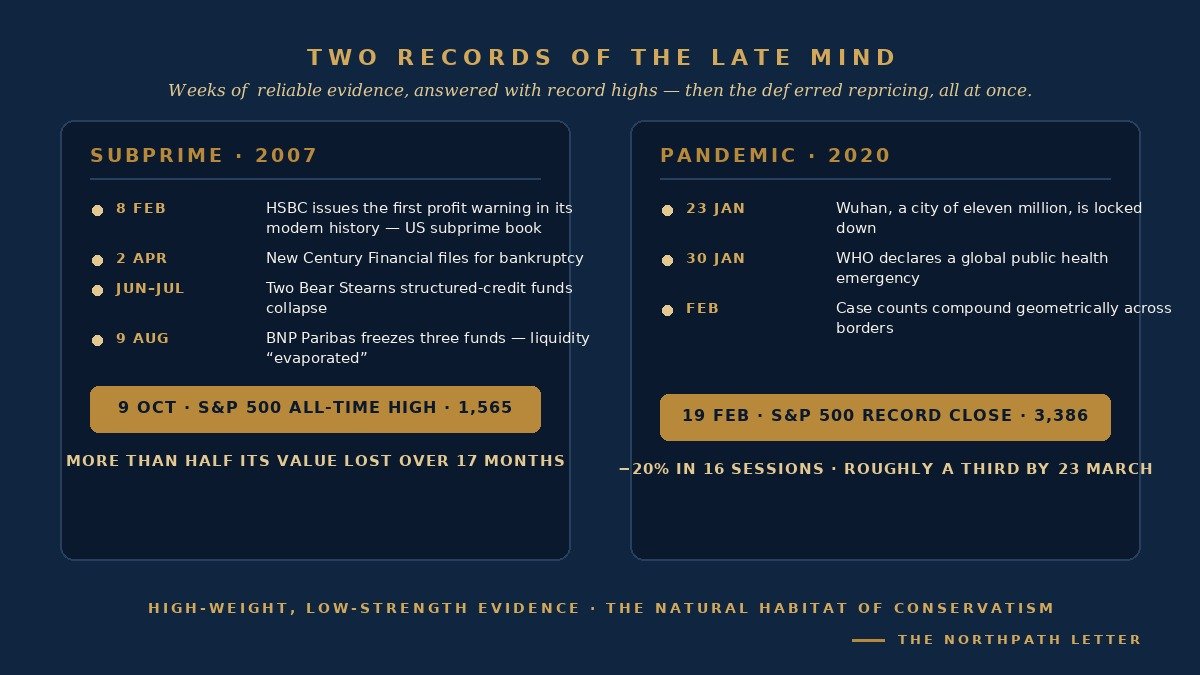
The credit crisis of 2008 is remembered as a thunderclap. The more instructive year for the student of conservatism is 2007, when the evidence arrived early, in order, and in writing — and the equity market revised like one of Edwards’s subjects. On 8 February 2007, HSBC issued the first profit warning in its modern history, confessing that impairments in its American subprime mortgage book would run some 20 per cent above forecasts. On 2 April, New Century Financial, one of the largest independent subprime lenders in the United States, filed for bankruptcy. In June and July, two Bear Stearns structured-credit hedge funds collapsed as the subprime securities they held were marked down; by the end of July they were nearly worthless. On 9 August, BNP Paribas froze three funds, declaring that liquidity in parts of the American securitisation market had “evaporated” — the event many historians treat as the true start of the crisis. Each datum was high-weight and low-strength: no single day looked like a crash, and official reassurance supplied the soothing prior — the Federal Reserve chairman told Congress in March that the subprime problem seemed “likely to be contained.”
The S&P 500 absorbed this sequence and proceeded to set its all-time closing high — 1,565 — on 9 October 2007, eight months after the first warning and two months after the interbank market had seized. The index would lose more than half its value over the following seventeen months. The point is not that an investor should have predicted the catastrophe’s full shape; almost nobody did. The point is narrower and more useful: a year of mounting, mutually corroborating, publicly available evidence about a specific asset class was met with a revision of approximately zero in the broad price of equities. The chips were on the table. The posterior did not move.
Episode Two: Nineteen Days in February, 2020
Thirteen years later the experiment was rerun at higher speed. On 23 January 2020, the Chinese government locked down Wuhan, a city of eleven million, to contain a novel coronavirus — an act without modern precedent, undertaken by a state with every incentive to avoid it. On 30 January, the World Health Organization declared a public health emergency of international concern. Through early February the case counts compounded geometrically and spread across borders; the evidence was statistical, cumulative, and almost perfectly devoid of drama — tables of numbers from far away. On 19 February 2020, the S&P 500 closed at a record 3,386.
What followed was the catch-up that conservatism always owes. The index needed only sixteen trading sessions to fall 20 per cent from that high — the fastest such descent from a record in market history — and by 23 March it had surrendered roughly a third of its value. Nothing material was learned in late February that a careful reader of the January evidence did not already possess; what changed was the strength of the signal, as the dull tables became Italian hospital footage. The market had not lacked information. It had lacked the willingness to multiply by it. When the revision finally came, it arrived with the violence of every deferred instalment falling due on the same day — the same pattern, compressed, that Bernard and Thomas had measured in quarterly miniature.
The Counter-Measure: Three Disciplines for Updating in Full
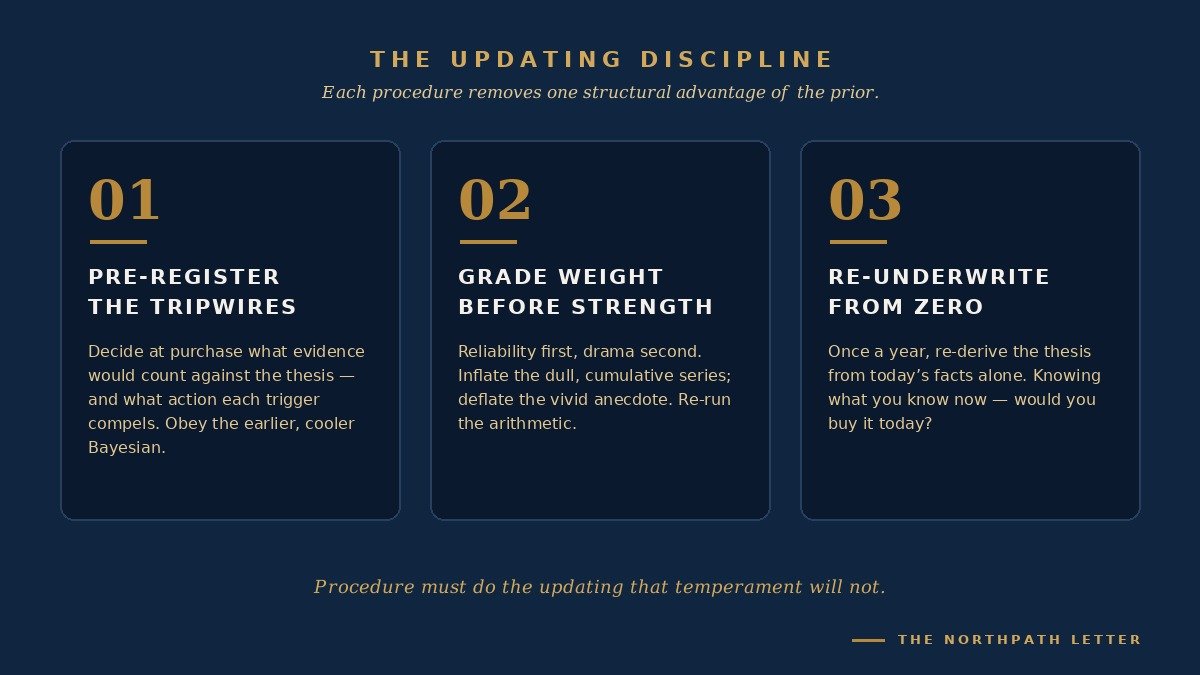
The investor cannot delete the bias; Edwards’s subjects included statisticians who knew Bayes’ theorem and underweighted the chips anyway. What can be built is procedure that does the updating the temperament will not. Three disciplines, each aimed at a specific joint of the mechanism, form a serviceable machine.
First: pre-register the tripwires. Conservatism does its work at the moment evidence arrives, when the prior is incumbent and revision is expensive. So move the decision to a moment when the prior has no position to defend. At the time of purchase, write down — in the investment journal, not the memory — the specific observable developments that would count against the thesis and the action each would trigger: the customer concentration that must not rise, the margin floor that must hold, the receivables growth that must not outrun revenue. When the development occurs, the question is no longer “how do I feel about this news?” but “what did I instruct myself to do?” The investor obeys his own earlier, cooler Bayesian — the one who had not yet fallen in love.
Second: grade weight before strength. For every material datum, ask two questions in a fixed order. How reliable is this — what is the sample, the source, the audit trail? Only then: how dramatic is it? The discipline runs both ways. It deflates the vivid anecdote that deserves a shrug, and — the conservatism side — it inflates the dull, cumulative series that deserves alarm: the fourth consecutive quarter of softening volumes, the third auditor qualification, the slow bleed of senior departures. A useful test: if this evidence had arrived all on one day, with a headline, what would I do? If the answer differs from what you are doing, the difference is the bias, measured in your own currency.
Third: re-underwrite from zero. The prior’s deepest advantage is incumbency — the thesis on file is the reigning champion, and new evidence arrives as a challenger who must win decisively. Strip the advantage on a schedule. Once a year per holding, re-derive the case from today’s facts alone, as though encountering the company for the first time, and ask the only question that has no anchor in it: knowing what I know now, would I buy this business today, at this price, in this size? A position that survives zero-based re-underwriting is owned for reasons that still exist. A position that survives only because it is already owned is a bookbag answer — a 75 per cent belief wearing a 97 per cent position.
How the Practitioners Fought It
The investors with the longest records have tended to describe this bias from the inside, as a scar rather than a citation. Warren Buffett’s most expensive tuition was paid to it. Berkshire Hathaway was, before it was a compounding machine, a New England textile manufacturer — and Buffett, having taken control in 1965, kept the looms running for twenty years while the evidence of structural decline mounted quarter by dull quarter: foreign cost advantages, commodity economics, returns below the cost of the capital they consumed. He closed the operation only in 1985, and his shareholder letters perform the autopsy with characteristic candour — the 1979 letter had already conceded the general law, that “turn-arounds” seldom turn, and the 1985 letter walks through how a stream of individually reasonable reinvestment decisions, each anchored on the prior of a salvageable business, compounded into an unreasonable twenty-year commitment. It is the bookbag experiment run with a payroll: every chip read correctly, the total kept badly.
Charlie Munger, Buffett’s partner of six decades, built his public teaching around the opposite procedure. In his “Psychology of Human Misjudgment” framework he treated the slow revision of cherished conclusions as among the most expensive of the standard errors, and held up Charles Darwin as the working model — the scientist who trained himself to record disconfirming evidence immediately, precisely because the mind could be trusted to bury it otherwise. Munger’s practical test was the willingness to destroy one’s own best-loved ideas on a schedule, and he liked to say that a year in which you did not retire at least one such idea was a wasted year. John Maynard Keynes is forever credited with the motto “when the facts change, I change my mind” — a sentence no scholar has located in his writings, and which earns its place here only as evidence of how badly investors want the discipline to have a famous patron. It does not need one. It needs a journal, a checklist, and a calendar.
Key Takeaways
- Conservatism is under-revision, not stubbornness. Ward Edwards’s 1968 bookbag experiments showed people update beliefs in the right direction but extract only a fraction of the evidence’s value — two to five observations doing one observation’s work.
- The market inherited the laboratory result. Post-earnings-announcement drift, documented since Ball and Brown in 1968 and measured by Bernard and Thomas at roughly 4 per cent over sixty days, is underreaction visible in prices — and a premise regulators in both Washington and London now build into official doctrine.
- The dangerous evidence is dull. Following Griffin and Tversky, the mind overweights vivid, low-reliability news and underweights cumulative, high-reliability series — which is why 2007’s written warnings and January 2020’s case tables were both answered with record index highs.
- Procedure must do what temperament will not. Pre-registered tripwires, a weight-before-strength audit, and annual zero-based re-underwriting each remove one of the prior’s structural advantages.
- Expertise deepens the bias. The heavier the research file and the more public the thesis, the costlier the revision — conservatism is a professional’s disease, and the longest-tenured practitioners, Buffett’s textile mill included, paid the largest tuition.
— Manish Goel, FCA / NorthPath Advisory OÜ / Tallinn, Estonia
|
Important. |