
Most of what this letter has examined so far lives inside the annual report: the cash flow statement, the segmental note, the related-party schedule, the contingent liabilities. These are the periodic accounts, struck once a year and reviewed once a quarter, and they are indispensable. But they share a defect that no amount of careful reading can cure. They are old. By the time an Indian company’s annual report reaches you, the financial year it describes has been closed for months, and the business has moved on. The annual report tells you what a company was. To learn what it is becoming — the acquisition signed last Tuesday, the factory that burned down on Friday, the regulator’s order served this morning — you must read a different and far less understood body of disclosure: the continuous, event-driven announcements a listed company is obliged to make between its periodic accounts.
In India the spine of that regime is a single provision, Regulation 30 of the Securities and Exchange Board of India (Listing Obligations and Disclosure Requirements) Regulations, 2015 — the LODR. It is the rule that decides what a listed company must tell the market the moment something happens, and, since a consequential rewrite in 2023, how fast. The answer to that second question is now startling. For a decision taken in a board meeting, the deadline is thirty minutes. Not thirty days, not the four business days an American company is given, not the “as soon as possible” that governs London. Thirty minutes from the gavel. This letter is about that rule: what it requires, the clocks it starts, the threshold that decides what counts as material, the curious new obligation to chase down market rumours, and how a reader can use all of it.
Two registers of disclosure
It helps to hold two registers of corporate disclosure apart in the mind, because they answer to different masters and serve different purposes. The first is periodic. It is the statutory rhythm of the accounts: the financial statements mandated by the Companies Act, 2013, the quarterly and annual results required by the LODR, the corporate-governance reports. This register is comprehensive but slow. It is designed to be complete, audited and comparable, and completeness takes time.
The second register is continuous, and it answers to a different imperative — that the price of a security should reflect what is known about the company at any moment, not merely what was true at the last balance-sheet date. A market in which insiders learn of a transformative acquisition weeks before the public is not a fair market; it is a private club with a ticker. Continuous disclosure exists to collapse that information gap to as near zero as the law can manage. Regulation 30 is the instrument. It requires a listed entity to disclose to the stock exchanges any event or information that is material, and it does so against a catalogue — Part A of Schedule III to the LODR — that runs to dozens of specified items, from the signing of a binding agreement to the resignation of an auditor to the receipt of a winding-up petition.
The distinction matters to a reader because the two registers can be read against each other. The annual report is the company’s considered self-portrait, composed at leisure. The Regulation 30 stream is the unedited footage — terse, dated to the minute, filed under pressure. When the two diverge, the footage is usually the more honest record.
What Regulation 30 actually requires
The architecture of Regulation 30 turns on a single question asked of every event: is it material? The regulation answers that question in two ways, and the division is the first thing a reader should understand.
Schedule III, Part A is split into two paragraphs. Paragraph A lists events that are deemed material — they must be disclosed without any further test, because the regulator has decided in advance that they always matter. The acquisition or disposal of a business, the outcome of a board meeting on dividends or fund-raising, a change in directors or the auditor, the initiation of insolvency proceedings, fraud or default by the company or its key personnel, action taken by a regulatory or law-enforcement authority — these are disclosed because they happened, full stop. There is no judgment to exercise and no threshold to clear.
Paragraph B lists events that are material only if they cross a threshold — disclosed on the application of the materiality guidelines set out in Regulation 30(4). Here the company must exercise judgment, and to discipline that judgment the regulation requires, under Regulation 30(4) and 30(5), that every listed entity adopt a board-approved materiality policy and name the key managerial personnel authorised to decide whether an event is material and to make the disclosure. That policy must be public — posted on the company’s website — and it must not dilute what the regulation requires. The reader’s point here is practical: a company’s own materiality policy is a document you can fetch and hold the company to. When a firm fails to disclose something and later claims it was not material, its own published policy is the yardstick against which that claim is measured.
The three clocks
For most of the regulation’s life, the deadline was a flat twenty-four hours. The SEBI (Listing Obligations and Disclosure Requirements) (Second Amendment) Regulations, 2023 — notified on 14 June 2023 and effective from 14 July 2023 — replaced that single deadline with three, calibrated to where the information comes from and how it arises. This is the change that made India’s regime the most demanding in the major markets, and it is worth stating precisely, because the differences are not cosmetic.
If the event is the outcome of a board meeting — a dividend declared, a buyback approved, a fund-raise cleared — the company has thirty minutes from the close of the meeting to disclose it. If the event or information emanates from within the listed entity but is not a board outcome — a contract won, a plant shut, a key resignation — the deadline is twelve hours. If the event does not emanate from within the entity — a natural disaster, a third party’s action, a court order served from outside — the company has twenty-four hours, the extra time a concession to the reality that a company cannot always control or instantly verify what is done to it from outside. So the first question a reader should ask of any Regulation 30 filing is not what it says but how quickly it came: the source of an event determines which of three clocks starts to run.
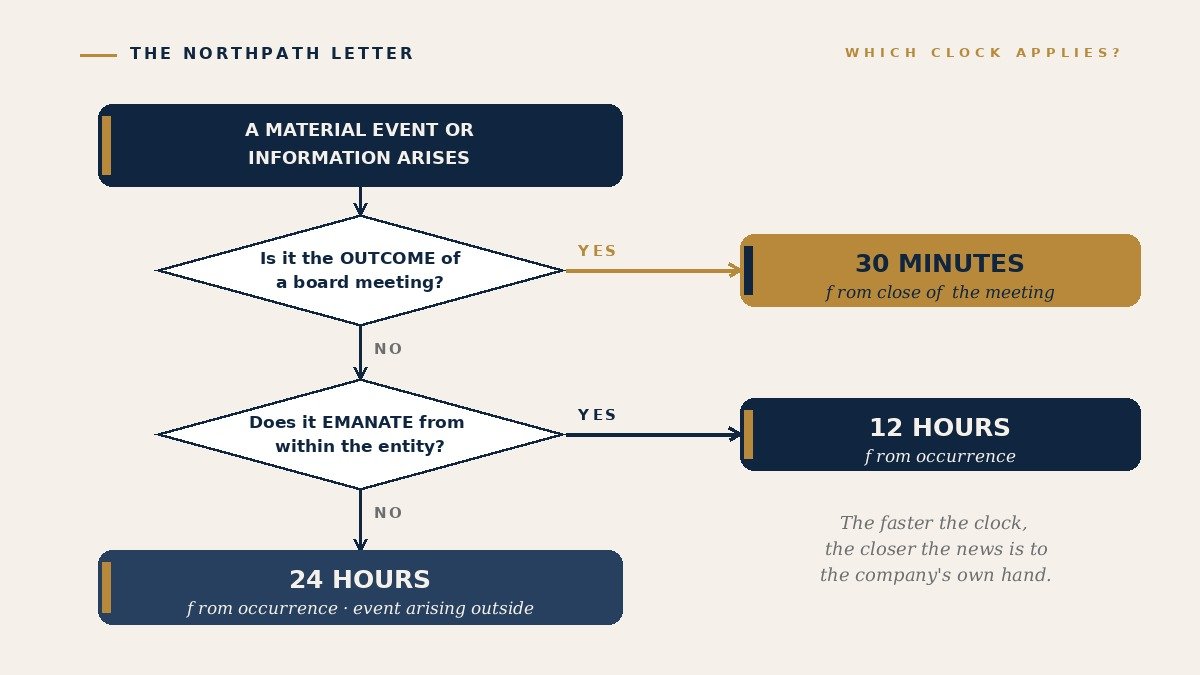
The thirty-minute rule deserves a moment’s reflection, because it changes the texture of an Indian board meeting. A board can no longer resolve on a dividend in the afternoon and let the news drift out overnight; the company secretary is filing with the exchanges before the directors have left the room. For the reader, this produces a usefully tight signal. A board-outcome disclosure that lands forty minutes after a competitor’s, or that trickles out in pieces, is itself information about how the company is run.
The materiality gate
The 2023 amendment did something else that practitioners had wanted for years: it put numbers on materiality. Before, the Paragraph B test was largely qualitative, and qualitative tests are elastic in the hands of a reluctant discloser. The amendment introduced an objective, quantitative gate. An event is material — and so must be disclosed — if its value or expected impact exceeds the lower of three figures: two per cent of turnover, as per the last audited consolidated financial statements; two per cent of net worth, on the same basis (unless net worth is negative, in which case that limb falls away); or five per cent of the average of the absolute value of profit or loss after tax for the last three audited consolidated years.
The word that does the work is lower. The regulation does not let a company pick the most flattering of the three denominators; the smallest of them is the trip-wire, and for a company with thin or volatile profits, the five-per-cent-of-average-PAT limb will often be a very low bar indeed. The effect is to drag a great deal more into the disclosure net than the old qualitative test ever did, and to make the materiality judgment auditable after the fact — anyone with the consolidated accounts can compute the thresholds and check the company’s working. The lower of the three is the trip-wire, and it is a far less forgiving one than it looks.
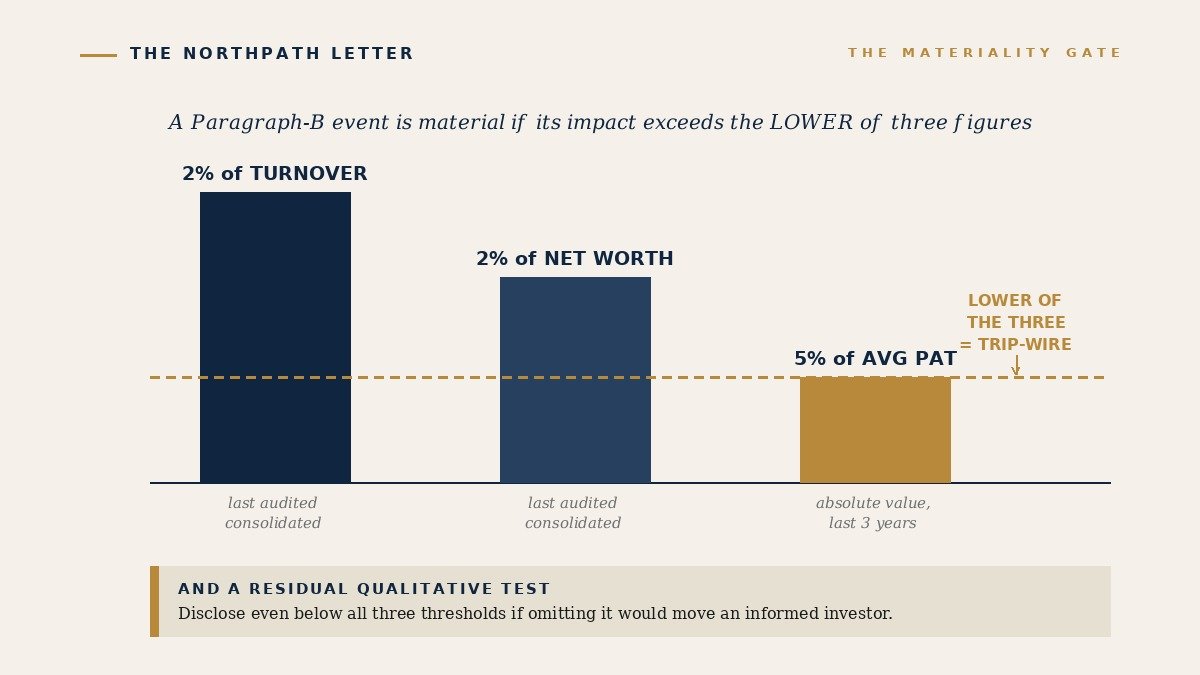
The quantitative gate did not abolish judgment entirely. The regulation retains a residual qualitative limb: even an event below all three thresholds must be disclosed if, in the opinion of the board or the authorised personnel, its omission is likely to discourage an informed investor or to cause a significant market reaction. The thresholds are a floor, not a ceiling. But the floor is now made of numbers, and numbers can be checked.
What the 2023 rewrite widened
The amendment also enlarged the catalogue of what must be told, and three additions matter most to a reader. First, actions by regulators, statutory bodies and law-enforcement agencies became disclosable in their own right — a search or seizure, a show-cause notice, an order or a prosecution must now reach the market promptly, rather than surfacing only when a journalist finds the court record. Second, frauds and defaults by the listed entity, its promoters, directors or key managerial personnel, and the arrest of any of them, were brought squarely into the deemed-material list. Third, and most quietly consequential, Regulation 30A and a new clause in Schedule III require disclosure of agreements that bind the listed entity or affect its management or control — including agreements to which the company is not itself a party, such as a pact among promoters or between shareholders. That last reform closed a genuine gap: control-altering arrangements had often lived entirely outside the company’s own filings, visible to the parties to them and invisible to everyone else who owned the shares.
A related provision is easy to overlook but useful in practice. Under Regulation 30(8) a listed entity must host its Regulation 30 disclosures on its own website and keep them there for a minimum period — at least five years — before archival. The consequence for a reader is that a company’s own site is a dated, searchable record of everything it was obliged to tell the market, independent of the exchange portals; when you are reconstructing a sequence of events, it is often the fastest archive to walk.
The rumour machine
The most novel — and most contested — of the 2023 changes addresses something disclosure rules had always left alone: the rumour. Markets run on talk, and a well-placed leak to a friendly newspaper had long been a way to move a price while keeping the formal record clean. Regulation 30(11), as amended, closes that door for the largest companies. A listed entity within scope must now confirm, deny or clarify any reported event or information in the mainstream media that is not general in nature and that indicates a specific impending material event is being discussed among the investing public.
The obligation arrived gradually, after several deferrals that themselves tell you how hard the industry fought it. As finally implemented, rumour verification applies to the top 100 listed entities by market capitalisation from 1 June 2024, and to the top 250 from 1 December 2024. The trigger is not the rumour alone but a material price movement — the exchanges specify the threshold — so that a company need not respond to every stray speculation, only to those the market is visibly acting upon. SEBI paired the rule with a piece of machinery to remove its sting: where a company confirms a rumour about an impending deal, the price inflation caused by the rumour itself can, under a defined “unaffected price” framework, be stripped out of the pricing of the eventual transaction. Without that relief, honest confirmation would have penalised the confirming company by inflating the reference price of its own acquisition. The detail is technical, but the principle is elegant: tell the truth promptly, and the regulation will not let your candour be used against you in the deal that follows.
How India compares
Set against the two markets an English-speaking reader is likeliest to know, India’s regime now looks unusually prescriptive. The United States relies on Form 8-K, the “current report” that fills the gap between quarterly filings. The 8-K is item-based — it enumerates the events that trigger it — and the deadline for most items is four business days after the triggering event, with no extension available. American disclosure is also policed at the edges by Regulation FD, which forbids selective disclosure to analysts or favoured investors ahead of the public. It is a sturdy system, but four business days is a different universe from thirty minutes.
The United Kingdom, and the European Union from which its rule derives, take a third path. Under the UK Market Abuse Regulation, Article 17, an issuer must disclose inside information “as soon as possible,” through a Primary Information Provider — in practice the London Stock Exchange’s Regulatory News Service. There is no fixed clock at all; the standard is a principle. Crucially, a UK or EU issuer may delay disclosure of inside information where immediate publication would prejudice its legitimate interests, provided the delay is not likely to mislead the public and confidentiality can be maintained — telling the regulator only after the fact. India permits no such standing right of delay for ordinary materiality. Its regime is faster, more rules-based and less forgiving of discretion than either of its Western counterparts demands. Whether that is a virtue is a fair question — prescription buys promptness at the cost of flexibility, and a thirty-minute clock can manufacture noise as readily as signal — but the direction of travel is unmistakable, and an investor who learned the rhythm of disclosure in New York or London will misjudge India if they assume the same latitude exists.

How to read a Regulation 30 filing
The practical pay-off of all this is that the Regulation 30 stream is free, public and largely unread, which is exactly the combination that rewards the diligent. The filings live in the “announcements” or “corporate filings” sections of the BSE and NSE websites, indexed by company and stamped to the minute. Here is how to read them.
Begin with the timestamp. Every filing carries the time of the event and the time of disclosure. The gap between them is the first thing to read. A board outcome filed inside thirty minutes is a company whose compliance machinery works; one that habitually files board outcomes late, or in dribs and drabs, is telling you something about its discipline before you read a single number.
Sort the deemed from the judged. Ask whether the event is a Paragraph A item — disclosed because it happened — or a Paragraph B item that cleared the materiality threshold. For the latter, you can compute the thresholds yourself from the last consolidated accounts and ask whether the company’s line is plausible. A string of “events” filed just below every threshold is a pattern worth noticing.
Fetch the materiality policy. It sits on the company’s website by mandate. Read who is authorised to decide materiality and how the policy defines it. A policy that merely parrots the regulation is fine; one that quietly narrows it is a flag.
Read the rumour confirmations with particular care. For a top-250 company, a Regulation 30(11) response to a media report is often the earliest formal acknowledgment that a transaction is real. The wording repays attention: “the company denies” is a strong statement that can be held against the board later; “the company is evaluating various opportunities in the ordinary course” is the language of confirmation dressed as denial.
Read the stream alongside the accounts. The deepest use of continuous disclosure is as a check on the periodic kind. An acquisition announced under Regulation 30 should reappear, months later, in the cash flow statement’s investing section and the related-party note. A contingent liability that first surfaced as a regulatory order in the disclosure stream should be traceable into the annual report’s contingencies. When the footage and the self-portrait disagree, you have found a question worth asking.
The annual report is the company’s considered self-portrait, composed at leisure. The Regulation 30 stream is the unedited footage — terse, dated to the minute, filed under pressure. When the two disagree, the footage is usually the more honest record.
None of this requires a data terminal or a subscription. It requires only the patience to read what every listed Indian company is already compelled to publish, against a clock that is now the tightest in the major markets. The takeaway is a single line: in India, the speed of a disclosure is itself a disclosure — read the clock before you read the contents.
Disclosure
This letter is journalism and education for a general audience. Nothing in it constitutes investment advice or a recommendation in respect of any security or financial instrument, nor an offer or solicitation to buy or sell anything. Companies and events are named only as factual or historical illustration, and the author holds no position in any security mentioned. Regulatory provisions are summarised for the general reader and are not a substitute for the text of the regulations or for professional advice; readers should consult an adviser authorised in their own jurisdiction before making any decision.
— Manish Goel, FCA · The NorthPath Letter · Tallinn