Behavioural Finance · Afternoon Edition · No. 14
The NorthPath Letter · 9 June 2026 · Tallinn
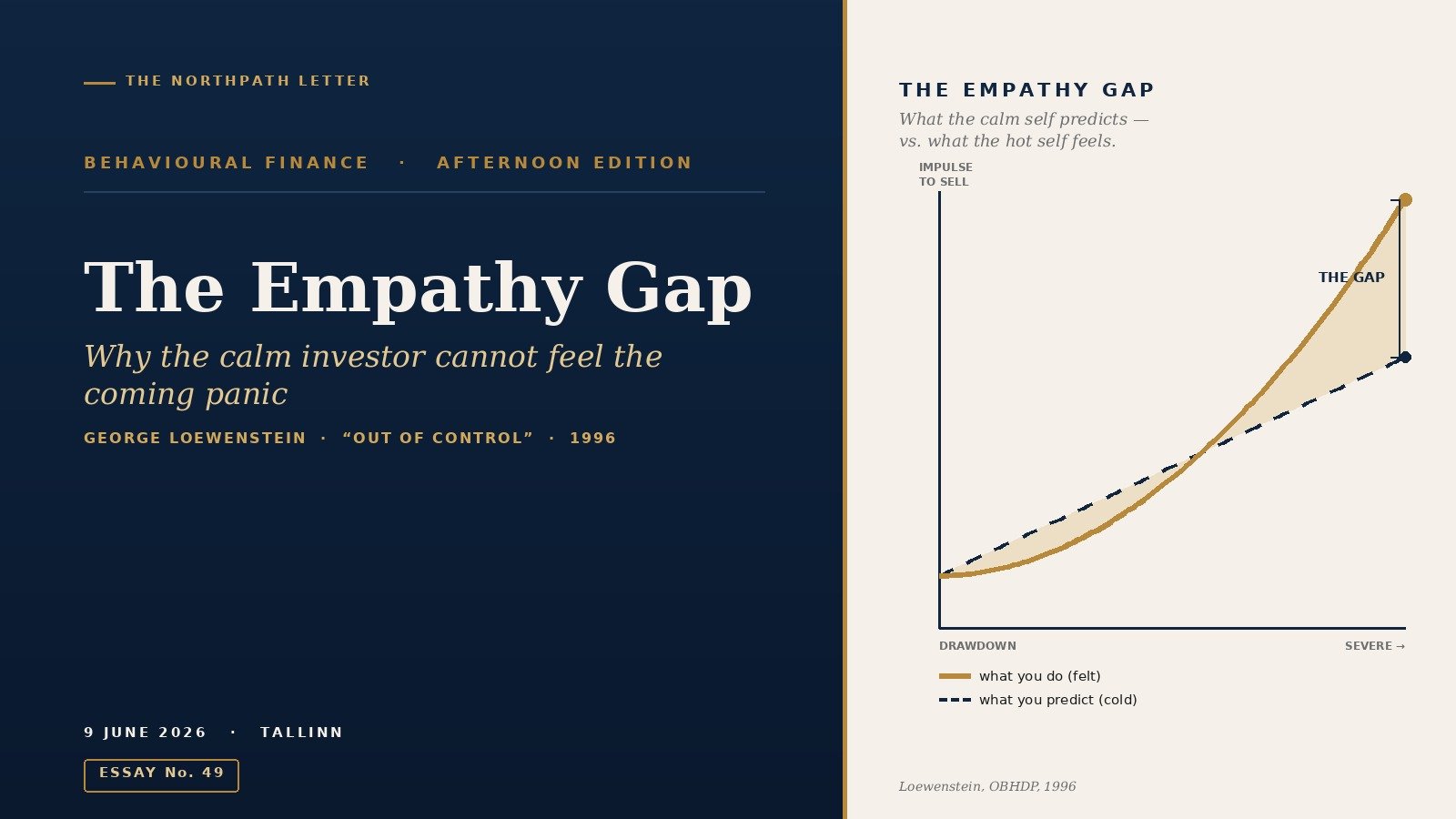
The calm investor who writes a sober plan on a quiet Sunday and the frightened investor who abandons it at the bottom of a crash are, in every way that matters, two different people. The first cannot feel what the second will feel, and so consistently overestimates the second’s composure. George Loewenstein gave this failure a name in 1996, and it explains more portfolio destruction than any chart pattern ever drawn.
The Bias: A Stranger to Your Other Self
In 1996, the Carnegie Mellon economist George Loewenstein published a paper in Organizational Behavior and Human Decision Processes with a title that doubled as a thesis: “Out of Control: Visceral Influences on Behavior.” His argument was that economics had quietly assumed a creature who does not exist — a decision-maker whose preferences sit still while the world moves around them. Real people, Loewenstein observed, are governed by what he called visceral factors: hunger, thirst, pain, fear, sexual arousal, fatigue, the craving of the addict, the panic of the frightened. These states share two defining features. They feel intensely pleasurable or aversive, and, while they last, they rearrange the relative desirability of every option in front of us. A person in the grip of a strong visceral factor does not weigh that factor against their other goals; the factor crowds the other goals out.
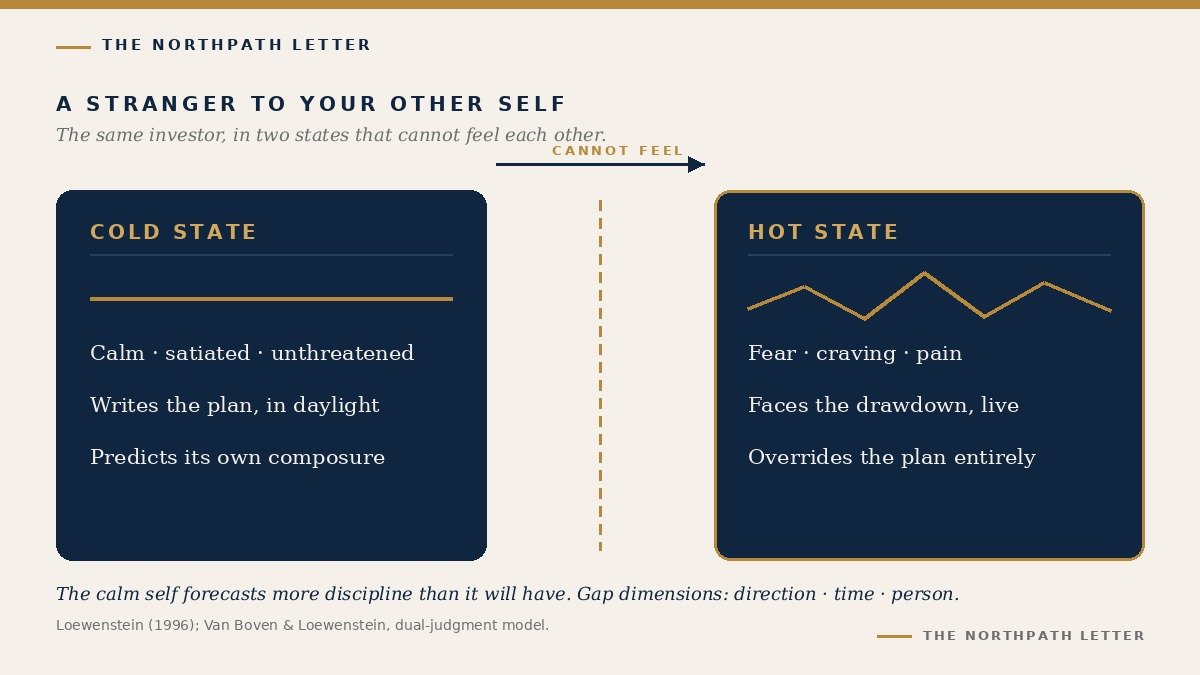
The deeper and more unsettling part of Loewenstein’s work concerned not how we behave inside these states, but how badly we predict them from outside. He and his collaborators documented what came to be called the hot-cold empathy gap: when we are in a “cold” state — calm, satiated, unthreatened — we systematically underestimate the power that a future “hot” state will exert over our own behaviour. And the reverse holds too. In the heat of the moment we cannot imagine ever being calm again. The gap runs in both directions, across time, and even across people. Loewenstein’s later model, developed with Leaf Van Boven, framed it as a failure of self-directed empathy: we are, to our own other-state selves, strangers.
The investing translation is exact, and it is brutal. The investor drafting an asset allocation on a peaceful weekend is in a cold state. The same investor watching a third of their net worth evaporate in three weeks is in a hot one. The first cannot feel the second. He will therefore set a risk budget he cannot keep, promise himself a discipline he will not honour, and be genuinely astonished, later, at what he did. He did not break his rules because the rules were wrong. He broke them because the person who wrote them never met the person who had to follow them.
The Mechanism: Why Introspection Fails Across States
Why can we not simply remember how fear feels and plan accordingly? The answer lies in the architecture of state-dependent preference. Visceral states do not merely add a term to our mental arithmetic; they reweight the entire equation. Loewenstein’s central finding is that the influence of a visceral factor on behaviour rises far faster than our ability to introspect about it. Mild hunger is easy to reason about; ravenous hunger hijacks attention entirely and collapses the time horizon to the immediate. Fear behaves identically. A 10% paper loss is an abstraction one can discuss over coffee. A 40% loss, marked to market in real time, with the financial press narrating catastrophe, is a visceral event that shrinks the decision frame to a single screaming imperative: make the pain stop.
Because the cold-state mind cannot reproduce the hot state’s intensity, it forecasts the future by anchoring on how it feels now and adjusting insufficiently. Loewenstein, Ted O’Donoghue and Matthew Rabin formalised this in their 2003 Quarterly Journal of Economics paper on projection bias: people predict their future utility as if it will resemble their present utility far more than it actually will. The hungry shopper buys food they will not want; the calm investor buys risk they will not be able to hold. This is also why the lessons of the last crash fade so completely. The memory of fear is stored, but the feeling of fear is not retrievable on demand, and it is the feeling, not the memory, that drives behaviour when the next decline arrives.
The psychologists Timothy Wilson and Daniel Gilbert, who mapped affective forecasting across two decades of research, isolated the specific defect at work. We are reasonably accurate at predicting whether a future event will feel good or bad; we are reliably poor at predicting how intensely, and for how long, it will move us — an error they named the impact bias. The investor’s exposure is to a particular slice of that failure. The drawdown one calmly expects to “ride out” will, in the event, exert a gravitational pull on behaviour that the forecasting self had no instrument to detect. The plan assumed a mild headwind; the reality is a current that carries.
This separates the empathy gap cleanly from its neighbours in the behavioural literature. It is not the salience bias of vivid information, nor the peak-end distortion of memory, nor the depletion of decision fatigue. It is a failure of affective forecasting — the documented human inability to predict the intensity and behavioural pull of our own future emotions. We are confident weather forecasters of our own composure, and we are miscalibrated in a single, dangerous direction: we almost always predict more calm than we will have.
The Empirical Record
The Laboratory
The cleanest demonstrations come from outside finance, where the stakes are low enough to study honestly. Daniel Read and Barbara van Leeuwen, writing in the same journal in 1998, asked office workers to choose in advance the snack they would receive a week later — fruit or chocolate. When the advance choice was made on a full stomach, just after lunch, a healthy 49% chose fruit. But of those virtuous planners, 74% reversed themselves when the moment of consumption arrived and hunger was present. The cold self planned for a hot self it could not feel, and the hot self simply overruled it. The plan was not weak; the forecast was.
Michael Sayette, Loewenstein and colleagues sharpened the point in 2008 with a study of ninety-eight smokers, published in Psychological Science. Smokers asked, while in a low-craving “cold” state, to predict how much they would value smoking in a future high-craving session systematically under-predicted that value, relative to smokers who made the same forecast while already craving. The implication for any investor is sobering: the discipline you feel certain of today is being assessed by the wrong version of you. The version that will actually face the temptation — to sell at the bottom, to chase at the top — is louder, and you cannot hear it yet.
The Market
The empathy gap does not stay in the laboratory. It shows up, denominated in basis points, every year. Morningstar’s annual Mind the Gap study compares the published total returns of funds with the dollar-weighted returns their investors actually captured — the difference being the cost of buying and selling at the wrong moments. For the decade ending December 2023, investors earned about 6.3% a year against the 7.3% their own funds returned, a shortfall of roughly 1.1 percentage points annually; the decade to December 2024 showed a similar gap of about 1.2 points. Most revealing of all, Morningstar found that funds with the most volatile cash flows — the ones investors traded in and out of most — produced the widest gaps, while the steadiest holdings lagged least. The behaviour gap is, in large part, the empathy gap with a price tag: the recurring cost of decisions made by the hot self that the cold self never authorised.
The Regulators
Financial regulators in two regions have independently arrived at the same diagnosis and, strikingly, the same remedy: insert friction to defeat the hot state. In the United Kingdom, the Financial Conduct Authority’s Policy Statement PS22/10, published in August 2022, rebuilt the rules for marketing high-risk investments. Among its requirements is a mandatory cooling-off period — a minimum of twenty-four hours before a first-time investor can act on a direct-offer promotion — which the FCA describes in plain terms as introducing “an appropriate degree of positive friction.” The accompanying personalised risk warnings went live on 1 December 2022, with the remaining rules following on 1 February 2023. The regulator’s theory is precisely Loewenstein’s: a day’s delay lets the cold self catch up with the hot self before money moves.
In the United States, the Securities and Exchange Commission approached the problem from the opposite direction — not the friction that protects, but the engineered frictionlessness that harms. In August 2021 the Commission issued a request for comment on “digital engagement practices,” the behavioural prompts, game-like features and “dark patterns” that trading apps use to nudge users toward more frequent activity. Chair Gary Gensler warned that such features can encourage investors to trade more often and take on more risk than they intend. The European Securities and Markets Authority had already acted in the same spirit in 2018, capping leverage on contracts for difference, mandating negative-balance protection and standardising risk warnings — each measure a brake on the impulse that the hot state manufactures. Three regulators, three jurisdictions, one shared insight: the most reliable way to protect investors from their hot selves is to slow the hot self down.
Two Episodes
2008–2009: The Capitulation
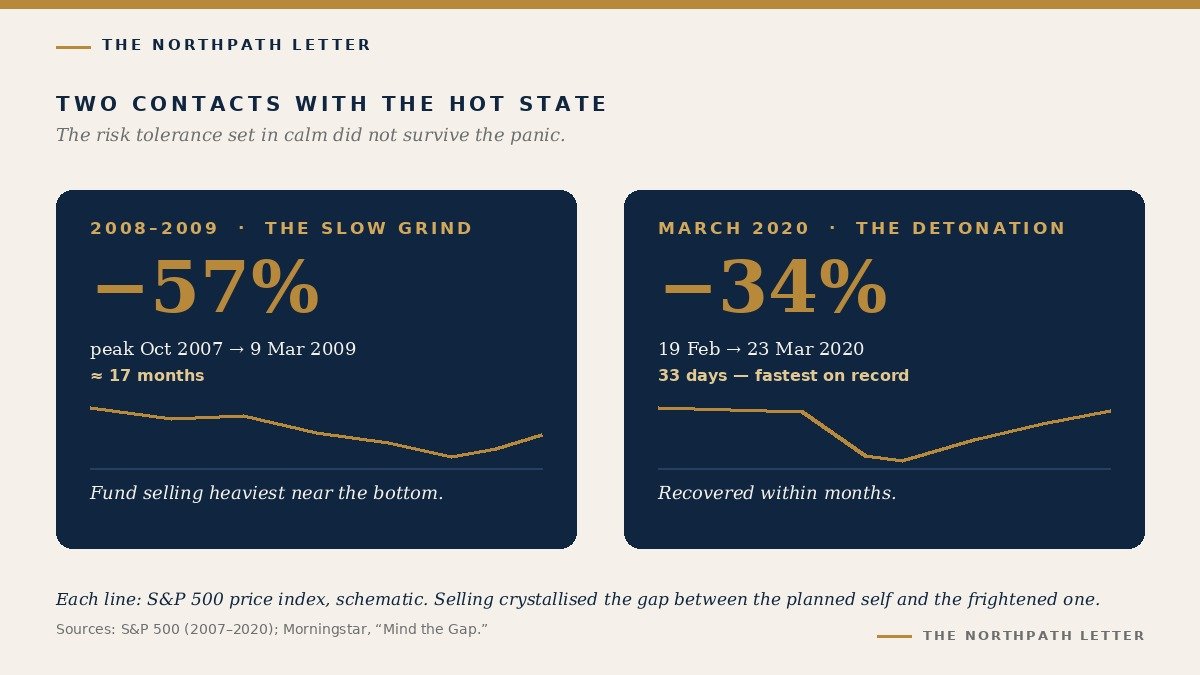
The financial crisis offered the empathy gap its largest modern stage. From its October 2007 peak the S&P 500 fell by roughly 57% to its trough on 9 March 2009 — a decline deep enough and slow enough to grind down even investors who had survived the dot-com bust. The instructive detail is in the timing of the selling. Flows out of equity funds were not heaviest at the top, when valuations were stretched and a cold-state risk manager would have trimmed; they were heaviest near the bottom, in late 2008 and early 2009, when the visceral pull of fear was at its maximum and prices were at their lowest. The risk tolerance that investors had sincerely reported on their 2006 questionnaires was a cold-state artefact. It did not survive contact with the hot state, and the gap between the two was paid for in realised losses, locked in days or weeks before one of the great recoveries in market history began. An investor who sold near the low and waited for the “all clear” missed a market that went on to more than triple over the decade that followed — the cost of a single hot-state decision, compounded for ten years.
March 2020: The Thirty-Three-Day Bear
If 2008 was a slow grind, March 2020 was a detonation. The S&P 500 fell 34% from its 19 February high to its 23 March low in just thirty-three calendar days — the fastest descent of that magnitude on record, against a historical average of roughly eleven months for declines of 30% or more. The speed mattered, because it gave the cold self no time to assert itself. There was no slow accumulation of bad news to reason through, only a near-vertical drop accompanied by genuine fear for life and livelihood. Investors who acted on that hot state — who sold to “stop the pain” — confronted an equally violent reversal: the index recovered its losses within months. The episode was a controlled experiment in the empathy gap. The decision that felt most urgent and most justified in the moment was, for the long-term owner of businesses, almost exactly wrong.
The Counter-Measure: Three Disciplines
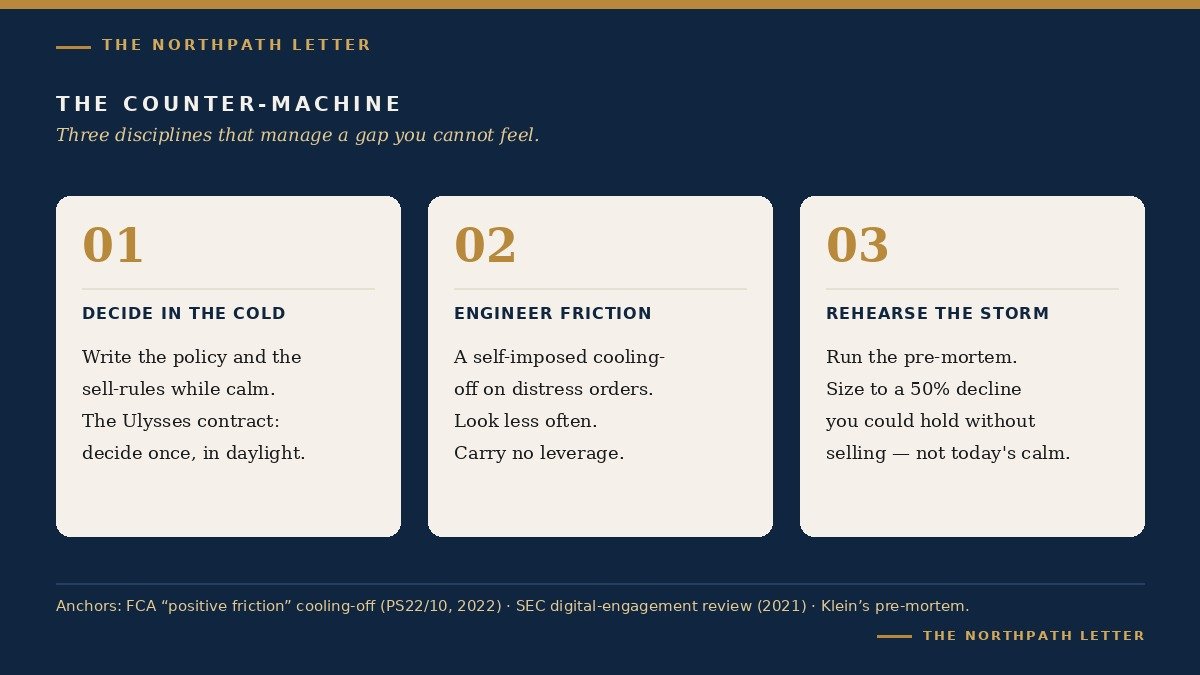
An empathy gap cannot be closed by trying harder to feel the future, because the feeling is, by construction, unavailable to the planning self. It can only be managed by structure — by arranging your affairs, while calm, so that the frightened version of you has as few decisions to make as possible. Three disciplines, in ascending order of difficulty, do most of the work.
1. Decide in the cold, in writing
The oldest remedy in the canon is the pre-commitment device — the rope by which Ulysses had himself bound to the mast so that his future, compromised self could not act on the Sirens’ song. Its modern form is the written investment policy statement and a set of explicit, pre-specified rules: what you own and why, the conditions under which you would sell, the rebalancing thresholds, and the cash reserve you will hold so that a forced sale is never required. The point is not the document’s eloquence but its timing. Rules written by the calm self, and made hard to revise in the moment, are the only instructions the hot self will ever receive from a clear-headed authority. Decide once, in daylight; obey in the dark.
2. Engineer positive friction; starve the triggers
The regulators’ insight is available to the individual at no cost. If a twenty-four-hour cooling-off period protects a first-time buyer, a self-imposed one protects everyone: a standing rule that no sell order placed in distress executes until the next day removes the worst decisions while keeping the necessary ones. Equally, the hot state can be starved of its triggers. Frequent portfolio-checking manufactures hot states out of ordinary volatility; reducing the frequency with which one looks is, on the evidence, one of the highest-return behaviours available to a long-term holder. Leverage and margin should be regarded as empathy-gap amplifiers, because they convert a paper decline into a forced, hot-state sale on someone else’s timetable. The investor who cannot be made to sell cannot be made to capitulate.
3. Rehearse the storm
Because you cannot feel the future panic, the safest assumption is that it will be worse than you can currently imagine — and you should size your commitments accordingly. The pre-mortem, a discipline popularised by the psychologist Gary Klein, asks you to stand in an imagined future in which the position has already failed and to narrate, in detail, how it happened. Done honestly, it imports a sliver of the hot state into the cold planning session, where it can do useful work. The practical test is simple: choose a portfolio you could hold through a 50% decline without selling, not the one that looks optimal in today’s calm. If a position is only tolerable while markets are serene, it is already too large.
How the Practitioners Closed the Gap
The investors who have compounded capital over decades are, almost without exception, people who built machinery to manage their hot selves rather than trusting their cold-state confidence. Warren Buffett has said for fifty years that temperament, not intellect, is the decisive investing trait — that the job requires “the ability to control the urges that get other people into trouble.” His most quoted maxim, that one should be “fearful when others are greedy and greedy when others are fearful,” is, read correctly, not a market-timing slogan but an instruction to act against one’s own visceral state. He demonstrated it in print at the depth of the 2008 panic, with his October 2008 op-ed declaring he was buying American equities for his personal account while fear was general. And he engineered the gap out of his enterprise structurally: Berkshire Hathaway holds permanent capital that cannot be redeemed at the bottom, runs with a deep aversion to debt, and is governed by a written owner’s manual — a cold-state constitution that constrains every hot-state impulse that might otherwise arrive.
Howard Marks of Oaktree Capital made the same battle the explicit subject of his life’s writing. His memos, composed contemporaneously rather than in hindsight, function as a cold-state record that cannot be quietly rewritten once the outcome is known. His refrain — “you can’t predict; you can prepare” — is a direct concession to the empathy gap: since you cannot know when the hot state will arrive or how it will feel, you prepare the structure in advance and let it carry you. In The Most Important Thing and Mastering the Market Cycle he describes investor psychology as a pendulum swinging between greed and fear, and the disciplined investor’s task as refusing to swing with it. The same instinct runs through John Bogle’s plain advice to “stay the course” and through the entire institutional apparatus of the investment policy statement: each is a device for letting the calm author of a plan overrule its frightened executor.
Key Takeaways
- The planner and the panicker are different people. The hot-cold empathy gap (Loewenstein, 1996) means the calm investor cannot feel the future fear, and so reliably overestimates their own future composure.
- The error runs one way. Affective forecasting fails in a predictable direction: we forecast more discipline than we will have. Read and van Leeuwen’s snack study (74% reversed their healthy choice when hungry) and the smoker studies show the cold self losing to the hot self every time.
- It has a price. Morningstar’s Mind the Gap puts the recurring cost at roughly 1.1–1.2 percentage points a year, with the most-traded funds suffering the widest shortfalls — the empathy gap, billed annually.
- Regulators now treat it as a hazard. The FCA’s mandatory cooling-off “positive friction” and the SEC’s scrutiny of gamified “dark patterns” both target the hot state directly; the individual can adopt the same tools for free.
- Structure beats willpower. Decide in the cold and in writing, engineer friction and remove leverage, and size to a panic you cannot yet feel. The practitioners who endure — Buffett, Marks, Bogle — won by building machinery, not by being braver.
— Manish Goel, FCA / NorthPath Advisory OÜ / Tallinn, Estonia
|
Important. |