There is an old maxim, usually credited to the academic Alfred Rappaport, that profit is an opinion but cash is a fact. It is the most useful single sentence an investor can carry into an annual report. A profit-and-loss account is, at bottom, an argument: it rests on judgements about when a sale has been earned, how quickly an asset wears out, which costs belong to this year and which to the next, and what a doubtful debt is really worth. A balance sheet is a photograph taken at one instant on one day, composed and lit to the issuer’s taste. The cash flow statement is something different in kind. It records what actually moved — money that left the bank and money that arrived in it — and money is the one item in the accounts that cannot be accrued, deferred, capitalised, revalued or otherwise reasoned into existence. You either have it or you do not.
This is why the third statement is the practitioner’s lie-detector. A company can report rising profits for years while the cash to support them never appears; the gap is where most accounting failures live. Learning to read the cash flow statement — and, specifically, to read the Indian one, which is assembled under rules that differ in quiet but consequential ways from the American and even the international template — is the closest thing equity analysis has to a routine medical test. This letter is that test, explained.
The youngest of the three statements, and why it is compulsory
For most of accounting history there were two statements: the profit-and-loss account and the balance sheet. The cash flow statement is a twentieth-century addition, and in India a comparatively recent compulsion. Under Section 2(40) of the Companies Act, 2013, the term “financial statement” is defined to include a cash flow statement — alongside the balance sheet, the statement of profit and loss, and the notes. In other words, in India a company’s accounts are statutorily incomplete without it.
There are exceptions, and they are worth knowing because they tell you who is not required to show their cash. The proviso to Section 2(40) excuses a one-person company, a small company and a dormant company from preparing a cash flow statement, and the Ministry of Corporate Affairs later extended the same relief to private companies that qualify as start-ups. A “small company” here is a private company below the paid-up-capital and turnover thresholds set from time to time — since the 2022 revision, capital up to ₹4 crore and turnover up to ₹40 crore. The principle is one of proportionality: the smallest and least active entities are spared the work. Every listed company, and every company of any size, is squarely within the requirement. If you are reading the report of a company whose shares you could buy, the cash flow statement is there by law.
The form it takes comes from the accounting standards, not from the Companies Act’s Schedule III. Schedule III prescribes the layout of the balance sheet and the statement of profit and loss in fastidious detail; it does not prescribe the cash flow statement’s format. That is governed by Indian Accounting Standard (Ind AS) 7 for the larger, Ind-AS-compliant companies — listed firms and unlisted companies above the net-worth thresholds in the Companies (Indian Accounting Standards) Rules, 2015 — and by the older Accounting Standard (AS) 3 for everyone still on the previous regime. Ind AS 7 is the Indian version of the international standard, IAS 7, and is for most purposes identical to it. For most purposes — but not all, and the exceptions are where the Indian statement earns separate study, as we shall see.
One more piece of plumbing. The reason almost every Indian cash flow statement you will ever read uses the indirect method — beginning from profit and working back to cash, rather than listing receipts and payments directly — is a SEBI rule that predates Ind AS entirely. Clause 32 of the old Listing Agreement, introduced in 1995, required listed companies to furnish a cash flow statement and to prepare it under the indirect method as set out in AS 3. That convention has outlived the Listing Agreement itself, surviving into the LODR era and into Ind AS practice. So when you open the statement and find it starts not with “cash received from customers” but with “profit before tax”, you are looking at the long shadow of a SEBI circular from the year before the BSE went electronic.
The bridge: how profit turns into cash
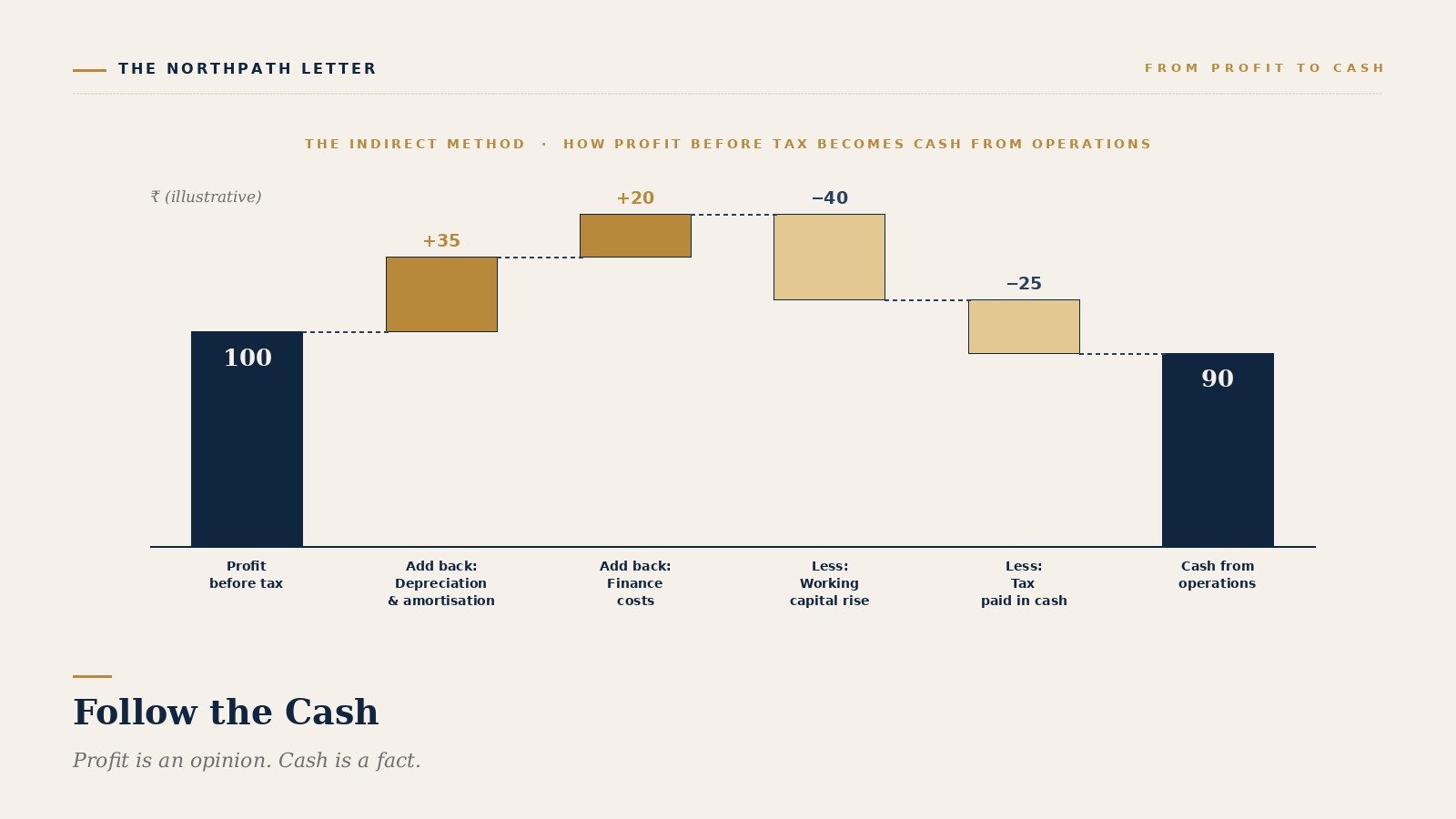
The indirect method is, in essence, a reconciliation. It takes the profit the company reported and rebuilds it into the cash the company actually generated, undoing every accounting entry that affected profit without moving money, and capturing every movement of money that the profit line ignored. Understanding this bridge is the single most valuable skill in reading the statement, because the bridge is where the company quietly tells you things the headline will not.
It begins with profit before tax. To that figure the statement adds back the non-cash charges — chiefly depreciation and amortisation, which reduced profit but cost no cash this year; impairments and write-downs; the expense booked for share-based payments; losses on asset sales. Because the Indian statement also strips finance costs out of operating profit (for reasons we come to shortly), interest expense is added back here too. The result so far is a sort of pre-cash operating profit.
Then comes the part that repays careful reading: the working-capital adjustments. Profit is earned when a sale is recognised, but the cash arrives only when the customer pays. If receivables have risen over the year, the company has booked sales it has not yet been paid for, and that increase is subtracted from profit to get to cash. If inventory has swelled, cash has been spent building stock that has not yet been sold, and that too is subtracted. If the company has stretched its own suppliers — letting payables rise — it has held on to cash it owes, and that increase is added. The working-capital block is, in miniature, the story of how hard the business has to work to turn a reported sale into spendable money. A company whose profits grow while its receivables and inventory grow faster is a company funding its own growth with cash it does not yet have, and the cash flow statement says so in plain arithmetic even when the chairman’s letter does not.
Finally, the tax actually paid in cash is deducted — note that this is cash tax, which can differ markedly from the tax charge in the profit-and-loss account once deferred tax and prior-year settlements are accounted for. What remains is the number that matters most in the whole report: cash generated from operations, the cash the core business produced this year by doing what it does.
The three rivers: operating, investing, financing
Below operating activities, the statement divides the rest of the company’s cash life into two more streams. Investing activities capture the money spent acquiring, and received disposing of, long-lived assets: purchases of property, plant and equipment and the movement in capital work-in-progress (this is where you find the year’s capital expenditure), acquisitions of businesses, and purchases and sales of investments. Financing activities capture the company’s dealings with the people who fund it: money raised from issuing shares or borrowing, and money returned to them through loan repayments, dividends and buybacks.
Read together, the signs of the three sections sketch a company’s life stage more honestly than any management commentary. A mature, healthy business typically shows operating cash positive and large, investing cash negative (it is reinvesting), and financing cash negative (it is returning capital and repaying debt) — cash is being generated by the business and distributed to its owners and lenders. A young, growing business often shows operating cash thin or negative, investing cash heavily negative, and financing cash positive — it is consuming cash and raising it from outside to do so, which is normal for a genuine growth company and alarming only when it never ends. The pattern to fear is operating cash negative, investing cash positive (the company is selling assets to survive), and financing cash positive (it is borrowing to stay alive) — a business funding its existence by liquidating itself and leaning on lenders. You can diagnose the stage and the health of a company from the three signs alone before you read a single footnote.
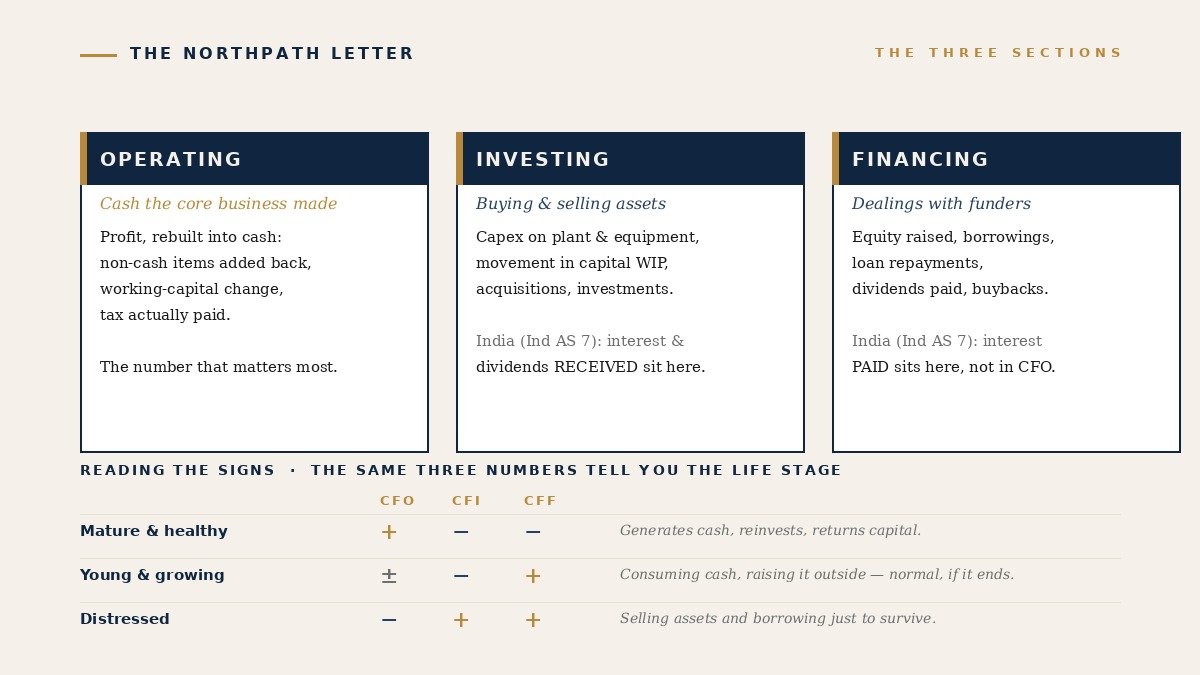
It is here that the Indian statement first departs from the template a global investor may carry in their head. Under IAS 7, the international standard, a non-financial company is given a choice about where to put interest and dividends: interest paid and interest and dividends received may be classified as operating cash flows, or interest paid may sit in financing and the receipts in investing. Ind AS 7 removes that choice. For a non-financial Indian company, interest paid must be classified under financing activities, and interest and dividends received must be classified under investing activities; dividends paid go to financing. (A financial institution — a bank or NBFC, for which interest is the business — classifies interest paid and interest and dividends received as operating, which is only sensible.) The Indian standard-setters took the view that interest is the cost of obtaining finance and so belongs with financing, and that investment income belongs with investing, and they closed the option that IAS 7 leaves open.
This is not a pedantic distinction. It changes the most-watched number in the statement.
The carve-out that flatters Indian operating cash flow
Consider a leveraged company — say one paying ₹500 crore a year in interest. Under US accounting rules (ASC 230), interest paid is an operating cash outflow: it sits inside, and reduces, cash from operations. Under Ind AS 7, that same ₹500 crore sits below operating activities, in the financing section. The mechanical consequence is that the Indian company’s reported operating cash flow is higher — by the full interest bill — than the identical company’s would be under American rules, purely because of where a line is placed. Two companies with the same economics, the same debt and the same cash, can report materially different “operating cash flow” depending only on the GAAP they file under.
For the analyst this carries a clear instruction: operating cash flow in an Indian report is a pre-interest number for non-financials, and it must be read as such. A heavily indebted Indian company can show robust operating cash flow while almost all of it is consumed servicing debt one section lower down. The discipline is to follow the cash all the way to the bottom — to look at operating cash flow after deducting the interest paid that the statement has tucked into financing — before forming any view of how much cash the business truly throws off for its owners. This is one of the carve-outs, in the same family as those covered in our earlier letter on Ind AS versus IFRS, that makes an Indian financial statement a genuinely different document rather than a translated one. The reader who imports an American mental model will systematically overstate the operating strength of a leveraged Indian balance sheet.
The quality test: cash versus the profit it is supposed to support
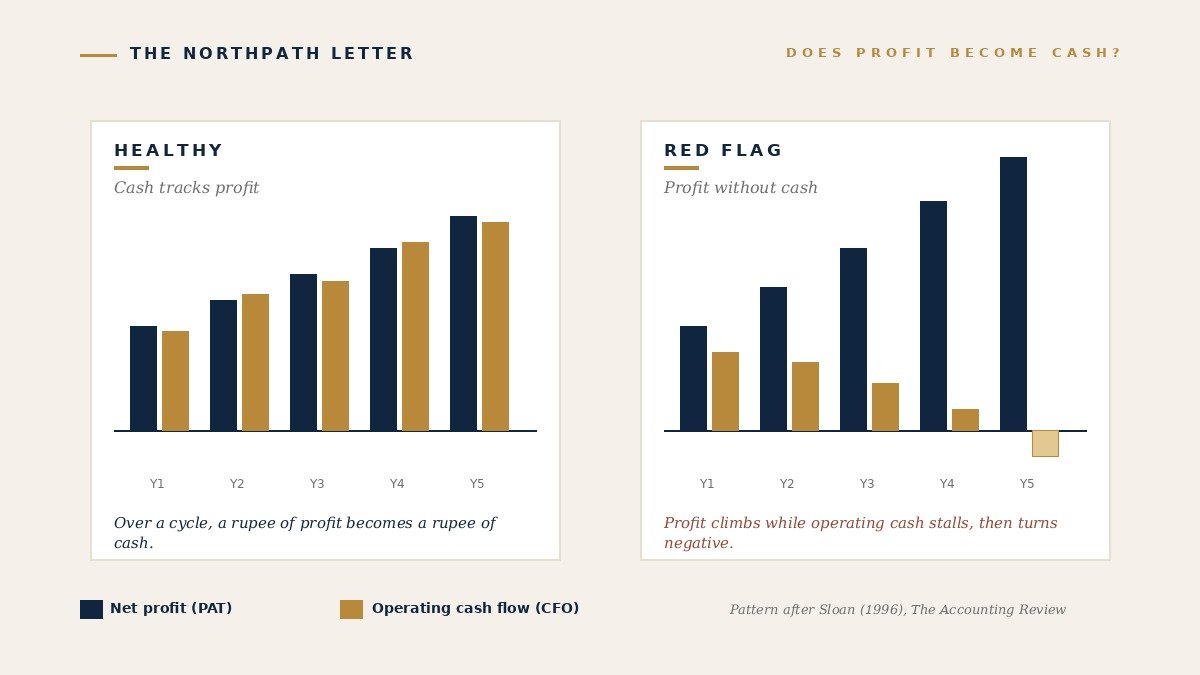
We come now to the reason the cash flow statement is worth more than the other two combined when judging the integrity of reported earnings. Profit is composed of two parts: the part backed by cash, and the part represented by accruals — sales booked but not collected, costs deferred, assets capitalised. The accountant Richard Sloan demonstrated, in a 1996 study in The Accounting Review that has been replicated across markets and decades, that these two parts do not behave alike. The cash component of earnings persists; the accrual component fades. Companies whose profits are heavily accrual-based tend to disappoint in the years that follow, and Sloan showed that the market, fixated on the headline profit, systematically failed to price the difference — so much so that a strategy of buying low-accrual companies and avoiding high-accrual ones earned, on his numbers, on the order of ten per cent a year. The market, in short, under-weights exactly the information the cash flow statement makes visible.
The practical version of Sloan’s finding is a single comparison any reader can make: line up cumulative cash from operations against cumulative net profit over five or more years. In a healthy business the two track each other; over a full cycle, a rupee of profit should turn into roughly a rupee of operating cash. When profit marches steadily upward while operating cash flow stays flat, lags further behind each year, or turns negative, you are looking at the classic fingerprint of earnings that exist mainly on paper — revenue recognised before it is collected, receivables and inventory swelling to fund the illusion, and a widening gap that must eventually close, almost always painfully.
India’s own cautionary archetype is Satyam Computer Services, whose 2009 collapse remains the country’s most instructive accounting fraud. The confession, when it came, was precisely a cash story: a balance sheet showing thousands of crores of bank deposits that did not exist, profits reported for years that were never matched by the cash they implied. An investor who had simply asked, year after year, where is the cash that all this profit should have become would have had reason for unease long before the letter of admission arrived. We raise Satyam as history and as method, not as a comment on any company trading today; the point is permanent and not about any one firm. The discipline it teaches is to treat a persistent divergence between profit and operating cash not as a curiosity to be explained away but as the single most important question to put to a set of accounts.
Free cash flow: the most important number that is not in the statement
There is one figure every owner cares about that the cash flow statement does not actually print: free cash flow, the cash left over after the business has paid to maintain and grow itself. You compute it yourself — operating cash flow, less the capital expenditure found in the investing section. It is the cash genuinely available to repay debt, pay dividends, buy back shares or build the war chest, and it is the truest measure of what a year of business was worth to its owners.
Reading capex out of the Indian statement takes a little care, because it is split between the purchase of property, plant and equipment and the change in capital work-in-progress — the half-built factory that has absorbed cash but not yet become a productive asset. A company in a heavy build-out phase can show healthy operating cash and negative free cash flow, which is not a defect but a choice; the question is whether the spending will earn a return. The subtler distinction, which the statement will not draw for you, is between maintenance capex — the spending merely to stand still — and growth capex. A business whose free cash flow is thin only because it is investing to grow is in a different position from one whose free cash flow is thin because it must spend heavily just to keep its existing assets running. The statement gives you the raw materials; the judgement is yours.
How to read one in ten minutes
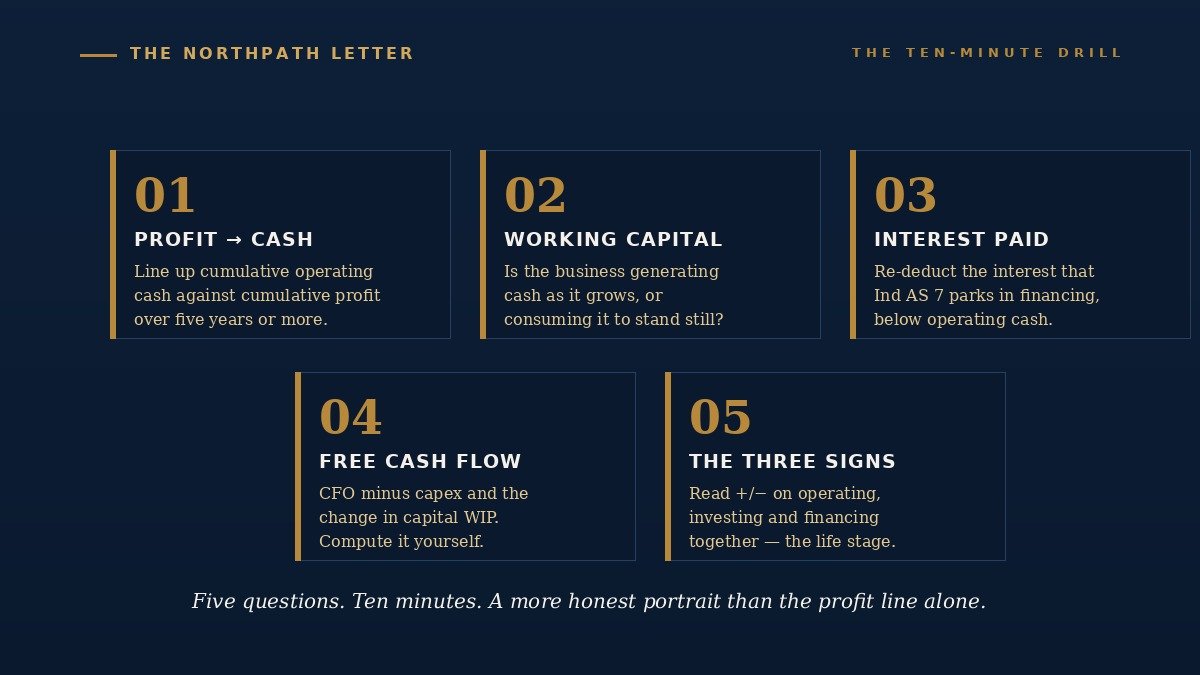
The drill, reduced to its essentials, runs as follows. First, find cash from operations and test it against profit — not for one year but cumulatively over five, asking whether profit is turning into cash. Second, read the working-capital block to see whether the business is generating cash or consuming it as it grows, and whether the movement is seasonal or a worsening trend. Third, deduct the interest paid that the Indian statement has placed in financing, so you judge operating strength net of the cost of the company’s debt rather than before it. Fourth, locate the capex in the investing section, combine it with the change in capital work-in-progress, and compute free cash flow for yourself. Fifth, read the three signs together — operating, investing, financing — to place the company in its life stage and confirm the story the other statements tell. Five questions, ten minutes, and a far more honest portrait than the profit line alone will ever give you.
The cash flow statement will not tell you what a company is worth. But it will tell you, more reliably than anything else in the report, whether the profits on which any valuation rests are real. Read the profit-and-loss account for the story; read the balance sheet for the structure; but follow the cash to find out whether the story is true.
The NorthPath Letter is written commentary and financial journalism for a global readership. It is educational and analytical in nature, is not investment research or advice, and is not a recommendation to buy or sell any security. Companies are named only for descriptive and historical illustration. The author holds no position in any security mentioned.