Between 2017 and 2023, one Indian company returned roughly sixty-six thousand crore rupees to its shareholders without paying an ordinary dividend cheque for any of it. Tata Consultancy Services ran five buybacks in those six years — sixteen thousand crore in 2017 at an eighteen per cent premium, again in 2018 and 2020, eighteen thousand crore in 2022, seventeen thousand crore in 2023 — each through a tender offer, each cancelling a slice of its own equity. To a reader trained on Western filings, this can look like a company quietly shrinking. It is the opposite. A buyback is a distribution of cash to owners, every bit as much as a dividend is; it simply travels by a different route, lands in a different line of the tax return, and — until very recently in India — was taxed in a different place entirely.
That last clause is why this letter exists. On 1 October 2024 India reset the taxation of buybacks, abolishing the company-level levy that had governed them for a decade and moving the entire burden onto the shareholder, as a deemed dividend. The change is technical, but its consequences ripple through how a repurchase is structured, why a board chooses it over a dividend, and what a reader should now look for. To understand the reset you have to understand the regime it replaced, and to understand that you have to start with what a buyback actually is under Indian company law.
What a buyback is, and what it is not
A share buyback is a company purchasing its own shares from existing holders and extinguishing them. The shares do not go into a treasury to be reissued later, as they can in the United States; under Indian law they are cancelled, and the company’s issued capital falls. That single fact — cancellation, not warehousing — is the structural heart of the Indian regime. A buyback is a reduction of capital, and the Companies Act treats it with the caution that any return of capital to owners deserves, because every rupee that leaves to a shareholder is a rupee no longer standing behind a creditor.
It helps to set the buyback beside its sibling, the dividend, because the two are the only orthodox ways a company hands cash back to its owners. A dividend is paid out of profits, pro-rata to every share, and leaves the share count untouched. A buyback is paid out of profits or capital reserves, takes shares out of circulation, and is usually offered at a premium to the market price. The dividend spreads a fixed pool thinly across all holders; the buyback concentrates a fixed pool on those who choose to sell, and mechanically lifts earnings per share for those who stay, because the same profit is now divided among fewer shares. The arithmetic of the second effect seduces boards and should never seduce a reader: a higher EPS produced by a smaller denominator is not the same achievement as a higher EPS produced by a larger numerator.
Indian law also keeps a firm line between a buyback under Section 68 and a formal reduction of capital under Section 66, which requires a tribunal’s sanction. The buyback route exists precisely so that a company can return surplus capital without the delay and scrutiny of a court-supervised reduction — and the price of that convenience is a cage of numerical limits, written into the statute, that a Section 66 reduction does not face.
The Section 68 cage
The governing provisions are Sections 68, 69 and 70 of the Companies Act, 2013, fleshed out by Rule 17 of the Companies (Share Capital and Debentures) Rules, 2014. Read them together and a company contemplating a buyback must pass through a series of quantitative gates, each designed to protect creditors and the company’s solvency.
The first gate is the source of funds. A buyback may be financed only out of free reserves, the securities premium account, or the proceeds of a fresh issue of shares — and never out of the proceeds of an earlier issue of the same kind of shares. The second gate is the aggregate ceiling: a buyback cannot exceed twenty-five per cent of the total of the company’s paid-up capital and free reserves. The third gate narrows the second for equity specifically — in any one financial year, the buyback of equity shares cannot exceed twenty-five per cent of paid-up equity capital. The fourth gate sets the approval threshold by size: a buyback of up to ten per cent of paid-up equity capital and free reserves can be authorised by a board resolution alone, but anything above that, up to the twenty-five per cent ceiling, requires a special resolution of shareholders. The fifth gate is the solvency test that does the real creditor-protection work: after the buyback, the company’s total secured and unsecured debt may not exceed twice its paid-up capital and free reserves — the 2:1 post-buyback debt-to-equity limit. The shares must be fully paid up; the buyback must be completed within one year of the authorising resolution; and having done one, a company must wait one year before launching another.
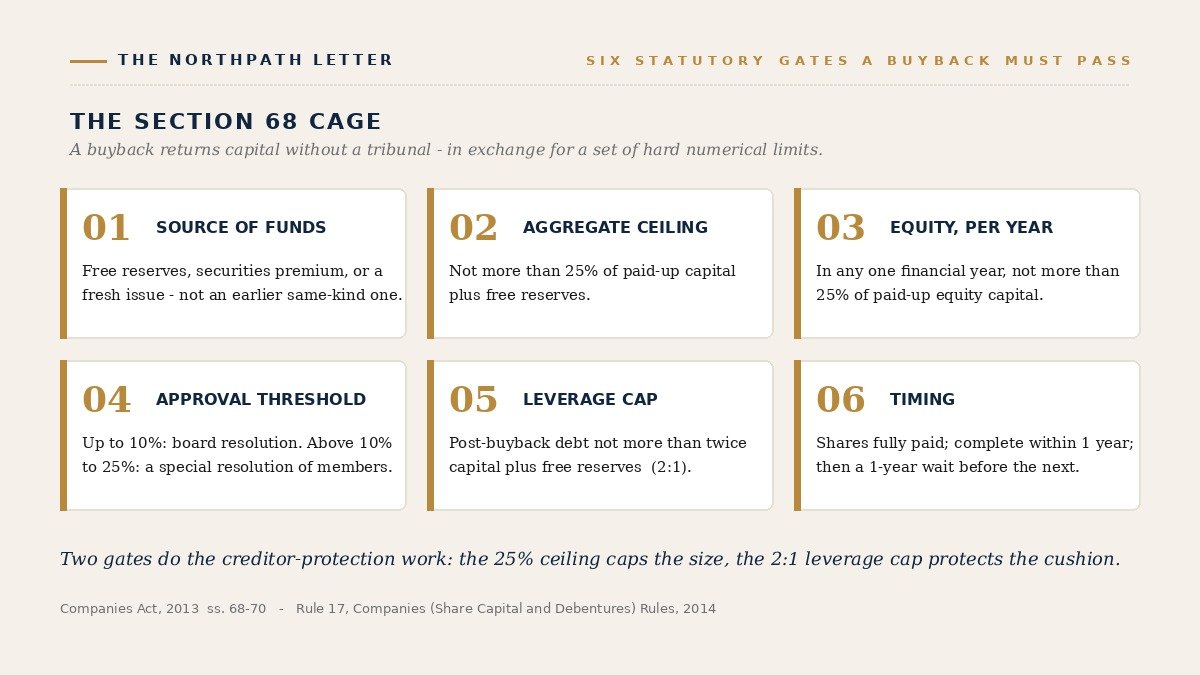
Two of these gates repay a reader’s particular attention. The post-buyback leverage cap is a quiet but powerful discipline: it stops a company from gutting its own equity cushion to flatter per-share metrics, and a buyback that pushes a balance sheet toward that 2:1 line is telling you the board is prioritising the share count over the safety margin. And the one-year cooling-off period is what makes serial buybacks — the TCS pattern — a deliberate, annual capital-allocation rhythm rather than an opportunistic raid; a company that buys back almost every year has effectively chosen the buyback as its primary distribution policy, and should be read as such.
Two doors: tender and open market
For a listed company, the Companies Act sets the outer limits but the Securities and Exchange Board of India sets the mechanics, through the SEBI (Buy-Back of Securities) Regulations, 2018. Historically there were two principal doors. The first is the tender offer: the company invites all shareholders to tender their shares at a fixed price, almost always a premium to the market, and buys them back proportionately, with a fifteen per cent reservation carved out for small shareholders so that the retail holder is not crowded out by institutions. The tender route is proportionate, transparent and pre-priced — every shareholder is offered the same exit on the same terms, which is exactly why it is the route the TCS buybacks used.
The second door was the open market purchase through the stock exchange: the company simply buys its own shares in the market over a period, at prevailing prices, up to a stated maximum. This route is cheaper and more flexible for the company, but it has a structural unfairness — only the shareholders who happen to sell during the buyback window benefit from the company’s buying pressure, while the rest get nothing, and the company can quietly support its own price. SEBI decided that unfairness was no longer worth tolerating, and legislated the open-market-through-exchange route out of existence on a glide path: the maximum permissible size was cut from fifteen per cent of paid-up capital and free reserves until March 2023, to ten per cent from April 2023, to five per cent from April 2024, and to zero from 1 April 2025. As of that date the open-market-through-exchange route is closed, and the tender offer is, in practice, the route that remains.
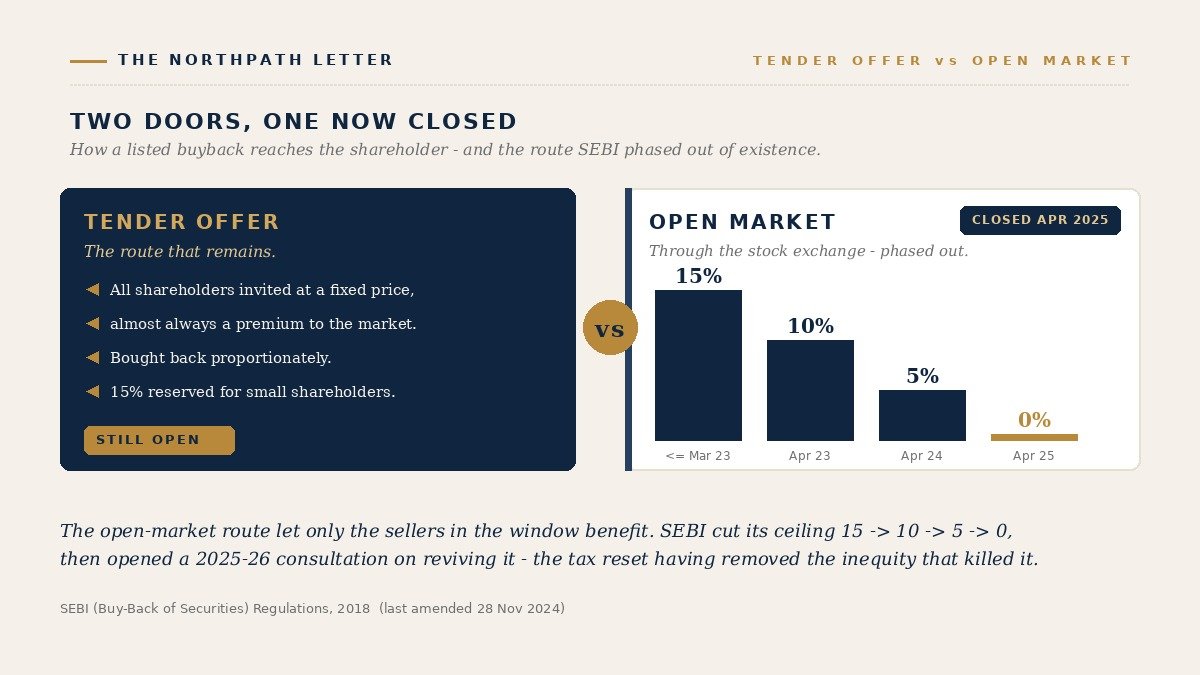
There is a coda worth recording, because it shows how tightly the plumbing and the tax interact. One of SEBI’s stated reasons for killing the open-market route was a tax inequity: under the old company-level buyback tax, shareholders who exited paid nothing while those who stayed bore a diluted benefit, and the open-market route sharpened that unfairness. With the 2024 tax reset shifting the burden onto the exiting shareholder, that particular inequity dissolves — and SEBI has since floated a consultation on reintroducing the open-market route. The regulator removed a door because of a tax distortion; once the distortion was gone, it began considering whether to open the door again. You cannot read the buyback rules without reading the tax that sits underneath them.
The tax arc
For most of the last fifteen years, the entire commercial logic of the Indian buyback was a tax logic, and it ran through three distinct eras.
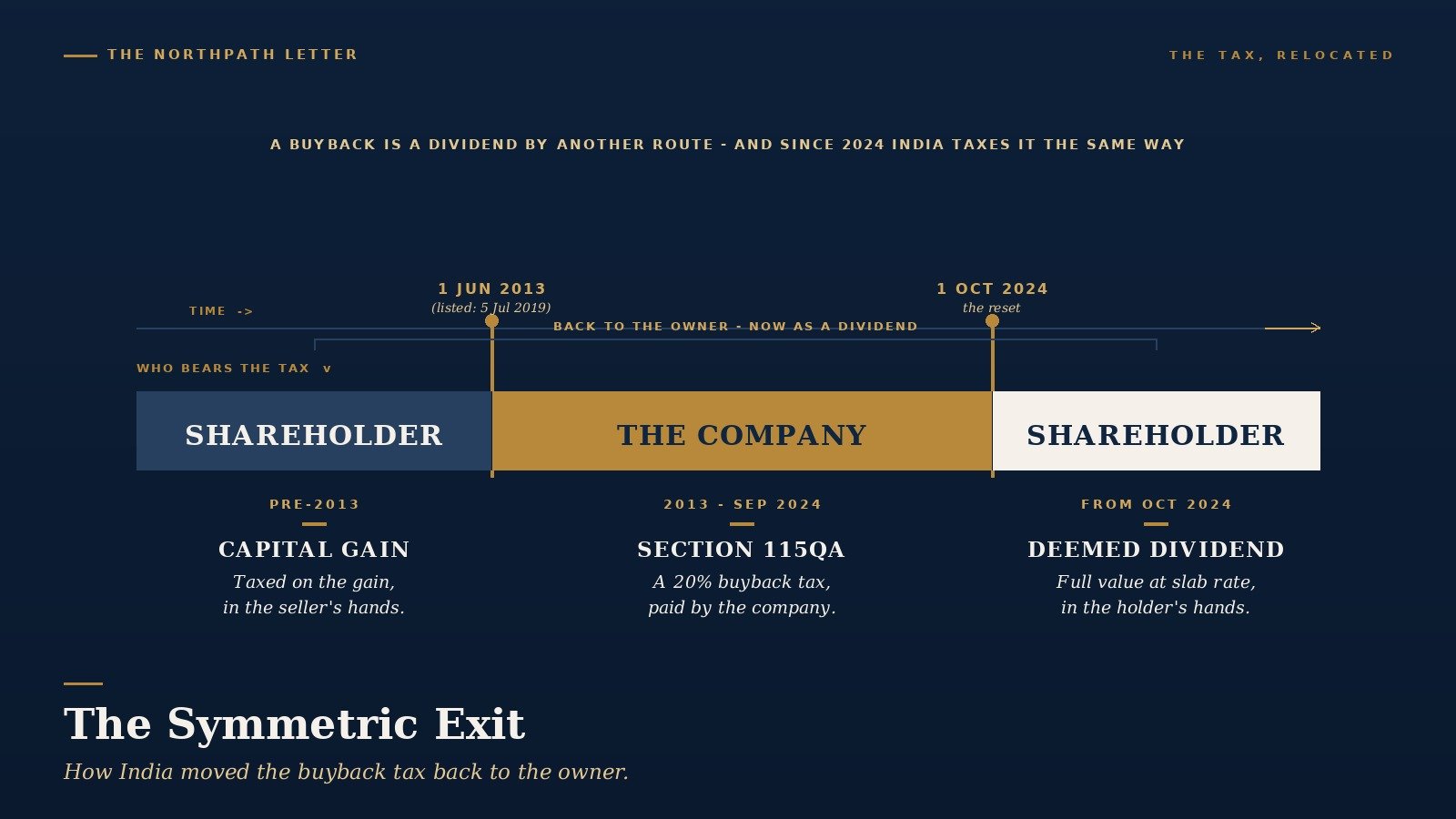
In the first era, before June 2013, a buyback was taxed as a capital gain in the hands of the selling shareholder — the difference between what they received and what they had paid. This created an arbitrage that was too tempting to last. A dividend, in those days, attracted dividend distribution tax; a buyback, taxed as a capital gain — often long-term, often at a concessional rate or, for listed shares, exempt — could return the same cash far more efficiently. Promoters and companies noticed, and buybacks began to substitute for dividends not because the capital structure demanded it but because the tax code rewarded it.
The second era began on 1 June 2013, when the Finance Act, 2013 inserted Section 115QA into the Income-tax Act. This flipped the incidence: instead of taxing the shareholder, it taxed the company, at twenty per cent on the “distributed income” of the buyback — broadly, the consideration paid out minus the amount the company had originally received when it issued those shares. With surcharge and cess the effective rate reached roughly 23.3 per cent, and the shareholder’s receipt was made exempt under Section 10(34A). Crucially, Section 115QA at first applied only to unlisted companies; listed companies could still run the old capital-gains arbitrage. That gap closed on 5 July 2019, when the Finance (No. 2) Act, 2019 extended Section 115QA to listed companies too, ending the loophole. From mid-2019, every Indian buyback, listed or unlisted, carried a flat company-level tax — paid before the cash ever reached a shareholder, and invisible on the shareholder’s own return.
The third era is the one we now live in. The Finance (No. 2) Act, 2024 abolished Section 115QA for any buyback occurring on or after 1 October 2024 and moved the tax back onto the shareholder — but not as a capital gain this time. Under the amended Section 2(22)(f), the entire consideration a shareholder receives in a buyback is now deemed to be a dividend, taxable in their hands at their applicable slab rate as income from other sources, with the company deducting tax at source at ten per cent for resident holders under Section 194. The shareholder’s cost of acquisition does not reduce that dividend; instead, by the proviso to Section 46A, the consideration for capital-gains purposes is treated as nil, so the cost the shareholder paid for those shares crystallises as a capital loss that can be set off against other capital gains and carried forward for up to eight years. The economic result is unforgiving for a high-bracket holder: the full buyback price is taxed as ordinary income, and the relief for the price they paid arrives only as a capital loss they must find gains to absorb.
Step back and the arc has a clean symmetry. In 2020, the Finance Act abolished dividend distribution tax and made ordinary dividends taxable in the shareholder’s hands at slab rates. Four years later, the buyback was brought into exactly the same treatment. India spent a decade taxing dividends and buybacks in two different places by two different mechanisms, which is precisely what created the arbitrage; it has now taxed them the same way, in the same hands, at the same rates. The buyback has stopped being a tax-efficient dividend and become, for the taxman, simply a dividend.
Dividend or buyback?
If the tax arbitrage is gone, why would a board still choose a buyback? The honest answer, after 1 October 2024, is that the reasons left are the real ones — the corporate-finance reasons that survive when the tax distortion is stripped away — and that is exactly why the reset is clarifying for a reader.
The first surviving reason is flexibility. A dividend, once raised, is sticky: cut it and the market punishes you, so boards treat the regular dividend as a near-permanent commitment and are reluctant to raise it on cash they may not earn again. A buyback carries no such expectation. It is a one-time act, announced and completed, with no implied promise to repeat — which makes it the natural vehicle for returning windfall or surplus cash that the board does not want to enshrine as a recurring payout. The second reason is signalling. A board that buys back its own shares at a premium is making a public statement that it considers those shares undervalued, and a tender offer priced well above the market is a more emphatic signal than a routine dividend. The reader’s job is to test the signal against the price: a buyback launched when the shares are demonstrably cheap returns capital and concentrates value for continuing owners; a buyback launched at a rich valuation merely shrinks the share count at a poor price, and is often really about defending an EPS target or absorbing the dilution from generous employee stock grants.
That last point — buybacks as a sponge for stock-based compensation — is worth holding, because it is the most common way a buyback destroys rather than creates value, and the American market offers the cleaner laboratory. The United States legitimised open-market repurchases through the SEC’s Rule 10b-18 safe harbour in 1982, and in the four decades since, buybacks have grown into the dominant form of US shareholder return, frequently exceeding dividends in aggregate. They grew large enough that in 2022 Washington imposed a one per cent excise tax on net repurchases by public corporations under the Inflation Reduction Act, effective from January 2023 — a deliberately small levy, but a signal that buybacks had become fiscally and politically conspicuous. The Indian and American systems now rhyme in intent if not in rate: both have decided that a buyback is a distribution and should bear a distribution’s tax.
The deeper truth underneath all of this is the one Modigliani and Miller proved in 1961 and that every practitioner relearns the hard way: in a frictionless world, the form of a cash return — dividend or buyback — does not change shareholder wealth, only its packaging. The frictions are the whole game, and the largest friction was always tax. With India having now equalised the tax on the two routes, the choice between dividend and buyback finally rests where it should: on flexibility, on signalling, and on whether the shares are cheap enough that buying them back is a genuine act of value concentration rather than financial cosmetics.
How to read one
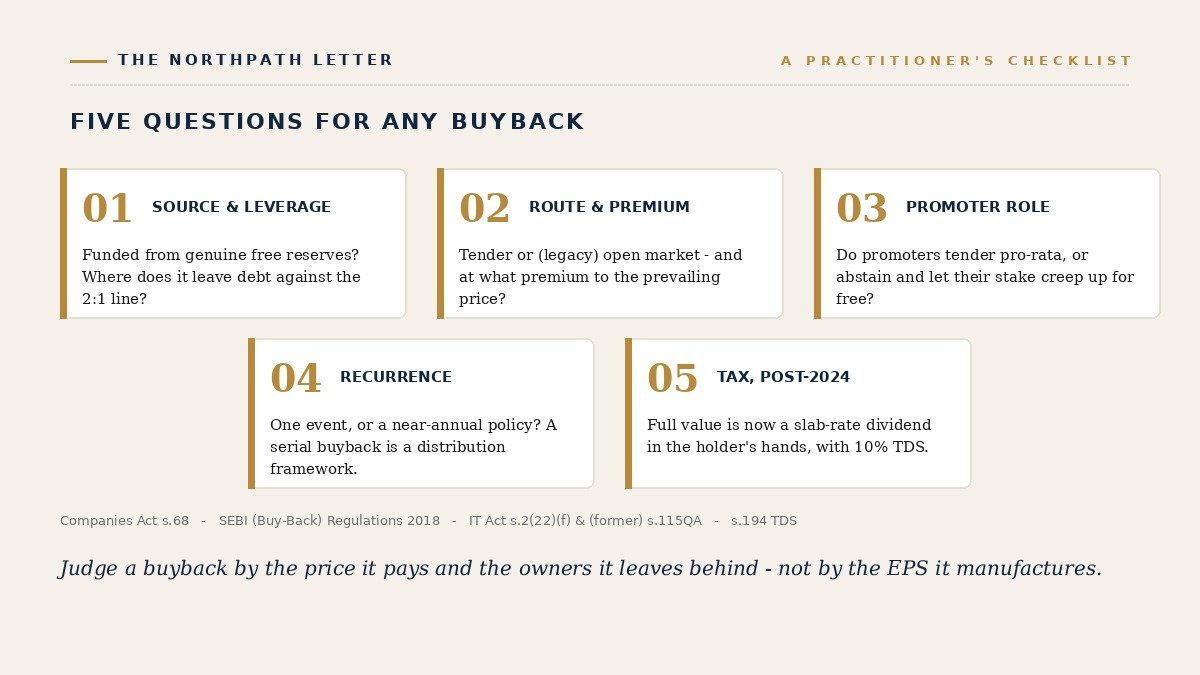
A buyback announcement, like the contingent-liability note, rewards a short and unglamorous routine. The first question is the source and the leverage: is the buyback funded from genuine free reserves, and where does it leave the post-buyback debt-to-equity ratio relative to the statutory 2:1 line? A buyback that consumes the company’s balance-sheet cushion is buying EPS with safety margin. The second question is the route and the price: tender offer or, in legacy filings, open market — and at what premium to the prevailing price? The premium tells you whether the board is paying up out of conviction that the stock is cheap, or simply distributing cash regardless of value. The third question is whether the promoter participates. In a tender offer, if the promoter group tenders pro-rata, the buyback is a neutral return of capital; if the promoters abstain while the public sells, their proportional ownership rises without their spending a rupee — a creeping consolidation of control financed by the company’s own cash, which is legal but should be read as exactly what it is.
The fourth question is recurrence. One buyback is an event; a buyback almost every year is a policy, and should be evaluated as the company’s chosen distribution framework, complete with the one-year cooling-off rhythm the statute imposes. The fifth question is the post-2024 tax incidence on the holder you care about: because the entire consideration is now a slab-rate dividend with a ten per cent withholding, a buyback that once looked tax-efficient may now be less attractive to a taxable resident than an equivalent dividend would have been a year earlier — and the board’s continued use of buybacks after the reset is itself information about its motives. A company that keeps buying back its shares now that the tax advantage is gone is telling you the decision was never really about tax.
A buyback is a dividend that chooses its recipients and shrinks the register on the way out. India spent a decade taxing the two differently; now it taxes them the same — and what remains is the only question that ever mattered: is the company returning cash at a price that rewards the owners who stay?
None of this requires a view on whether any particular company should be bought or sold. It requires only that the reader treat a buyback as what it is — a return of capital governed by a statutory cage, executed through a regulated door, and, since October 2024, taxed in the shareholder’s own hands exactly as a dividend is. Read it that way and the repurchase stops being a mysterious act of corporate self-purchase and becomes what it always was: a distribution policy, legible in the same filings as everything else.
The one line to carry away: a buyback is a dividend in disguise, and in 2024 India finally took off the disguise — so read every repurchase as a return of capital, and judge it by the price it pays and the owners it leaves behind.
Manish Goel, FCA — Founder, NorthPath Advisory OÜ, Tallinn.
Important. All content on this site is journalism and education for a general audience. Nothing here constitutes investment advice or a recommendation in respect of any specific financial instrument, nor an offer or solicitation to buy or sell any security. Companies are named only as historical or descriptive illustration, and the author holds no position in any security mentioned. Readers should consult an authorised financial adviser regulated in their own jurisdiction before making any investment decision.