Consider two property developers, identical in every commercial respect. Both sell the same flats in the same city at the same prices; both collect money from buyers in instalments across a four-year build; both hand over the keys in the fourth year. The only difference is the financial year in which you happen to read their accounts. Read one for the year to March 2018 and it reports a quarter of each project’s profit every year, smoothly, as the towers rise. Read the other a year later and it reports almost nothing until the flats are handed over, and then books the lot in a single, lumpy year. Nothing about the business changed. The flats are the same, the cash is the same, the buyers are the same. What changed is that India’s accountants stopped letting a company call a sale a sale until the customer actually controlled what they had bought.
The standard, precisely
That change was Ind AS 115, Revenue from Contracts with Customers, notified by the Ministry of Corporate Affairs through the Companies (Indian Accounting Standards) Amendment Rules, 2018, on 28 March 2018, and effective for accounting periods beginning on or after 1 April 2018. In a single step it replaced the two standards that had governed the top line for a generation — Ind AS 18, Revenue, and Ind AS 11, Construction Contracts — together with their associated appendices, and it withdrew, for companies on Ind AS, the Institute of Chartered Accountants of India’s 2016 Guidance Note on Accounting for Real Estate Transactions. One number on the income statement, the most-watched number of all, was placed under entirely new law overnight.
The lineage matters. Ind AS 115 is India’s adoption of IFRS 15, the global revenue standard issued by the International Accounting Standards Board, which the IASB developed jointly with the United States’ Financial Accounting Standards Board. The American twin is ASC 606. For the first time in the history of financial reporting, the rule that decides when revenue exists is, to a first approximation, the same rule in Mumbai, in London and in New York. An analyst who learns the Indian standard has, almost for free, learned the one a US 10-K and a UK annual report now use. That is a rare gift, and this letter is in part about how to collect it.
The old world rested on a soft idea: revenue was earned when the “risks and rewards” of ownership passed to the buyer. It was a test you could feel your way around. Ind AS 115 replaced the feeling with a single hard principle — that an entity recognises revenue to depict the transfer of promised goods or services to a customer in the amount the entity expects to be entitled to — and, crucially, it changed the trigger from risks and rewards to control. Revenue is earned when the customer obtains control of the promised good or service. Everything that follows is machinery for finding the moment control passes.
The five steps
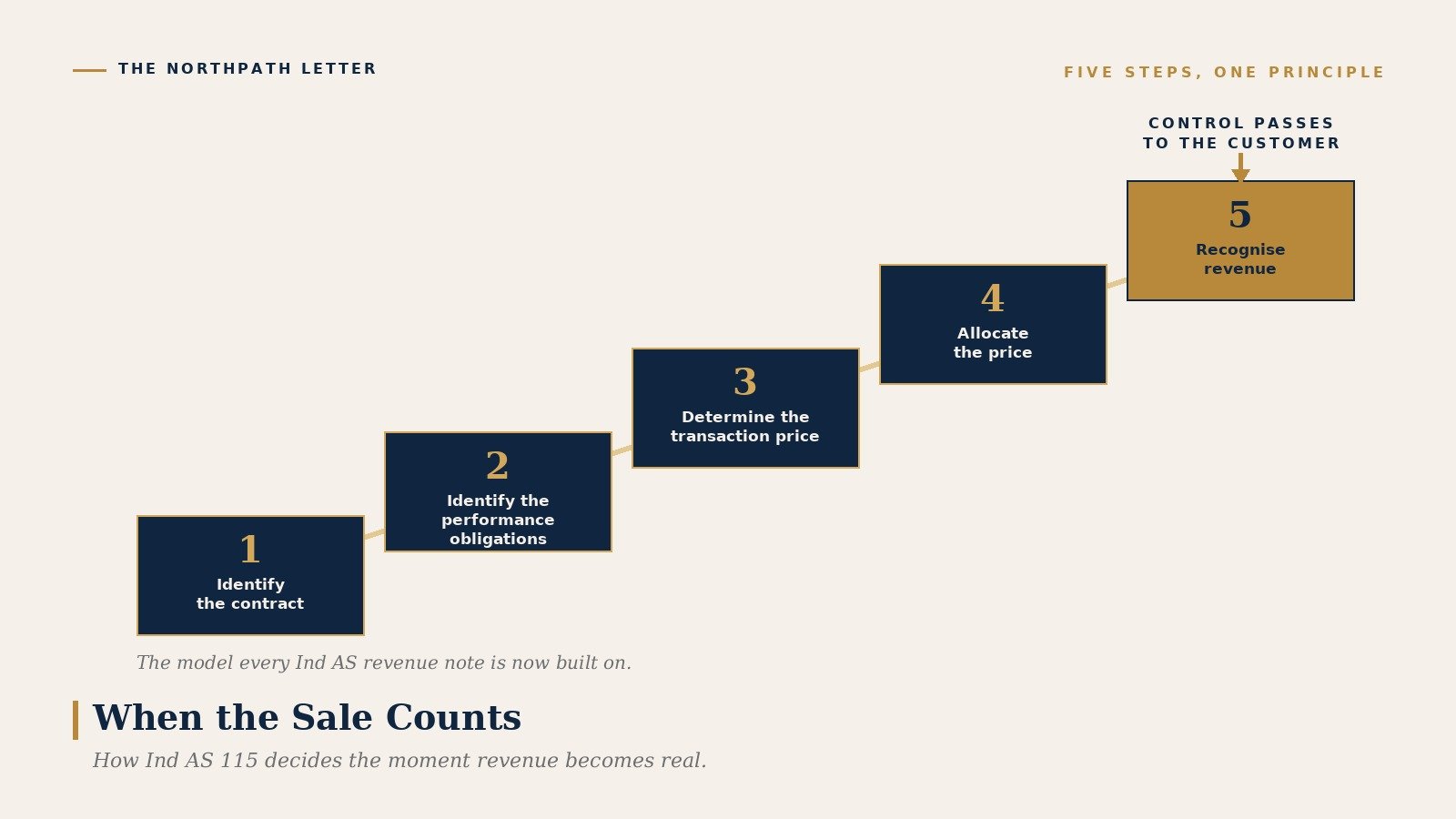
The machinery is a five-step model, and it is worth committing to memory because every revenue note in every Ind AS annual report is now built on it, whether or not the company spells it out.
Step one: identify the contract. There must be an agreement — written, oral or implied by custom — that creates enforceable rights and obligations, where collection of the consideration is probable. No enforceable contract, no revenue.
Step two: identify the performance obligations. A contract may promise several distinct things. A telecom plan bundles a handset with months of service; a software deal bundles a licence with installation and support; an appliance comes with a warranty. Each distinct promise is a separate performance obligation, and the standard forces the company to unbundle them rather than treat the contract as one undifferentiated lump.
Step three: determine the transaction price. This is the consideration the entity expects to receive — and it is rarely the sticker price. Discounts, rebates, volume incentives, penalties, rights of return and performance bonuses all make the price variable, and the standard requires the company to estimate that variable consideration and then constrain it: include it only to the extent it is highly probable that a significant reversal will not occur. Optimism is rationed.
Step four: allocate the transaction price. The single price is spread across the separate performance obligations from step two, in proportion to their stand-alone selling prices. The handset gets its share; the months of service get theirs.
Step five: recognise revenue when (or as) each performance obligation is satisfied — that is, when control of that promised good or service passes to the customer. This is where the timing is decided, and it is the step that re-wrote India’s accounts.
Over time, or at a single point in time
Step five contains the judgement that matters most, and it turns on one question, asked obligation by obligation: is the performance obligation satisfied gradually, over a period of time, or all at once, at a single moment?
Paragraph 35 of the standard decides this question on a fork. A performance obligation is satisfied over time — and revenue is therefore spread across the work, typically by a percentage-of-completion measure — if any one of three criteria is met: the customer simultaneously receives and consumes the benefits as the entity performs (a cleaning contract, a subscription); or the entity’s work creates or enhances an asset the customer already controls (building on the customer’s own land); or the entity’s work creates an asset with no alternative use to the entity and the entity has an enforceable right to payment for performance completed to date. If none of the three is met, the obligation is satisfied at a single point in time, and revenue waits until that moment arrives — usually delivery, or the transfer of legal title and possession.
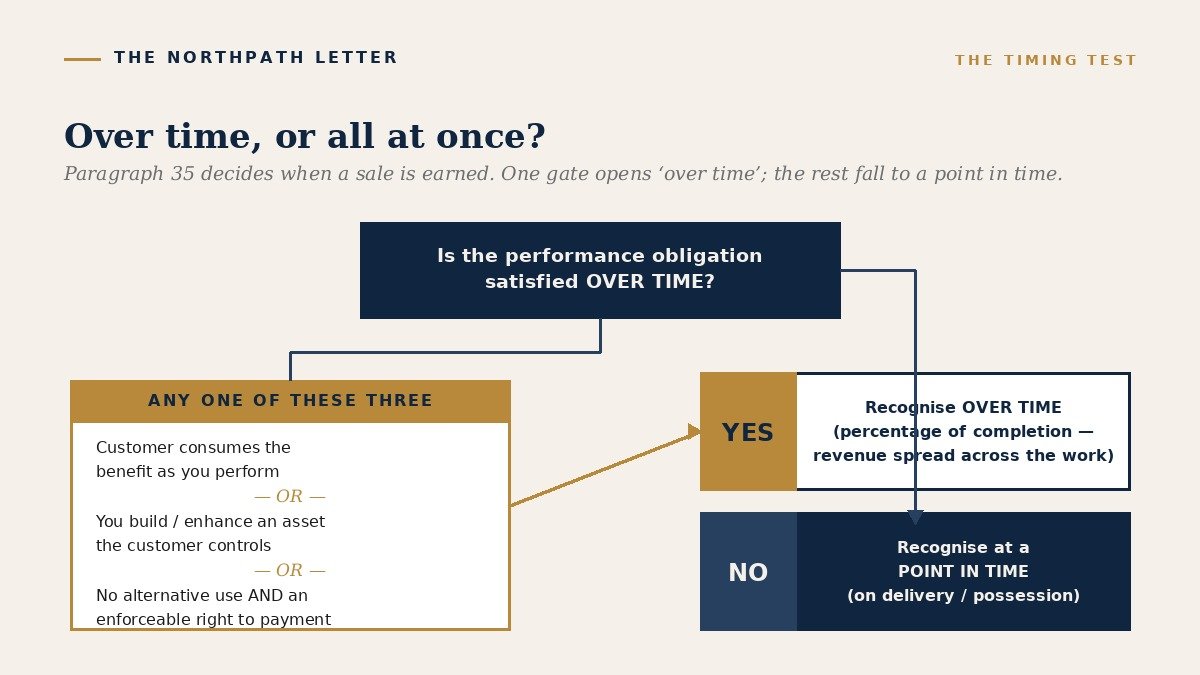
That fork — three narrow gates to “over time,” and the cliff of “point in time” for everyone who fails to pass through one of them — is the whole drama of Ind AS 115 compressed into a single paragraph.
The real-estate earthquake
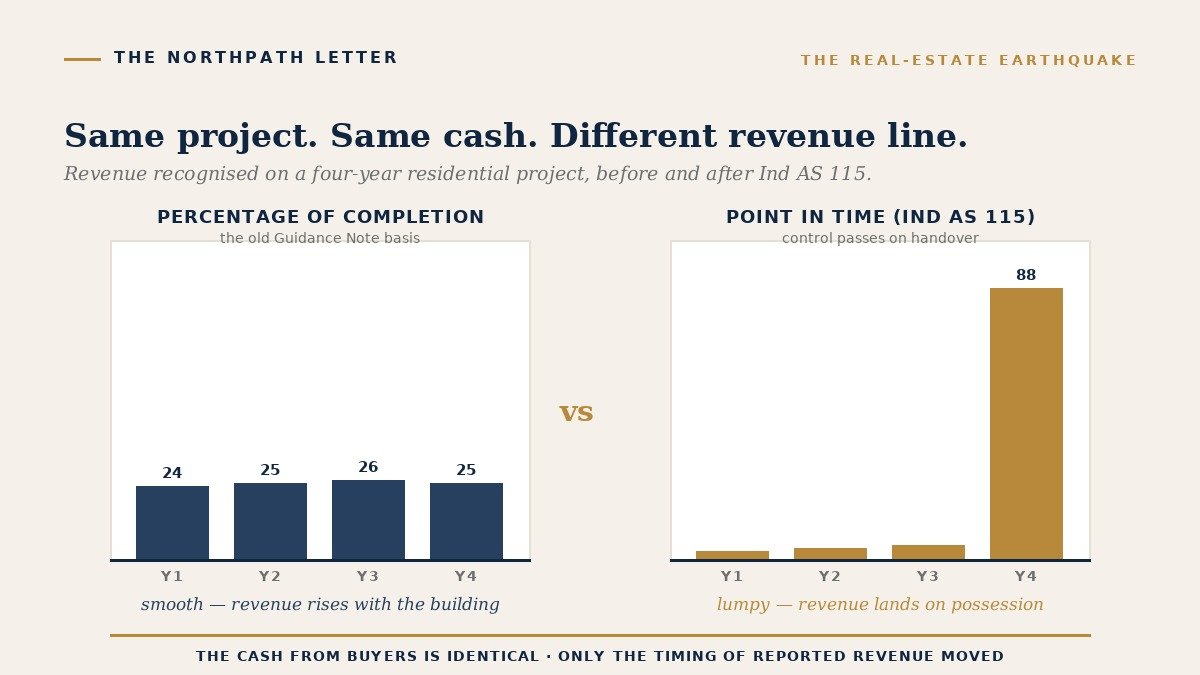
Nowhere did the fork bite harder than in real estate. Under the old Guidance Note, Indian developers used the percentage-of-completion method almost universally: as a project crossed construction and collection thresholds, a proportionate slice of revenue and profit was booked each year, so a four-year project produced four years of reasonably smooth earnings. It flattered the income statement, it smoothed the cycle, and it let a developer show growing revenue while a tower was still a hole in the ground.
Ind AS 115 forced every developer to re-ask the paragraph-35 question, and for the typical Indian residential sale-agreement the answer came back “point in time.” The reasoning is technical but worth following: a standard apartment, mid-build, arguably has an alternative use to the developer (it can be sold to another buyer), and the developer often lacks a genuinely enforceable right to payment for work done to date if the buyer walks away — so the over-time gates do not open, and control of the flat is judged to pass only on possession. Revenue that used to be spread across the build now waits, and lands in a lump in the year of handover. The Institute of Chartered Accountants of India has clarified that percentage-of-completion is not dead — where a contract genuinely meets the over-time criteria, it survives — so the outcome is a matter of judgement, project by project and clause by clause. But the dominant effect across the listed sector was a shift from smooth, build-along revenue to lumpy, handover-driven revenue.
The balance sheet tells the other half of the story. Money collected from buyers ahead of handover can no longer sit in revenue; it sits as a liability — an advance from customers, in the language of the standard a contract liability — and unwinds into revenue only when the flats are delivered. On adoption, developers’ balance sheets swelled with these advances, and their reported top lines, for a year or two, could look strangely thin against the cash pouring in. A reader who did not understand the standard would have mistaken an accounting reclassification for a collapse in trading.
Beyond property: where else the standard bit
Real estate was the loudest case, but it was not the only one, and the other sectors illustrate the model’s other edges.
In telecommunications, the bundling problem of step two came alive. A two-year plan that throws in a “free” handset is, under Ind AS 115, two performance obligations — the device and the service — and the single monthly price must be allocated across both at their stand-alone selling prices. The consequence is that some revenue is pulled forward to the moment the handset is handed over, and a contract asset appears for the device value not yet billed. The headline subscriber revenue did not change; its shape did.
In software and IT services — the part of corporate India most exposed to this standard — the questions multiply. Is a software licence distinct from the implementation and support sold alongside it, or so entangled that the whole is a single obligation recognised over the contract? Is a fixed-price development project satisfied over time, because the code being written has no alternative use to the vendor and the contract gives an enforceable right to payment for work done — in which case revenue accrues as the work progresses, and unbilled revenue, a contract asset, builds between billing milestones? For the large Indian IT exporters, the answer is frequently yes, which is why their balance sheets carry substantial unbilled balances and why the movement in those balances is a genuine operating signal rather than an accounting curiosity.
The sharpest re-rating of reported size, though, came from the principal-versus-agent question on platforms and in e-commerce. Step two asks whether the entity controls a good or service before it is transferred to the customer. If it does, it is a principal and reports the gross amount as revenue; if it merely arranges for another party to provide the good, it is an agent and reports only its net commission. Under Ind AS 115’s control-based test, a number of Indian marketplaces and aggregators that had reported the full gross value of goods transacted on their platforms were judged to be agents, and their reported revenue fell sharply to the commission they actually kept — with no change whatever in the economics or the cash. An investor comparing a platform’s revenue across the 2018 break, or against a peer on a different basis, who did not understand this distinction would have drawn precisely the wrong conclusion about scale.
And across pharmaceuticals and consumer goods, the variable-consideration machinery of step three did the quiet work: chargebacks, shelf-stock adjustments, rebates, trade incentives and rights of return all have to be estimated and constrained, so that the revenue booked is the amount the company genuinely expects to keep, not the amount it first invoices.
New words on the balance sheet
Ind AS 115 did not only move revenue in time; it gave the balance sheet two new residents that repay close attention. A contract asset is the entity’s right to consideration in exchange for goods or services it has already transferred, when that right is conditional on something other than the mere passage of time — most familiarly, unbilled revenue, work done and earned but not yet invoiced. A contract liability is its mirror: consideration received, or unconditionally due, before the entity has done the work — the advance, the deposit, the prepayment. Distinguishing a contract asset from a plain trade receivable, and a contract liability from deferred income of the old kind, is now part of reading any Ind AS balance sheet, and the movement in these balances from one year to the next is often a more honest guide to a business’s trajectory than the revenue line itself.
The disclosures that reward the careful reader
Here Ind AS 115 is unusually generous, and most readers leave the gift unopened. The standard requires a disaggregation of revenue into categories that show how the nature, amount, timing and uncertainty of revenue differ — by geography, by product line, by customer type, and, tellingly, by timing: how much was recognised over time versus at a point in time. That single split, buried in the notes, tells you whether you are looking at a smooth subscription business or a lumpy delivery business, regardless of how the headline number behaves.
It requires, too, a reconciliation of contract balances — the opening and closing contract assets and liabilities, and how much of last year’s contract liability turned into this year’s revenue. And it requires disclosure of the transaction price allocated to remaining performance obligations — in plainer words, the order book: revenue contracted but not yet recognised, and roughly when it is expected to arrive. For a construction, capital-goods, defence or large-contract IT business, this is among the most forward-looking numbers in the whole report, and it exists only because of this standard.
India and the wider world
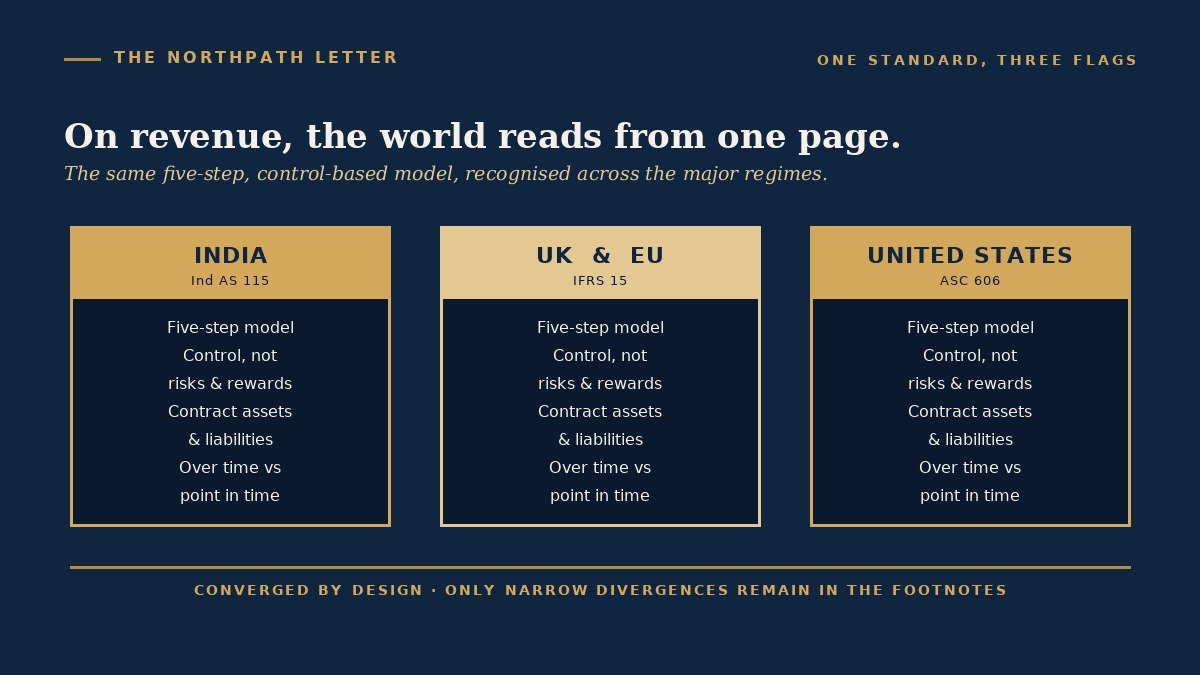
This is the comparison cross-border investors most often get wrong, usually by over-worrying about it. Because Ind AS 115 is built on IFRS 15, and because IFRS 15 and the United States’ ASC 606 came out of the same joint project, the revenue standard is now substantially the same across India, the United Kingdom and the European Union (all IFRS 15) and the United States (ASC 606). The five-step model, the control principle, the over-time-versus-point-in-time fork, the contract asset and contract liability — all of it carries across. An Indian software firm and an American one, recognising revenue on near-identical multi-element contracts, now do so under near-identical rules.
The divergences that remain are real but narrow, and an analyst should hold them lightly: the threshold for “probable” collection in step one is interpreted more loosely under US GAAP than under IFRS; the two regimes treat certain licences of intellectual property, shipping-and-handling activities and a handful of practical expedients slightly differently. These are matters for the footnotes of a footnote. The headline is the opposite of the lease story, where India’s single model and America’s dual model genuinely part ways: on revenue, for once, the world reads from one page.
One mechanical point completes the picture. Companies adopted Ind AS 115 on 1 April 2018 by one of two routes — full retrospective application, restating the comparative year as though the standard had always applied, or the modified retrospective method, leaving the prior year untouched and booking the entire cumulative effect of the change as a one-off adjustment to opening retained earnings on the transition date. Most chose the modified route, which is why, for many companies, the FY2018 and FY2019 revenue figures are not strictly comparable, and why the equity statement of that year contains a transition adjustment that is easy to miss and important to find.
How to read the revenue note now
A practitioner’s drill, in six moves. First, find the disaggregation table and read the over-time-versus-point-in-time split before you read the headline; it tells you what kind of revenue you are dealing with. Second, track the contract liability — advances from customers — year on year: a rising balance against flat revenue is often a leading indicator, not a warning. Third, distinguish unbilled revenue (a contract asset) from trade receivables, and ask why work is earned but not yet billed. Fourth, read the remaining-performance-obligations disclosure as the order book it is, and note how much is expected to convert within twelve months. Fifth, in any company adopting from FY2019, locate the transition adjustment to retained earnings and treat the pre- and post-adoption revenue lines as measured on different rulers. Sixth, for real estate and long-cycle construction, never compare a percentage-of-completion year to a handover-driven year without first reading which basis each used.
Revenue is the number every reader trusts and the number this standard made the hardest to read casually. The reward for reading it carefully is that, for the first time, the same care works in Mumbai, in London and in New York.
The one-line takeaway: Ind AS 115 stopped a company from booking a sale until the customer actually controls what they bought — so read the timing split in the revenue note, not just the top-line total, before you trust the growth.
Important. This letter is journalism and education for a general audience. Nothing in it constitutes investment advice or a recommendation in respect of any specific financial instrument, nor an offer or solicitation to buy or sell any security. Companies are named only as historical and descriptive illustration, and the author holds no position in any security mentioned. Readers should consult an authorised financial adviser regulated in their own jurisdiction before making any investment decision.