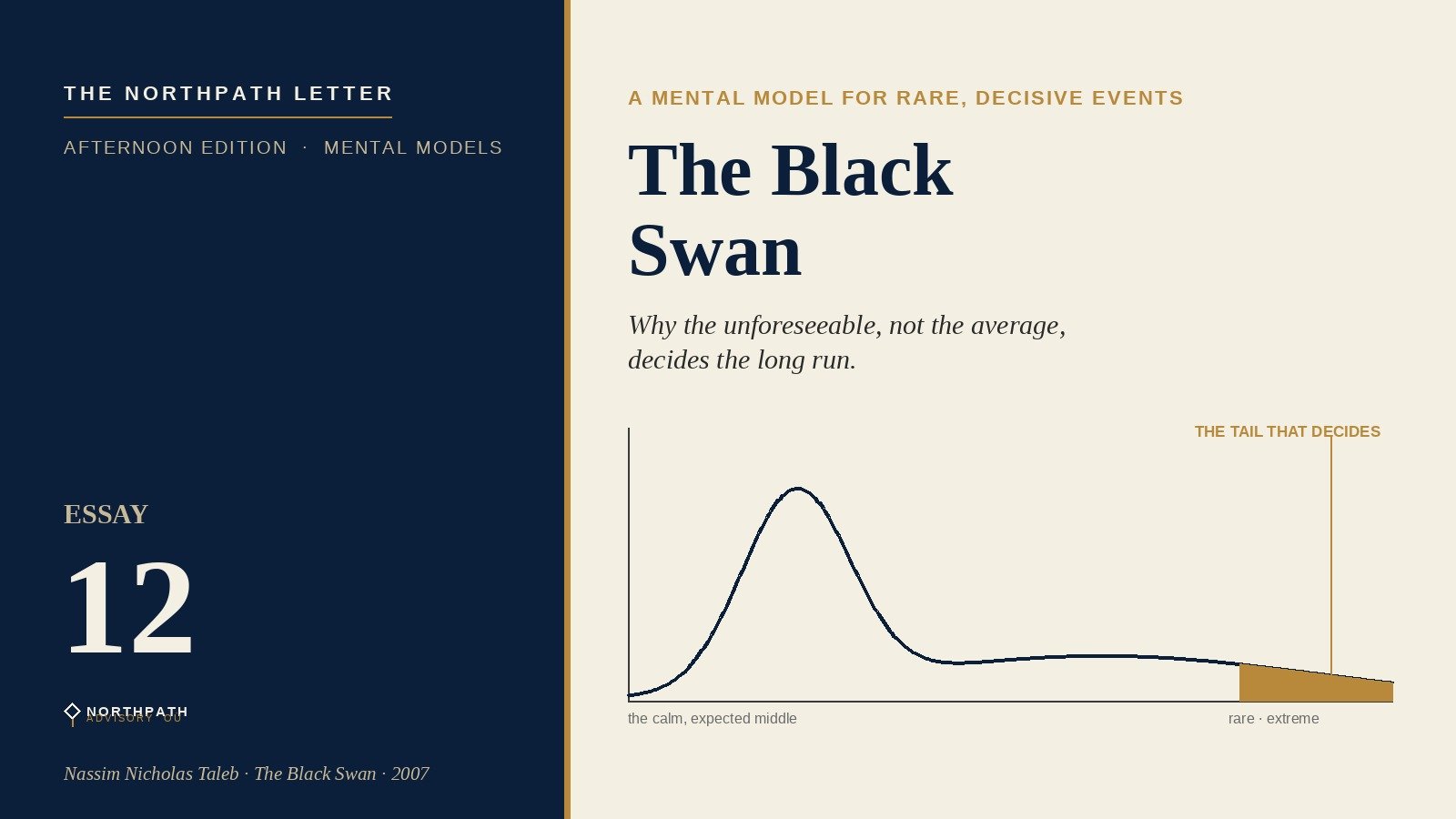
AFTERNOON EDITION — MENTAL MODELS. Before 1697, every swan a European had ever seen was white, and the word “swan” carried “white” as a silent premise. Then Dutch explorers reached the Swan River in Western Australia and found Cygnus atratus, black from beak to tail. A single observation overturned a belief that millennia of confirming sightings had hardened into certainty. Nassim Nicholas Taleb borrowed the bird as the emblem of his 2007 book and turned it into the most consequential risk model a long-term equity investor can hold: that the history which matters most is the history that has not happened yet, and that the rare, the unforeseen, and the seemingly impossible do more to shape outcomes than everything we can confidently forecast.
1. The model: a definition, its discovery, and its one-sentence form
Taleb defines a Black Swan by three attributes, and the discipline of the model lives entirely in holding all three at once. First, it is an outlier—it lies outside the realm of regular expectations, because nothing in the past can convincingly point to its possibility. Second, it carries an extreme impact. Third, and most insidiously, it is retrospectively, though not prospectively, predictable: after the fact, human nature manufactures an explanation that makes the event appear as though it could have been anticipated all along. Rarity, extreme impact, retrospective predictability—a thing is a Black Swan only when it has all three.
The idea arrives in The Black Swan: The Impact of the Highly Improbable (Random House, 17 April 2007), the centre of a body of work Taleb began with Fooled by Randomness (2001) and extended in Antifragile (2012). But the philosophical machinery is far older. The bird is a teaching device that the philosopher Karl Popper, and John Stuart Mill before him, used to dramatise the problem of induction—the logical scandal, first stated sharply by David Hume in A Treatise of Human Nature (1739), that no number of confirming observations can ever prove a universal claim, while a single disconfirming observation can demolish it. You may see a million white swans and conclude nothing certain; you need see only one black swan to know that “all swans are white” was false. Popper built his whole theory of science, in The Logic of Scientific Discovery (1959), on this asymmetry: knowledge advances not by accumulating confirmations but by surviving attempts at refutation.
The one-sentence form, then, is this: the events that determine the long run are precisely the ones your history could not have taught you to expect, so build for the swan you cannot see rather than the average you can.
2. The mechanism: why rare events dominate, and why we keep missing them
The model works because two separate engines reinforce one another—one in the world, one in the mind. The engine in the world is the shape of the distributions that govern markets. Taleb divides reality into two provinces. In Mediocristan, no single observation can meaningfully move the aggregate: add the tallest human alive to a sample of a thousand people and the average height barely twitches, because biology is bounded. In Extremistan, a single observation can dominate the total: add one billionaire to a sample of a thousand and the average wealth lurches, because wealth, book sales, pandemic deaths, and security returns are unbounded and scalable. Financial markets live in Extremistan. There, the comfortable bell curve—which assigns vanishing probability to large moves—systematically understates how often, and how violently, the tail arrives. The rare event is not a deviation from the system; in Extremistan it is the system, and the quiet years between are the deviations.
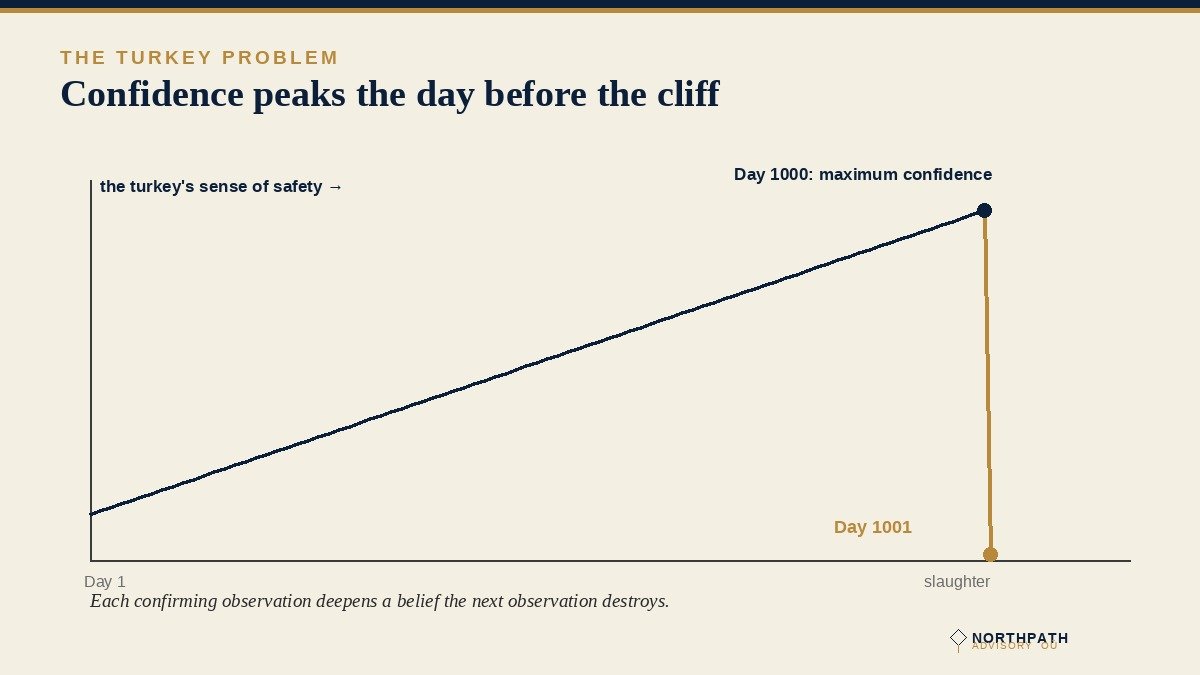
The engine in the mind is induction, running on a database that by construction excludes the event that matters. Taleb’s sharpest illustration—adapted from Bertrand Russell’s inductivist chicken in The Problems of Philosophy (1912)—is the turkey. A turkey is fed every day for a thousand days. Each feeding confirms, with mounting statistical confidence, the turkey’s theory that the farmer is a benevolent provider. The turkey’s sense of safety is at its mathematical maximum on the afternoon before Thanksgiving, the precise moment its risk is greatest. The feeding history did not merely fail to warn of slaughter; it actively manufactured confidence in the opposite. This is the deep trap for investors: the very track record that makes a strategy look safe—the long run of confirming returns—is the evidence that should worry us most, because it is generated by the same process that will eventually produce the reversal.
Two further cognitive faults complete the mechanism. Silent evidence: we study the survivors and the events that occurred, never the ones that were silenced, so the record we reason from is curated by chance into a misleadingly smooth story. And the ludic fallacy—the mistake of believing that the tame, known probabilities of the casino, where the odds are written on the table, resemble the wild uncertainty of real life, where the rules themselves can change without notice.
Binding all of this together is the narrative fallacy: our compulsion to weave events into causal stories. A story is compression, and compression discards exactly the noise from which the next surprise will emerge. The smoother and more satisfying the narrative we tell about why the past unfolded as it did, the more it convinces us the future is equally legible—and the less prepared we are for the discontinuity that no tidy account contained. The third attribute of the Black Swan, retrospective predictability, is the narrative fallacy at work after the fact: the mind cannot tolerate an inexplicable catastrophe, so it back-fills a cause, declares the event “obvious in hindsight,” and emerges more confident—and therefore more exposed—than before.
3. The empirical record
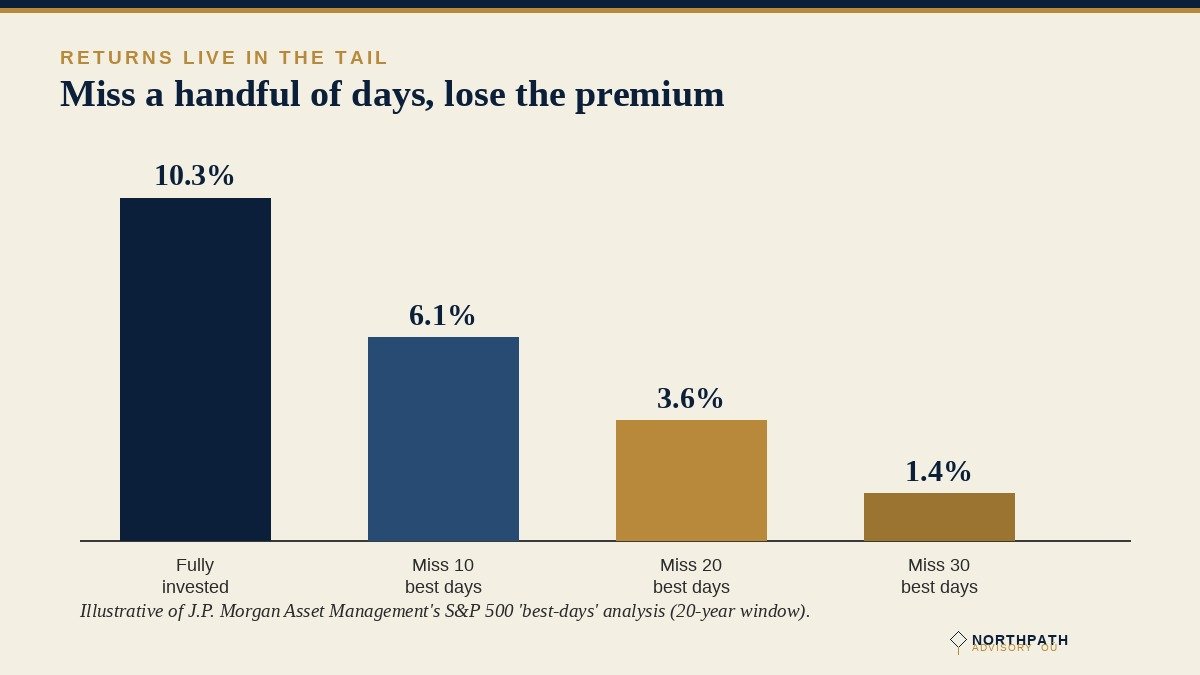
The clearest market evidence that we live in Extremistan is the brutal concentration of returns into a handful of days no forecaster reliably identifies in advance. J.P. Morgan Asset Management’s widely cited analysis of the S&P 500 finds that an investor fully invested over a recent twenty-year stretch earned roughly double the annualised return of one who missed merely the ten best days; missing the best thirty days erased almost the entire equity premium. The detail that matters for the Black Swan model is the clustering: seven of the ten best days occurred within roughly two weeks of the ten worst days. The largest positive surprises are nested inside the largest negative ones, in a sequence no rule could anticipate. Returns do not accrue smoothly, like the turkey’s daily feed; they arrive in rare, decisive, unpredictable bursts—the signature of a fat-tailed world.
There is a deeper point lurking in these figures than “stay invested.” The reason missing a few days is so costly is that the distribution of daily returns is not the gentle bell the textbooks draw; it is fat-tailed, with a small number of extreme observations carrying a disproportionate share of the total. In such a distribution the sample mean is unstable—it can be dominated, at any moment, by a single observation not yet drawn—which is precisely why the average of the past is a treacherous guide to the future. The investor who reasons from “the market returns about ten percent a year” is quoting a number assembled almost entirely from days that, in advance, looked indistinguishable from any other.
The academic record points the same way. Hendrik Bessembinder’s study “Do Stocks Outperform Treasury Bills?” (Journal of Financial Economics, 2018) found that the entire net wealth created by the U.S. stock market since 1926, above Treasury bills, is attributable to the best-performing 4 percent of listed companies, while the majority of individual stocks underperformed cash. Wealth creation, like catastrophe, is a tail phenomenon. A portfolio reasoned from the “typical” stock is reasoning from a region of the distribution where the decisive outcomes do not live. Whether the tail is benign or malign, the lesson is identical: averages describe a world the investor does not actually inhabit.
4. Two historical episodes the model explains
Consider first Black Monday, 19 October 1987. The Dow Jones Industrial Average fell 508.32 points, or 22.61 percent, in a single session—still the largest one-day percentage decline in its history. Under the Gaussian assumptions embedded in the portfolio-insurance and risk models then in fashion, a move of that magnitude was not merely unlikely; it was so far into the thin tail of the bell curve that its probability rounded to a number with dozens of zeros after the decimal point—an event not expected once in the lifetime of the universe. It happened on a Monday. The models had not under-estimated the risk by a little; they had been built on a distribution that made the actual event effectively impossible. And within days, commentators had assembled tidy explanations—program trading, valuation, the dollar—completing the third attribute of the model: retrospective predictability draped over an event no one had positioned for.
Consider second the collapse of Long-Term Capital Management in 1998. The fund, founded in 1994 by John Meriwether, counted among its principals Myron Scholes and Robert Merton, who in 1997 received the Nobel Memorial Prize in Economic Sciences for the option-pricing theory at the heart of modern quantitative finance. LTCM’s models were the most sophisticated in the world, and for three years they delivered annual returns above 40 percent. Then Russia defaulted on its domestic debt in August 1998, correlations the models treated as independent snapped to one, and the fund lost roughly 4.6 billion dollars in under four months. On 23 September 1998, fourteen financial institutions agreed to a 3.65-billion-dollar recapitalisation under the supervision of the Federal Reserve to prevent a disorderly liquidation of a portfolio exceeding 100 billion dollars from cascading through the banking system. The Nobel-grade machinery had been calibrated on a few years of data that simply did not contain a sovereign default of that kind. It was the turkey problem with leverage attached: a confirming history that ended at the knife.
5. Application to long-term equity investing: three operating disciplines
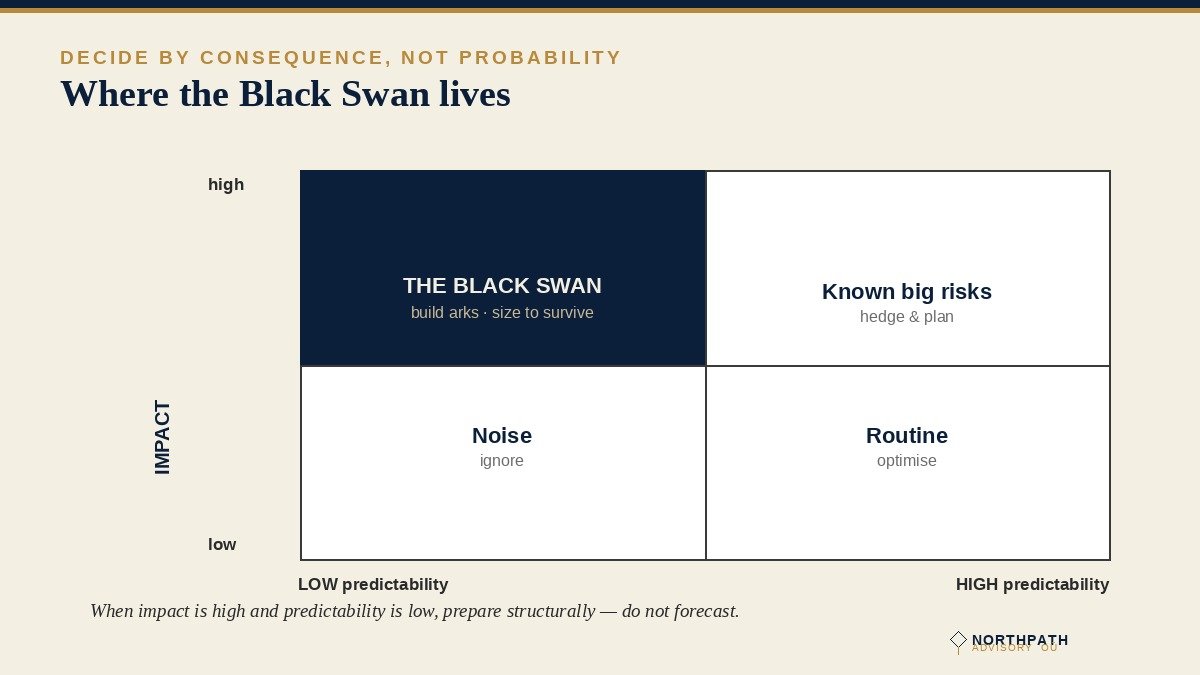
The Black Swan model is often misread as a counsel of paralysis—if the decisive events are unknowable, why act at all? That is the wrong inference. Taleb’s own conclusion is that since we cannot compute the probability of rare events, we should shift attention from probability to consequence, and to the robustness of our position should the improbable arrive. For the long-term equity investor, that translates into three concrete disciplines.
First, survive before you optimise. Position size so that no single outcome—no fraud, no fat-tailed sector collapse, no decade-defining drawdown—can take you out of the game. The arithmetic of compounding is unforgiving of zeros: a position that can deliver a total loss must be small enough that its total loss is survivable, however attractive its expected return looks on paper. Graham’s margin of safety, applied at the portfolio level rather than the security level, is a Black Swan defence: it is the structural buffer that lets you be wrong about the unknowable and still be standing.
Second, prefer convexity to forecasting. Build a portfolio whose payoff is asymmetric—limited on the downside, open-ended on the upside—so that you do not need to predict the swan in order to benefit from it. The owner of a durable, well-financed compounder bought with a margin of safety holds exactly this shape: a floor set by balance-sheet resilience and a ceiling set only by the long, fat right tail of business success that Bessembinder documents. You cannot know which holding becomes the 100-bagger, just as you cannot know which day delivers the year’s return; you arrange to be present and solvent when it happens.
Third, distrust the smooth track record—especially your own. The strategy that has never had a bad year, the manager whose returns are suspiciously linear, the model whose backtest is flawless: treat smoothness as a question, not an answer. Often it signals a turkey approaching its thousandth day—a strategy that earns small, steady premiums by selling insurance against a tail event that has not yet been called. Ask of every position not “what is the expected return?” but “what is hidden in the tail that this calm is being paid to ignore?”
6. How the long-term equity tradition has used the model
Warren Buffett runs, at the core of Berkshire Hathaway, an insurance operation whose entire art is the pricing and survival of rare catastrophe. His most candid statement of the Black Swan discipline is a confession. In the Berkshire Hathaway Chairman’s Letter accompanying the 2001 annual report, written after the 11 September attacks led General Re to pay roughly 2.4 billion dollars in losses, Buffett admitted he had foreseen the possibility of a mega-catastrophe but had not acted on it: “I violated the Noah rule: Predicting rain doesn’t count; building arks does.” The line is the model in eight words. Foresight is worthless without a structural response; the discipline is not to predict the flood but to be the firm that has already built for it. Buffett’s insistence that Berkshire hold a fortress balance sheet, never write business that could threaten solvency in a tail year, and keep cash precisely when it earns least is Noah’s arithmetic applied to capital.
Howard Marks made the same principle the spine of Oaktree Capital’s philosophy. His memo “You Can’t Predict. You Can Prepare.” (20 November 2001) and his book The Most Important Thing (Columbia University Press, 2011) argue that the future is a probability distribution rather than a fixed point, that the most important thing is to know where we are in a cycle rather than to forecast where it goes next, and that risk control means surviving the outcomes you did not predict. Marks’s repeated warning—that the greatest losses come not from poor average assumptions but from underestimating how bad the worst case can be—is Taleb’s tail risk in the vocabulary of a practitioner who has compounded client capital through multiple credit cycles. Seth Klarman, in Margin of Safety (1991), reaches the same destination from the value tradition: because the future cannot be forecast, the only durable protection is to demand a discount large enough to absorb adverse surprises. Taleb himself has practised what he models: the tail-hedging approach he helped inspire, run since 2007 by his former colleague Mark Spitznagel at Universa Investments, deliberately accepts a small, steady cost in normal years in exchange for a large, convex payoff when the rare crash arrives—the structural inverse of the turkey’s trade. The common thread across these practitioners is not pessimism. It is the refusal to let the calm of confirming years be mistaken for the absence of the tail, and the willingness to pay—in forgone yield, in held cash, in unlevered patience—for the right to still be solvent and buying when the improbable finally prints.
7. Key takeaways
- The decisive events are the unforeseeable ones. A Black Swan is rare, extreme in impact, and explained only in hindsight; in markets, which live in Extremistan, the tail is not noise around the story—it is the story.
- A confirming history is not safety. The turkey is most confident the day before slaughter. A long, smooth track record can be evidence that a hidden tail risk is being sold cheaply, not that none exists.
- Shift from probability to consequence. Since the odds of rare events cannot be reliably computed, decide by asking what happens to you if the improbable arrives, and arrange to survive it regardless.
- Build convex, survivable positions. Size so no single outcome can ruin you, prefer payoffs with a floor and an open-ended upside, and let compounding and the fat right tail do the work prediction cannot.
- Build arks, not forecasts. Buffett, Marks, and Klarman converge on the same discipline: you cannot predict, but you can prepare—and preparation, not prophecy, is what compounds across the rare events that define a lifetime of investing.
— Manish Goel, FCA / NorthPath Advisory OÜ / Tallinn, Estonia
|
Important. |