The publication archive
The NorthPath Letter
Long-form strategic analysis of global businesses, capital markets, and the business of investing — written for the professional reader who wants structural understanding, not daily noise.
Subscribe — Free
Get every new essay delivered to your inbox.
All issues
All essays are journalism and education for a general professional readership. Nothing on this page is investment advice or a recommendation in respect of any specific financial instrument. Where individual securities are discussed, the author’s position is disclosed in the relevant essay in line with MAR Article 20.
- The Half-Life of Facts: Burton and Kebler’s 1960 Borrowed Metaphor, Poynard’s Forty-Five-Year Measurement of Clinical Truth, and Why the Long-Term Equity Investor Dates Every Input to a Thesis

- Hanlon’s Razor: Bloch’s 1980 Printing of an Older Warning, the Arithmetic of Intent and Error, and Why the Long-Term Equity Investor Writes the Tripwire Before the Surprise

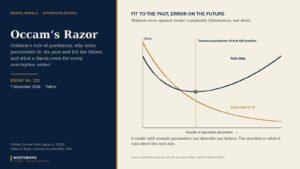
- Occam’s Razor: Ockham’s Fourteenth-Century Rule of Parsimony, the Bayesian and Predictive Case for It, and Why the Long-Term Equity Investor Counts the Assumptions in a Thesis
- The Stockdale Paradox: Collins’s 2001 Name for Faith in the End and Honesty About the Present, and Why the Long-Term Equity Investor Needs Both Without a Date Attached

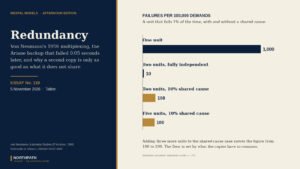
- Redundancy: Von Neumann’s 1956 Multiplexing Theorem, the Ariane Backup That Failed 0.05 Seconds Later, and Why the Long-Term Equity Investor Counts Shared Causes Before Counting Cushions
- The OODA Loop: Boyd’s 1976 Theory of Orientation, the Korean War Kill Ratio That Would Not Hold, and Why the Long-Term Equity Investor Wants a Better Picture Before a Faster One

- Symbiosis: de Bary’s 1879 Definition, Bronstein’s Conditional Outcomes, and Why the Long-Term Equity Investor Asks Whether a Partnership Is Feeding the Business or Feeding on It

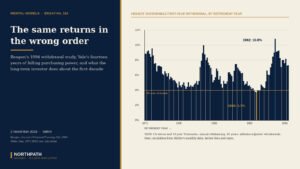
- Sequence-of-Returns Risk: Bengen’s 1994 Withdrawal Study, Yale’s Fourteen Years of Falling Purchasing Power, and What the Long-Term Equity Investor Does About the First Decade
- Ecological Succession: Clements’s 1916 Sequence, Connell and Slatyer’s Three Mechanisms, and What a Cleared Market Teaches the Long-Term Equity Investor

- Cynefin: Snowden and Boone’s Domain Map, and Why Naming the Domain Comes Before Choosing the Method

- Where the Light Is: Kaplan’s 1964 Drunkard’s Search, the Body Count That Stood In for Winning, and What the Long-Term Equity Investor Does With the Value a Ledger Cannot Show

- Being First Is Not Staying First: Lieberman and Montgomery’s 1988 First-Mover Advantages, Golder and Tellis’s Test on 500 Brands, and What the Long-Term Equity Investor Should Ask of an Early Lead

- Long Calm, Sudden Change: Eldredge and Gould’s 1972 Punctuated Equilibrium, the Swiss Watch Industry’s Quartz Decade, and Why the Long-Term Equity Investor Plans for Stasis Broken by Short Bursts

- The Castle and the Courtyard: Shackel’s 2005 Motte-and-Bailey Doctrine, the Adjusted Earnings Measure, and Why the Long-Term Equity Investor Reads the Narrow Claim Behind the Broad One

- The Strongest Version of the Other Side: Davidson’s 1973 Principle of Charity, Rapoport’s Four Rules, the Letter Kennedy Answered, and Why the Long-Term Equity Investor Must State a Case Before Judging It

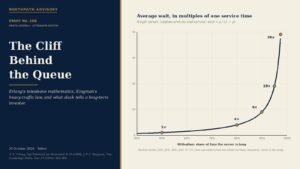
- The Cliff Behind the Queue: Erlang’s 1909 Telephone Mathematics, Kingman’s Heavy-Traffic Law, and Why the Long-Term Equity Investor Must Ask How Much Slack a Business Keeps
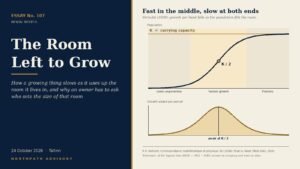
- The Room Left to Grow: Verhulst’s 1838 Logistic Law of Population, Pearl and Reed’s 197-Million Forecast, the Help-Wanted Pages That Emptied, and Why a Long-Term Equity Investor Asks What Sets the Carrying Capacity
- The Price That Moved Too Much: Shiller’s 1981 Variance Bound, the Dividends That Never Fell as Far as the Market, and Why the Long-Term Equity Investor Must Ask What a Price Move Revised

- Moved Out, Rented Back: How to Read Lessor Accounting and Sale-and-Leaseback Transactions in an Indian Annual Report

- The Test the Other Side Designs: Joseph Stiglitz’s 1975 Theory of Screening, the Glass Company That Changed How It Paid, the Offer to Leave That Zappos and Amazon Make, and Why a Long-Term Equity Investor Asks Whom Each Term Sends Away

- The Glow in the Fee: Andreoni’s 1990 Warm-Glow Theory, Riedl and Smeets’s 2017 Evidence from Socially Responsible Fund Owners, and Why the Long-Term Equity Investor Must Itemise What a Value Costs Before He Forecasts What It Returns

- Collected, Not Traded: How to Read the Classification of Financial Assets, the Business-Model Test and the SPPI Test in an Indian Annual Report

- The Relative at the Table: Hamilton’s 1964 Rule for Helping Kin, the Family That Closed Ranks at Hermès, the Siblings Who Settled in 2025, and Why a Long-Term Equity Investor Asks How Thin the Kinship Has Become

- The Product Built to Resist Comparison: Carlin’s 2009 Theory of Strategic Complexity, Célérier and Vallée’s 2017 Evidence from 55,000 Structured Products, and Why the Long-Term Equity Investor Must Say What He Receives Before He Asks What It Pays

- Right, Not Hope: How to Read the Current and Non-Current Classification of Liabilities and the Covenant Rule in an Indian Annual Report

- The Seat Only One Can Fill: Gause’s 1934 Competitive Exclusion, Hardin’s 1960 Warning About the Name, the Two Discounters That Opened in 1962, and Why a Long-Term Equity Investor Asks Who Else Is in the Niche

- The Face Value of a Chief Executive: Todorov and Colleagues’ 2005 Finding That a Glance at a Face Predicts an Election, the Borrowers of Prosper, the Call at Arup, and Why the Long-Term Equity Investor Must Separate Who Is Chosen From What Is Earned

- Guided, Not Bound: How to Read a Proxy Adviser’s Voting Report, the Stewardship Code and the Voting Results of an Indian Listed Company

- The Claim That Forbids Something: Popper’s 1934 Falsifiability, the Eclipse of 1919, the €1.9 Billion Anyone Could Have Checked, and Why a Long-Term Equity Investor Writes Down What Would Prove the Thesis Wrong

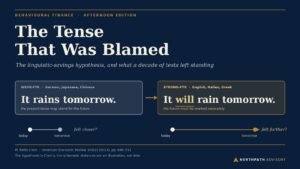
- The Tense That Was Blamed: M. Keith Chen’s 2013 Linguistic-Savings Hypothesis, Japan’s Falling Saving Rate, and Why the Long-Term Investor Must Count the Independent Observations
- Priced Among Friends, Tested Against Strangers: How to Read Transfer Pricing and the Arm’s-Length Test in an Indian Annual Report

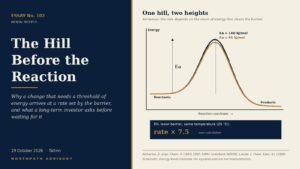
- The Hill Before the Reaction: Svante Arrhenius’s 1889 Activation Energy, the Battery That Burned in Boston, and Why a Long-Term Equity Investor Asks Who Supplies the Energy
- The Stranger in the Portfolio: Hershfield and Colleagues’ 2011 Age-Progressed Future Self, the Liability General Motors Did Not Book Until 1992, and Why the Long-Term Investor Must Make the Owner of the Money Visible

- Rebuilt, Not Restated: How to Read the First-Time Adoption of Ind AS and the Equity Reconciliation in an Indian Annual Report

- The Stone That Held the Arch: Robert Paine’s 1966 Starfish Experiment, the Brake Valve That Stopped Toyota, and Why a Long-Term Equity Investor Measures Effect per Unit of Abundance

- The Fudge Factor: Mazar, Amir and Ariely’s 2008 Theory of Self-Concept Maintenance, the Income That Was Pulled Forward, and Why the Long-Term Equity Investor Must Read the Width of the Corridor

- Counted Whole, Owned in Part: How to Read Non-Controlling Interests and Put Options over Them in an Indian Annual Report

- The Fence Nobody Remembered: Chesterton’s 1929 Rule, the Cassava Roots That Travelled Without Their Recipe, and Why a Long-Term Equity Investor Asks What a Structure Is For Before Wanting It Gone

- The Number That Was Paid For: Hirshleifer, Jian and Zhang’s 2018 Lucky Listing Codes, the Traders Who Favoured Eight Over Four, and Why the Long-Term Equity Investor Must Price the Business, Not the Digit

- Shared, Not Split: How to Read Joint Operations and Joint Ventures in an Indian Annual Report

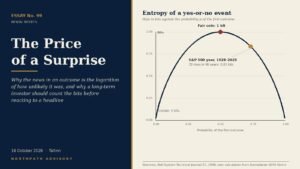
- The Price of a Surprise: Claude Shannon’s 1948 Entropy, the Printer’s Type Case, and Why a Long-Term Investor Counts the Bits in the News
- The Signal That Stopped Being Checked: Skitka, Mosier and Burdick’s 1999 Automation Bias, the Ship Seventeen Miles Off Course, and Why the Long-Term Equity Investor Must Audit the Tool Before He Trusts the Number

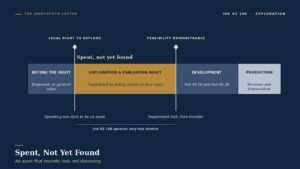
- Spent, Not Yet Found: How to Read Exploration and Evaluation Assets in an Indian Annual Report
- The Shape of a Lifetime: Davis’s 1952 Failure Data, the Bathtub Curve, and Why a Long-Term Investor Should Ask How Old a Risk Is

- The Experience That Taught Nothing: Kahneman and Klein’s 2009 Conditions for Intuitive Expertise, the Forecasters Cowles Scored, and Why the Long-Term Equity Investor Must Ask Whether His Environment Can Teach

- Provided For, Not Paid: How to Read Decommissioning and Restoration Obligations in an Indian Annual Report

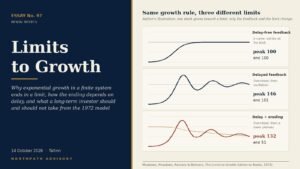
- The Ceiling and Its Height: Meadows, Randers and Behrens’s 1972 Limits to Growth, Hubbert’s Oil Peak and the Record That Followed, and What a Long-Term Investor Can Take From a Limit
- The Window the Issuer Waits For: Baker and Wurgler’s 2002 Evidence That Capital Structure Records Past Market Timing, and Why the Long-Term Equity Investor Reads the Issuance History Before the Forecast

- Judged, Not Counted: How to Read the Significant Judgements and Estimation Uncertainty Note in an Indian Annual Report

- The Whip and the Wrist: Lee, Padmanabhan and Whang’s 1997 Bullwhip Effect, the Diapers That Babies Used Steadily, and Why the Long-Term Equity Investor Must Read Upstream Orders as a Distorted Message
