Spin-Off Investing: Joel Greenblatt’s 1997 Framework and Three Decades of Academic Evidence on Corporate Separations

valueinv cover spin off investing

MORNING EDITION — VALUE INVESTING

In April 1997, a forty-year-old hedge-fund manager named Joel Greenblatt published You Can Be a Stock Market Genius. Eight chapters in, he arrived at what he called “the single best area to look for opportunities” — corporate spin‑offs, the legal separation of a subsidiary from its parent, distributed pro‑rata to the parent’s existing shareholders. He told the reader, with the directness of someone reporting field data rather than offering opinion, that the average US spin‑off between 1963 and 1988 had outperformed the broad market by roughly ten percentage points per year over its first three years of independent trading.

The claim sounds either too neat or too narrow to take seriously. Too neat because the equity market is the most heavily intermediated capital market on earth, and a ten‑percentage‑point edge that persists for three decades after publication ought to have been arbitraged away. Too narrow because the global pipeline of separations is small relative to the listed‑equity universe, and even a specialist would build a portfolio at the rate of a handful of names a year. Both reactions miss the point. The spin‑off premium is not an anomaly defying market efficiency; it is a predictable consequence of how institutional capital is mandated to behave. And while the flow of separations is small, it is steady, geographically diverse, and concentrated at the moments — conglomerate break‑ups, forced divestitures, post‑merger rationalisation — when the underlying businesses are most likely to be mispriced.

This morning’s letter is about that framework: where it came from, why the mechanism works, what three decades of academic replication has confirmed, and how a long‑term practitioner ought to translate it into process today.

1. The Principle and Its Primary Source

The framework was set out in Chapter 3 of Greenblatt’s 1997 book, “Chips off the Old Stock”. A spin‑off, in legal form, is a distribution by a parent company of the shares of a wholly‑owned subsidiary to the parent’s shareholders on a pro‑rata basis. The parent receives no cash; the shareholders receive a new security whose value reflects the standalone economics of the spun‑off business. In the United States, the transaction is generally structured to qualify as tax‑free to both the parent and the shareholders under Section 355 of the Internal Revenue Code. Comparable structures exist under United Kingdom demerger relief, the German Umwandlungsgesetz, and — adapted with friction — under Section 2(19AA) of the Indian Income Tax Act.

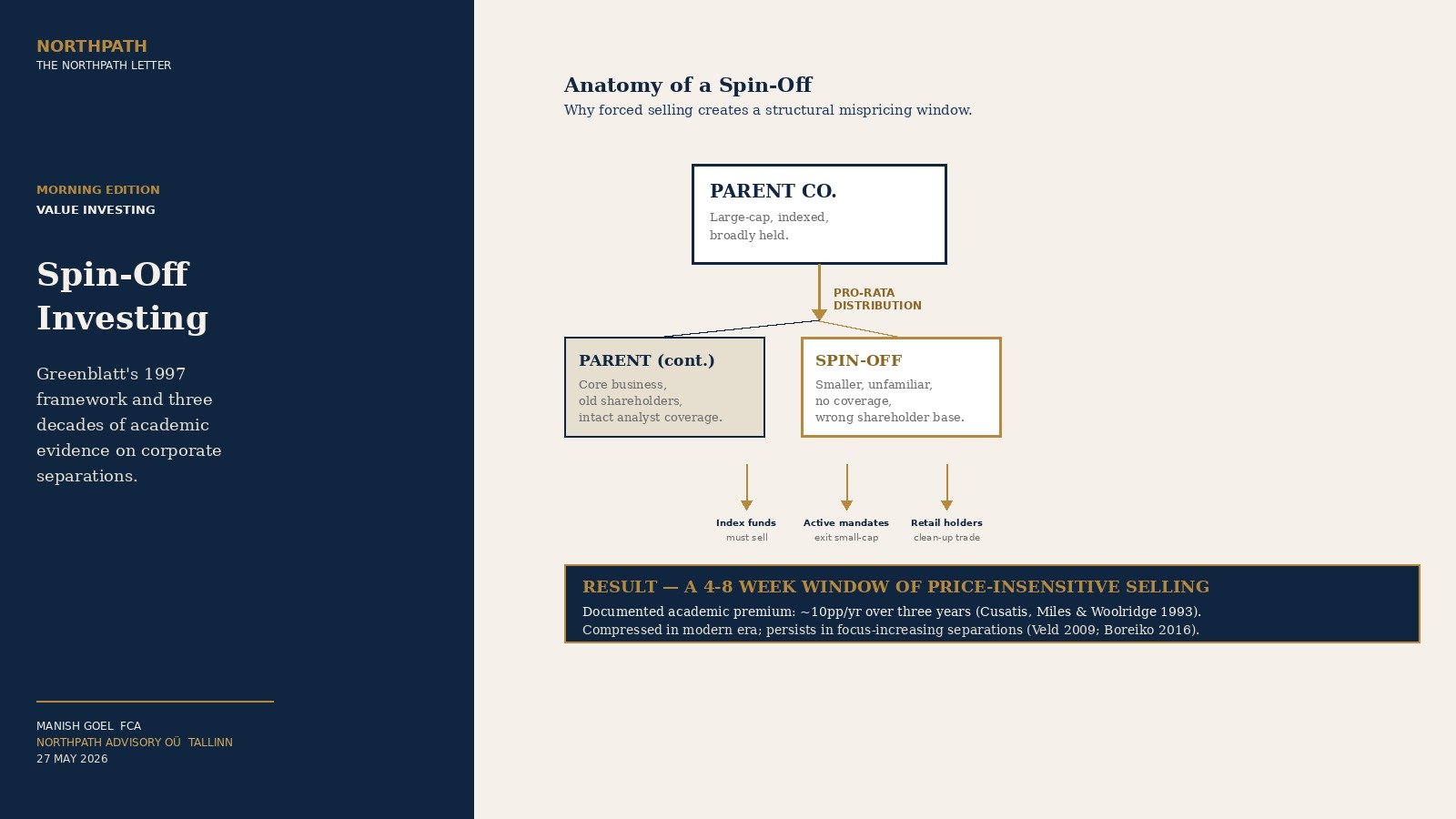
Greenblatt’s argument, stripped to its load‑bearing claims, was this. First, that the new spun‑off security is, at the moment of distribution, in the wrong hands. The original parent’s shareholder base was assembled to own the parent — for index reasons, for sector reasons, for size reasons, sometimes simply because the parent had been in the portfolio for a long time. The spun‑off subsidiary is, by definition, a different business in a different sector at a different size. A meaningful fraction of the inheriting shareholders are structurally compelled to sell within the first weeks: index funds whose mandate excludes the new security, large‑cap funds that cannot hold the smaller spin, sector funds whose mandate excludes the new industry, retail holders who view the unfamiliar new ticker as a clean‑up trade. Second, that this forced selling is largely price‑insensitive — the selling is driven by mandate, not by valuation, and it lands on a security with a tiny circle of natural buyers, no Wall Street research coverage for at least a quarter, no earnings history as a standalone entity, and a shareholder register that is itself in flux. Third, that the underlying business is, on average, structurally healthier after separation: a sub‑scale subsidiary that had been starved of capital under the conglomerate often emerges with sharper management focus, cleaner economics, equity compensation tied directly to its own performance, and the freedom to make capital‑allocation decisions on its own terms.

Greenblatt’s recommended process was almost embarrassingly simple. Read the SEC Form 10 — the registration statement filed by the spun‑off entity ahead of its first day of independent trading — in full. Look for three signals: insider ownership and incentives that align management with the standalone business, a balance sheet whose debt load is appropriate to the new standalone cash flows rather than weighted with the parent’s legacy, and a business that, on its own, the patient investor would want to own at the price implied by the post‑distribution market value. Wait through the initial forced‑selling window — typically four to eight weeks — and act when the technical pressure has cleared. The discipline trades activity for asymmetric exposure: nothing is bought until the structural mispricing is visible in the tape.

2. The Mechanism — Why the Premium Exists at All

The premium does not exist because investors are foolish. It exists because the rules under which the world’s largest pools of equity capital are managed produce a predictable, recurring window in which a subset of listed securities is mispriced for reasons unrelated to the underlying business. Three structural features explain the mechanism, and all three are still in force three decades after Greenblatt described them.

The first is the architecture of indexed and benchmark‑hugging capital. Globally, more than half of equity assets under management are now either passively indexed or run against a benchmark with low tracking‑error tolerance, per Morningstar industry data through 2024. When a parent in the S&P 500 or MSCI World Large Cap spins off a subsidiary that lands, on its first day, in the small‑cap index, the funds tracking the larger index are mandated to sell — not by judgement, but by rule. Active funds benchmarked to the large‑cap index face the same arithmetic. The selling lands on a security whose natural buyers — small‑cap dedicated funds — are themselves not yet positioned to take it, because most have not yet been notified by their benchmark provider that the new ticker is in their universe.

The second is the absence of sell‑side coverage at the moment of listing. Until separation, the standalone subsidiary was a segment in the parent’s annual report. It had no analyst model of its own, no consensus earnings estimate, no broker target price. Analyst coverage usually takes one to two quarters to assemble. Until it does, the spun‑off security trades on Form‑10 filings and management presentations — both available, both requiring work to read. The bias of most short‑term trading capital is to wait for coverage to begin; the result is a window in which the price reflects the marginal seller far more than the marginal informed buyer.

The third — and the one Greenblatt emphasised most — is the change in management incentives at the moment of independence. Inside a conglomerate, the manager of a sub‑scale division is paid against the parent’s consolidated metrics. Capital is rationed by the corporate office. After separation, the same manager runs a public company. Equity compensation is tied to the standalone share price. Capital can be redeployed without permission from a corporate parent. The same business, with the same assets and the same people, can produce materially different financial results in its first three years of independence — not because it has changed, but because the constraints under which it was being run have changed.

Three structural forces — forced selling, coverage gap, incentive reset
Figure 1. The three structural forces — forced selling, sell-side coverage gap, and management incentive reset — combine in the weeks following separation to produce a predictable mispricing window.

3. The Empirical Record — Three Decades of Academic Replication

The interesting thing about Greenblatt’s framework is not that he made the claim. The interesting thing is that the academic literature has, with considerable consistency, replicated it across three decades, three continents, and several methodologies. The exact magnitudes differ, the windows differ, and the statistical significance varies by sub‑sample; but the direction is the same.

The first major academic study was Cusatis, Miles and Woolridge, published in the Journal of Financial Economics in 1993 under the title “Restructuring through Spinoffs: The Stock Market Evidence”. Examining a sample of 161 spin‑offs from US parents between 1965 and 1988, the authors documented a buy‑and‑hold abnormal return of roughly twenty‑five per cent over the three years following the distribution, with the bulk of the excess concentrated in the second and third years rather than the first. Desai and Jain, writing in the Journal of Financial Economics in 1999, extended the sample to 144 spin‑offs through 1995 and identified an important sub‑sample: “focus‑increasing” spin‑offs — those in which the spun‑off business operated in a different two‑digit SIC code from the parent — earned abnormal returns of roughly thirty‑three per cent over the three‑year window, while “non‑focus‑increasing” spin‑offs delivered no statistically significant excess return.

McConnell and Ovtchinnikov, writing in the Journal of Investment Management in 2004, addressed the most pointed critique of the earlier literature: that the excess returns were a small‑sample artefact driven by a handful of outliers. They tested 311 spin‑offs from 1965 to 2000 and showed that the result survived the removal of the largest outliers; the median spin‑off, not just the mean, outperformed the market. Veld and Veld‑Merkoulova published a meta‑analysis in the International Review of Financial Analysis in 2009, pooling 26 studies across the US, the UK, and continental Europe. They concluded that the average announcement‑date return to the parent of 3.0 per cent, and the post‑separation three‑year abnormal return to the spin of roughly 9.6 per cent annualised, were robust to geography and to time period.

Two important caveats appear in the more recent literature. The first, documented by Boreiko and Murgia in the European Financial Management Journal in 2016 for European spin‑offs between 1989 and 2013, is that the magnitude of the spin‑off premium has compressed in recent decades. The 1965‑1988 sample on which Greenblatt’s original number rests included a great many cases in which a conglomerate that traded at a meaningful discount to its sum‑of‑the‑parts handed shareholders a corrected valuation simply by separating. As conglomerate discounts narrowed in the late 1990s and as activist investors began pre‑empting many of the most obvious value‑unlocking transactions, the premium available to the patient generalist after a spin‑off compressed. The second caveat, documented by Chemmanur and Yan in the Journal of Financial Economics in 2004, is that the premium concentrates in spin‑offs that are focus‑increasing — separations that meaningfully change the strategic geography of both the parent and the child. Spin‑offs that are essentially financial engineering, in which the same management team and the same capital‑allocation philosophy continue to run both halves, have not, on average, delivered excess returns.

The honest reading of the literature is therefore this. The spin‑off premium is real; it is global; it is persistent over a thirty‑year window. But it has compressed in magnitude, it concentrates in focus‑increasing transactions, and it requires that the practitioner read the Form 10, separate the genuinely independent spins from the cosmetic ones, and pay attention to insider incentives and balance‑sheet structure. The single number — “ten per cent per year for three years” — was always a textbook average; the practitioner’s number is whatever the practitioner’s discipline can earn within that distribution.

Three-year abnormal returns to spun-off entities by academic study
Figure 2. Reported three-year abnormal returns to the spun-off entity by published academic study. The premium has compressed in recent decades but the direction has been replicated across the US, the UK, and continental Europe.

4. Two Historical Episodes

Two episodes, separated by a quarter‑century and an ocean, illustrate the framework in action. Neither is offered as a recommendation; both are case‑studies in why the mechanism works and where it can fail.

The first is the Marriott separation of October 1993. Marriott Corporation split itself into Host Marriott Corporation, which retained the hotel real estate and the historical long‑dated debt, and Marriott International, which retained the asset‑light hotel management and franchising business. The transaction was controversial when announced — Host Marriott carried roughly $2.9 billion of the parent’s senior debt while owning the cyclical real estate; bondholders sued; institutional shareholders who had bought a hospitality compounder found themselves holding a leveraged real‑estate vehicle they had not asked for. In the months following distribution, Host Marriott traded at a substantial discount to its underlying property value, while Marriott International traded close to a fee‑based comparable multiple. Over the subsequent five years, as the US hotel cycle recovered and the debt schedule worked through, the combined value of the two securities materially exceeded that of the pre‑split parent. The episode became the case‑study by which a generation of US analysts learned to read Form 10 carefully and to separate noisy first‑months trading from underlying business value.

The second is the Mercedes‑Benz Group separation from Daimler Truck Holding AG in December 2021. After more than two decades during which Daimler AG had operated as a single listed entity combining the Mercedes‑Benz passenger car franchise with the Daimler Truck business, the European board concluded that the strategic geographies of the two businesses had diverged sufficiently — battery‑electric passenger vehicles on one side, heavy commercial vehicle electrification and hydrogen on the other — to warrant separation. Daimler Truck Holding AG listed on the Frankfurt Stock Exchange on 10 December 2021; the parent renamed itself Mercedes‑Benz Group AG on 1 February 2022. The forced‑selling pattern was textbook: a number of European large‑cap mandates could not hold Daimler Truck; the new entity began trading without the analyst coverage that had attached to Daimler AG for decades; insider equity grants at Daimler Truck were re‑based to the standalone share price. In the first six weeks of independent trading, the two securities together traded at a discount to the implied pre‑separation value; by mid‑2022, as European institutional capital re‑allocated and as analyst coverage of both standalone entities matured, the discount had narrowed. The episode reads as a European replication of the mechanism Cusatis, Miles and Woolridge had documented in the US three decades earlier.

5. The Application Framework — Three Process Disciplines

What follows is not motivational. It is process. The framework is operationally simple and analytically demanding; the simplicity is exactly what makes it survive the cycle.

Discipline one: build a written watch‑list, refreshed quarterly, of announced and pending spin‑offs in the markets in which the investor is willing to commit capital. The pipeline is finite — globally, between 50 and 100 spin‑offs of meaningful size complete each year, with the largest concentrations in the US and Europe. Anchor the watch‑list to the announcement of the corporate separation, not to the distribution date; the announcement is publicly knowable, often six to twelve months before the actual distribution, and provides the analyst with the runway to read the Form 10 (or its UK / European equivalent) once it is filed. The watch‑list is not a buy list. It is a research queue.

Discipline two: read the Form 10 in full, and write a one‑page memo to oneself before any decision. The memo answers three questions: whether the standalone business is one the long‑term investor would want to own at any price; whether the balance sheet handed to the spin is appropriate to its standalone cash flows or saddled with disproportionate parent legacy debt; and whether the equity compensation of the standalone management team is aligned with the standalone business’s long‑term performance. If any of the three questions returns a negative answer, the spin is not actionable for the patient investor regardless of how attractive the first‑day price action looks. The memo is the discipline that separates a framework from a tip.

Discipline three: wait through the technical‑selling window before sizing a position, and size it within a portfolio context. The forced‑selling pattern typically clears within four to eight weeks of distribution. First‑week price action reflects index rebalancing rather than considered valuation; positions established into that window are frequently marked down before the technical pressure clears. The patient investor sizes the position only after the structural sellers have completed their work, and sizes it as a fractional holding within the broader portfolio rather than as a concentrated bet. Spin‑off investing rewards the practitioner who treats each separation as one observation in a portfolio of observations, not as a thesis to be defended.

Four-step practitioner process for the patient generalist
Figure 3. The four-step process — watch-list, Form 10, wait, size — that converts the structural opportunity into a disciplined portfolio allocation.

6. How Long‑Term Practitioners Have Applied It

Greenblatt himself remains the most documented practitioner of the framework. The Gotham Funds, which he co‑founded with Robert Goldstein, ran an explicit spin‑off strategy through the 1990s and into the 2000s; the firm’s reported audited returns from inception of the original Gotham Capital partnership in 1985 through its 1995 closure averaged approximately 50 per cent gross annualised, a figure that Greenblatt has discussed publicly and is documented in his subsequent writing including The Little Book That Beats the Market (2005). The strategy was concentrated, opportunistic, and explicitly tied to corporate events including spin‑offs, recapitalisations, and rights offerings. Greenblatt has been consistent in both the books and the interviews he has given over thirty years that the spin‑off premium is structural, not stylistic, and that the discipline of reading the Form 10 is what converts the structural opportunity into realised return.

A second well‑documented practitioner is Murray Stahl of Horizon Kinetics, whose firm has managed long‑duration equity capital since 1994. In the firm’s quarterly commentaries across the 2010s, Stahl developed the thesis that the academic spin‑off premium concentrates in what he termed “owner‑manager spin‑offs” — separations in which the new standalone entity emerges with strongly aligned insider ownership — and effectively disappears outside that sub‑sample. His framework refines Greenblatt’s by asking the practitioner to focus the research budget on spins in which the people running the new business have a meaningful personal stake in its long‑term success, rather than on the full distribution of separations, most of which are organisational rearrangements with limited insider re‑alignment.

The author of this letter holds no position in any spin‑off or post‑spin entity discussed above.

7. Key Takeaways

First, the spin‑off premium is real and globally persistent over a thirty‑year academic record. It is not an anomaly defying market efficiency; it is a structural consequence of how indexed and benchmark‑hugging capital is mandated to behave in the weeks following a corporate separation.

Second, the magnitude of the premium has compressed since Greenblatt’s 1997 publication, and it now concentrates in focus‑increasing separations in which the parent and the child operate in materially different strategic geographies. Cosmetic spin‑offs and financial‑engineering separations have not, on average, delivered excess returns.

Third, the framework is operationally simple: build a watch‑list, read the Form 10, write a memo, wait through the forced‑selling window. The simplicity is exactly what makes it executable by a generalist long‑term investor without specialised infrastructure.

Fourth, the framework rewards discipline over activity. The pipeline is finite, the actionable subset is smaller still, and the patient investor will commit capital to a small number of separations a year. Treated as one process among several in a long‑term equity portfolio, it is one of the few corners of the market in which structural mispricing is documented, replicated, and still available to the practitioner willing to read the filings.

Fifth, and perhaps most importantly, what Greenblatt’s 1997 chapter actually teaches is a habit of mind that extends well beyond spin‑offs. The habit is to ask, of any apparent mispricing in listed equity, whether there is a structural reason why a particular pool of capital is constrained from acting on what would otherwise be a profitable trade. Wherever mandate, benchmark, or coverage produces forced behaviour at known dates, the patient investor who is not so constrained holds an asymmetric option to act. Spin‑offs are one such corner. There are others. The framework belongs to anyone willing to think about the equity market as a system of constraints as much as a system of prices.

— Manish Goel, FCA / NorthPath Advisory OÜ / Tallinn, Estonia

Important.
All content on this site and in this email is journalism and education for a general audience. Nothing here constitutes investment advice or a recommendation in respect of any specific financial instrument, nor an offer or solicitation to buy or sell any security. Readers should consult an authorised financial adviser regulated in their own jurisdiction before making any investment decision.