There is a quiet structural oddity at the heart of the Indian stock market. The companies that sell soap, biscuits, noodles and hair oil — products with no patents, no network effects and no switching costs worth the name — have for decades traded at valuation multiples that would make a software monopolist blush, earned returns on capital that textbooks say competition should have erased, and held those returns through wars, droughts, demonetisation and a pandemic. A bar of soap is not a difficult thing to make. Why, then, has it been so difficult to compete with the people who make it?
The answer is not the soap. It is the structure underneath the soap: a distribution pyramid assembled over eight decades, a peculiar ownership layer of listed multinational subsidiaries that pay a royalty toll to their parents, a state that periodically redraws the sector’s plumbing through tax design, and — for the first time in roughly fifty years — a genuine attack on the pyramid itself, mounted not by a rival manufacturer but by a warehouse with no customers in it. This letter is a structural anatomy of Indian fast-moving consumer goods: how the machine is built, what economics the build produces, and how a careful reader should examine an FMCG annual report now that the machine’s most defensible part is, at last, being contested.
The pyramid
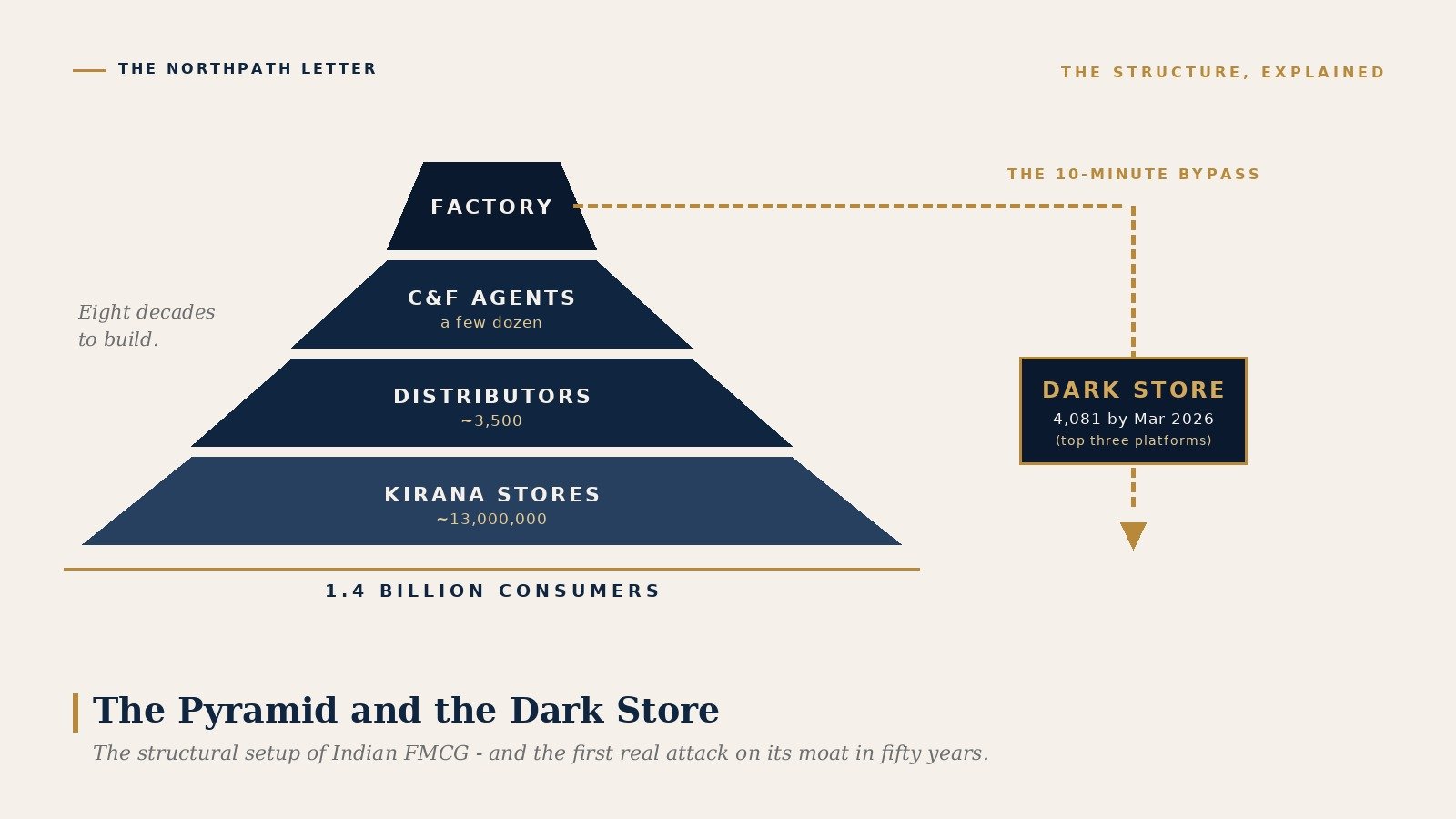
Start with the shape of Indian retail. The country has somewhere between twelve and thirteen million kirana stores — family-run neighbourhood shops, frequently smaller than a parking space, selling perhaps a thousand items within walking distance of their customers. Despite two decades of supermarket construction and one decade of e-commerce, most estimates still put general trade — the kiranas and their wholesale feeders — above eighty per cent of the sector’s sales. No other large consumer market looks like this. In the United States or the United Kingdom, a consumer-goods company negotiates with a handful of grocery chains that control the shelf; the retailer holds the power, and supplier margins are ground down accordingly. In India, the shelf is owned by thirteen million sole proprietors, none of whom has any bargaining power at all.
Reaching them, however, is brutally hard — and that difficulty is the moat. The canonical structure has four layers. The manufacturer ships to a few dozen carrying-and-forwarding agents, who hold stock state by state. They sell to redistribution stockists or distributors — a large company runs three to four thousand of them — each of which finances its own inventory, employs its own salesmen, and services a defined territory of shops. The distributor’s salesman, or increasingly an app in the shopkeeper’s hand, takes the weekly order from the kirana; the kirana sells to the household, often on familiarity and micro-credit no platform can underwrite. Hindustan Unilever, the system’s archetype and oldest practitioner, has been refining this pyramid since the 1940s; its products today reach over nine million outlets, roughly three million of them served by its distributors directly. The pyramid is not a logistics arrangement that happens to exist; it is the accumulated, replicated, audited work of generations of territory salesmen, and a new entrant cannot rent it, licence it or raise venture capital fast enough to copy it.
That is the first structural fact of Indian FMCG, and it inverts the Western power balance. Because no single retailer matters, the manufacturer — not the retailer — owns the customer relationship at scale. The brand on the sachet, plus the certainty that the sachet is physically present in a village of four hundred people, is the franchise. Everything else in the sector’s economics follows from this.
The economics the pyramid produces
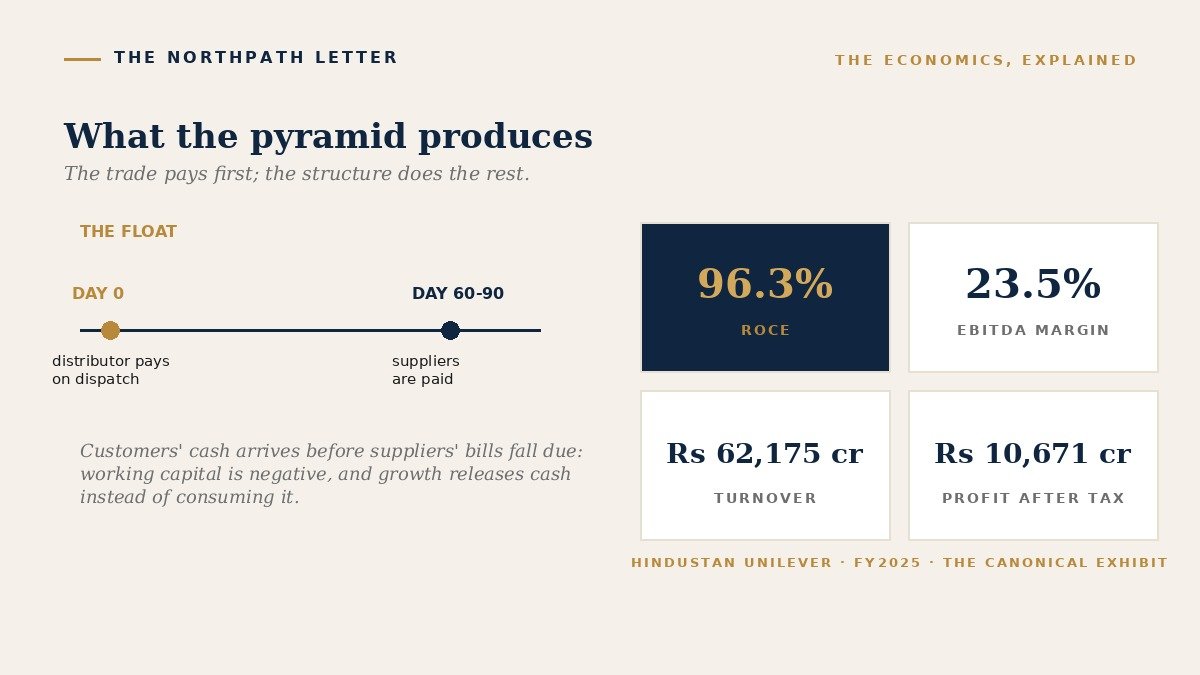
Follow the cash, as an earlier letter in this series put it, and the pyramid’s consequences appear on the balance sheet before they appear anywhere else. The distributor typically pays the manufacturer on dispatch or within days — the trade finances the company. The company, meanwhile, pays its own suppliers on sixty- or ninety-day terms. The result is the most coveted sign in working-capital arithmetic: a negative working-capital cycle, in which customers’ money is collected before suppliers are paid, and growth releases cash rather than consuming it. Combine that with the modest fixed-asset base of mixing, packing and labelling operations, and the denominator of return on capital nearly vanishes.
The numerator, meanwhile, is protected by the moat. Hindustan Unilever’s results for the year ended March 2025 are the canonical exhibit: consolidated turnover of roughly ₹62,175 crore, profit after tax of about ₹10,671 crore, an EBITDA margin of 23.5 per cent — and a return on capital employed of 96.3 per cent. Read that last figure again. A business earning back its entire capital base in thirteen months is not enjoying a good year; it is exhibiting a structure. Capital-intensive Indian manufacturers celebrate when ROCE crosses twenty.
This is also why the sector’s valuations, which look indefensible on any one year’s earnings, have persisted for decades. A company that requires no incremental capital to grow can distribute essentially all of its profit and still compound; the market, correctly or not, capitalises that annuity-like stream at bond-adjacent discount rates. Whether the price paid is wise is a separate question this letter does not address. The structural point is that the multiple is not an accident of sentiment — it is the pyramid, capitalised.
One caution belongs here. Reported growth in this sector arrives in two flavours — volume and price — and the distinction is the single most important line in any Indian FMCG management commentary. Price-led growth can be inflation pass-through, mix, or quiet grammage reduction (the sachet shrinks, the price point stays). Volume is the only honest measure of whether more Indians bought more product. The sector’s own data bears watching on exactly this axis: NielsenIQ measured the Indian FMCG market growing 13.9 per cent in value but only 6 per cent in volume in the June 2025 quarter, and 12.9 per cent value against 5.4 per cent volume in the September quarter — with rural volumes, at 7.7 per cent, outpacing urban for a sixth consecutive quarter, a reversal of the sector’s long urban-led pattern.
The ownership layer, and the royalty toll
The second structural peculiarity is who owns these machines. A striking share of Indian FMCG profit pools sits inside listed subsidiaries of global multinationals — Hindustan Unilever under Unilever PLC, Nestlé India under Nestlé S.A., alongside the listed Indian arms of other global consumer houses. This is itself a historical artefact: foreign-exchange legislation in the 1970s forced multinationals to dilute Indian operations to local shareholders, and the listings never reversed. The Indian public market is one of the few places on earth where a minority shareholder can directly own a fractional claim on Unilever’s or Nestlé’s single best growth market.
But the arrangement carries a standing toll: the royalty. The Indian subsidiary pays its parent a percentage of sales for brands, technology and central services — a payment that is simultaneously legitimate (the brands are real, the R&D is real) and structurally conflicted, since it moves money from all shareholders to the controlling shareholder before profit is struck. Royalty is, in the vocabulary of an earlier letter in this series, the most consequential related-party transaction in the sector, recurring every year, priced by negotiation between a parent and a board the parent appointed.
The recent record shows both the toll rising and, for the first time, the toll-gate being challenged. In January 2023 Hindustan Unilever agreed to lift its royalty and central-services payments to Unilever from approximately 2.65 per cent of turnover to approximately 3.45 per cent, phased over three years from February 2023 — a board-approved arrangement that did not go to a minority vote. In May 2024, by contrast, Nestlé India did put its proposal to shareholders, as the materiality thresholds of SEBI’s LODR Regulation 23 required: a rise from 4.5 per cent of net sales towards 5.25 per cent over five years. Under Regulation 23(4), no related party may vote on a material related-party transaction — so Nestlé S.A., holding a majority of the company, had to stand aside while the minority decided. The minority said no: 57.18 per cent of the votes cast went against the board’s own resolution. It was the first time minority shareholders of a major Indian multinational subsidiary had rejected a parent’s royalty demand outright.
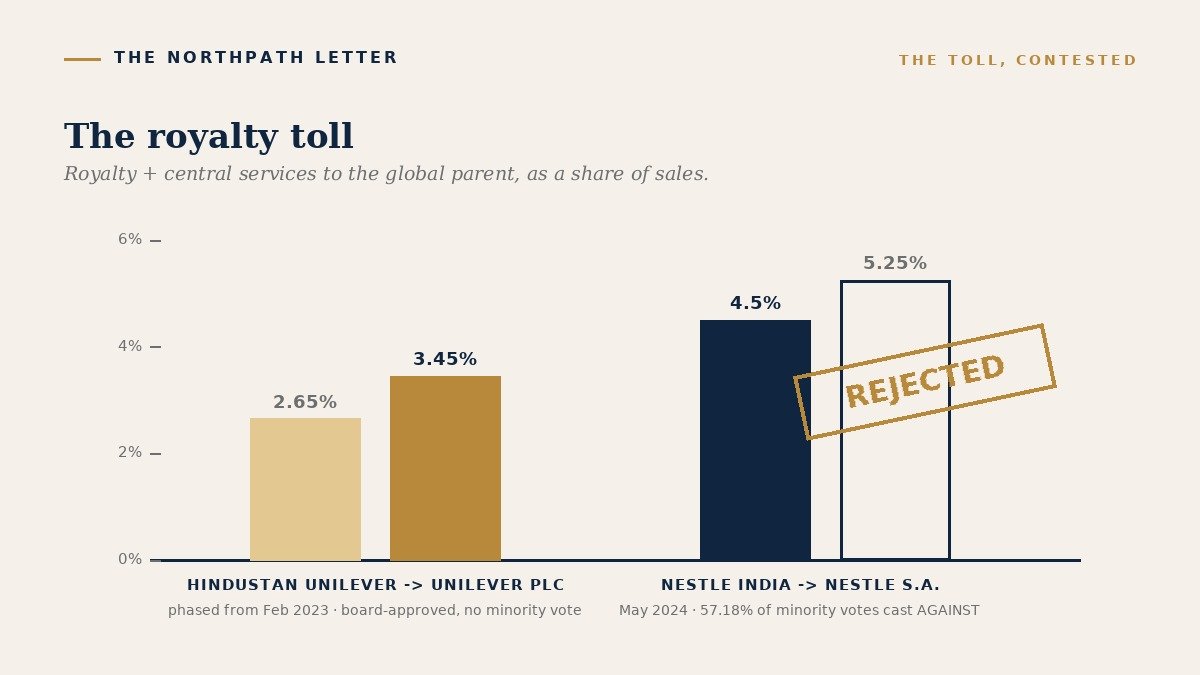
That vote deserves to be read as a structural event, not a news item. The majority-of-minority machinery — Section 188 of the Companies Act 2013 read with LODR Regulation 23 — exists precisely because Indian listed companies are overwhelmingly controlled enterprises, as Issue 3 of this letter set out. The Nestlé vote demonstrated the machinery functioning as designed: the controlling shareholder proposed, the minority disposed. For a reader of FMCG accounts, the practical lesson is that the royalty note is not boilerplate. It is a live negotiation, annually disclosed, in which your interests and the parent’s diverge by definition.
A reader should therefore treat the royalty line as a third claim on the business, ranking ahead of both tax and dividend: compute it as a percentage of sales and of pre-royalty profit, trace its trajectory over a decade, and check whether increases were put to — or kept away from — a minority vote. The numbers are all in the related-party schedule; the work is twenty minutes.
The state as restructurer
The third structural force is the state — not as regulator of the product, but as designer of the plumbing through which the sector’s goods and taxes flow. The Goods and Services Tax of 2017 was the largest single restructuring event in the sector’s modern history: by collapsing state-by-state levies into one national tax with creditable input chains, it shrank the cost advantage of the unorganised, tax-light manufacturer and handed share to the branded, compliant incumbent. Formalisation, in this sector, is a tailwind with a legislative serial number.
The state adjusted the plumbing again, dramatically, in 2025. On 3 September 2025 the GST Council abolished the 12 and 28 per cent slabs outright, moving to a two-rate structure of 5 and 18 per cent (with a 40 per cent rate reserved for demerit goods), effective 22 September 2025. Nearly everything in the old 12 per cent slab — packaged foods, sauces, namkeens, instant noodles, chocolates, butter, ghee — dropped to 5 per cent. For a sector whose demand curves are written in ₹5 and ₹10 price points, a seven-point tax cut on packaged food is not a rounding adjustment; it is a volume event, and the quarters since have been a live experiment in how much of the cut is passed through, how fast trade inventories bought at old rates unwind, and whose price points reset first.
The pattern for the structural reader is consistent: in Indian FMCG, the tax code is a competitive weapon that none of the competitors controls. Every major reset — 2017, 2025 — has transferred share toward the organised incumbents the pyramid already serves.
The dark store: the first real attack in fifty years
Which brings us to the fourth and newest force, the one that earns this letter its title. The pyramid has repelled every previous challenger — supermarkets stalled against real-estate costs and kirana convenience; first-generation e-commerce foundered on delivery economics for low-value baskets. The dark store is different, because it does not try to out-shop the kirana. It replicates the kirana’s two genuine advantages — proximity and immediacy — inside a closed warehouse of one to two thousand square feet, stocked by algorithm, delivering in ten minutes.
The scale is no longer hypothetical. By March 2026 the three large platforms operated 4,081 dark stores between them — Blinkit at 1,954, Zepto at 1,089, Swiggy Instamart at 1,038 — across four hundred-odd cities, with the leader publicly targeting three thousand stores of its own by March 2027. The Indian quick-commerce market, around $6.8 billion in 2025, is projected to roughly double by 2029. Quick commerce already carries the substantial majority of e-grocery orders — a May 2025 Bain–Flipkart study put it above two-thirds — and contributes, by NielsenIQ-derived estimates, over three-fourths of the FMCG sales that flow through e-commerce. In affluent urban micro-markets, the channel is now a third of online FMCG purchase occasions for some households.
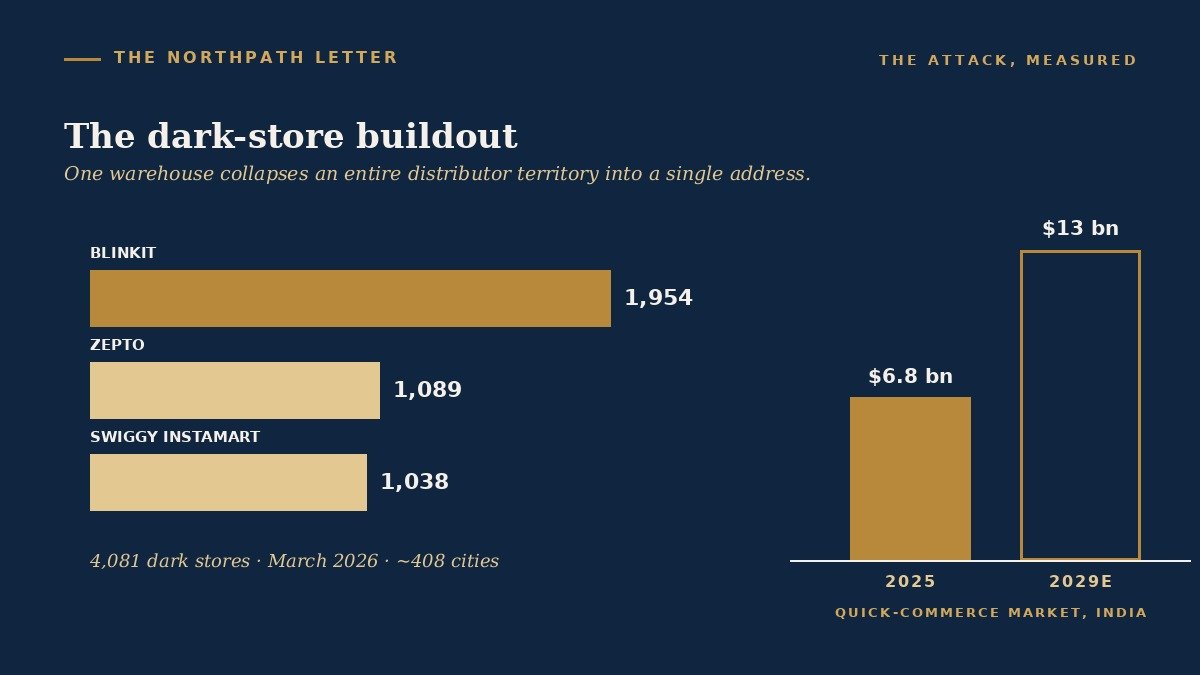
For the manufacturers, the dark store is a paradox: a channel that grows their sales while corroding their structure. The pyramid’s value lies in the difficulty of reaching thirteen million counters; a dark store collapses an entire distributor territory into a single delivery address. Selling to it is operationally trivial — which is exactly the problem. A channel that is trivial to serve is trivial for your competitor to serve too, and it concentrates bargaining power in three platforms in a way the fragmented kirana base never could. The Western disease the pyramid had inoculated India against — the powerful retailer who owns the customer and squeezes the supplier, then launches a private label against him — arrives in India not as a hypermarket but as an app. Blinkit’s inventory-led pivot and stated private-label ambitions make the parallel explicit.
The incumbents’ response, visible through 2025 and 2026, has been instructive on both flanks. Toward the platforms: dedicated quick-commerce pack sizes, channel-specific teams, and careful price-parity management to keep the kirana from open revolt. Toward the pyramid: a pointed re-engagement with general trade — wider assortments, better trade margins, faster replenishment — reported across ITC, Tata Consumer and Dabur by mid-2025, precisely because the kirana remains eighty-plus per cent of volume and one hundred per cent of the moat. And at portfolio level, the era’s signature move is focus: ITC demerged its hotels in January 2024; Hindustan Unilever demerged its ice-cream business into Kwality Wall’s (India) Limited with a record date of 5 December 2025, every shareholder receiving one share of the new company per HUL share. Cold-chain ice cream — capital-hungry, infrastructure-heavy, strategically distant from the soap-and-sachet pyramid — is exactly what a structure-minded board sheds when the core structure comes under attack.
Distribution disruption, it should be said plainly, cuts both ways on the income statement. The same dark store that threatens the pyramid’s exclusivity also delivers premium products to postcodes no distributor van found economic, at fulfilment costs the platform — not the manufacturer — bears. Whether quick commerce is net moat-erosion or net market-expansion is the single most important open structural question in Indian consumer goods, and a reader should hold it as a question, not an answer.
How to read an Indian FMCG annual report
The framework above converts into a concrete reading drill. Seven steps, in the order a practitioner would take them.
First, split growth into volume and price. The management discussion will headline revenue growth; find the underlying volume growth figure (companies now disclose it, NielsenIQ corroborates it). A business growing 12 per cent in value and 2 per cent in volume is a different organism from one growing 8 and 6.
Second, check the sign of working capital. Current assets minus current liabilities, excluding cash and borrowings. The franchise’s health shows here before it shows in margins: a negative cycle drifting positive means the trade is no longer financing the company — often the first quantitative trace of channel power shifting.
Third, read the royalty as a third claim. From the related-party schedule (Ind AS 24), take royalty plus technical and central-service fees as a percentage of turnover; trace ten years; note whether each step-up faced a minority vote under LODR Regulation 23. Compare against the Nestlé May 2024 precedent.
Fourth, find the channel mix. Disclosure is improving: investor presentations now quantify e-commerce and quick-commerce salience, modern trade share, and rural-urban splits. What management chooses to disclose — and ceases disclosing — about quick commerce is itself a signal.
Fifth, treat advertising spend as capex in disguise. The A&P line in the P&L is the annual maintenance charge on the brand layer of the moat. A margin expansion achieved by cutting A&P is borrowing from the moat to pay the current year’s optics.
Sixth, for the conglomerates, apply the segmental discipline. ITC’s cigarettes-funding-FMCG arithmetic, or any diversified house, is only legible through the Ind AS 108 operating-segment note this letter dissected in Issue 8 — segment ROCE separates the franchise from its passengers.
Seventh, listen for the pyramid’s own health. Distributor counts, direct-coverage outlet numbers, trade-scheme spending buried in “other expenses”, and any sudden growth in returns or inventory at the distributor layer. The pyramid reports its condition every year, in fragments, to the reader patient enough to assemble them.
The takeaway
None of this, to be explicit, is a comment on whether any security named above is attractively priced; companies are named because they are the structure’s clearest exhibits, and this letter holds no view on their shares. The structural claim is narrower and, I think, more durable: Indian FMCG’s extraordinary economics were never really about soap. They were about the pyramid — and for the first time in five decades, the pyramid has a serious rival with an address, an algorithm and a balance sheet.
The one-line takeaway: in Indian consumer goods, the moat was never the brand alone but the thirteen-million-storefront machine beneath it — so read the working-capital sign, the royalty toll and the channel mix before you read a single adjective about the brand.
Disclosure
This letter is journalism and education for a general audience. Nothing in it constitutes investment advice or a recommendation in respect of any security or financial instrument, nor an offer or solicitation to buy or sell anything. Companies and events are named only as factual or historical illustration, and the author holds no position in any security mentioned. Regulatory provisions are summarised for the general reader and are not a substitute for the text of the regulations or for professional advice; readers should consult an adviser authorised in their own jurisdiction before making any decision.
— Manish Goel, FCA · The NorthPath Letter · Tallinn