The NorthPath Letter · Behavioural Finance · Afternoon Edition
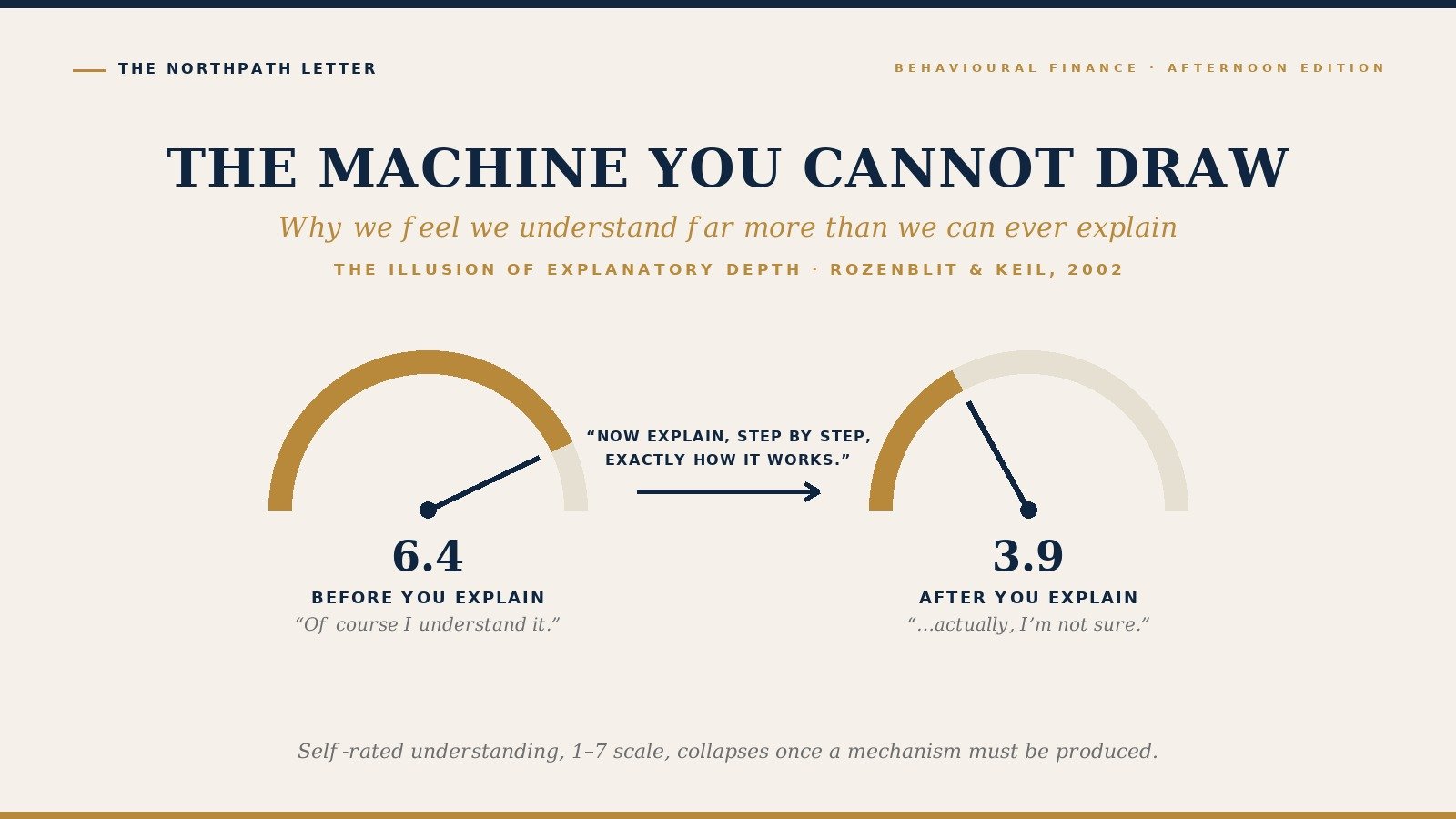
Ask yourself how well you understand a bicycle. Not in the abstract — the actual machine. On a scale of one to seven, how completely could you explain why turning the pedals moves it forward, where the chain runs, how the gears change the ratio, why it stays upright at all? Most people answer confidently: a five, a six. Then comes the second instruction, and it is a quiet act of demolition. Now draw one. Put the frame, the chain, the pedals and the wheels in their correct places, and explain each step of how the parts work together. The pen hesitates. The chain ends up looping the wrong cogs, or connecting both wheels, or going nowhere. Asked again to rate their understanding, the same people drop two whole points. Nothing about the bicycle changed in those two minutes. What changed was the discovery that a feeling of understanding had been standing in for the thing itself.
The bias: a confidence that survives only until it is tested
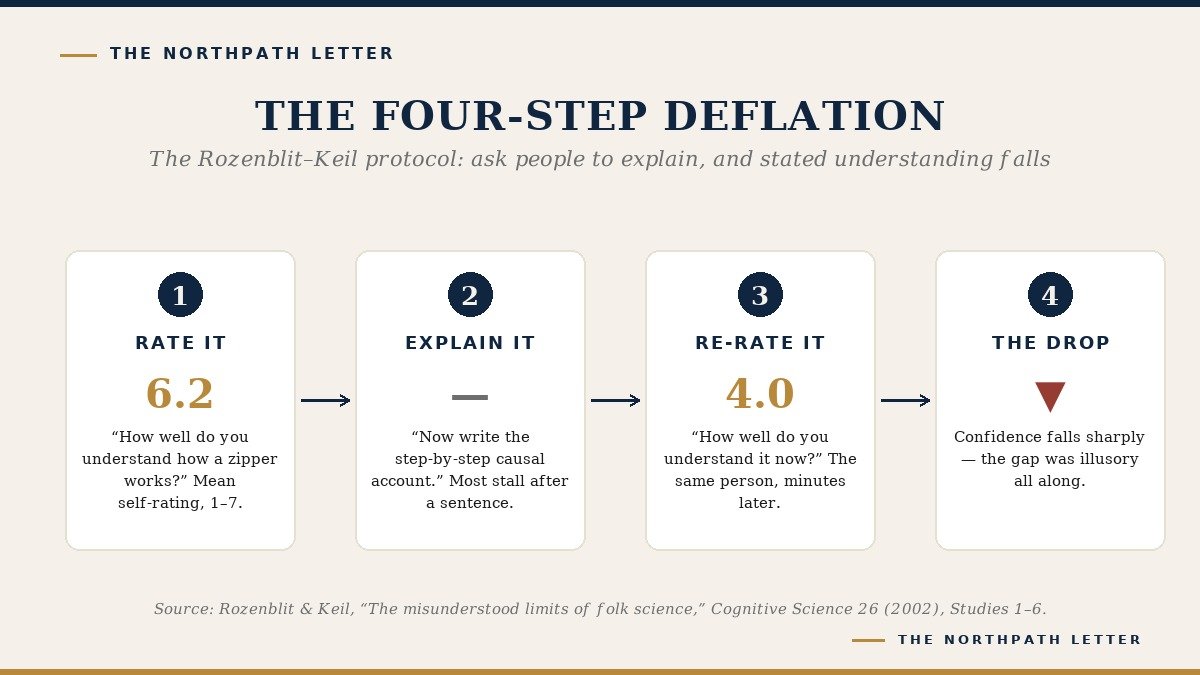
This gap between felt comprehension and demonstrable comprehension is the illusion of explanatory depth. It was named and measured by Leonid Rozenblit and Frank Keil of Yale in a 2002 paper in Cognitive Science with a deliberately wry title: “The misunderstood limits of folk science: an illusion of explanatory depth” (Rozenblit & Keil, Cognitive Science 26(5):521–562, 2002). Their method was elegant in its cruelty. They asked subjects to rate, on a one-to-seven scale, how well they understood everyday devices — a zipper, a flush toilet, a cylinder lock, a helicopter, a sewing machine. Then they asked them to produce a full, step-by-step causal explanation of how the device worked. Then they asked them to re-rate their understanding. Across the studies, the re-rating fell sharply. The mere attempt to articulate a mechanism punctured a confidence that had felt entirely solid moments before.
The crucial detail is that this collapse is specific to explanatory knowledge. Rozenblit and Keil ran the same paradigm on other kinds of knowledge — facts, procedures, narratives — and the effect was far weaker or absent. People are reasonably well calibrated about whether they know a capital city, a recipe, or the plot of a film. They are badly miscalibrated about whether they understand how a thing works. We carry, it turns out, an inflated sense of the depth and coherence of our mechanistic understanding of the world, and that inflation deflates the instant we are made to cash it out in an actual chain of cause and effect.
The mechanism: why the feeling outruns the knowledge
Why should the mind systematically overrate its own grasp? Rozenblit and Keil offered several mutually reinforcing explanations, and later work has thickened the account. The first is that we confuse familiarity and recognition with comprehension. We have seen bicycles ten thousand times; we can picture one in vivid detail; we can use one without falling. The fluency of that perceptual and motor familiarity is read, wrongly, as evidence of understanding the underlying mechanism. The mind treats “I can recognise this and operate it” as if it were “I can explain this.”
The second is the seductiveness of mental imagery. Mechanical systems present their parts to the eye. You can visualise a zipper’s teeth interlocking, and the richness of that image masquerades as a richness of causal knowledge. But a picture of the teeth is not an account of why the slider forces them together on the way up and apart on the way down. The image is detailed; the explanation behind it is thin; and because the image is the part that reaches consciousness, the thinness goes unnoticed.
The third, and for investors the most important, is that explanations have levels, and we mistake possession of one level for possession of them all. I can say “a bicycle’s gears change the mechanical advantage.” That is a true statement at a high level. It generates the feeling of an explanation while concealing that I cannot specify the level below it — the actual geometry of sprockets and chain. There is almost always a coherent explanation somewhere — engineers understand bicycles completely — and we quietly borrow the existence of that explanation in the world as if it were resident in our own heads. The division of cognitive labour in a complex society makes this borrowing efficient most of the time, and dangerous exactly when we must act alone on our own understanding.
A fourth contributor is the scarcity of corrective feedback. We rarely have to produce a full causal account of anything, so the illusion is rarely tested and rarely corrected. The Rozenblit–Keil protocol works precisely because it manufactures the feedback that ordinary life withholds: it forces the explanation into the open, where its gaps become visible. Absent that forcing, the inflated estimate simply persists, untouched, available to be acted upon.
The empirical record: from zippers to ballot boxes to balance sheets
The original finding has proved robust and has travelled well beyond household gadgets. Rebecca Lawson’s much-cited 2006 study (Memory & Cognition 34(8):1667–1675) handed people a schematic of a bicycle with parts missing and asked them to complete it; a large fraction of adults — including many who rode regularly — drew frames and chains that could not possibly function, while having confidently claimed to understand the machine. The illusion is not the preserve of the mechanically illiterate; it is the human default.
More consequentially, Philip Fernbach and colleagues showed in 2013 (Psychological Science 24(6):939–946) that the illusion governs not just gadgets but positions. Asked to rate how well they understood complex public policies, people were confident; asked then to explain mechanistically how each policy would actually produce its effects, their confidence fell — and, strikingly, so did the extremity of their stated views. Being forced to confront the shallowness of one’s own causal model induces humility. The companion finding is the warning: merely asking people for reasons to favour a position, rather than a mechanism, produces no such humbling, because reasons can be recited without understanding. Steven Sloman and Fernbach later built their 2017 book The Knowledge Illusion around exactly this theme — that individual minds know far less than they feel they do, and survive by leaning on a community of knowledge they mistake for their own.
The bridge to equity analysis is direct, because security analysis is explanatory knowledge wearing a numerical disguise. To “understand a company” is to hold a causal model of how it converts inputs into durable cash, and of what would have to change for that conversion to stop. Yet the very things that breed the illusion are abundant in markets: a recognisable brand and a familiar product generate fluency that feels like comprehension; a clean chart and a confident narrative supply vivid imagery; and a one-line thesis — “it is a compounder,” “it dominates its category” — delivers the high-level summary that conceals the missing level beneath. Most investors are never forced to write the full mechanism down, so the inflated estimate persists, available to be acted upon at exactly the wrong moment. The discipline of analysis is, in large part, the discipline of manufacturing the Rozenblit–Keil feedback for oneself, on purpose, before committing capital.
Financial regulators have documented the same illusion in the wild, in two different jurisdictions, without ever using the academic term. In the United Kingdom, the Financial Conduct Authority’s 2015 thematic review of structured products (TR15/2) and its accompanying consumer research found that retail customers routinely struggle to understand the complex features of these products and systematically overestimate the returns they will deliver — on average overstating five-year returns by close to a tenth of the amount invested, and failing to recognise that the products were unlikely to beat a plain fixed-term deposit. In the United States, the Securities and Exchange Commission’s Office of Investor Education and Advocacy issued an Investor Bulletin on structured notes in 2015 warning that such notes “can have payout structures that are difficult to understand” and that investors who do not understand how a note works should not assume they do. An SEC official framed the entire problem in a speech whose title is itself a behavioural-finance thesis: “Structured Products — Complexity and Disclosure — Do Retail Investors Really Understand What They Are Buying and What the Risks Are?” The regulators’ implicit model of the investor is precisely Rozenblit and Keil’s subject: confident at the point of sale, unable to produce the mechanism, and unaware of the difference.
Two episodes: when the label was simple and the machinery was not
The illusion is most expensive when a product wears a familiar label over unfamiliar machinery, because the label supplies the false feeling of understanding for free. Two episodes from the same crisis year illustrate the pattern on two continents.
The first is the collapse of the United States auction-rate securities market in February 2008. Auction-rate securities were long-dated instruments whose interest rates were reset at frequent auctions, and they had been marketed to corporate treasurers and individuals alike as “cash equivalents” — as good as a money-market fund, available when you needed your money. The market reached roughly $330 billion. What buyers were not told, and mostly did not understand, was that the apparent liquidity depended entirely on the dealer banks themselves quietly placing support bids whenever genuine demand fell short. When those banks, under their own strains, stepped away in February 2008, around 85 per cent of auctions failed almost at once, and holders discovered that their “cash” was frozen, sometimes for years. Investors had bought a label — cash-equivalent — and never possessed the mechanism beneath it. Regulators and state authorities ultimately drove settlements in which firms repurchased tens of billions of dollars of the securities, an admission, in effect, that the gap between what buyers thought they understood and what they had actually bought was the firms’ to answer for.
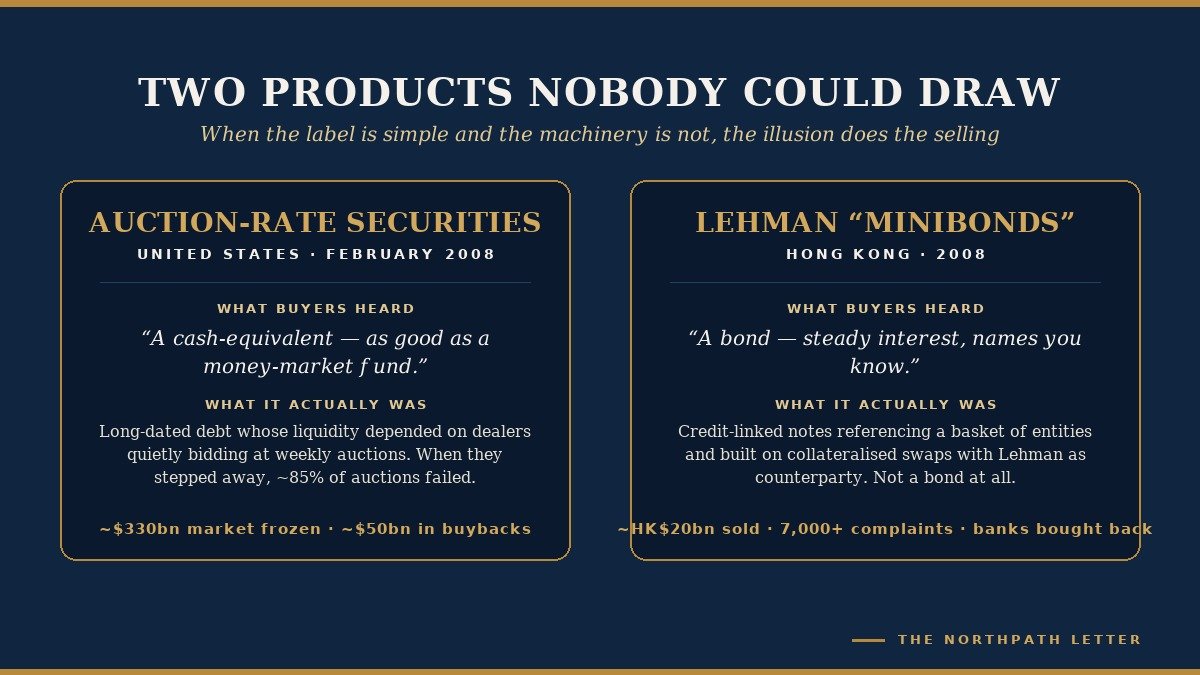
The second episode unfolded in Hong Kong and across parts of Asia in the same autumn: the Lehman Brothers “minibonds.” The name did the damage. A “minibond” sounds like a bond — a modest, steady instrument paying interest, referencing names the buyer recognised. In reality these were credit-linked notes, structured on collateralised swap arrangements with Lehman Brothers as a key counterparty; their value depended on credit events affecting a basket of reference entities and on Lehman’s own solvency. When Lehman failed in September 2008, tens of thousands of ordinary Hong Kong savers, many of them elderly, found that roughly HK$20 billion of supposed “bonds” had become something they could neither value nor explain. The Hong Kong Monetary Authority received thousands of mis-selling complaints, and distributing banks were eventually pressed into large-scale buybacks. The buyers had not been reckless gamblers. They had bought a word that felt fully understood — bond — wrapped around machinery that almost no retail buyer, and arguably few of the sellers, could have drawn with a crayon.
The counter-measure: three disciplines that force the mechanism into the open
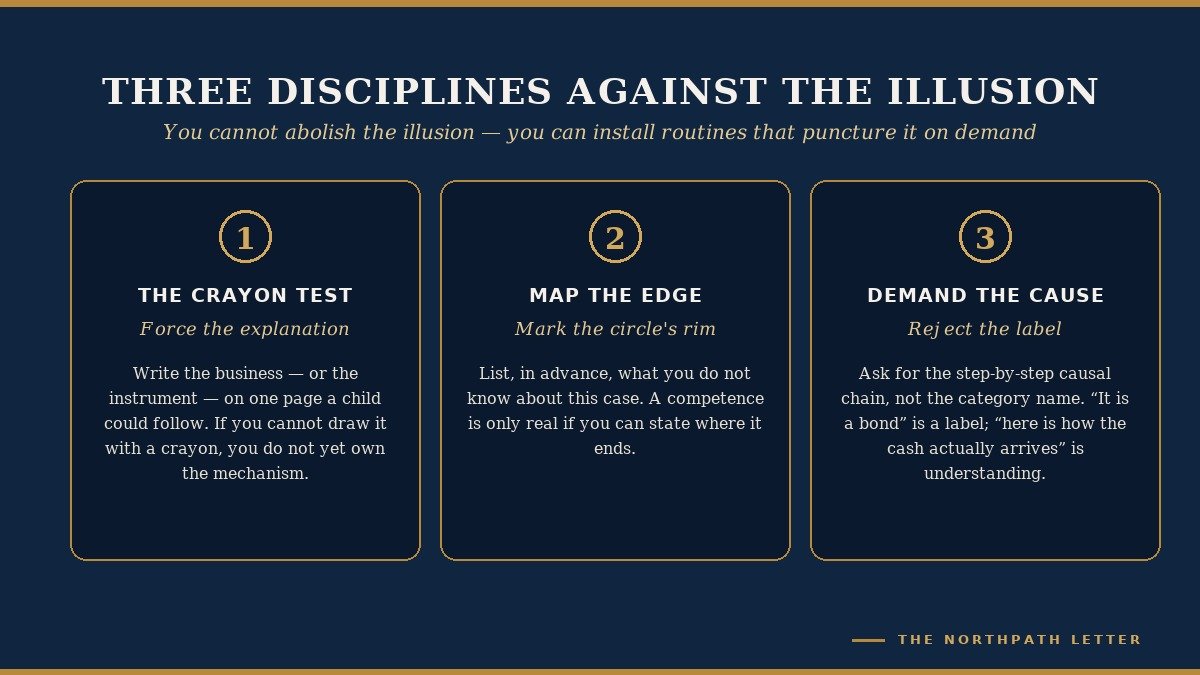
You cannot abolish the illusion of explanatory depth; it is a structural feature of how the mind economises. What you can do is install routines that, like the Rozenblit–Keil protocol, manufacture the missing feedback on demand — that force you to cash out the feeling of understanding into an actual chain of cause and effect before money is committed.
The first discipline is the crayon test: before buying anything, write the business, or the instrument, on a single page that a reasonably bright child could follow — where the cash comes from, what has to remain true for it to keep coming, and what could stop it. If you cannot draw it that simply, you do not yet own the mechanism, no matter how confident the feeling. The test is valuable precisely because it is humiliating; it is the moment the pen hesitates over the bicycle chain, deliberately provoked.
The second discipline is to map the edge of your competence rather than its centre. Before each decision, list, in advance and in writing, the specific things you do not know about this particular case — the assumptions you are taking on trust, the parts of the machine you are borrowing from someone else’s understanding. A competence is only real if you can state where it ends; an investor who cannot name the boundary of his knowledge does not have knowledge, he has the illusion of it.
The third discipline is to demand the cause, not the label. When a product or a thesis is offered to you, refuse the category name and ask for the step-by-step causal account. “It is a bond,” “it is a cash-equivalent,” “it is a compounder,” “it is AI” — these are labels, and labels are exactly the currency the illusion trades in, because a familiar word generates the feeling of understanding at no cost. “Here is precisely how the cash arrives, and here is what must hold for it to keep arriving” is understanding. The difference between the two sentences is the difference between the buyers of 2008 and the people who declined to buy.
How long-term practitioners armoured themselves against it
The most durable equity investors built their entire method around the suspicion that they understood less than they felt they did — long before psychologists gave the bias a name. Warren Buffett and Charles Munger made the point the cornerstone of their approach with the idea of the circle of competence. Buffett’s repeated insistence is that what matters is not how large the circle is but how honestly you know its boundary: an investor who operates strictly inside the perimeter of what he can actually explain will do well, while one who strays outside it — however clever — eventually meets a machine he cannot draw. Munger put the discipline in its bluntest form: the first rule of competence is knowing the edge of your own, and “knowing what you don’t know is more useful than being brilliant.” Their decades-long refusal to buy technology businesses they could not mechanistically forecast was not technophobia; it was the crayon test, applied with iron consistency, to companies whose labels were exciting and whose cash mechanics they judged themselves unable to draw.
Peter Lynch reached the same place from a different temperament. His most quoted maxims are, in substance, anti-illusion routines: “Know what you own, and why you own it,” and “Never invest in any idea you can’t illustrate with a crayon.” Lynch’s celebrated openness to ordinary, recognisable businesses is sometimes misread as a licence to buy what is familiar. It is the opposite. Familiarity, as Rozenblit and Keil showed, is the very thing that breeds the false feeling of understanding; Lynch’s rule converts familiarity into a starting point that must still be earned by a plain, mechanistic account of how the company makes money. The crayon is not a lowering of the bar. It is the device that exposes whether the understanding was ever there.
Key Takeaways
- The feeling of understanding is not understanding. Rozenblit and Keil (2002) showed that self-rated comprehension of how things work collapses the moment people are asked to produce an actual step-by-step mechanism — and the same gap governs investors as governs people explaining zippers.
- The illusion is specific to explanatory knowledge and fed by familiarity. We are well calibrated about facts and procedures but badly overconfident about mechanisms, because we mistake recognition, vivid imagery, and a high-level summary for the causal chain beneath them.
- Regulators have documented it on both sides of the Atlantic. The FCA’s structured-products work and the SEC’s structured-notes bulletin both describe retail buyers who are confident, who overestimate returns, and who cannot assess products they believe they understand.
- The danger peaks when a simple label hides complex machinery. Auction-rate securities sold as “cash-equivalents” (US, 2008) and Lehman “minibonds” sold as “bonds” (Hong Kong, 2008) both monetised the illusion: buyers possessed the word, not the mechanism.
- The counter-measures are routines, not insights. Force the explanation (the crayon test), map the edge of your competence in writing, and demand the cause rather than the label — the same disciplines Buffett, Munger and Lynch built their records upon.
— Manish Goel, FCA / NorthPath Advisory OÜ / Tallinn, Estonia
|
Important. |