Afternoon Edition — Mental Models
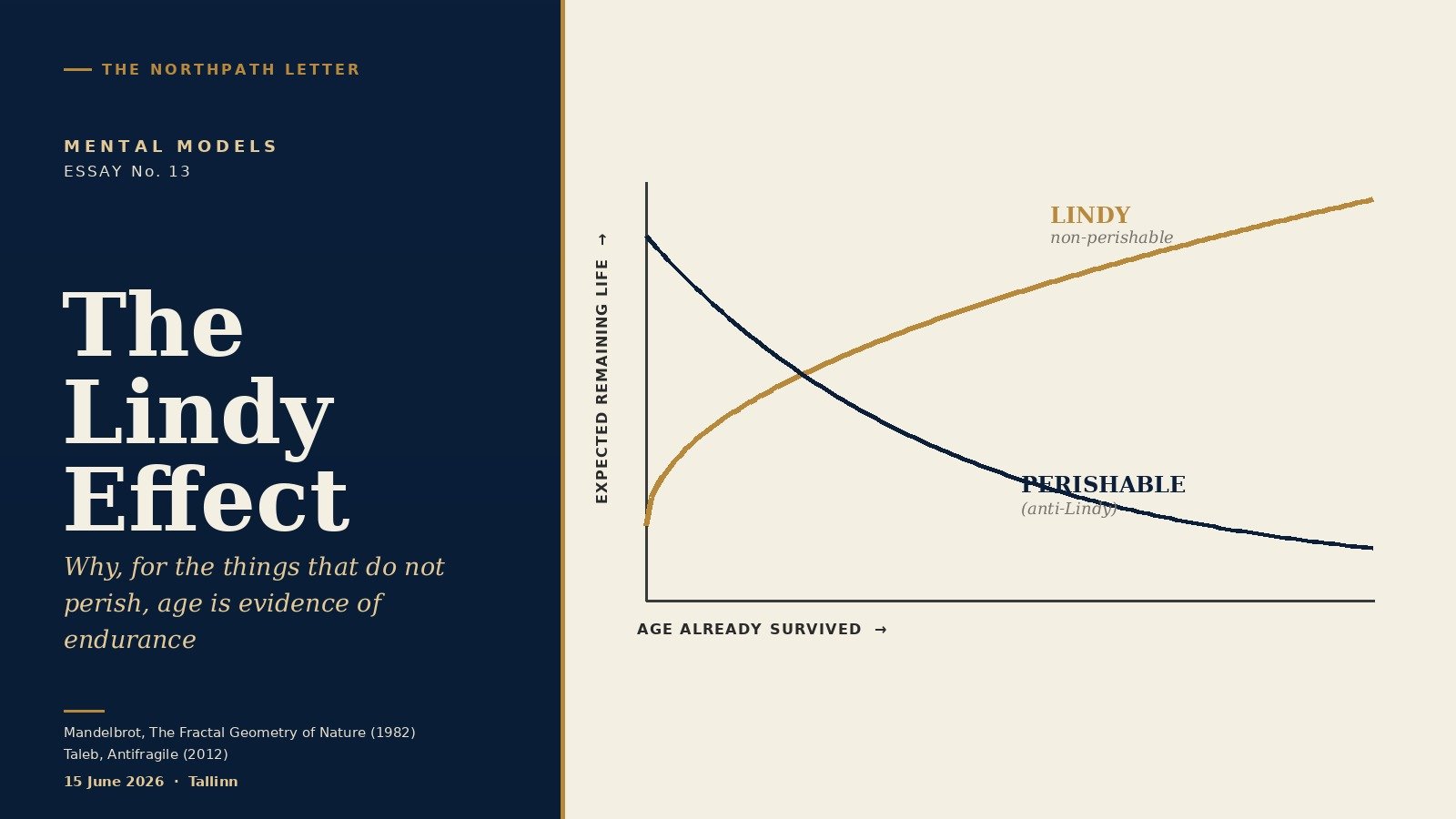
There is a particular kind of confidence that the passage of time confers, and most investors apply it backwards. A business that has just listed, with a soaring chart and a thrilling story, feels like the safer bet than the unglamorous manufacturer that has been compounding quietly since before the Second World War. The Lindy effect says the instinct is inverted. For a certain class of things, the longer they have already lasted, the longer they are likely to last still. Age is not a countdown. It is a track record — and, properly understood, it is evidence.
The model: a showbiz joke, reversed by a mathematician
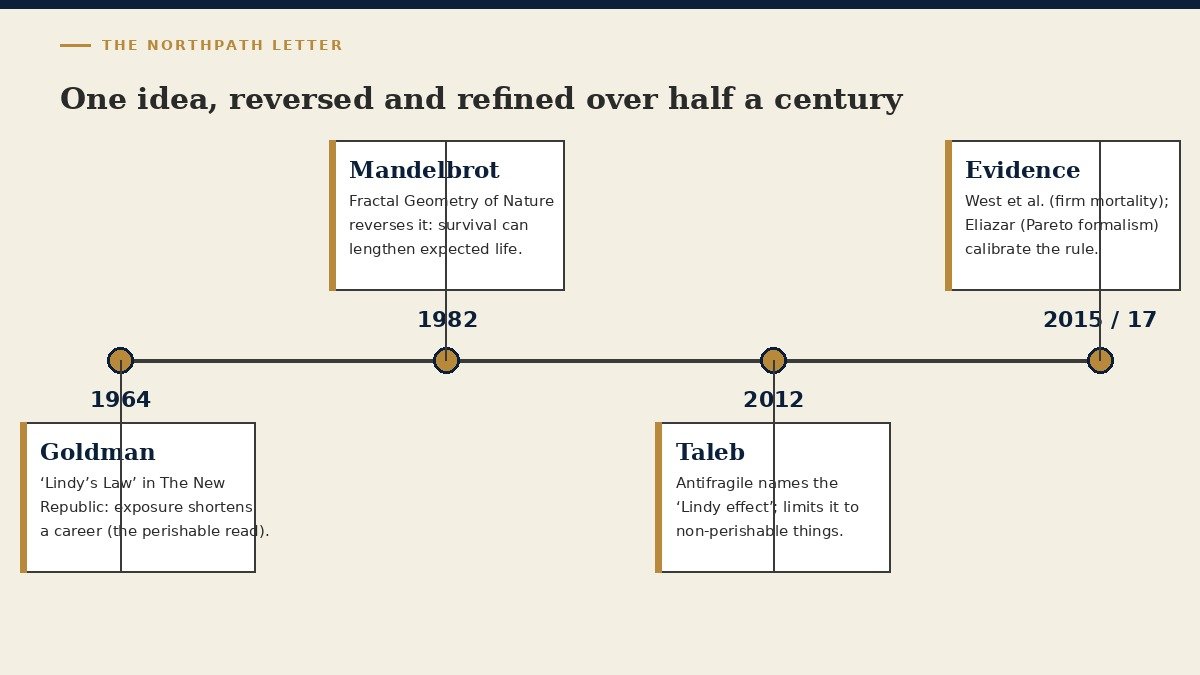
The idea entered print as a piece of Broadway folklore. In June 1964 the cultural critic Albert Goldman published a short essay in The New Republic titled simply “Lindy’s Law,” named after Lindy’s delicatessen on Broadway, where comedians gathered late at night to dissect one another’s careers (Goldman, “Lindy’s Law,” The New Republic, 13 June 1964). The law as the comedians told it was pessimistic: a performer has only so much material, so the more heavily he is exposed on television, the faster he burns through it, and the sooner he is finished. In that original telling, exposure shortened the expected remaining life of a career.
Roughly two decades later the mathematician Benoît Mandelbrot took the same observation and reached the opposite conclusion. In The Fractal Geometry of Nature (1982) he treated the survival of a creative work or a technology not as the depletion of a fixed stock but as a draw from a heavy-tailed distribution, and noted that for such processes the expected future life can increase with the life already lived. Nassim Nicholas Taleb adopted Mandelbrot’s version, sharpened it, and gave it its modern name in Antifragile: Things That Gain from Disorder (Random House, 2012). In Taleb’s formulation the Lindy effect applies to the “non-perishable” — ideas, books, technologies, institutions, formulas, brands — anything that is informational rather than physical and does not have a biologically fixed lifespan.
The one-sentence form is this: for a non-perishable thing, every additional period it survives lengthens, rather than shortens, its expected remaining life — so endurance breeds the expectation of further endurance. A book in print for fifty years can be expected to remain in print far longer than a book published last spring; a technology in daily use for forty years is a better bet to be in use in 2050 than one launched this quarter. The reversal Mandelbrot performed on Goldman is the whole point: among non-perishables, survival is not consumption of a finite reserve. It is a signal.
The mechanism: why age can be informative
The Lindy effect is not magic; it is a property of a specific family of survival curves. A human being is “perishable”: mortality rises steeply with age, so a 90-year-old has a far shorter life expectancy than a 30-year-old. Most engineered objects are perishable too. The Lindy class behaves differently because its survival times follow a power-law, or Pareto, distribution rather than a thin-tailed one. Under such a law the hazard of disappearing does not climb with age; for the purest case it falls, so that the conditional expectation of remaining life is proportional to age already attained. Iddo Eliazar gave the relationship its formal statistical treatment, showing that Lindy behaviour corresponds exactly to lifetimes drawn from a Pareto law and tying it to the same mathematics that governs Zipf’s law and socioeconomic inequality (Eliazar, “Lindy’s Law,” Physica A: Statistical Mechanics and its Applications, vol. 486, pp. 797–805, 2017).
Intuitively, the reasoning is a form of Bayesian updating on durability. When you do not know in advance how robust a thing is, its continued survival is data. Each year it remains standing makes the hypotheses “this is fragile and short-lived” less likely and “this is robust and long-lived” more likely. A pop song that is still played thirty years after release has demonstrably survived shifts in taste, format and generation; that demonstrated robustness is exactly what raises the odds it survives the next thirty. The age is not causing the longevity. The age is revealing a robustness that was always present but unobservable at birth.
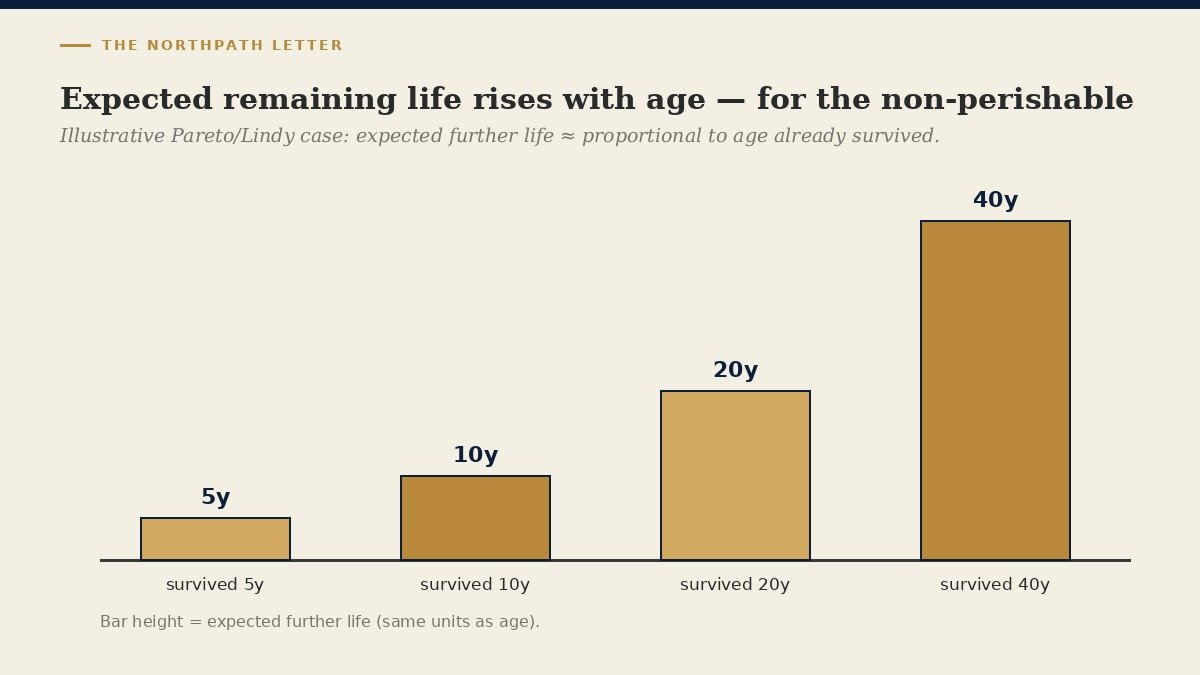
There is a clean quantitative version of this intuition for the purest Lindy case. If lifespans follow the canonical Pareto survival law, the expected remaining life of a surviving thing is simply proportional to the age it has already reached: a technology in use for ten years has an expected further life on the order of ten more, one in use for forty years an expected further life on the order of forty. The proportionality constant depends on the tail of the distribution, and real-world cases are messier than the textbook law, but the qualitative shape is the lesson. Where survival times are heavy-tailed, the right forecast of how much longer something will last is anchored to how long it has already lasted — not to a fixed actuarial table that ignores history. This is why, for the non-perishable, the question “how old is it?” is not idle curiosity but the single most useful input available.
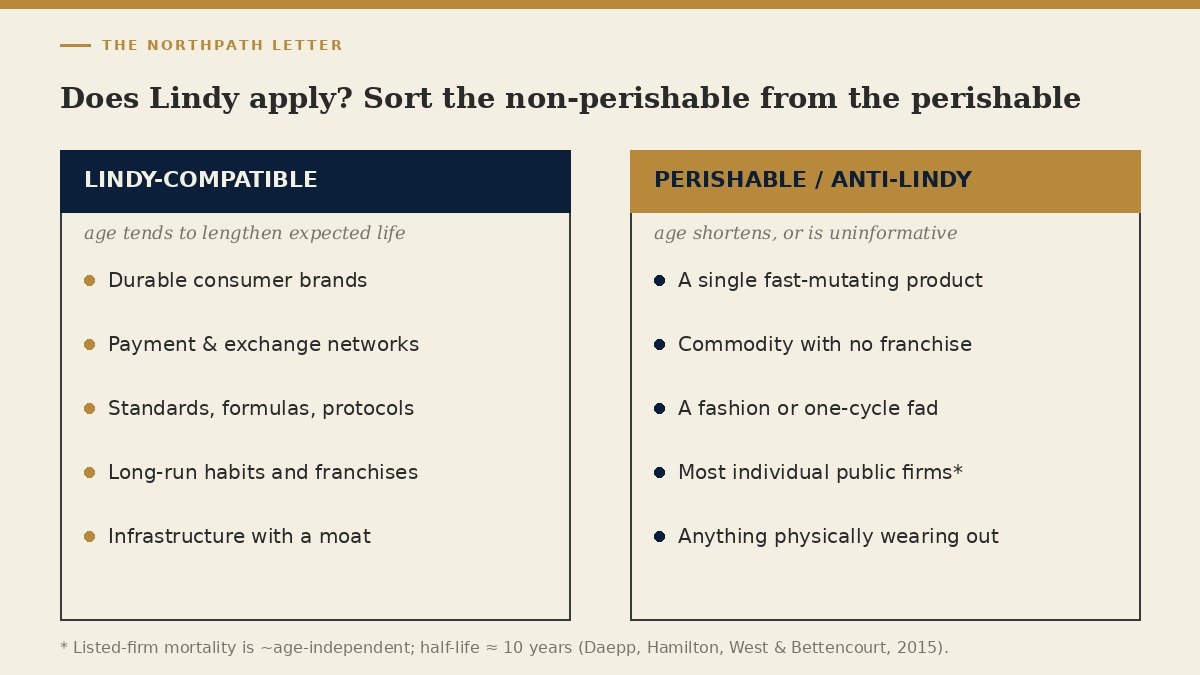
The boundary condition matters more than the rule, and Taleb is emphatic about it. The Lindy effect holds only for the non-perishable. Apply it to a perishable thing and you get the reverse, the “anti-Lindy” case: a ninety-year-old man, a battery, a carton of milk. The investor’s analytical task, therefore, is never simply “this has lasted, so it will last.” It is the harder, prior question: is the thing I am looking at the kind of thing to which Lindy can even apply? A durable consumer brand, a payments network, a tollroad-like franchise — these may be Lindy-compatible. A single technological product in a fast-mutating category may be deeply perishable however long its parent firm has existed.
The empirical record: most companies are not Lindy
Honesty requires a sharp caveat, and it is the most useful thing in this essay. At the level of the individual public company, the Lindy effect largely does not hold. The most careful study of corporate lifespans was conducted by researchers at the Santa Fe Institute, who examined more than 25,000 publicly traded North American companies from 1950 to 2009 (Daepp, Hamilton, West & Bettencourt, “The mortality of companies,” Journal of the Royal Society Interface, vol. 12, 20150120, 2015). Their finding was striking: the mortality of listed firms follows an approximately constant hazard rate, independent of age and largely independent of sector. The typical half-life of a public company is about a decade. A constant hazard means firm death looks more like radioactive decay than like Lindy — the company that has lasted forty years is, on this evidence, no less likely to die in the coming year than one that has lasted four.
This is not a refutation of the model; it is its correct calibration. It tells the investor that the Lindy property is rare and must be earned, not assumed from a long incorporation date. Most enterprises are closer to perishable. The minority that genuinely exhibit Lindy behaviour — whose survival probability actually improves with age because each decade deepens a brand, widens a network, entrenches a standard, or compounds a cost advantage — are precisely the franchises the long-term equity tradition has always prized. The corporate-mortality data and the Lindy heuristic are therefore complements: the first warns you that durability is the exception, the second tells you what the exception looks like and why age, where it is real, is informative.
Two independent lines of work reinforce the warning. Richard Foster and Sarah Kaplan’s Creative Destruction (Doubleday, 2001) documented the relentless turnover of the largest American corporations across the twentieth century, with average index tenure falling decade by decade. Arie de Geus, in The Living Company (Harvard Business School Press, 1997), estimated that the average life expectancy of a multinational was well under fifty years, while a rare cohort of survivors persisted for centuries. The picture that emerges is bimodal: a large, perishable majority and a small, Lindy-compatible minority of genuine survivors.
Two episodes the model explains
Consider first Coca-Cola. The formula was first sold in an Atlanta pharmacy in 1886. By the time Berkshire Hathaway began buying the shares in 1988 — eventually accumulating a stake of roughly a billion dollars — the product had already survived prohibition, the Depression, two world wars, sugar rationing, the rise and fall of countless rival beverages, and a notorious self-inflicted wound in the 1985 “New Coke” reformulation, from which the original promptly returned stronger. A century of survival across that range of shocks was not a guarantee of the future, but it was powerful evidence about the robustness of the franchise: a brand, a distribution system and a habit that had repeatedly demonstrated they could absorb disruption. The Lindy reading of 1988 was that a hundred-year-old consumer franchise had earned a long expected remaining life. Nearly four decades later the product is still sold in more than two hundred territories. Age was evidence, and the evidence held.
Contrast the dot-com cohort of 1999–2001. Webvan, the online grocery venture, completed its initial public offering in November 1999 with a multi-billion-dollar valuation and almost no operating history; it filed for bankruptcy in July 2001, less than two years later. Pets.com listed in February 2000 and was liquidated before the year was out. These were not failures of vision alone — online grocery and pet supply are now large industries — but failures of durability testing. The businesses had no track record across a single full cycle, no demonstrated capacity to survive a downturn, no evidence of robustness beyond a narrative. A Lindy-minded observer would not have claimed to know they would fail; he would have insisted that nothing about their brief lives entitled anyone to assume they would last. The base rate for the unproven is short. When the funding climate turned, the perishable perished, exactly as the absence of any survival evidence should have warned.
The two episodes are not a counsel to buy old companies and shun new ones. They are an illustration of where the burden of proof lies. The century-old franchise had supplied evidence of robustness; the two-year-old venture had supplied only a story. Lindy is a rule about how to weigh that difference.
It is worth noting how each story interacts with valuation, because durability and price are not the same thing. The Lindy reading never claimed Coca-Cola was cheap in 1988, nor that the dot-com ventures were doomed in every possible future; it claimed only that one franchise had earned a long expected life and the others had not. An investor can still overpay grievously for a genuinely durable business, and several of the proven franchises of the late 1990s were later poor investments precisely because their durability was bought at an extravagant multiple. Lindy speaks to the longevity of the business, not to the adequacy of the entry price. Both judgments are required, and the model is explicit that it answers only the first.
Application: three operating disciplines
The first discipline is to treat demonstrated survival as a screen, not a conclusion. A long history of profitable operation through varied economic weather is one of the few pieces of genuinely hard evidence available to an outside investor. A business that has earned good returns on capital across multiple cycles, recessions and management teams has revealed something about its structural robustness that no projection can. The discipline is to give real analytical weight to that lived record — to ask how many independent shocks a franchise has already absorbed — while remembering that the record screens for robustness rather than proving it.
The second discipline is to separate the perishable layer from the non-perishable layer of any business. Within a single company there is usually a durable core and a perishable surface. The Coca-Cola brand and bottler network is far more Lindy than any particular flavour or marketing campaign. A railway’s right-of-way is more durable than its rolling stock; a payment network’s merchant-and-cardholder habit is more durable than any app interface. The analyst’s job is to locate the long-lived asset and ask whether the company’s economics rest on it or on the perishable layer above it. Where the value depends on something that mutates every few years, a long corporate age offers little comfort.
The third discipline is to respect the corporate-mortality base rate and price accordingly. Because the average listed company has a half-life of roughly a decade, durability is scarce, and scarce things are routinely mispriced in both directions. The market sometimes over-pays for the illusion of permanence in a fashionable name with no real moat, and sometimes under-pays for genuine, unglamorous endurance because endurance is boring. The discipline is to demand a margin of safety that reflects the true odds — to assume perishability as the default and to require positive evidence, in the form of a demonstrated and mechanistically explicable track record, before granting any business the benefit of the Lindy doubt.
How the long-term equity tradition has used it
Warren Buffett expressed the Lindy intuition years before Taleb named it. In his 1989 Chairman’s Letter to Berkshire Hathaway shareholders he wrote that “time is the friend of the wonderful business, the enemy of the mediocre,” adding that he had been forced to learn the principle the hard way, several times over (Berkshire Hathaway, Chairman’s Letter, 1989). The sentence is Lindy in miniature: for the genuinely robust franchise, additional time deepens the advantage and lengthens the runway, whereas for the weak business time merely surfaces more problems. Buffett’s Coca-Cola purchase the year before was the doctrine in action — a deliberate bet on a franchise whose century of survival was treated as evidence of durability rather than as a sign it was running out of road. His and Charlie Munger’s lifelong preference for businesses with long, legible histories over exciting newcomers is, in substance, a Lindy preference.
Terry Smith, the founder of Fundsmith, has made the same idea almost a statistical signature of his portfolio. His firm reports the average year of foundation of its holdings, and in recent annual letters that average has sat around 1919 — a portfolio of businesses founded, collectively, more than a century ago (Fundsmith Equity Fund, Annual Letters to Shareholders). Smith compresses his whole philosophy into seven words — “buy good companies, don’t overpay, do nothing” — and the first of those words leans heavily on demonstrated longevity: he prefers franchises that have already proven, across decades and multiple cycles, that they can sustain high returns on capital. Notably, Smith has also let the average founding year drift later as he has added technology businesses, which is itself a disciplined application of the boundary condition: he is willing to back younger firms only where he judges the underlying franchise to be Lindy-compatible rather than merely young and fashionable.
The same instinct runs through the wider tradition. Charlie Munger’s insistence on businesses he could imagine prospering for decades, and Nick Sleep’s argument in the Nomad Investment Partnership letters (2001–2013) that the most robust franchises are those whose competitive position strengthens with scale and time, are variations on the Lindy theme: each treats demonstrated, structurally grounded endurance as the rarest and most valuable evidence an investor can find. The common thread is that none of these investors treats age as decoration. They treat it as a test a business has either passed or not yet sat.
Both practitioners use the model the way it should be used: not as a superstition that old is automatically good, but as a structured prior that demonstrated, mechanistically intelligible survival is the most reliable evidence of durability an investor can obtain — and that such durability, where it is genuine, is the engine of long-term compounding.
Key takeaways
- Lindy reverses the intuition about age. For non-perishable things, expected remaining life grows with age already attained; survival is a signal of robustness, not the depletion of a finite reserve (Mandelbrot 1982; Taleb 2012).
- The rule is conditional on non-perishability. Applied to perishable things — and to single fast-mutating products — it inverts. The prior question is always whether Lindy can apply at all.
- Most public companies are not Lindy. Listed-firm mortality is roughly age-independent, with a half-life of about a decade (Daepp, Hamilton, West & Bettencourt, 2015). Durability is the rare exception that must be earned and explained.
- Use survival as a screen. A track record across multiple cycles is hard evidence of robustness; weigh it heavily, but separate the durable core of a business from its perishable surface.
- The tradition already lives by it. Buffett’s “time is the friend of the wonderful business” and Terry Smith’s century-old average founding year are the Lindy effect applied with discipline.
— Manish Goel, FCA / NorthPath Advisory OÜ / Tallinn, Estonia
|
Important. |