The NorthPath Letter · Behavioural Finance · Afternoon Edition · 30 May 2026
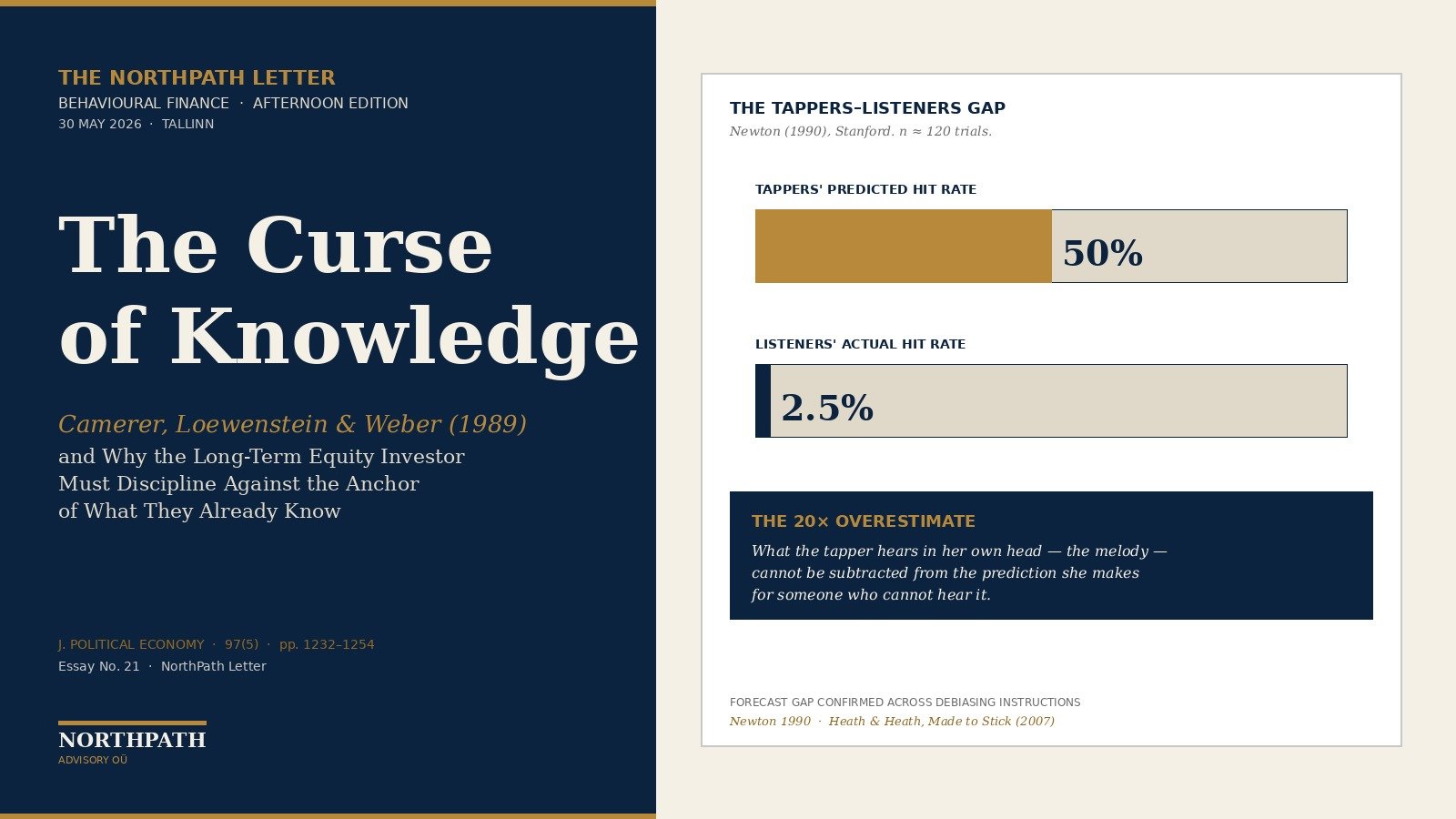
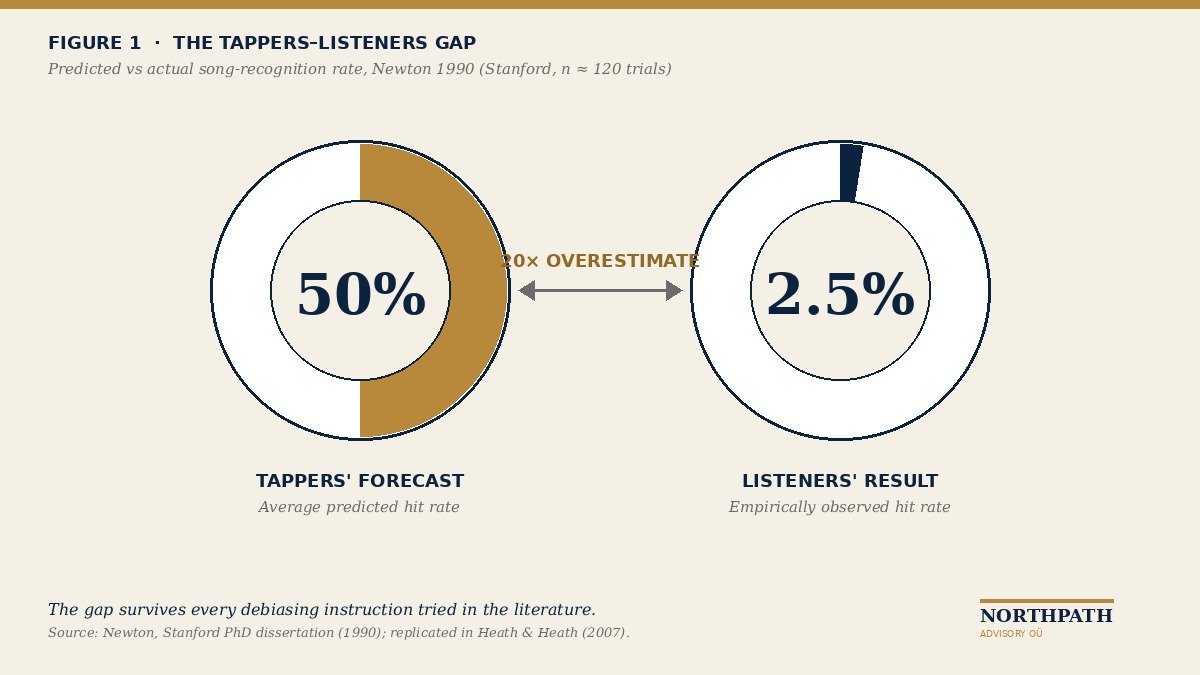
In the spring of 1990, Elizabeth Newton, then a graduate student in psychology at Stanford, ran one of the smallest and most quoted experiments in the cognitive-science canon. She divided her subjects into two groups. The “tappers” were given a list of twenty-five well-known songs — Happy Birthday, The Star-Spangled Banner, the like — and asked to tap out the rhythm of one of them on the table for a “listener” who could not see them. Before each round, the tappers were asked to estimate the probability that the listener would correctly identify the tune. The tappers’ average estimate was fifty per cent. The actual hit rate was two and a half per cent — one tune in forty. The tappers, hearing the melody play out in their own heads as they drummed, could not imagine that the listener was hearing nothing but a flat, atonal sequence of knocks. Newton’s experiment is the cleanest demonstration ever recorded of what economists, just one year earlier, had baptised the curse of knowledge.
1. The bias
The phrase enters the literature in Colin F. Camerer, George Loewenstein and Martin Weber’s 1989 paper “The Curse of Knowledge in Economic Settings: An Experimental Analysis,” published in the Journal of Political Economy (volume 97, issue 5, pages 1232–1254). The three authors set out to test a specific economic prediction. Standard agency theory presumes that a better-informed agent (a manager, a research analyst, an issuer’s CFO) can mentally strip away her private information when she needs to forecast the behaviour of less-informed counter-parties. In Camerer’s experiment, subjects with private information about the fundamental value of a security were asked to predict the prices that uninformed traders would set in a laboratory double-auction. The hypothesis under test was that the well-informed would correctly anchor on the uninformed traders’ (low) information set and predict prices close to the prior mean. The hypothesis failed. Informed subjects systematically over-predicted that the uninformed market would price the asset closer to true value. The information they possessed exerted an anchor they could not switch off. Market discipline — repeated rounds, monetary incentives, feedback — eroded the curse by approximately half, but did not extinguish it.
The bias has a longer ancestry. Robin Hogarth had identified a related “hindsight bias” in the 1970s; Baruch Fischhoff’s 1975 paper “Hindsight ≠ Foresight” in the Journal of Experimental Psychology documented the inability of subjects, once told an outcome, to reconstruct what they would have predicted before it. Camerer’s contribution was to recast the problem in the strict language of agency and markets and to give it the title that stuck. A subsequent developmental replication by Susan Birch and Paul Bloom, “The Curse of Knowledge in Reasoning About False Beliefs” (Psychological Science 18(5), 2007, pp. 382–386), showed that even three-year-olds who have just learned a fact assume that a peer who lacks the fact still knows it. The architecture is not learned; it is structural to how human working memory integrates new information.
2. The mechanism
Three features of human cognition combine to produce the curse. The first is informational anchoring: once a fact has been encoded, it becomes the default starting point for any subsequent estimate, including estimates of what others know. The mind does not store a clean before-and-after record; it stores the present state and confabulates the past. The second is perspective collapse: simulating another agent’s reasoning is computationally expensive, and under load the brain substitutes its own state for theirs. Theory-of-mind research at the University of Chicago and at MIT (notably Boaz Keysar’s work on the “illusory transparency of intention,” published from 1994 onwards) has shown that even when subjects are explicitly instructed to take the perspective of a less-informed listener, they revert to their own perspective within seconds. The third is egocentric salience: information acquired with effort feels more obvious, not less, after the effort has been forgotten, so the analyst who spent two months understanding a balance sheet is the worst-placed person to estimate how long it would take a retail investor to do the same.
For the long-term equity investor the mechanical consequence is straightforward. Once a thesis has been built — and especially once it has been written down and shared with a partner or a committee — the investor will systematically overestimate the degree to which other market participants are pricing the same insight. This is the cognitive substrate underneath what Howard Marks has called “first-level thinking,” and it is the reason Marks’s “second-level thinking” requires an act of deliberate violence against one’s own mental state.
3. The empirical record
The original Camerer paper reported curse-of-knowledge effects of the order of 30 to 50 per cent of the maximum possible error, even after multiple trading rounds and substantial monetary incentives. Subsequent replications — by Keysar at Chicago, by Birch and Bloom at British Columbia and Yale, and a meta-analytic survey by Ghrear, Birch and Bernstein in Wiley Interdisciplinary Reviews: Cognitive Science in 2016 — confirm both the magnitude and the resistance to debiasing instructions.
The regulatory record provides a parallel demonstration. The United States Securities and Exchange Commission promulgated Regulation Fair Disclosure in August 2000, effective 23 October 2000, precisely because the pre-Reg-FD analyst community had developed a structural curse-of-knowledge problem: sell-side analysts and large institutional investors had been receiving issuer guidance in private calls under the (curse-driven) assumption that the information thus shared was either de minimis or already obvious to the retail public. The SEC’s adopting release explicitly framed the rule as an attempt to restore the symmetric information condition the textbooks had always presupposed. In the twenty-six years since Regulation FD, SEC enforcement statistics record more than fifty settled selective-disclosure actions, the largest of which (against issuers including Office Depot, Schering-Plough and Flowserve in the 2002–2014 window) involved issuer officials who plainly believed that the figures they were tipping were public information already.
The same pattern recurs in the United Kingdom. The Financial Conduct Authority’s Consumer Duty, which came into force on 31 July 2023 for new and existing products and on 31 July 2024 for closed-book products, imposes on regulated firms an obligation of “consumer understanding” — that is, communications must be such that the retail recipient can in fact comprehend them. The FCA’s Consumer Composite Investments (CCI) framework, which replaces the inherited UK PRIIPs regime from 6 April 2026, extends the principle to product disclosures. Both rules read, in substance, as a regulator-mandated debiasing protocol for a financial-services industry whose product manufacturers and distributors had spent two decades writing disclosures legible only to themselves. The FCA’s Financial Lives 2024 survey, the largest such instrument in any major jurisdiction with a sample of 17,950 adults, recorded that 24 per cent of respondents had “low” financial confidence and a further 36 per cent “moderate” — figures that any product designer who took them seriously would find chastening.
4. Two historical episodes
The first is the autumn of 1998. Long-Term Capital Management — the partnership of John Meriwether, Myron Scholes, Robert Merton and a roster of arbitrage specialists who had built the modern fixed-income relative-value playbook — collapsed in a six-week sequence beginning with Russia’s debt default on 17 August 1998. The proximate causes are well documented in Roger Lowenstein’s When Genius Failed (Random House, 2000) and in the Federal Reserve Bank of New York’s coordinated rescue meeting of 23 September 1998. The underlying cognitive failure is rarely named, but it is plainly curse-of-knowledge. The LTCM partners had spent careers immersed in the convergence trades that depended, structurally, on counter-parties willing to take the other side at modest spreads. When the Russian default forced a global rush to quality, the partners’ models predicted spreads would converge because, by their own informational standard, the trades had become spectacularly more attractive. What the partners could not internalise was that the marginal counter-party in late August 1998 was not another arbitrage specialist who understood the trades but a generalist credit risk officer at a bulge-bracket bank, instructed to cut exposure to anything labelled “exotic.” The information the partners had — that the trades were now thirty per cent richer than entry — was, to that risk officer, illegible noise. By the time the partners realised this, the leverage line had moved against them, and the rescue was the only stop short of disorderly liquidation.
The second episode is the unwinding of the dot-com analyst conflicts in the period 2002–2003. The Global Research Analyst Settlement of 28 April 2003, jointly executed by the SEC, the New York Stock Exchange, NASD and the New York Attorney-General Eliot Spitzer with ten Wall Street investment banks, imposed an aggregate USD 1.4 billion penalty and required structural separation of research from investment banking. The settlement papers, and the Spitzer office’s subpoenas of analyst emails at Merrill Lynch (the Henry Blodget correspondence), at Salomon Smith Barney (Jack Grubman) and at Morgan Stanley (Mary Meeker), document a research function in which the analysts had grown so immersed in the new-economy metrics — eyeballs per session, gross merchandise value, page views — that they could no longer accurately predict how a generalist or retail audience would interpret a “buy” rating attached to a company whose earnings were negative and whose business model was, by Blodget’s contemporaneous private description, “a piece of junk.” The curse-of-knowledge interpretation is not a charitable one for the analysts; it is, however, the most economical explanation for the consistent gap between their internal scepticism and their published recommendations. The Settlement’s restructured Chinese walls and its mandatory independent research distribution were a regulatory attempt to drive a wedge between the analyst’s private information set and the retail audience’s reading of the published note.
5. The counter-measure framework
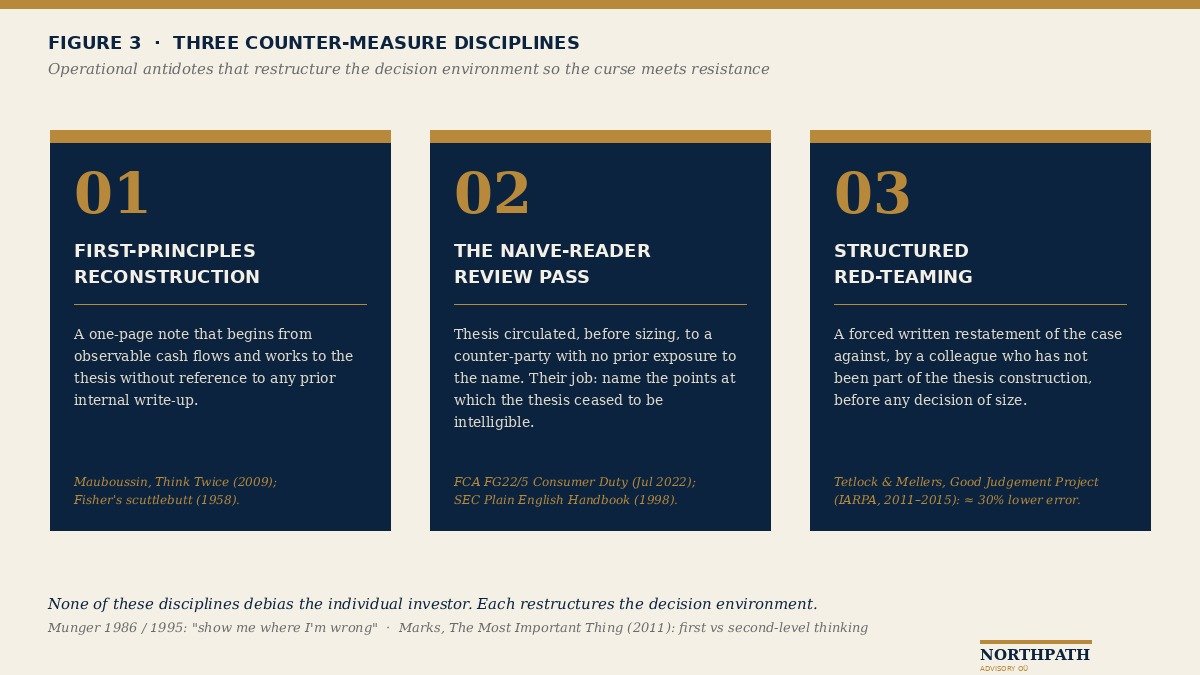
Three disciplines, operationally distinct, have stood the test of long-term investment practice as antidotes to the curse.
First — written first-principles reconstruction
The investor commits, at the start of every position, to producing a one-page note that begins from observable cash flows and works to the thesis without reference to any prior internal write-up. The act of reconstruction strips out the silent priors that the original thesis was built on. When the reconstructed page diverges materially from the working thesis, the divergence — not the working thesis — is the signal. The discipline owes its origin to Phil Fisher’s “scuttlebutt” routine in Common Stocks and Uncommon Profits (Harper, 1958), but its modern formulation is Michael Mauboussin’s recommendation, in Think Twice (Harvard Business Press, 2009), that an investor write the price-implied expectations explicitly and only then ask which of those expectations she disputes.
Second — the naive-reader review pass
Before any thesis is acted on at size, it is read aloud, or circulated in writing, to a counter-party with no prior exposure to the name and no professional vocabulary in the sector. The instruction to the naive reader is not to assess the thesis but to identify the points at which the thesis ceased to be intelligible. Each such point marks an embedded prior — a curse residue — that the investor had failed to notice. The practice is recommended in the FCA’s own Consumer Duty guidance under the heading “communicate in a way that supports understanding” (FCA finalised guidance FG22/5, July 2022) and, in the United States, in the SEC’s Plain English Handbook (1998), drafted under the chairmanship of Arthur Levitt.
Third — structured red-teaming with cognitive distance
The discipline imposes, before any decision of consequence, a forced restatement of the case against the position, written by a colleague who has not been part of the thesis construction. The red-team’s instruction is to argue the contrary as it would be argued by a sceptical generalist with neither the analyst’s deep priors nor any axe to grind in the opposite direction. The Good Judgement Project’s work under Philip Tetlock and Barbara Mellers (University of Pennsylvania, 2011–2015, under IARPA funding) showed that calibration error among forecasters dropped by approximately 30 per cent when this practice was made structural rather than discretionary.
6. How long-term-equity practitioners addressed it
Two practitioners stand out for the explicitness with which they built the curse of knowledge into their working method.
Charlie Munger opened his Harvard Law School commencement remarks of 13 June 1986 with what would become his most repeated maxim: “I never allow myself to have an opinion on anything that I don’t know the other side’s argument better than they do.” He developed the same proposition at greater length in his 1995 talk “The Psychology of Human Misjudgment” (delivered at Harvard, expanded in print in Poor Charlie’s Almanack, Donning, 2005). The instruction is not a rhetorical flourish. It is a procedural commitment to manufacture, on demand, the perspective of a counter-party who lacks the analyst’s private information — the only practical antidote to the Camerer-Loewenstein-Weber finding that the analyst cannot, by introspection, switch the information off. Munger’s standing offer to interlocutors — “show me where I’m wrong” — is the social-engineering complement: he had no faith in his own ability to debias and structured his decision environment to outsource the work.
Howard Marks built the antidote into the conceptual frame of every Oaktree memo. The first chapter of The Most Important Thing (Columbia Business School Publishing, 2011) opens with the distinction between “first-level thinking” — “I see a great company; therefore the stock will go up” — and “second-level thinking” — “everyone else also sees a great company; the market already prices it as a great company; therefore the question is whether it will be revealed to be greater still or only equally great.” The distinction is, in cognitive terms, an explicit instruction to invert the curse: instead of asking what the analyst knows that others do not, the question becomes what the analyst can credibly claim is not already in the price. Marks’s memos “You Can’t Predict, You Can Prepare” (May 2001), “The Most Important Thing” (July 2003) and “Sea Change” (December 2022) return repeatedly to the same operational test: whichever side of the trade requires the marginal counter-party to be a fool is the side on which the curse is doing the heavy lifting.

A third practitioner is worth recording for the operational contrast. Philip Fisher’s “scuttlebutt” routine — interviews with suppliers, customers, ex-employees and competitors — was, in modern cognitive language, a structured exercise in importing external information sets that the analyst, by virtue of office-bound research, could not generate from her own head. The premise of scuttlebutt is the inverse of the curse: that what the analyst knows about a company from filings and accounts is, almost certainly, less than what a third-shift production supervisor knows about the same company from twenty years on the line.
7. Key takeaways
First, the curse of knowledge is not a personal failing or an analyst-specific weakness; it is a feature of human working memory documented in subjects as young as three years old, and it survives every introspective debiasing instruction tried in the academic literature.
Second, the Camerer-Loewenstein-Weber 1989 finding that market discipline reduces the curse by approximately half, but does not eliminate it, is the empirically credible upper bound on how much an unaided investor can expect a competitive market to do the work of debiasing for her. Approximately half of the curse remains and must be addressed by deliberate procedure.
Third, the regulatory record — Regulation Fair Disclosure 2000 in the United States, the Consumer Duty 2023 and the Consumer Composite Investments framework 2026 in the United Kingdom — is most economically read as a regulator-imposed debiasing protocol for an industry whose practitioners had grown unable to estimate what their retail audience actually knew.
Fourth, the operational antidotes that have stood the test of time are not intellectual but procedural: a written first-principles reconstruction, a naive-reader review pass, and structured red-teaming with cognitive distance. Each works by restructuring the decision environment so that the curse encounters resistance before it is acted on at size.
Fifth, the most useful question an investor can ask before any consequential decision is Howard Marks’s question in its strict form: which side of this trade requires the marginal counter-party to know less than I do, and what is the probability that I am simply mistaken about how much that counter-party knows?
— Manish Goel, FCA / NorthPath Advisory OÜ / Tallinn, Estonia
Sources. Camerer, Loewenstein & Weber, “The Curse of Knowledge in Economic Settings: An Experimental Analysis,” Journal of Political Economy 97(5), 1989, pp. 1232–1254. Newton, “Overconfidence in the Communication of Intent: Heard and Unheard Melodies,” Stanford University PhD dissertation, 1990. Fischhoff, “Hindsight ≠ Foresight: The Effect of Outcome Knowledge on Judgment Under Uncertainty,” Journal of Experimental Psychology: Human Perception and Performance 1(3), 1975, pp. 288–299. Birch & Bloom, “The Curse of Knowledge in Reasoning About False Beliefs,” Psychological Science 18(5), 2007, pp. 382–386. Ghrear, Birch & Bernstein, “Outcome Knowledge and False Belief,” WIREs Cognitive Science 7(6), 2016, pp. 415–428. Keysar, “The Illusory Transparency of Intention: Linguistic Perspective Taking in Text,” Cognitive Psychology 26(2), 1994, pp. 165–208. US Securities & Exchange Commission, Final Rule “Selective Disclosure and Insider Trading,” Release Nos. 33-7881, 34-43154 (15 August 2000); effective 23 October 2000. Office Depot SEC settlement order Release No. 34-63152 (21 October 2010). Global Research Analyst Settlement, SEC Litigation Release No. 18111 (28 April 2003). UK Financial Conduct Authority, Policy Statement PS22/9 and finalised guidance FG22/5 on the Consumer Duty (July 2022); rules in force 31 July 2023 / 31 July 2024. FCA Policy Statement PS24/17 establishing the Consumer Composite Investments framework, in force 6 April 2026. FCA Financial Lives 2024 Survey (May 2025 publication, n = 17,950). Federal Reserve Bank of New York, “The President’s Working Group on Financial Markets: Hedge Funds, Leverage, and the Lessons of Long-Term Capital Management” (April 1999). Lowenstein, When Genius Failed (Random House, 2000). Fisher, Common Stocks and Uncommon Profits (Harper & Bros, 1958). Mauboussin, Think Twice (Harvard Business Press, 2009). Munger, “The Psychology of Human Misjudgment,” Harvard talk, 1995; expanded in Poor Charlie’s Almanack (Donning Company, 2005). Marks, The Most Important Thing (Columbia Business School Publishing, 2011); Oaktree memos “You Can’t Predict, You Can Prepare” (May 2001), “The Most Important Thing” (July 2003), “Sea Change” (December 2022). Tetlock & Mellers, Superforecasting: The Art and Science of Prediction (Crown, 2015). SEC Plain English Handbook (1998).
|
Important. |