Indian Market Context · 30 May 2026 · Issue 20
Twenty-three years of taxing the company instead of the shareholder bent how India returns cash. The Finance Act 2020 unwound that; the Finance (No. 2) Act 2024 then unwound the workaround.
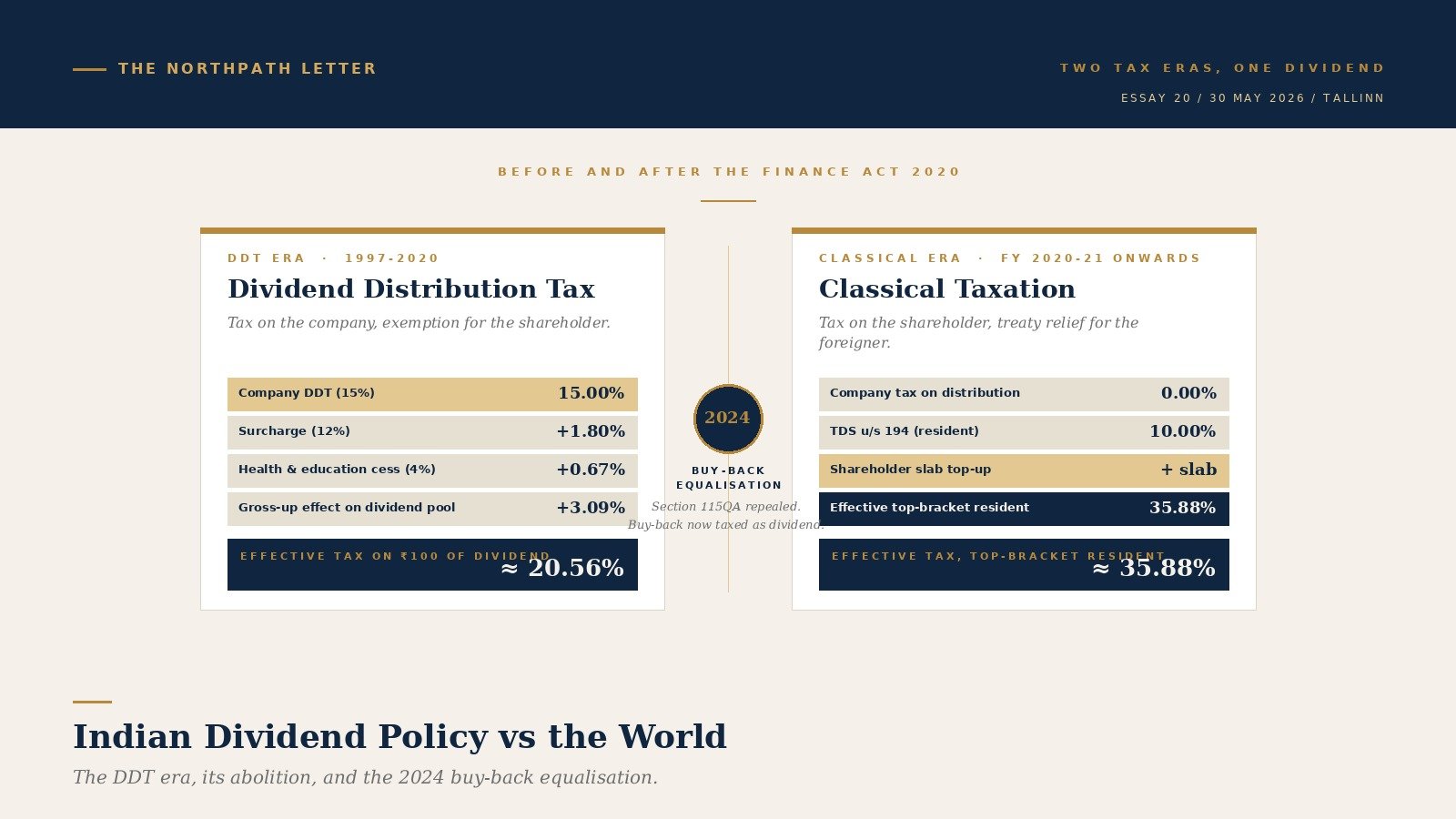
In April 2020 India quietly removed a piece of tax architecture that had distorted Indian corporate capital allocation for twenty-three years. The Dividend Distribution Tax — DDT — had been introduced by the Finance Act 1997, abolished by the Finance Act 1997 in its original form for a brief experiment, reintroduced, and then expanded steadily until 2020. For most of those years it taxed the company at the moment of distribution, not the shareholder, at an effective rate that ended its life at roughly 20.56 per cent grossed-up. Then, on 1 April 2020, it was gone. Section 115-O of the Income-tax Act 1961 was put to bed, and India returned to what the rest of the world calls the classical system: dividends taxed in the hands of the recipient at the recipient’s slab rate, with withholding at source.
Four years later, in the Finance (No. 2) Act 2024, the government quietly removed the workaround that the DDT regime had bred. Indian listed companies had, by long habit, preferred share buy-backs to dividend payments — partly because under Section 115QA the company paid an effective 23.296 per cent buy-back tax and the proceeds were exempt in the shareholder’s hands under Section 10(34A), so a high-bracket shareholder receiving a tender-offer cheque on retirement saved meaningfully against a cash dividend at her marginal rate. From 1 October 2024 that arbitrage is closed. Section 115QA no longer applies. The entire buy-back consideration is now deemed a dividend in the shareholder’s hands under the newly inserted Section 2(22)(f), taxable as Income from Other Sources at slab rates, with the original cost basis of the surrendered shares becoming a notional capital loss that can be carried forward for eight assessment years.
These two changes — abolition of DDT in 2020, taxation of buy-backs as dividend from October 2024 — are the most important pieces of context a foreign reader needs to understand modern Indian dividend policy. They explain why the structural payout pattern looks different from the United States and the United Kingdom; why the headline yield on the Nifty 50 understates total return-of-capital; why the effective tax on a non-resident shareholder collecting Indian dividends is now a treaty question rather than a company-level question; and why some of the comparisons the global investor instinctively reaches for — “Indian companies pay so little compared to UK utilities” — turn on a structural difference rather than a managerial one.
This letter walks through the history, the current regime, the cross-jurisdiction comparison, and what an analyst sitting in London, New York or Singapore should do differently when reading an Indian dividend line.
The DDT era — twenty-three years of taxing the company, not the shareholder
The Dividend Distribution Tax was introduced by Section 115-O, inserted into the Income-tax Act by the Finance Act 1997. The mechanism was simple. When an Indian company resolved to pay a dividend, it first paid tax on the amount being distributed — initially at 10 per cent, climbing in stages — and the shareholder received the dividend tax-free under Section 10(34). The company’s tax was not a deduction at source; it was a separate, additional, non-creditable corporate tax on the act of distribution.
By the time it was abolished, DDT had reached an effective grossed-up rate of approximately 20.56 per cent — 15 per cent base rate, plus a 12 per cent surcharge, plus a 4 per cent health-and-education cess, applied on a grossed-up dividend amount. A company resolving to pay ₹100 of dividend in cash to its shareholders effectively spent close to ₹120.56 of post-tax profits to do so. From the company’s point of view, the DDT was indistinguishable from a higher effective corporate tax rate triggered by the decision to distribute rather than retain.
Two structural distortions followed.
The first was on retained-earnings policy. A 20 per cent tax on the act of distribution amounted to a 20 per cent subsidy on the alternative of holding cash on the balance sheet or reinvesting. Indian boards facing average returns on incremental capital that did not meaningfully beat that 20 per cent wedge were rationally inclined to retain. The result, visible in any Indian large-cap data set across the 2010s, is a cash-and-equivalents line on the typical Nifty 50 balance sheet that is noticeably higher than the comparable line in the US S&P 500 or the FTSE 100. Critics, including the Standing Committee on Finance in several reports, argued that DDT created an inefficient pool of idle corporate cash; defenders pointed out that for cyclical and capex-heavy businesses the retention bias acted as a self-imposed conservatism.
The second was on the foreign investor’s after-tax economics. Because the tax sat at the company level, not the shareholder level, the dividend received by a non-resident was already net of Indian tax. The Double Taxation Avoidance Agreements India signs typically allocate the right to tax dividends to the residence state but allow the source state to impose withholding up to a treaty cap — 15 per cent under the Indo-US DTAA for substantial holders, 10 per cent under several bilateral treaties for portfolio holders, 5 per cent under the Indo-Mauritius DTAA for 10 per cent shareholders. Under DDT, none of these caps mattered. The Indian company had already paid its 20.56 per cent at distribution; the non-resident received a “tax-free” dividend (under Section 10(34)) and had no Indian withholding credit to bring home. Indian tax authorities took the position — disputed by many — that the DDT was not “tax on the shareholder” within the meaning of the treaty article, so the treaty rate did not bound it. The effect: a US pension plan holding Indian listed equity through an FII paid a real 20.56 per cent Indian tax on every rupee of dividend received, with no credit creditable against its home tax (and, often, no home tax against which to credit it in the first place).
These two distortions — the retention bias, and the foreign-investor friction — are the substantive reason the DDT was unwound in 2020. The Finance Bill 2020 explained the rationale plainly in the Memorandum to the Bill: the DDT had become an “incidence of tax” borne by the company rather than the shareholder; it produced unfair outcomes for low-income shareholders (who paid the same 20.56 per cent as billionaires); and it impeded the ability of non-residents to claim treaty relief. The Bill abolished DDT effective 1 April 2020, repealed Section 115-O, removed the Section 10(34) exemption, and reinserted dividends into the residual head of “Income from Other Sources” under Section 56.
The current regime — what India taxes today, and at what rate
Since 1 April 2020 the Indian dividend regime works as the global default. The simple version: the company pays no tax on the act of distribution; the shareholder pays at her own slab rate; and the company is required to deduct tax at source under Section 194 (for residents) or Section 195 (for non-residents).
For a resident shareholder the architecture is now this. Dividends are taxable as “Income from Other Sources” at slab rates — which, for a high-bracket individual, means 30 per cent plus surcharge and cess, reaching an effective 35.88 per cent at the top. The company must deduct 10 per cent at source under Section 194 on any aggregate dividend payment to a single resident that exceeds ₹5,000 in a financial year; the shareholder receives the dividend net, claims credit for the 10 per cent at her return, and pays the residual at her slab. A retail investor in the 20 per cent slab pays an additional 10 per cent at return time; a top-bracket investor pays a residual of roughly 25 per cent on top of the 10 per cent already withheld.
For a non-resident the architecture is treaty-driven. Domestic law sets a default withholding rate of 20 per cent (plus surcharge and cess) under Section 195 for dividends paid to non-residents. The DTAA caps this — 15 per cent for substantial holders under the Indo-US treaty, 25 per cent for portfolio holders under that same treaty, 5 per cent for 10-per-cent-plus Mauritius shareholders, 10 per cent under several others. The non-resident must furnish a Tax Residency Certificate (TRC) and, since 2013, a Form 10F, to obtain the treaty rate; absent these the default 20 per cent applies. Critically, no surcharge or cess is added when the treaty rate is applied — a meaningful difference from the surcharge-laden domestic computation.
The headline change for a foreign holder is therefore a reduction in effective Indian tax from the previous 20.56 per cent under DDT (no treaty relief available) to a treaty-capped rate that, for most institutional holdings under most treaties, sits between 10 and 15 per cent. For US-based pensions and endowments holding through structures that get treaty access, the difference is roughly five to ten percentage points of after-tax yield. That is not a small number compounded over a thirty-year holding period.
The buy-back regime — closed in October 2024
The arbitrage that had grown up under the DDT era was the share buy-back. Section 115QA, inserted in 2013, taxed buy-back consideration at the company level at 20 per cent plus surcharge and cess — approximately 23.296 per cent grossed-up — and exempted the shareholder under Section 10(34A). For a high-bracket Indian individual receiving a tender-offer in retirement, the 23.296 per cent company-paid tax was lower than the 35.88 per cent slab-plus-cess she would have paid on a cash dividend. The board therefore had a 12-point pure tax preference for the buy-back route over the dividend route, before any consideration of signalling, EPS accretion or share-supply effects.
This was not a small phenomenon. The aggregate value of Indian listed-company buy-backs in fiscal year 2023-24 ran into multiple billions of dollars, with several large-cap names — including some flagship technology services companies — preferring tender-offer buy-backs to special dividends despite explicit cash-return guidance. The structural preference was rational; it was also exactly the kind of tax-driven distortion that the 2020 reform had ostensibly cleared away.
The Finance (No. 2) Act 2024 closed it. From 1 October 2024 Section 115QA no longer applies to buy-backs. The entire buy-back consideration is now deemed a dividend in the shareholder’s hands under a newly inserted Section 2(22)(f), taxable as Income from Other Sources at slab rates. The company is required to deduct tax at source at 10 per cent under Section 194 (residents) or treaty rate under Section 195 (non-residents). The Section 10(34A) exemption is gone.
The tax architecture for the shareholder is now consciously parallel between dividend and buy-back. Both are dividend income, both deduct at 10 per cent at source, both are taxed at slab rates in the recipient’s hands, both attract the same treaty cap for non-residents. The buy-back’s only remaining tax property of interest is on the capital-loss side: the original cost basis of the surrendered shares, under the proviso to Section 46A, is now treated as a notional capital loss (the “consideration” being deemed nil), which can be set off against capital gains in the year of the buy-back and carried forward for eight assessment years. For a high-bracket Indian individual this notional loss can be valuable — but it is a loss carry-forward, not the headline tax shield the old regime provided.
The practical consequence is that the structural Indian board-room preference for buy-backs over dividends has, as of October 2024, no surviving tax basis. Buy-backs will continue to occur for the same reasons they occur in the US and UK — EPS accretion, signalling of management’s view of intrinsic value, balance-sheet right-sizing — but the 12-point tax preference is gone. Expect the dividend share of total cash returned to rise over the next two to three reporting cycles as boards re-optimise.
How this compares to the United States
The US dividend regime is the most-cited point of comparison and it differs from India’s in three structural ways.
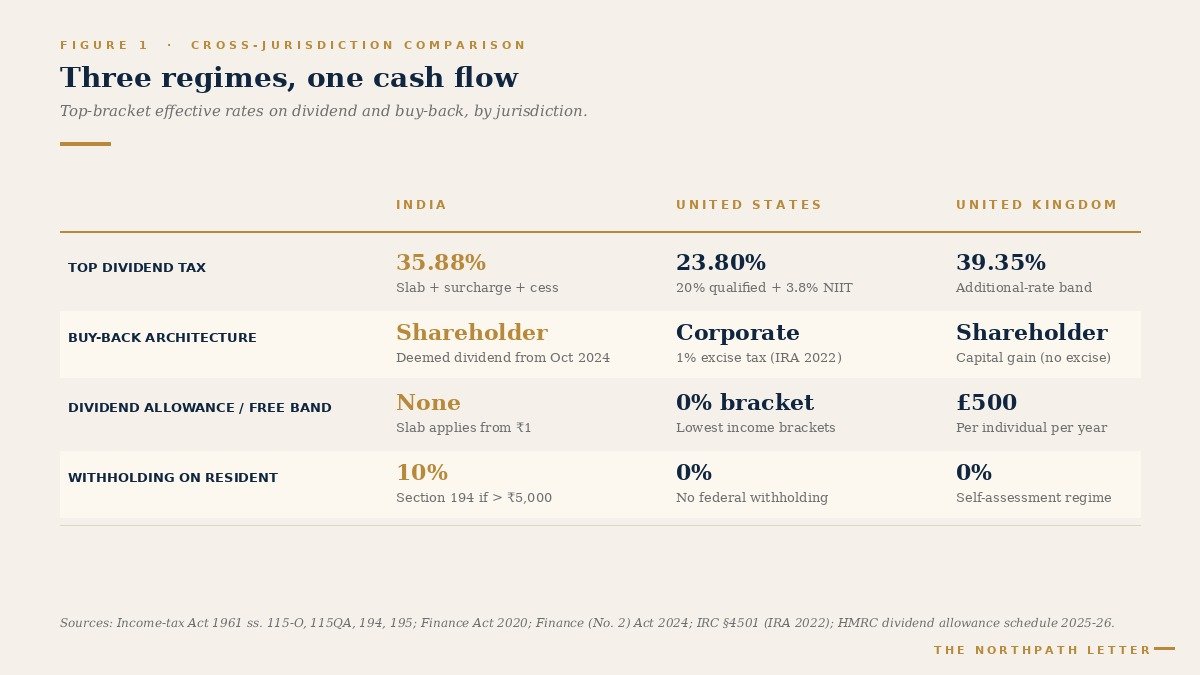
First, the tax rate. US qualified dividends — the default treatment for dividends paid by a US corporation or a qualifying foreign corporation to a US individual holder for the requisite holding period — are taxed at the long-term capital gains schedule: 0 per cent in the lowest brackets, 15 per cent in the middle brackets, and 20 per cent in the top brackets. A high-bracket US individual receiving a US-corporate dividend pays 20 per cent federal plus the 3.8 per cent net investment income tax (NIIT), reaching an effective 23.8 per cent federal, plus state income tax where applicable. The Indian high-bracket individual pays 35.88 per cent. The same dividend rupee, paid by a comparable company to comparable shareholders, attracts roughly 12 percentage points more tax in India than in the United States.
Second, the buy-back regime. The Inflation Reduction Act 2022, signed 16 August 2022, introduced a 1 per cent excise tax on stock repurchases by US publicly traded corporations exceeding $1 million in the aggregate per tax year, effective for repurchases after 31 December 2022. The Joint Committee on Taxation estimated the provision would raise $74 billion over fiscal years 2022 to 2031. The Biden administration’s Fiscal Year 2025 budget proposal sought to raise this to 4 per cent; that proposal has not been enacted. Final regulations were issued in 2025 and are effective 24 November 2025. The US buy-back tax is therefore a 1 per cent corporate-level tax, applied to the company, with no shareholder-level effect — exactly the architecture India had under Section 115QA before the 2024 repeal. From October 2024 onward the US is the lighter-touch jurisdiction on buy-backs.
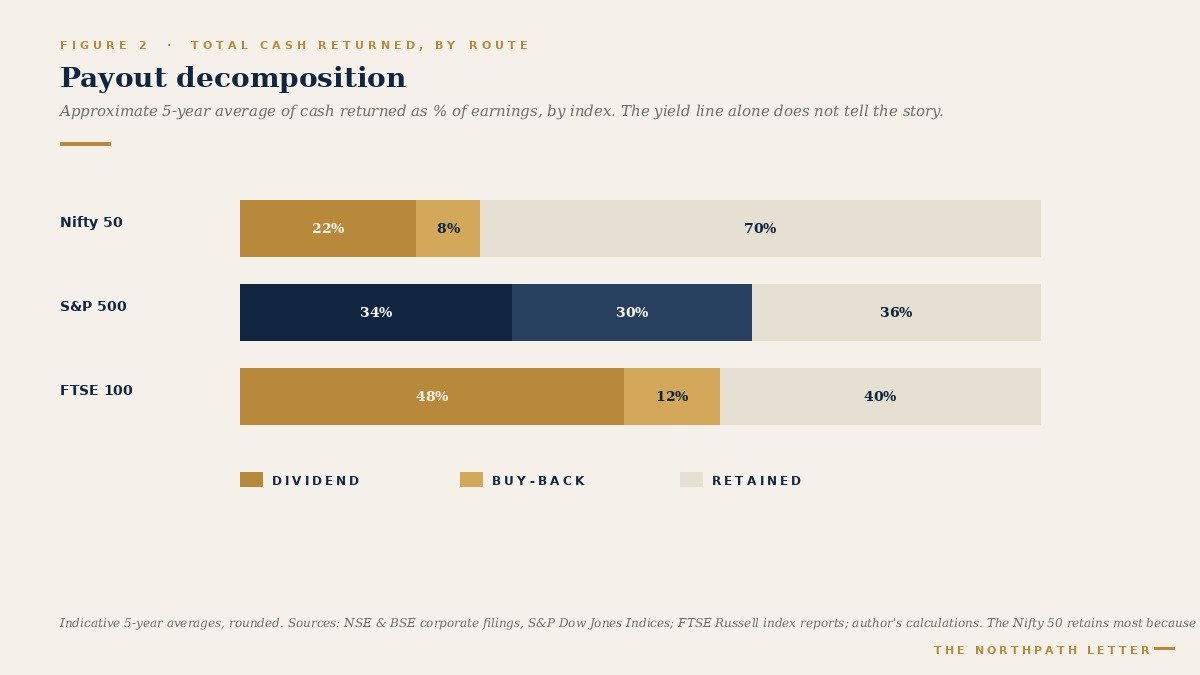
Third, the dividend-payout culture. The S&P 500 has, for most of the past two decades, paid a dividend yield of between 1.4 and 2.0 per cent of price, with payout ratios in the 30 to 40 per cent range — the balance returned through buy-backs at scale, particularly post-2010. The Nifty 50 has, over the same window, run a payout ratio closer to 25 to 30 per cent, with a slightly lower dividend yield. Some of the gap is the DDT era’s retention bias; some is the structural composition (Indian large-caps are more capex-intensive in aggregate); but the comparison should not be drawn at the yield line alone. Total cash returned — dividends plus net buy-backs — is the relevant figure on both sides.
How this compares to the United Kingdom
The UK regime is closer to India’s classical structure than the US’s qualified-dividend schedule, but with a small allowance and a step-up of rates by income band.
For 2025-26, UK individuals receive a £500 dividend allowance — dividend income up to this amount is tax-free. Beyond that allowance, dividends are taxed at 8.75 per cent for basic-rate taxpayers (income between £12,570 and £50,270), 33.75 per cent for higher-rate taxpayers (£50,270 to £125,140), and 39.35 per cent for additional-rate taxpayers (above £125,140). The April 2026 fiscal event has signalled a 2-percentage-point increase to the basic and higher rates, lifting them to 10.75 per cent and 35.75 per cent respectively from April 2026.
The UK does not levy a buy-back-specific excise tax. Buy-back consideration is generally treated as a capital gain for a private investor (assuming the company is not a close company subject to the on-market-purchase rules), making it tax-preferred against dividends for higher-rate shareholders. The UK structure is therefore intermediate: a small annual allowance, classical taxation above, no buy-back tax — which is roughly where India sat in the run-up to October 2024 except without the £500 allowance and with a buy-back tax that was company-paid rather than shareholder-borne.
For the long-term equity reader the salient point is that the UK additional rate of 39.35 per cent (rising to 41.35 from 2026) sits very close to India’s effective top dividend rate of 35.88 per cent. A high-bracket Indian and a high-bracket UK investor, holding comparable dividend-paying equity, face within five points of the same after-tax outcome. The difference between either of them and a US high-bracket investor at 23.8 per cent is closer to twelve points.
What this means for the non-resident reader of an Indian dividend line
Three discipline points for any global investor approaching the Indian equity dividend stream.
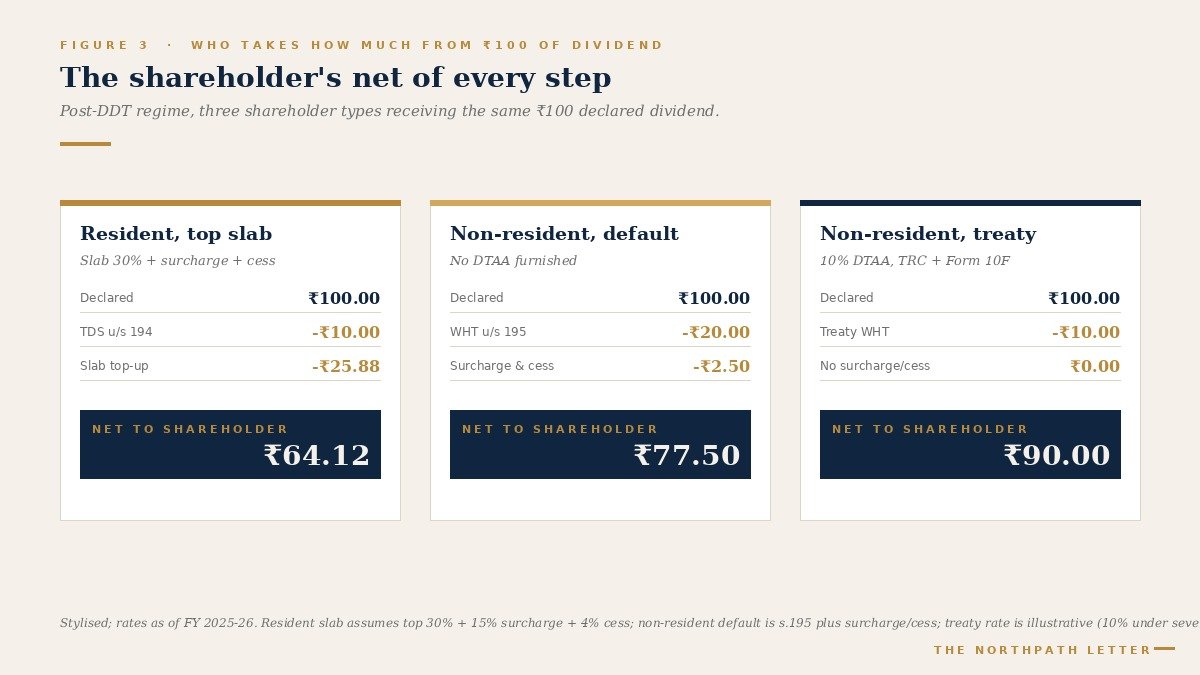
The first is to read the gross-versus-net distinction carefully. Reported dividend per share on an Indian company’s screen is the gross number — the amount the board declared. The cash a non-resident receives is that gross number reduced by the treaty rate (10, 15, 25 per cent depending on the DTAA and shareholding pattern). The cash a resident receives is the gross number reduced by 10 per cent under Section 194 if the aggregate annual dividend from that company exceeds ₹5,000. The yield line a global screener produces is almost always the gross yield. The take-home yield is meaningfully lower.
The second is to evaluate the total return-of-capital, not the dividend alone. Indian large-caps return capital through both dividends and buy-backs. Historically, particularly in the IT services sector — Infosys, TCS, Wipro, HCL — the buy-back has been the larger of the two routes. Post October 2024, with the buy-back arbitrage gone, the mix is likely to shift toward dividends, but the underlying cash-return story has not changed. A reader who looks only at the trailing dividend yield will miss roughly thirty to forty per cent of the cash returned by these names over the previous five years.
The third is to factor in the Foreign Tax Credit position in the home jurisdiction. The 10 to 15 per cent Indian withholding tax on dividends paid to a US holder is creditable against US federal income tax on that same dividend, subject to the per-country and overall limitations of the FTC regime. For a US individual receiving a 15 per cent Indo-US withheld dividend on which she also owes 20 per cent US qualified-dividend tax plus 3.8 per cent NIIT, the FTC mechanic typically cleans the overlap; the effective Indian “cost” is the difference between the withheld 15 per cent and the US 23.8 per cent — i.e. the higher rate. Under DDT this credit relief did not work — the Indian tax was a corporate tax not creditable in the US. The 2020 reform makes Indian dividend investing meaningfully less expensive for the typical US institutional holder.
Why Indian payout ratios remain structurally lower
After all the regulatory unwinding, the global reader still sees a payout ratio in the 25 to 30 per cent range across the Nifty 50, against 30 to 40 per cent for the S&P 500 and 40 to 60 per cent for the FTSE 100. The DDT regime explained part of this gap until 2020. The buy-back tax explained part of it until October 2024. With both gone, why does the gap persist?
Three structural reasons.
First, the Indian listed universe remains more capex-intensive on average than the US listed universe. The S&P 500 today is more than a quarter market-capitalisation-weighted in software-and-services; its capex needs are modest and its free cash conversion is high. The Nifty 50 carries a much heavier weighting in materials, capital goods, energy and infrastructure-adjacent businesses; these names reinvest more of operating cash, and the residual available to distribute is correspondingly lower. Composition matters more than policy.
Second, India is still a higher-growth economy. The marginal return on retained capital — measured by ROCE, ROIC or whatever proxy the reader prefers — is, for a typical Nifty 50 company, materially above the cost of equity. A board with high-return reinvestment opportunities should retain, not distribute, as a matter of basic capital-allocation theory. The DDT era pushed this further than was efficient; the post-DDT environment lets it settle at the level the underlying economics actually justify.
Third, the promoter-shareholder framework changes the optimisation. As discussed in an earlier letter in this series, most Indian listed companies are promoter-controlled. The promoter’s tax position — typically the same 35.88 per cent slab — is identical to that of the high-bracket retail shareholder. The board’s tax-driven preference between retaining and distributing is therefore not biased by a wedge between insider and outsider, the way it is in widely-held US public companies. Indian boards distribute when they have no better internal use for the cash, and not before. This is, in fact, the textbook capital-allocation discipline; it just produces lower headline payout ratios than the US norm.
The reader’s playbook
The practical disciplines for reading an Indian dividend line, condensed.
When you see a yield, ask whether it is the trailing twelve-month dividend yield only or includes buy-back consideration. For Indian large-caps in the technology services, financials and consumer goods sectors, the buy-back component over a five-year trailing window is often the larger half of total cash-return.
When you compare an Indian payout ratio to a US or UK payout ratio, decompose the gap into the composition effect (sector mix), the growth effect (higher marginal ROIC justifies higher retention) and the residual policy effect. The residual policy effect, post-October 2024, should be small.
When you compute an after-tax yield for your own holding, apply the treaty rate, not the domestic 20 per cent rate, and add no surcharge or cess (the treaty rate is final). Verify that the Indian custodian has a current TRC and Form 10F on file; absent these the custodian must withhold at the domestic rate.
When you model the future dividend stream, expect the next two to three reporting cycles to show a higher dividend share of total cash returned, as boards re-optimise away from the now-equalised buy-back route. The total cash returned should not change materially; the mix should.
When you read the dividend policy statement in the annual report, treat the company’s stated payout-ratio band as a soft commitment, not a hard one. The Indian board’s discretion over the timing of distributions is much wider than the implicit US contract of “level or rising quarterly dividend, never cut except in catastrophe”. An Indian board can skip a payment without provoking the share-price reaction a US board would see.
The one-line takeaway: between April 2020 and October 2024 India quietly aligned its dividend and buy-back regime with the global classical norm; the foreign reader who treats an Indian dividend like a US qualified dividend is now closer to right than wrong, but the structural payout-ratio gap is composition and growth, not tax — and that gap is unlikely to close.
— Manish Goel, FCA / NorthPath Advisory OÜ / Tallinn, Estonia
|
Important. |