The NorthPath Letter · Value Investing · Morning Edition
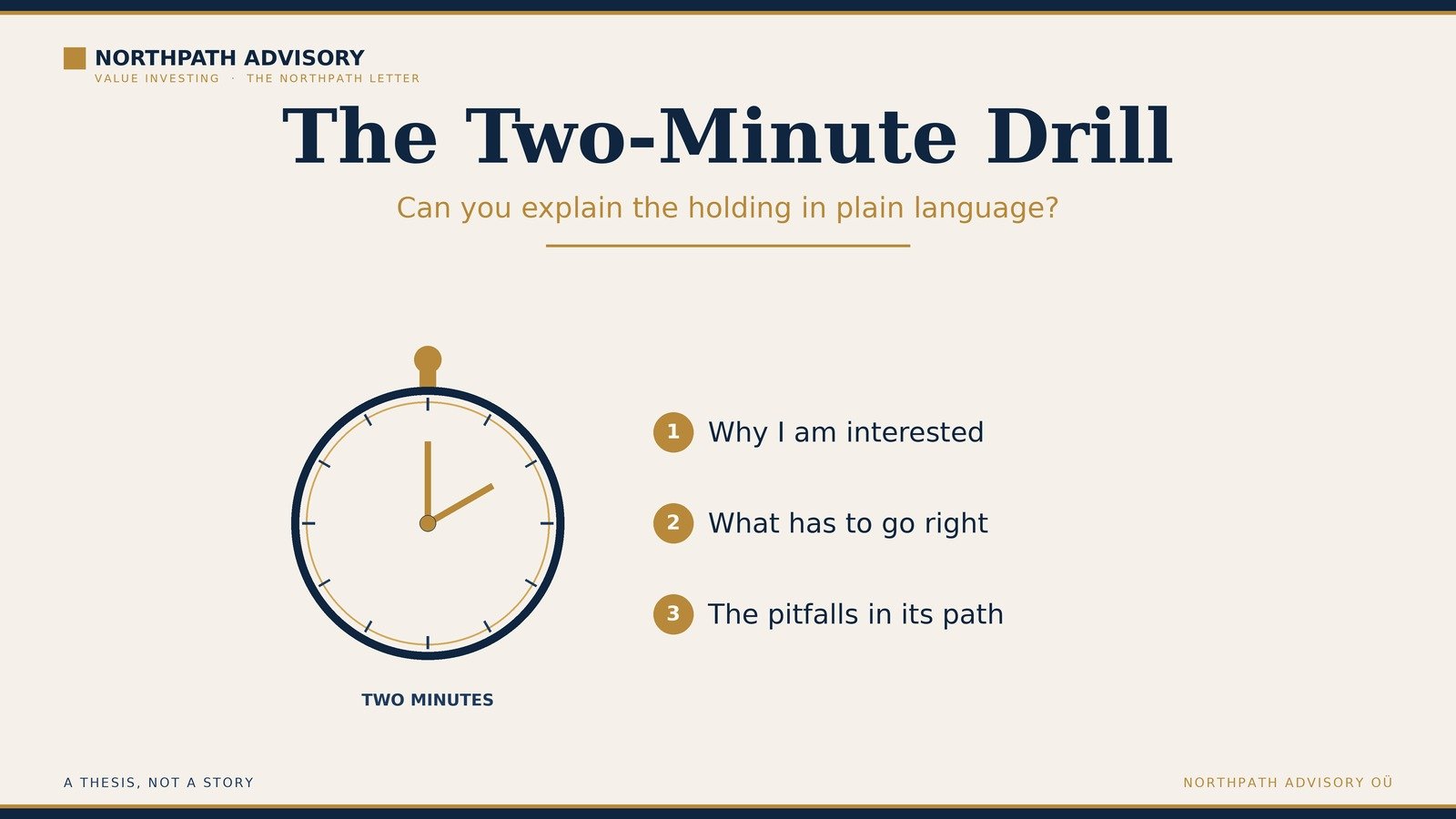
There is a simple test that separates an investment from a hope, and it takes about two minutes. Can you explain, in plain language a child would follow, what the business does, why it is mispriced, what has to go right, and what would prove you wrong? If you can, you own a thesis. If you cannot, you own a story — and stories, however thrilling, are not collateral. The discipline of forcing that explanation before you commit capital is one of the most useful habits a long-term investor can build, and one of the most widely skipped.
The principle
Peter Lynch, who ran Fidelity’s Magellan Fund through its most celebrated years, set out the test in One Up on Wall Street (1989). He called it the two-minute drill. “Before buying a stock,” he wrote, “I like to be able to give a two-minute monologue that covers the reasons I’m interested in it, what has to happen for the company to succeed, and the pitfalls that stand in its path.” The standard of clarity he demanded was deliberately humbling: you should be able to tell the story of a stock to your family, your friends, or the dog, so that even a child could understand it. Only then, he argued, do you have a proper grasp of the situation.
The drill is not a slogan; it has structure. Lynch insisted that the monologue begin by placing the company in one of his categories — slow grower, stalwart, fast grower, cyclical, turnaround, or asset play — because the category dictates what you should expect and how you will know whether the thesis is working. A stalwart bought for a thirty per cent move is a different proposition from a cyclical bought near the bottom of its cycle or a turnaround bought on a balance-sheet repair. The drill then has to name the engine of return (why this company, why now) and, crucially, the pitfalls — the things that could break the thesis. A monologue that contains only reasons to be excited and no honest account of what could go wrong has failed the test before it has begun.
The discipline the principle asks for is therefore a discipline of refusal. It gives the investor explicit permission — indeed an obligation — to decline anything they cannot explain. Not “this looks complicated, I’ll trust the experts,” but “if I cannot run the two-minute drill on this, it does not enter the portfolio, however good the tip and however fast it is rising.” It converts the vague, agreeable feeling of being informed into a concrete artefact: a short, falsifiable, plain-language case that can be written down, said aloud, and judged later against what actually happens.
The plain-language standard is easy to mistake for anti-intellectualism, but it is the opposite. Lynch was not claiming that good investments are simple; many are not. He was claiming that your explanation must be simple, because an explanation you can give only in jargon is usually not an explanation at all — it is a way of concealing, from others and from yourself, the places where the reasoning runs out. A genuinely understood business, however intricate its operations, can still be reduced to a few honest sentences about how it earns money and why the market is wrong about it. When that reduction proves impossible, the problem is rarely that the idea is too sophisticated for plain words; far more often it is that the sophistication is doing the work that evidence should be doing.
The mechanism
Why does so modest a habit do so much work? The first reason is that articulation is a far stricter test than recognition. It is easy to nod along to a bullish narrative and feel that you understand it. It is much harder to reconstruct that narrative yourself, in order, without the prompts — and the act of trying immediately exposes the gaps. The two-minute drill forces the harder task. The moment you have to say out loud why the company will earn more in five years than the market expects, and what specifically would have to happen for that to be true, you discover whether you have a thesis or merely an impression.
The second reason is that the drill makes the thesis falsifiable. By naming the pitfalls and the conditions for success in advance, you create a record against which reality can be checked. This is what separates investing from barracking. If you have written that the case depends on margins recovering as a particular cost pressure eases, then you know precisely what to watch, and you know what news would tell you that you are wrong. Without that written record, the mind quietly rewrites the thesis as events unfold, so that whatever happens can be made to fit — the most comfortable and most expensive habit in markets.
The third reason is that classification sets expectations honestly. Lynch’s insistence on naming the category is not housekeeping; it is risk management. Most investment disappointments are really expectation errors — judging a slow, cyclical business by the yardstick of a fast grower, or expecting a turnaround to compound like a stalwart. By forcing you to declare, at the outset, what kind of company this is and therefore what a good outcome would even look like, the drill prevents you from being surprised by the thing you should have expected all along. The monologue is, in effect, a pre-commitment device: it fixes your reasoning in plain words while you are still calm and disinterested, before ownership, price movement and the desire to be right begin to distort it.
It is worth distinguishing the drill from the familiar advice to “do your research”. Research is an input, and inputs are easy to mistake for understanding — hours spent reading can leave you with a thick file and no thesis. The two-minute drill is an output test: it asks not how much you have studied but whether you can now produce a clear, ordered account of the case. That is a higher and rarer bar, and it has a valuable second use. Run in reverse, it becomes an exit discipline. If you once could give the monologue and now find that you cannot — because the facts have changed, or because you never understood the case as well as you thought — that failure is itself information, and usually a reason to reduce or exit rather than to invent a new story that happens to fit the new price.
The empirical record
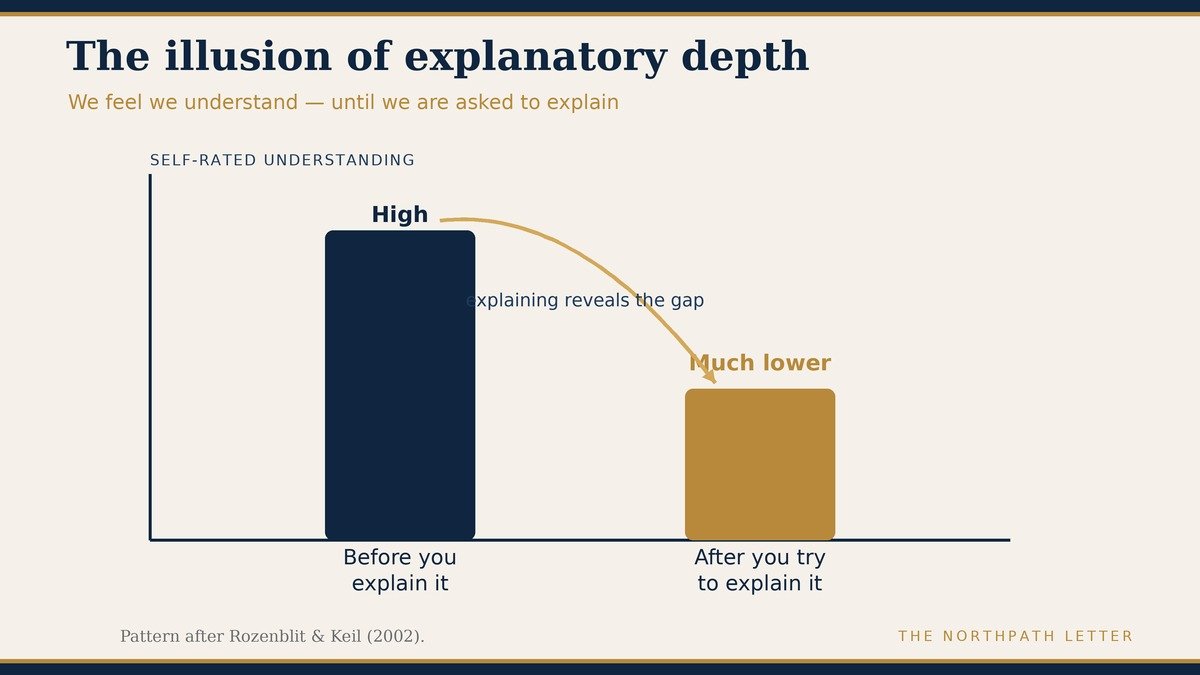
The drill works because it targets a documented flaw in how human beings assess their own knowledge. In 2002 the Yale researchers Leonid Rozenblit and Frank Keil described what they named the illusion of explanatory depth (Cognitive Science, vol. 26). They asked people to rate how well they understood everyday objects and systems — a zip, a bicycle, a flush toilet — then to write a detailed, step-by-step explanation of how each actually worked, and finally to rate their understanding again. The second rating was reliably and sharply lower. People had believed they understood mechanisms they could not, in fact, explain. The illusion was far stronger for explanatory knowledge than for facts or stories. This is precisely the trap the two-minute drill is built to spring: the demand to explain, out loud and in sequence, converts an unearned feeling of understanding into an honest measure of it.
The cost of skipping that test shows up in the returns of investors who act without one. In one of the most cited studies of individual investor behaviour, Brad Barber and Terrance Odean examined the accounts of more than sixty-six thousand households at a US discount broker from 1991 to 1996 (“Trading Is Hazardous to Your Wealth,” Journal of Finance, 2000). The households that traded most earned an annual return of 11.4 per cent while the market returned 17.9 per cent — a gap of more than six percentage points a year, compounding into an enormous lifetime difference. Their explanation was overconfidence: investors who believe they understand more than they do trade more than they should, and the trading destroys their returns. The two-minute drill is a direct antidote. By raising the bar that any idea must clear before it becomes a transaction, it suppresses exactly the low-conviction, story-driven activity that the data show to be so costly.
Two historical episodes
The first episode is the technology bubble of 1999 and 2000. At its height, vast sums flowed into companies on the strength of a category rather than a business — “the internet,” “broadband,” “B2B” — by investors who could describe the trend in a sentence but could not, if pressed, explain how a particular company would ever convert that trend into cash, what it actually sold, or what would have to be true for the price to be justified. Run the two-minute drill on many of the era’s favourites and it failed at the first question: what does this company do, and how does it make money? When the narrative broke in 2000 and 2001, the holdings that could not survive a plain-language explanation were, unsurprisingly, the ones that fell furthest. The demand thesis — that the internet would grow — was correct; the absence of any company-level thesis was fatal.
The second episode is the meme-stock episode of early 2021, and it is instructive precisely because it was not really about the businesses at all. GameStop, a declining bricks-and-mortar video-game retailer, rose from under three dollars in 2020 to an intraday peak of roughly four hundred and eighty-three dollars on 28 January 2021, propelled by a coordinated wave of retail buying organised on social media. For most participants the position had no two-minute thesis in Lynch’s sense: there was no plain account of what the company would earn, which category it belonged to, or what would prove the case wrong. There was a movement, a price, and a feeling. Some who bought early and sold into the spike did well; many who arrived later, owning the excitement rather than a thesis, were left holding a stock whose price had detached entirely from any explanation they could give. The episode is a clean modern illustration of the difference between a tradeable story and an ownable business.
These two episodes are separated by twenty years and by completely different technologies and crowds, yet the failure mode is identical: capital committed to something the owner could not explain. The eras change; the discipline that would have protected the investor does not.
The application framework
To be useful, the drill has to be a written process, not a good intention. Three disciplines turn it into one.
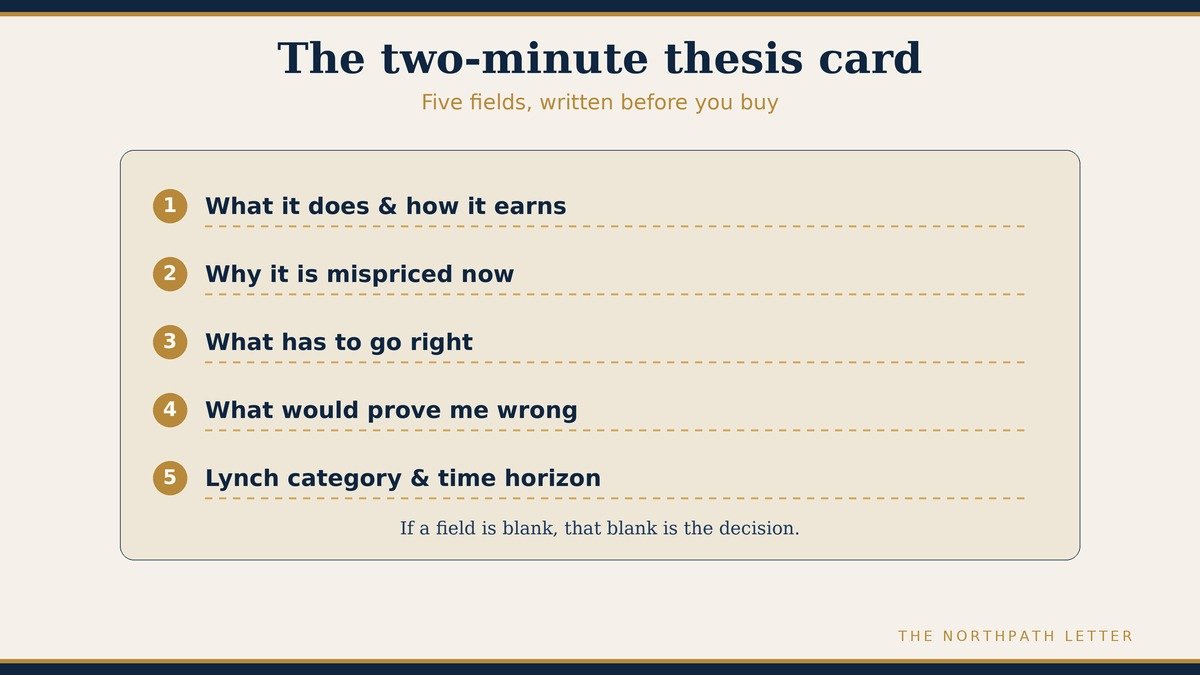
First, write the two-minute thesis before you commit. In plain language, and in no more than a short paragraph, set down five things: what the business does and how it actually makes money; why it is mispriced today; what specifically has to happen for the thesis to work; what would prove you wrong or trigger a sale; and which of Lynch’s categories it belongs to, so your expectations are calibrated from the start. If any of the five cannot be filled in, that is the finding — you do not yet have an investment, you have a candidate for further work or for the rejection pile.
Second, run the explanation test, not the conviction test. Conviction is not understanding; people are most confident about exactly the things the illusion of explanatory depth hides from them. So say the thesis aloud, ideally to someone who does not follow markets, and watch for the point at which you reach for jargon or hand-waving instead of a mechanism. That point is the edge of your real knowledge. Wherever possible, replace adjectives with numbers — not to create false precision, but because “it should grow nicely” and “revenue has to roughly double over five years for this to make sense” are very different statements, and only the second can be checked.
Third, date it, file it, and score it. A thesis you cannot find later is a thesis you cannot learn from. Keep the written monologue with the date you bought, revisit it when results arrive and again when you exit, and grade honestly whether the case played out as written, whether you were simply lucky, or whether you were wrong and the price bailed you out. Over years this builds something no tip sheet can provide: calibration — a growing, evidence-based sense of which of your judgements deserve confidence and which do not.
A common objection is that the best opportunities are often the least obvious, and that demanding a tidy explanation will filter out the misunderstood gems where the real money is made. But the drill does not penalise non-obviousness; it penalises false understanding. A misunderstood, genuinely cheap business is precisely the kind of thing you should be able to explain better than the crowd does — that superior explanation is the edge. What the drill filters out is the opposite case: the widely loved holding whose owners cannot actually say why it will earn what the price already implies. Far from blunting contrarian conviction, the discipline sharpens it, because a thesis you can state plainly is one you can hold through a sharp fall, while a thesis you cannot articulate is one you will abandon at exactly the wrong moment.
How long-term practitioners applied it
Lynch practised the drill as seriously as he preached it. Far from a two-minute effort, he wrote that he would often spend hours building and stress-testing the monologue for a single holding, and he treated the ability to tell the story simply as the signal that he was ready to act — and its absence as a signal to wait. His categories were not decoration but the spine of the exercise: identify the type of company first, and the right questions, the right expectations and the right exit conditions follow. The genius of his formulation is its accessibility. It asks for no model the ordinary investor cannot build, only the honesty to keep explaining until the explanation either holds together or falls apart.
Warren Buffett arrives at the same destination by a different road, through the idea of the circle of competence. In his shareholder letters and the Berkshire owner’s manual he has argued for decades that an investor does not need to be an expert on every business, but does need to know the boundary of what they genuinely understand and to operate strictly inside it. “Risk,” as he has put it, “comes from not knowing what you are doing.” The practical expression is his famous willingness to consign ideas to the “too hard” pile — to decline, without embarrassment, anything he cannot explain to his own satisfaction, however attractive others find it. That is the two-minute drill in a different vocabulary: the refusal to own what you cannot account for. When two of the most successful long-term investors of the past half-century, working independently, both make the ability to explain a holding the precondition for owning it, the discipline deserves to be treated as central rather than optional.
Disclosure: the companies named in this letter appear solely as historical illustrations of the principle under discussion. The author holds no position in any of them, and nothing above is a view, favourable or otherwise, on any security.
Key takeaways
- If you cannot explain it, you do not own it — you are exposed to it. Lynch’s two-minute drill (1989) demands a plain-language monologue covering why you are interested, what has to go right, and the pitfalls, before you commit capital.
- Articulation beats recognition. The illusion of explanatory depth (Rozenblit & Keil, 2002) means we feel we understand mechanisms we cannot explain; saying the thesis out loud exposes the gap before money is at risk.
- Story-driven activity is costly. The most active individual traders earned 11.4% versus the market’s 17.9% (Barber & Odean, 2000); a higher bar to action protects returns.
- Name the category. A cyclical, a stalwart and a turnaround demand different expectations; declaring the type up front prevents the expectation errors behind most disappointments.
- Write it, date it, score it. A filed thesis turns outcomes into calibration. Buffett’s circle of competence is the same discipline — own only what you can account for, and put the rest on the “too hard” pile.
— Manish Goel, FCA / NorthPath Advisory OÜ / Tallinn, Estonia
|
Important. |