There is a settled piece of conventional wisdom about Indian banking, repeated often enough by foreign analysts that it has hardened into something like a fact: that it is a structurally poor business. State-dominated, over-regulated, prone to violent bad-debt cycles, forced to lend where the government rather than the credit committee directs — the picture is of a system that intermediates capital inefficiently and rewards its owners badly for the privilege. It is a tidy story, and for long stretches of the last fifteen years it was even true.
It is not true now, and the gap between the story and the numbers is the most useful place an outside investor can start.
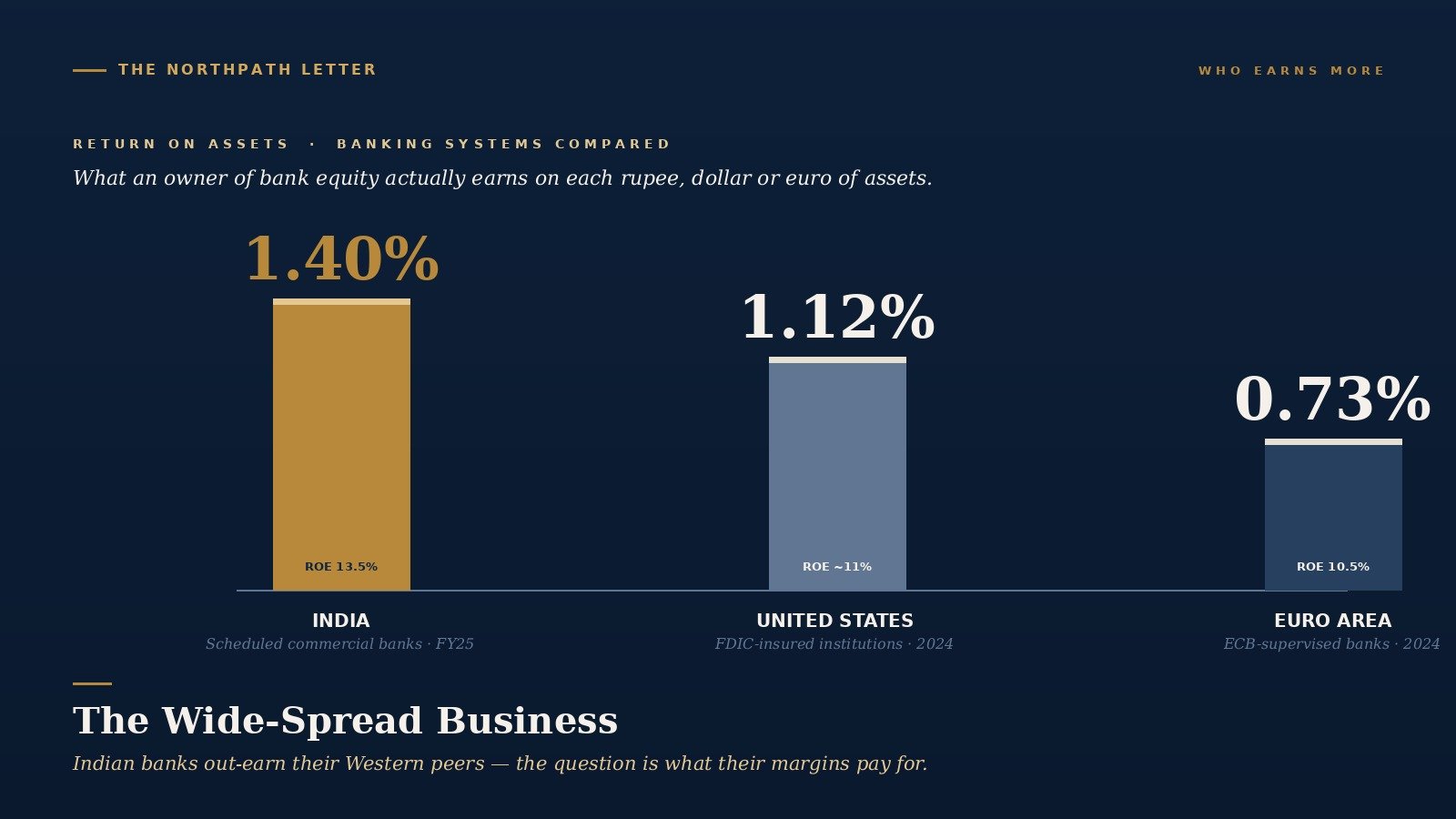
In the financial year ended March 2025, India’s scheduled commercial banks earned a return on assets of 1.4 per cent and a return on equity of 13.5 per cent. In the same window, the United States banking industry — the deepest, most sophisticated, most fee-rich banking market on earth — returned 1.12 per cent on assets. The euro area’s banks, supervised directly by the European Central Bank and sitting on the strongest capital ratios in their history, managed 0.73 per cent on assets and 10.5 per cent on equity. On the two measures that matter most to an owner of bank equity, the much-maligned Indian system is the most profitable of the three, and it is not especially close.
That ought to stop a careful reader in their tracks, because it inverts the received wisdom completely. The right question is no longer “why does Indian banking earn so little?” It earns more than the West. The right question is the more interesting one: how does it earn it, and what does the answer tell you about the durability of those returns? Because the way a bank makes its money — the structure underneath the headline ratio — is what determines whether the number you are looking at is a fair guide to the next ten years or a flattering snapshot of an unusually kind moment in the cycle.
This letter is about that structure. It is not a view on any bank, and nothing here is a recommendation to do anything. It is an attempt to explain why Indian banks run on wide spreads, what those spreads are compensating for, and how a reader who did not grow up inside the Indian system should adjust the Western mental model before applying it.
The spread is the whole story
Begin with where the money comes from. Western banking, and American banking in particular, has spent forty years diversifying away from the spread. The repeal of the Glass-Steagall separation by the Gramm-Leach-Bliley Act in 1999 let commercial banks, investment banks and insurers combine under one roof, and the modern American universal bank earns a great deal of its income from things that are not interest at all: card interchange, wealth and asset management fees, investment-banking advisory, payments, trading. Across the past decade, roughly thirty-five per cent of US banks’ total income has come from non-interest sources. The spread — the difference between what a bank earns on its loans and pays on its deposits — still matters enormously, but it is one engine among several.
Indian banking has barely begun this diversification. Fee and other non-interest income remains a structurally smaller share of the total than the global average of something close to thirty-eight per cent; the new private banks and the foreign banks have built respectable fee franchises, but for the system as a whole, and for the public-sector banks that still dominate it, the spread is overwhelmingly the business. An Indian bank is, to a first approximation, a machine for borrowing at the deposit rate and lending at the loan rate, and almost everything it earns is the difference.
This is why the net interest margin — the spread expressed against interest-earning assets — is the single most important number on an Indian bank’s income statement, in a way it simply is not for JPMorgan or BNP Paribas. And it is wide. The better Indian private banks have for years run net interest margins in the region of 3.3 to 3.5 per cent; the system average sits around three per cent, dragged down by the public-sector banks. Compare that to the euro area, where the net interest margin across all supervised banks was about 1.7 per cent in 2024 — less than half. The American picture is more competitive than it used to be: a long-running US margin near 2.8 per cent has widened in the higher-rate environment to 3.39 per cent by late 2025, the highest since 2019. But the euro-area number is the one to hold onto, because it shows what a mature, deeply penetrated, low-growth, low-inflation banking market looks like from the inside. Spreads compress toward nothing.
Indian spreads do not compress toward nothing, and the reason is not that Indian bankers are cleverer. It is that the spread is being asked to do a great deal of work that Western spreads are not.
What the spread pays for, part one: the pre-empted balance sheet
The first claim on an Indian bank’s balance sheet is made before it lends a single rupee to a customer, and it is made by the state.
Every scheduled commercial bank must hold a Cash Reserve Ratio — a fraction of its deposits parked with the Reserve Bank of India, earning no interest at all. The CRR is a creature of Section 42(1) of the Reserve Bank of India Act, 1934, and after a phased reduction through 2025 it now sits at three per cent of net demand and time liabilities. On top of that sits the Statutory Liquidity Ratio, mandated by Section 24 of the Banking Regulation Act, 1949: a further eighteen per cent of deposits that must be held in government securities, gold, or cash. The SLR earns a return — government bond yields — but it is a return the bank does not choose and cannot reach for; it is a captive buyer of sovereign debt by law.
Put the two together and roughly twenty-one paise of every rupee an Indian bank takes as a deposit is pre-empted — locked into instruments that yield either nothing or the risk-free rate — before the lending business begins. No American or European bank carries a regulatory reserve burden of remotely this magnitude. The US reserve requirement was reduced to zero in March 2020 and has not returned; European banks hold minimum reserves of one per cent. The Indian bank, by contrast, must earn its entire return on rather less than four-fifths of its funding base, and it must earn enough on that fraction to cover the drag from the rest. A wide spread is not a luxury in that arithmetic; it is a necessity.
The second claim is the lending mandate. Under the Reserve Bank’s Priority Sector Lending directions, a domestic commercial bank must direct at least forty per cent of its adjusted net bank credit to priority sectors — and within that, eighteen per cent to agriculture, twelve per cent to weaker sections, and seven and a half per cent to micro enterprises. These are not suggestions; a bank that falls short must park the shortfall in low-yielding deposits with development institutions such as NABARD, or buy Priority Sector Lending Certificates from banks that have lent in surplus. The mandate is, in effect, a quasi-fiscal function — the developmental allocation of credit — delegated to the banking system and financed out of the spread. It is the single largest structural difference between Indian banking and the Western model, and it has no real analogue in the United States. The closest American cousin, the Community Reinvestment Act of 1977, obliges banks to serve the communities they take deposits from, but it sets no forty-per-cent quantitative quota on the loan book.
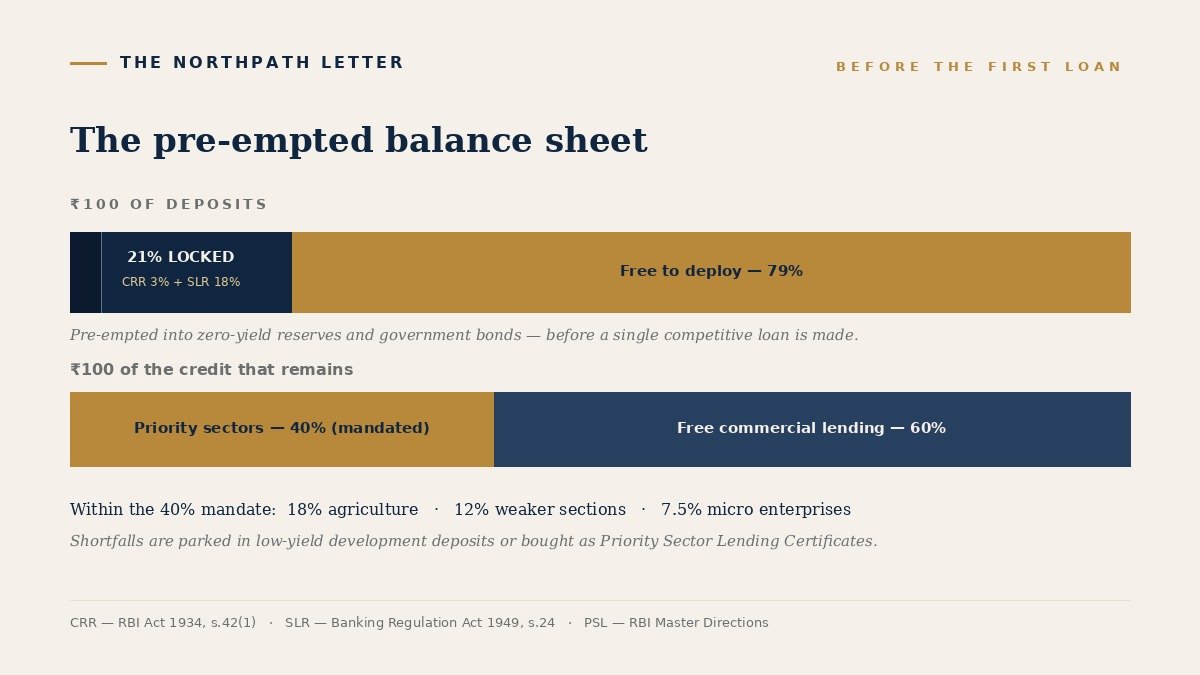
So before competition, before credit risk, before the cost of running a branch network across a subcontinent, the Indian bank operates with about a fifth of its deposits earning nothing or the risk-free rate, and two-fifths of the credit it does extend reserved for sectors it would not necessarily choose on commercial grounds. The wide spread is what is left over once the system has paid for these obligations. Read that way, a three-and-a-half per cent net interest margin in India and a 1.7 per cent margin in the euro area may represent roughly the same commercial freedom; the Indian number simply has more weight to carry before it reaches the shareholder.
What the spread pays for, part two: two banking systems wearing one average
The second adjustment a Western reader must make is to stop treating “Indian banks” as a single population. The sector average — that flattering 1.4 per cent return on assets — is the blend of two systems with almost nothing in common except a regulator.
India nationalised its major private banks in two waves, fourteen in 1969 and six more in 1980, and the consequence is still visible in every aggregate statistic the country produces. Public-sector banks — the State Bank of India and its peers, majority-owned by the government — still hold close to sixty per cent of the system’s assets. The remainder belongs to the private banks, a category that for practical purposes means the institutions built or rebuilt after liberalisation in the 1990s. The two cohorts earn their keep in entirely different ways. Studies of the two groups, and the Reserve Bank’s own data, put the public-sector banks’ return on assets well below one per cent — often around 0.6 to 0.7 — against private-sector returns comfortably above 1.4. That is more than a twofold gap in the efficiency with which a rupee of assets is turned into profit, and it persists through cost-to-income ratios, through fee income, through the speed of credit growth, and through asset quality.
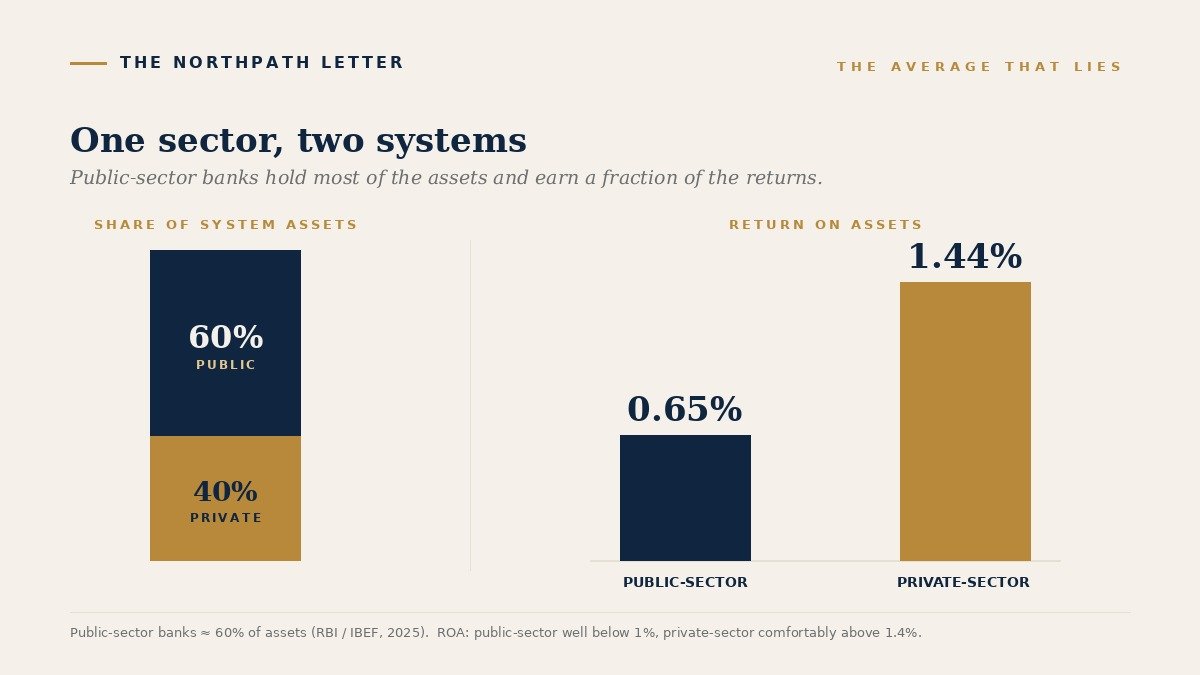
This bimodality is the most important fact about Indian banking that the headline numbers hide, and it has a direct consequence for anyone reading the sector from the outside. The 1.4 per cent system return on assets is not a description of a typical Indian bank. It is the weighted blend of a large, slow, low-return public cohort and a smaller, fast, high-return private one. The same is true of net interest margins, of digital adoption, of provisioning discipline. To average them is to describe a country that does not exist — a bank that is neither the State Bank of India nor HDFC Bank but a statistical phantom that is both. The single most common analytical error a foreign investor makes with Indian banking is to read the aggregate and imagine it describes the median. It describes neither end of a barbell.
What the spread pays for, part three: the cycle behind the calm
The third thing the spread pays for is the part of the story that does not show up at all in a single year’s accounts, and it is the one most likely to mislead.
India’s gross non-performing assets ratio at the end of March 2025 was 2.2 per cent, falling further to 2.1 per cent by September — a multi-decadal low, and on its face a sign of a banking system in robust health. It is robust. But it must be read against where it came from. As recently as the financial year ended March 2018, the gross NPA ratio for all scheduled commercial banks stood at 11.2 per cent, and for the public-sector banks alone at a staggering 14.6 per cent. One rupee in seven that the public banks had lent was not being repaid. That crisis was not a recession; India did not have one. It was the unwinding of a credit boom from the late 2000s, surfaced by Governor Raghuram Rajan’s Asset Quality Review in 2015 and 2016, which forced banks to recognise the bad loans they had been quietly restructuring. The clean-up that followed — the Insolvency and Bankruptcy Code of 2016, a vast recapitalisation of the public banks by the government, and a wave of public-sector mergers in 2019 and 2020 — took the better part of a decade and tens of billions of dollars of taxpayer capital.
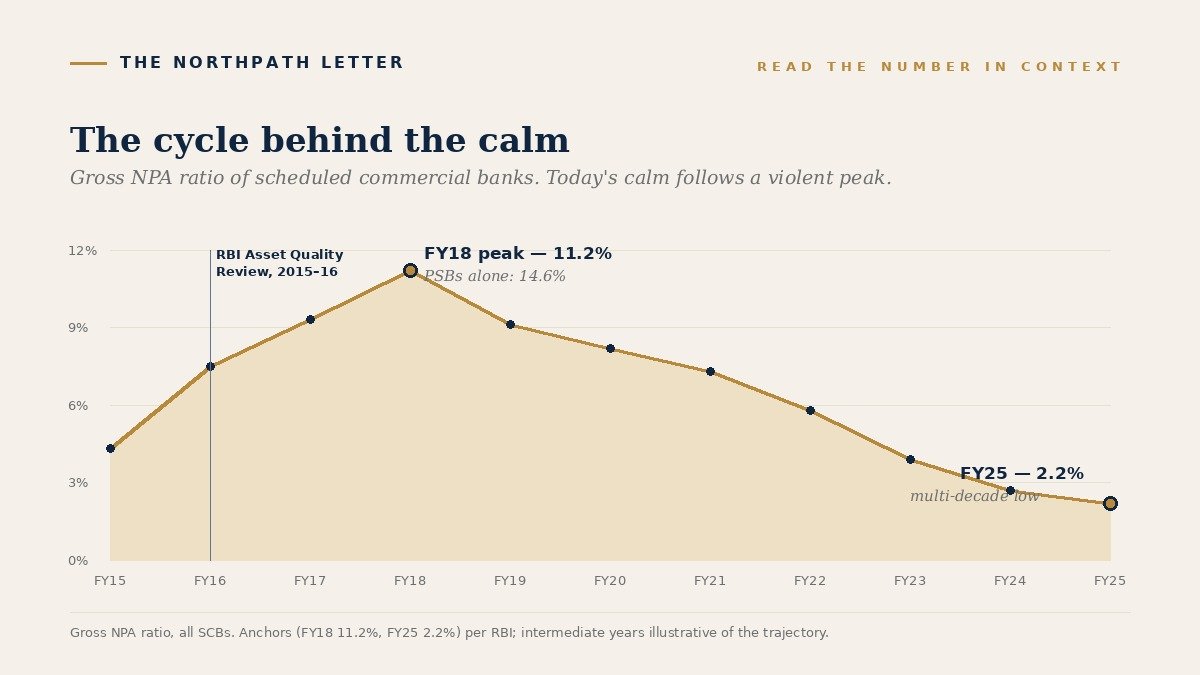
This is the cycle the wide spread exists to absorb. A banking system that can move from a 2.2 per cent bad-loan ratio to an 11.2 per cent one inside a single boom-and-bust must earn, through the good years, enough of a margin to provision for the bad ones. The benign credit cost of 2025 is not the normal state of the world; it is the top of a cycle, and a 1.4 per cent return on assets earned at the top of a credit cycle is a very different thing from the same number earned in the middle of one. The discipline that this history imposes on the careful reader is to discount the current profitability for a through-cycle credit cost that is structurally higher and more volatile than anything in the American or European data. Europe’s banks have their own bad-debt history, but nothing in the post-war record of US or euro-area banking looks like an 11.2 per cent system-wide NPA ratio outside of an actual financial crisis.
The shallow pool that makes it all sustainable
If the picture so far were the whole picture, you would expect Indian banking returns to be fragile — wide spreads holding up an over-regulated, state-heavy, cyclically dangerous system. The reason they are not fragile, and the reason the high returns can persist even as the book grows, is the one structural feature that works entirely in the system’s favour: India is dramatically under-banked, and growing into its banking system rather than out of it.
Domestic credit to the private sector in India runs at roughly half of GDP. In the euro area the same measure is around 85 per cent; in the United States, on the broad World Bank measure, it approaches twice GDP. The Western banking systems are mature in the precise sense that they have already lent to almost everyone who can usefully borrow; their growth tracks nominal GDP at best, and competition for a static pool of borrowers is exactly what grinds the euro-area margin down toward 1.7 per cent. India is the opposite. Its credit-to-GDP ratio has decades of deepening ahead of it, which means its banks can grow their loan books at double-digit rates — deposits and credit both grew in double digits again in FY25 — without having to win every rupee from a competitor by underpricing it. Growth that comes from a widening pool rather than a fixed one is growth that does not require sacrificing the spread to get it. That is the engine that lets a wide margin coexist with a fast-growing book, and it is the single most important difference in the trajectory, as opposed to the level, of Indian versus Western bank profitability.
It is also why the comparison with Europe is more instructive than the comparison with America. The United States combines deep penetration with a fee-rich, scale-driven model and a competitive but currently wide spread; its banks earn their 1.12 per cent in a thoroughly different way from India’s 1.4. Europe is the cautionary mirror: a banking union that was never completed — there is common supervision through the Single Supervisory Mechanism since 2014, but still no shared deposit insurance scheme — leaving a fragmented market of national champions, a decade of negative policy rates from 2014 to 2022 that compressed deposit margins to nothing, and the structurally thin spreads that result. Europe shows what happens when a banking system is deep, fragmented, slow-growing and margin-starved all at once. India, for all its constraints, is none of those things.
Indian banks do not earn less than their Western peers — they earn it differently: wide spreads on a shallow, fast-deepening, heavily pre-empted book.
THE NORTHPATH LETTER
How to read an Indian bank when you didn’t grow up with one
For the reader who wants to translate this into a way of looking at the financial statements rather than a set of opinions, the structure above implies a short checklist of adjustments to the Western mental model. None of this is advice; it is the set of questions the structure makes worth asking.
First, never read the sector average as a description of a bank. Separate public from private before you do anything else, because the two cohorts are different businesses with different economics, and blending them produces a number that describes no real institution.
Second, read the net interest margin against the funding base, not in isolation. The number that distinguishes a strong Indian bank is the cost of its deposits, which is largely a function of its CASA ratio — the share of low-cost current and savings accounts in its deposit mix. A bank that funds itself cheaply through a sticky deposit franchise earns its wide spread durably; a bank that buys its deposits in the bulk market at high rates is renting its margin and will lose it when competition or the rate cycle turns. The spread is the headline; the deposit franchise is the moat underneath it.
Third, discount the current credit cost for the cycle. Look past the reported gross NPA ratio to the provision coverage ratio (how much of the bad loans are already written down), the slippage ratio (how fast good loans are turning bad), and the restructured book. A benign NPA number at the top of a cycle tells you less than the trajectory of slippages, which turns first.
Fourth, find the priority-sector and reserve drag and treat it as the cost of doing business in India, not as a temporary imposition. It is permanent. A bank’s skill is measured partly by how profitably it meets the forty-per-cent mandate — whether it has built genuine, well-underwritten franchises in agriculture and microfinance and small business, or whether it merely buys certificates to comply.
Fifth, watch the fee line. The structural under-development of non-interest income in Indian banking is, depending on the institution, either a permanent weakness or the largest untapped lever it has. The banks that are building card, wealth, payments and transaction-banking fee streams are the ones beginning to look, in the composition of their income, like the Western universal banks — and are diversifying away from sole dependence on the spread.
And sixth, hold the capital framework in view. Indian banks operate under the Reserve Bank’s Basel III regulations, with a minimum total capital adequacy ratio of nine per cent plus a capital conservation buffer of 2.5 per cent — a floor above the Basel global minimum. Deposit insurance, through the Deposit Insurance and Credit Guarantee Corporation, covers five lakh rupees per depositor, raised from one lakh in 2020, the rough Indian analogue of the FDIC’s $250,000 in the United States. These are the guardrails within which the whole wide-spread machine runs.
The takeaway
Indian banks do not earn less than their Western peers — on the most recent numbers they earn more — but they earn it differently: wide spreads on a shallow, fast-deepening, heavily pre-empted book, where a benign-looking sector average conceals both a chasm between excellent private banks and weak public ones and a through-cycle credit history far more violent than the calm of the moment suggests.
Important. All content on this site and in this email is journalism and education for a general audience. Nothing here constitutes investment advice or a recommendation in respect of any specific financial instrument, nor an offer or solicitation to buy or sell any security. Readers should consult an authorised financial adviser regulated in their own jurisdiction before making any investment decision.