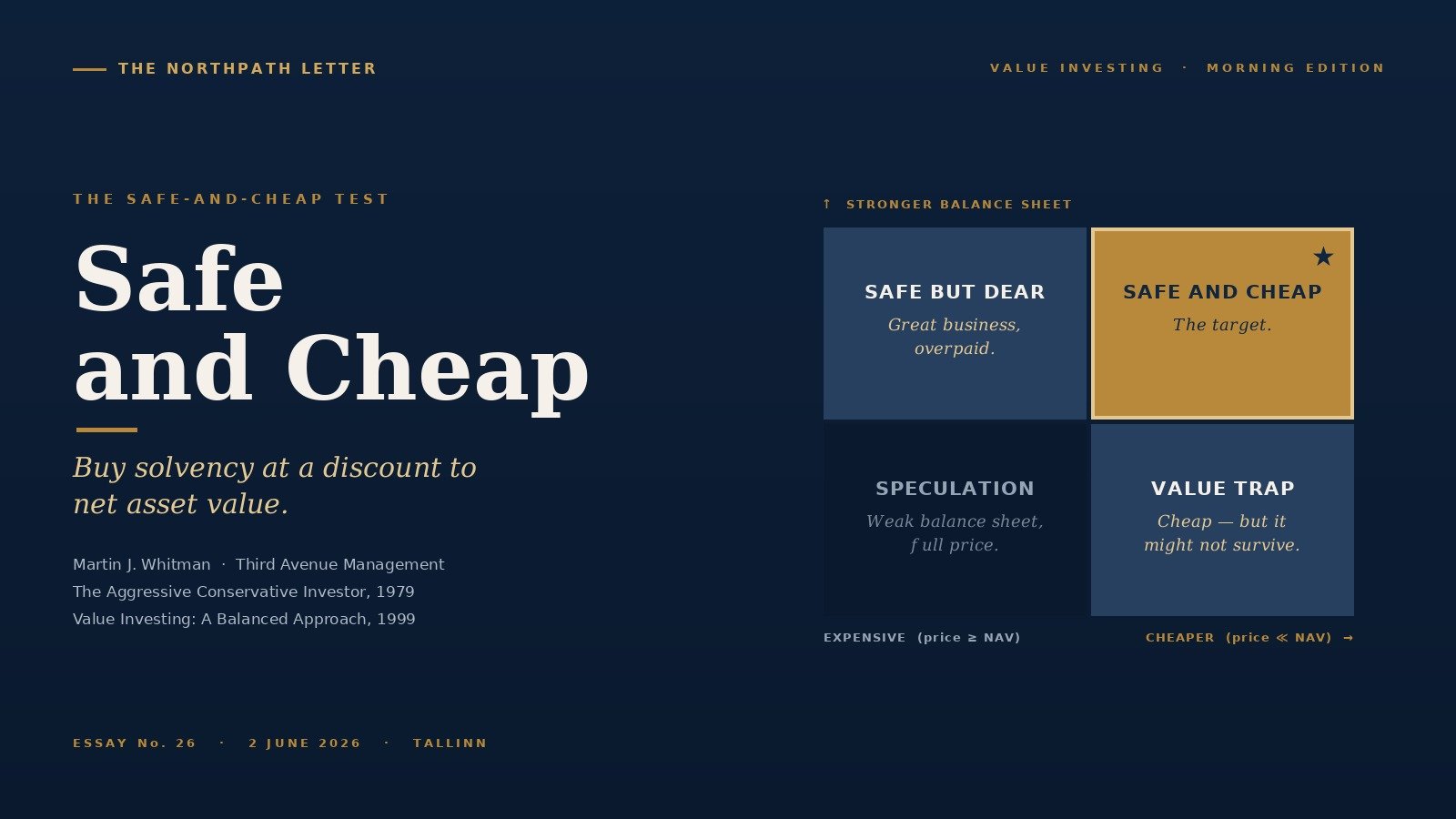
The NorthPath Letter · Morning Edition · Value Investing
Most value investing starts with the income statement and asks what a business will earn. Martin Whitman started with the balance sheet and asked what a business owns and what it owes — then refused to buy unless the company was financially close to indestructible and the price was a fraction of its net worth. He called it “safe and cheap.” It is among the most underrated disciplines in the value canon, and one of the few a long-term investor can actually execute without forecasting the future.
The principle: safe first, then cheap
The phrase belongs to Martin J. Whitman, the New York investor who founded Third Avenue Management and ran its flagship Third Avenue Value Fund from its inception on 1 November 1990. Whitman set out the doctrine two decades before that, in The Aggressive Conservative Investor, written with the game theorist Martin Shubik and first published in 1979, and refined it in Value Investing: A Balanced Approach (1999) and in a long run of Third Avenue shareholder letters. The title of the 1979 book is the whole thesis in three words. You are conservative because you insist on financial strength and a margin of safety in the price; you are aggressive because, having insisted on both, you can concentrate, ignore the market’s mood, and wait for years without a catalyst.
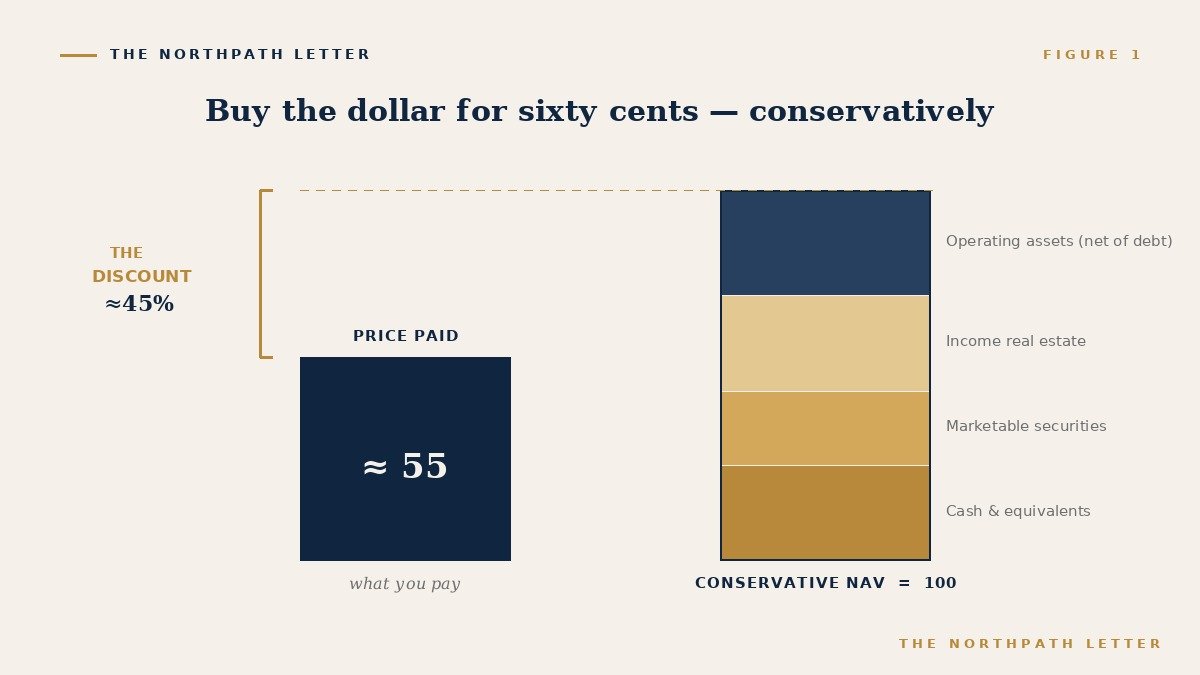
“Safe and cheap” is a conjunction, and the order matters. Safe comes first. A safe security, in Whitman’s vocabulary, is the common stock of a company with a super-strong financial position: ample cash and marketable securities, little debt, manageable maturities, and an honest, creditor-conscious management. Cheap comes second, and only once safety is established: the price must sit at a meaningful discount to a conservative estimate of net asset value — what the business would be worth to a private owner who could see the assets and the liabilities for what they are. Third Avenue’s own description of the strategy is exact: invest with “an emphasis on financial strength and an ability to compound net asset value,” while “restricting investment activity to securities priced at significant discounts to conservative estimates of net asset value.”
The discipline this asks of an investor is unusual. It tells you to stop forecasting next year’s earnings, stop trying to time the macroeconomy, and start reading the balance sheet as the primary document — because the balance sheet, unlike the earnings forecast, is largely a record of things that already exist. Whitman’s quarrel with mainstream security analysis was precisely its “primacy of the income statement”: the habit of valuing a company almost entirely off a stream of projected earnings, capitalised at a multiple that itself depends on a mood. Begin instead, he argued, with what the company holds and what it owes, demand that the first comfortably exceeds the second, and pay well below the difference. Whitman went further still: he gauged a company’s progress not by reported earnings but by the growth in its net asset value over time — the figure he believed actually tracked the creation of wealth. A business that quietly compounds book value while carrying no solvency risk is, on this reading, doing the only thing that finally matters.
The mechanism: why solvency bought at a discount compounds
Safe-and-cheap works because it stacks two different protections that most strategies treat as alternatives. The first is survival. A company with a fortress balance sheet cannot be forced to sell assets at the bottom, cannot be marched into a dilutive emergency rights issue, and cannot be handed to its creditors in a downturn. It controls its own destiny across the full credit cycle. That single property removes the most expensive event in investing — the permanent loss of capital that occurs when a cheap, fragile company is wiped out before its cheapness is ever recognised. Financial strength converts a price decline from a catastrophe into a temporary quotation.
The second protection is the discount itself, and here Whitman’s framing is sharper than the textbook “margin of safety.” A patient minority shareholder, he argued, should buy a business for materially less than a control buyer would rationally pay for the whole of it. The gap between the quoted price and that conservative private-owner value is not merely a cushion; it is optionality. Over time, the gap tends to be closed by what Whitman called resource conversion: a buyback funded out of surplus cash, a takeover, a recapitalisation, a refinancing, a sale of a division, a spin-off, or the arrival of an activist. The safe-and-cheap investor does not need to predict which of these will happen, or when. He needs only to own a solvent business at a discount and let the corporate-finance machinery — and his own patience — do the work.
Why does the market leave such situations on the table? Because it is built to do the opposite of what this strategy requires. Prices are set at the margin by participants who extrapolate recent earnings, who are rewarded on quarterly and annual horizons, and who therefore demand a visible near-term catalyst. A well-financed company that is dull, asset-heavy, and growing slowly offers none of that. It is “dead money” until it isn’t. The long-term owner who has underwritten the balance sheet is, in effect, being paid to supply the patience the marginal price-setter cannot afford to supply. That is the structural inefficiency safe-and-cheap exploits — not a mispriced earnings forecast, but a mispriced time horizon.
The empirical record
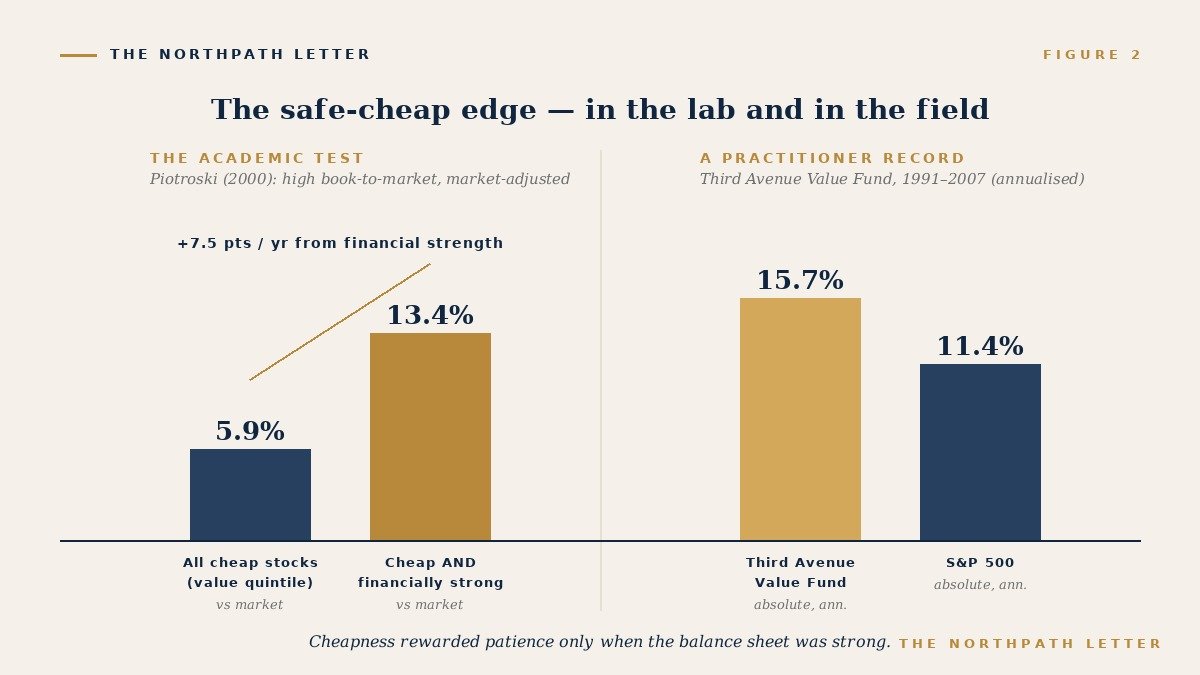
The headline evidence is Whitman’s own. From 1991 through 2007 — the first seventeen full years he ran it — the Third Avenue Value Fund compounded at roughly 15.7% a year against about 11.4% for the S&P 500, a margin of more than four percentage points annually sustained across a full market cycle. That is the affirmative case. The cautionary case arrived in 2008, and an evidence-based letter is obliged to report it: the fund fell about 45.6% that year, worse than the S&P 500’s 37% decline. The lesson is not that the discipline failed; it is that “readily ascertainable net asset value” is only as reliable as the analyst’s reading of the assets. When a portfolio leans into financial and real-estate-linked securities and the credit cycle breaks, the “net” in net asset value can prove far softer than the audited carrying values implied. Safe-and-cheap is a method for thinking; it is not a guarantee, and its single largest failure mode is mistaking a marked balance-sheet number for a hard one.
Step back from any single manager and the broad academic record points the same way. The value premium — the long-run tendency of statistically cheap stocks, measured by a high ratio of book value to price, to outperform expensive ones — was documented by Eugene Fama and Kenneth French in 1992 and explained behaviourally by Josef Lakonishok, Andrei Shleifer and Robert Vishny in their 1994 study of contrarian investment: investors over-extrapolate recent results, pricing dull companies as if their dullness were permanent. Whitman’s refinement was to observe that the premium is not spread evenly across the cheap. It concentrates, decisively, in the financially strong.
The principle also has support that does not depend on any one manager. Walter Schloss, one of the “Superinvestors of Graham-and-Doddsville” whom Warren Buffett profiled in his 1984 Columbia Business School address, ran money by buying first below net working capital and later below book value, checking only that the company had a long operating history and an honest management. From 1955 to early 1984 his partnership compounded at roughly 21.3% gross — about 16.1% to limited partners after fees — against 8.4% for the S&P 500. He did it from public filings, holding around a hundred names, almost never speaking to management. His was the balance-sheet-first, asset-value discipline in its purest form.
Then there is the academic anchor that ties the whole idea together. In 2000, the University of Chicago accounting professor Joseph Piotroski published “Value Investing: The Use of Historical Financial Statement Information to Separate Winners from Losers” in the Journal of Accounting Research. He scored cheap, high book-to-market companies on nine simple binary signals of financial health — profitability, leverage and liquidity, and operating efficiency — and found that buying only the financially strong members of the value universe improved the return on a low price-to-book portfolio by at least 7.5 percentage points a year; the strongest-scoring value stocks beat the market by about 13.4% annually, against 5.9% for the value group as a whole. The mirror image of that result is the “distress anomaly” documented by John Campbell, Jens Hilscher and Jan Szilagyi in their 2008 study In Search of Distress Risk: the most financially distressed stocks, far from rewarding bargain-hunters, have delivered abnormally low returns. Cheapness alone is not an edge. Cheapness conditioned on financial strength — Whitman’s exact prescription — is.
Two episodes where safe-and-cheap was visible
The first is Japan after 1989. The Nikkei 225 peaked at 38,915.87 on 29 December 1989 and then began a generational decline that no amount of earnings forecasting could have navigated. What it created, over the following two decades, was the richest hunting ground for balance-sheet value in modern history: hundreds of listed Japanese companies eventually traded below the value of their own cash and marketable securities, net of all liabilities — Graham net-nets with operating businesses still attached. But the episode is instructive precisely because cheapness was everywhere and safety was not. The over-leveraged property and financial companies that looked cheap on earnings were value traps; the ones that rewarded patience were the cash-rich, debt-light manufacturers and holding companies whose “net” assets were genuinely there to be counted. The eventual wave of buybacks, governance reform and activist pressure — resource conversion, arriving a decade or two late — closed many of those discounts. Safe-and-cheap was the filter that separated the two.
The second is the American technology bubble of 2000 to 2002. The Nasdaq Composite peaked near 5,048 in March 2000 and fell roughly 78% to about 1,114 by October 2002. In the eighteen months before that peak, capital had stampeded into cash-burning internet companies, and to fund the stampede it had been pulled out of exactly the businesses a safe-and-cheap investor cares about: profitable, asset-rich, slow-growing “old economy” companies — property owners, insurers, industrial holding companies, consumer staples — left for dead at low multiples of tangible book. When the bubble burst, those unfashionable, well-financed balance sheets were among the best performers of the subsequent two years, while the fragile growth stories were wiped out. Once again the same pattern held: the market had mispriced the time horizon, paying up for an exciting future and discarding a boring present that happened to be solvent and cheap.
The application framework: three disciplines
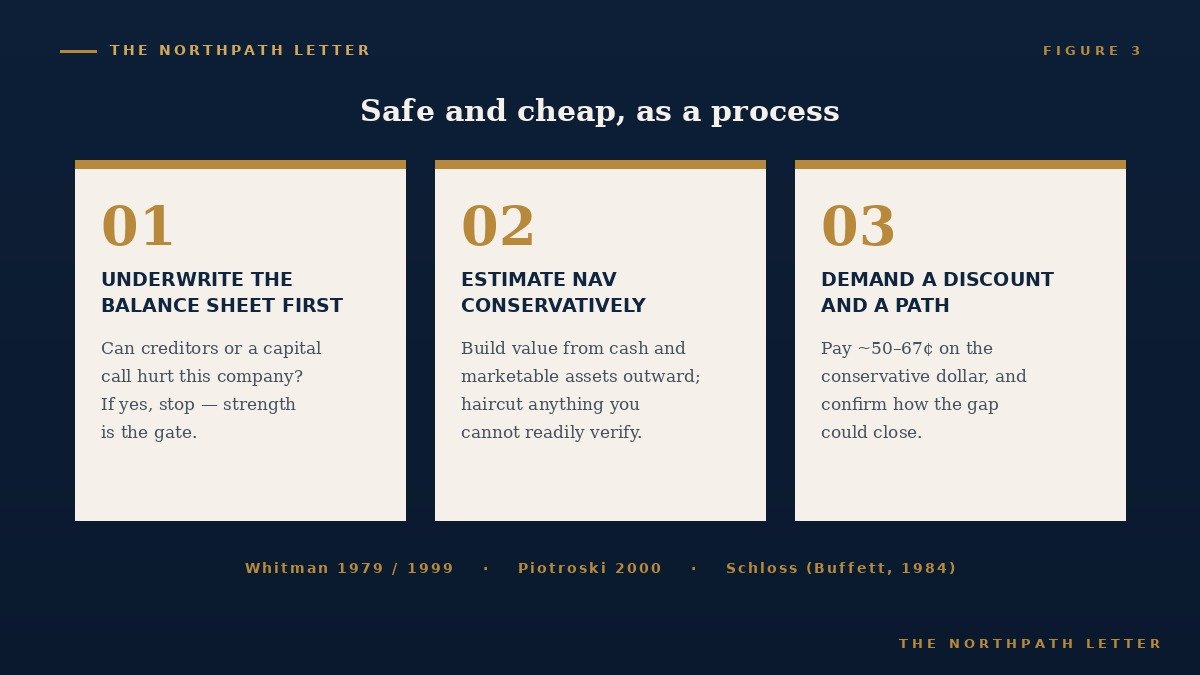
One: underwrite the balance sheet before you look at the earnings. Whitman’s first question was never “what will this earn?” but “can this company be hurt by its creditors or its capital needs?” In practice that means reading the debt note before the income statement — the quantum of borrowings, the maturity ladder, the covenants, the off-balance-sheet commitments, the pension and lease obligations — and quantifying the cash and marketable securities that offset them. The pass/fail test is blunt: if a recession or a frozen credit market could force this company to raise capital on someone else’s terms, it is not safe, and nothing about its cheapness matters. Strength is the gate; everything else is downstream of it.
Two: estimate net asset value conservatively, and only from assets you can readily ascertain. The discipline lives or dies on the word readily. Build value from the hard outward: cash and equivalents at face, marketable securities at market, income-producing real estate at a defensible capitalisation of its rents, and only then the operating assets — and haircut anything whose value depends on an assumption you cannot check. Goodwill, deferred tax assets, and self-marked financial instruments are where 2008 did its damage; treat them with suspicion. The output is not a precise number but a conservative range, and the rule is to act only when the price is below the bottom of it.
Three: demand a genuine discount and a plausible path to closing it. Whitman generally wanted to pay no more than about 50 to 67 cents on his conservative dollar of net asset value. The discount does two jobs: it is the margin of safety against your own analytical error, and it is the source of return when the gap closes. So pair it with a second question — how could this discount be converted? A buyback the surplus cash can fund, a strategic buyer, a refinancing, a break-up, an activist. You are not forecasting that any one of these will occur on a timetable; you are confirming that the situation is the kind in which value can be realised at all, so that patience is rewarded rather than merely tested.
How the practitioners actually applied it
Whitman ran Third Avenue as a literal application of these rules. The fund’s letters returned again and again to the same four characteristics — a strong financial position, honest and capable management, an understandable business with reliable disclosure, and a price far below readily ascertainable net asset value — and to the idea that a passive minority investor should behave like a control buyer who simply happens to be buying a sliver rather than the whole. He was equally willing to express the idea through distressed debt and post-reorganisation equities, where the balance sheet had already been cleaned by bankruptcy and the surviving securities were, by construction, safe and cheap. What he waited for in each holding was the same: a resource-conversion event — a refinancing, an asset sale, a merger, a return of capital — that would translate a static balance sheet into a realised gain, on a schedule he never pretended to know in advance. He stepped back from managing the flagship fund in 2012 and died in 2018 at the age of 93, but the method he codified outlived his own track record’s late stumble.
Walter Schloss applied a narrower, even more austere version of the same instinct. Working from a small office with his son and little more than the financial press and company filings, he bought diversified baskets of stocks trading below book value, insisting only on a long operating history and a management with a decade-long reputation for honesty. He carried no debt of his own, took no meetings, and let a hundred small discounts compound for half a century. Buffett’s 1984 tribute made the point that this record could not be luck: Schloss “knows how to identify securities that sell at considerably less than their value to a private owner,” and he did nothing else.
The same insistence runs through Seth Klarman, whose 1991 book Margin of Safety built the Baupost Group’s philosophy around absolute returns, bottom-up bargain-hunting, and a refusal to own anything whose downside was not protected by hard asset value or creditworthiness. All three descend from Benjamin Graham and the balance-sheet primacy of Security Analysis (1934) — but Whitman’s contribution was to generalise Graham’s narrow net-net screen into a broader test that a well-financed, growing company could also pass, and to insist that the “safe” half of the conjunction was not optional. Cheapness without strength, all three would say, is not value. It is a trap with a low price tag.
Key takeaways
- Safe is the gate, cheap is the reward. Whitman’s order of operations is the whole discipline: establish financial indestructibility first, and only then ask whether the price is a fraction of net asset value. Reverse the order and you are buying value traps.
- Read the balance sheet as the primary document. The balance sheet records what largely already exists; the earnings forecast records a hope. Underwrite debt, maturities and liquidity before you capitalise a single rupee, dollar or euro of projected profit.
- The edge is empirical, not just anecdotal. Piotroski (2000) showed that screening cheap stocks for financial strength added at least 7.5 points of annual return; the distress-risk literature shows the cheap-but-fragile underperform. Strength-conditioned cheapness is the part of the value premium that survives.
- The discount is optionality, not just cushion. A solvent business bought well below private-owner value gets re-rated by resource conversion — buybacks, M&A, refinancing, break-ups, activism. You supply the patience the marginal price-setter cannot, and are paid for it.
- Respect the method’s failure mode. 2008 showed that “readily ascertainable” net asset value is only as hard as the assets behind it. Haircut self-marked, credit-sensitive and intangible items, and the method protects you; trust them, and it will not.
— Manish Goel, FCA / NorthPath Advisory OÜ / Tallinn, Estonia
|
Important. |