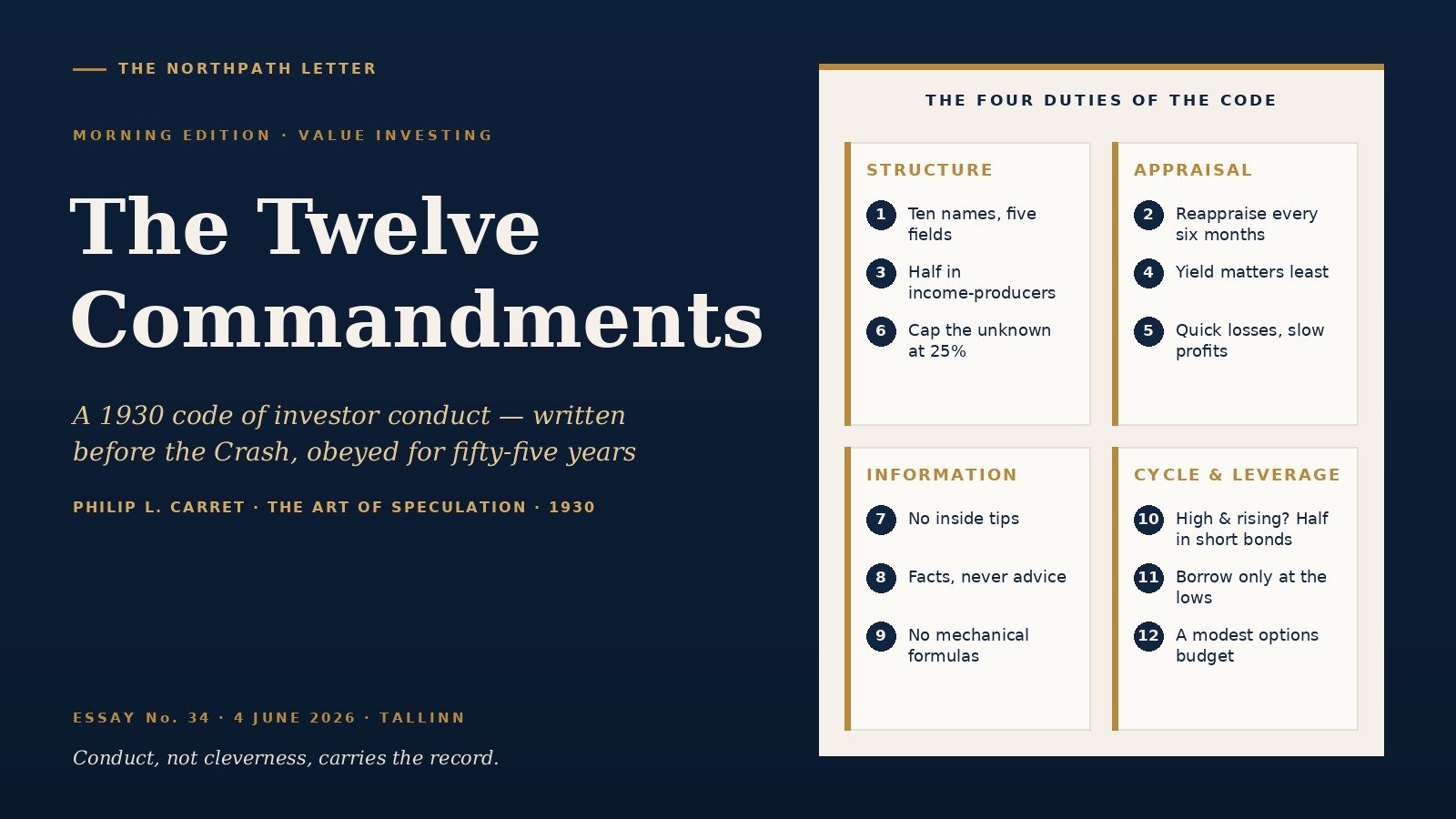
Value Investing · The NorthPath Letter · Morning Edition
In 1930, a thirty-three-year-old former Barron’s reporter published twelve rules of investor conduct — four years before Graham and Dodd, nineteen before The Intelligent Investor. He then spent fifty-five years running the same fund through the Great Depression, a world war, and every regime that followed, compounding at roughly thirteen per cent a year. This letter is about Philip Carret’s Twelve Commandments, and about why the part of value investing that survives every era is a code of behaviour, not a method of valuation.
The principle: a code of conduct, not a stock screen
Most of the canonical documents of value investing tell the reader what to buy. Benjamin Graham’s seven tests for the defensive investor are a quantitative filter on companies. Philip Fisher’s fifteen points are a qualitative examination of a business. The oldest useful document in the American canon does something different. It tells the reader how to behave — whatever he owns.
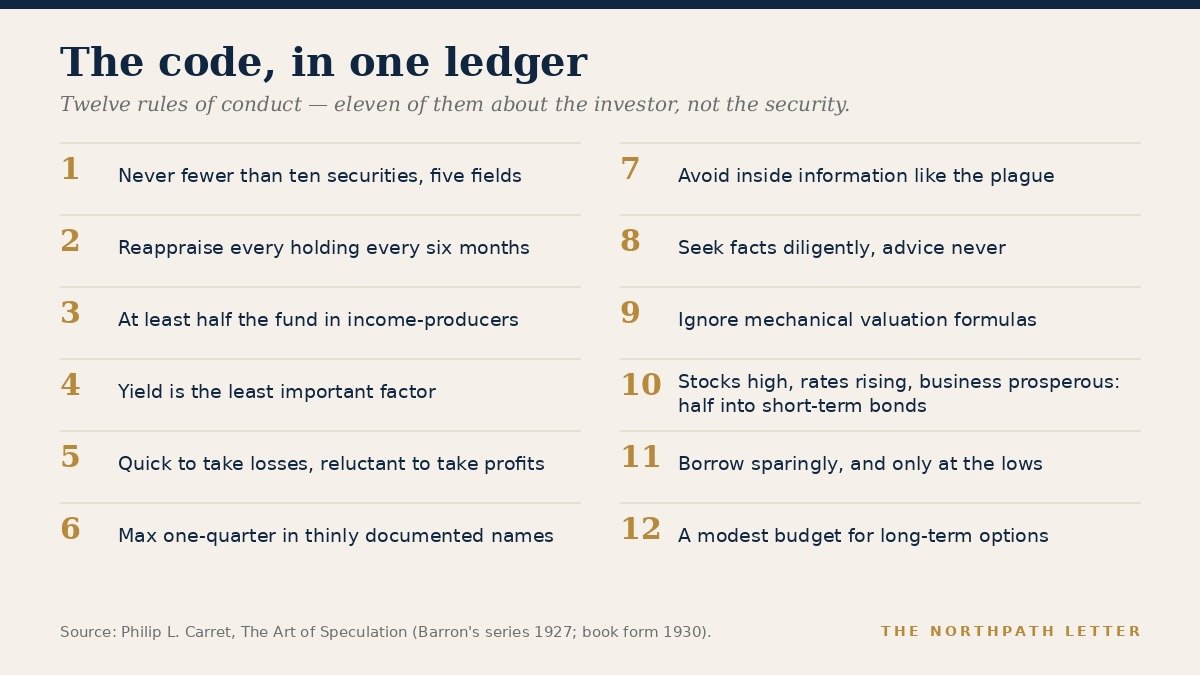
Philip Lord Carret (1896–1998) wrote The Art of Speculation as a series of articles for Barron’s in 1927, published in book form in 1930. Near its close he set out what he called the twelve precepts — later universally known as his Twelve Commandments. They deserve quoting in full, because their brevity is the point. Never hold fewer than ten different securities covering five different fields of business. At least once in six months, reappraise every security held. Keep at least half the total fund in income-producing securities. Consider yield the least important factor in analysing any stock. Be quick to take losses, reluctant to take profits. Never put more than a quarter of a given fund into securities about which detailed information is not readily and regularly available. Avoid “inside information” as you would the plague. Seek facts diligently, advice never. Ignore mechanical formulas for valuing securities. When stocks are high, money rates rising and business prosperous, at least half a given fund should be placed in short-term bonds. Borrow money sparingly, and only when stocks are low, money rates low or falling, and business depressed. Set aside a moderate proportion of available funds for the purchase of long-term options on stocks of promising companies, whenever available.
Read the list again and notice what is absent. There is no valuation method in it. There is no earnings multiple, no asset test, no margin calculation. Eleven of the twelve rules govern the conduct of the investor — how many things he owns, how often he re-examines them, what he reads, whom he refuses to listen to, when he is permitted to borrow. Carret had concluded, before the 1929 crash gave the world a demonstration, that the binding constraint on investment results is not analytical skill but behaviour under pressure. Sixty-one years later, in the memoir he published at ninety-four, A Money Mind at Ninety (1991), he gave that cast of temperament its name: the money mind — the habit of thinking about businesses and probabilities steadily, across decades, while other people think about prices, daily.
The discipline the code asks of its owner is therefore different in kind from the discipline a screen asks. A screen is consulted at the moment of purchase and then falls silent. A code is in force every day the portfolio exists — most of all on the days the owner would prefer to forget it.
The mechanism: why conduct compounds
Why should rules about behaviour, written before the Depression, outperform rules about valuation, which are revised every generation? Because the investor is the only component of the system he fully controls. A long-term equity result is the product of two series multiplied together: what the businesses do, and what the owner does. The first series is partly knowable and never controllable. The second is entirely controllable and, in practice, the place where most of the damage occurs. Carret’s code is an attempt to fix the second series in advance, in writing, while the author of the rules is still calm.
Each rule maps onto a specific, measurable failure mode. The leverage rule — borrow sparingly, and only at the bottom of the cycle — is ruin-avoidance arithmetic. A fifty per cent decline requires a hundred per cent recovery; an unleveraged investor who halves can wait, while a leveraged one who halves is usually removed from the game at the point of maximum opportunity. The diversification floor and the information minimum — at least ten securities in five fields, and never more than a quarter of the fund in anything thinly documented — cap the cost of any single analytical error, which is another way of saying they assume the analyst errs, including this one.
The fifth commandment — quick to take losses, reluctant to take profits — is the most remarkable of the twelve, because it inverts, by instruction and five decades in advance, a bias that had not yet been documented. Hersh Shefrin and Meir Statman named the disposition effect in 1985; Terrance Odean, examining ten thousand discount-brokerage accounts (“Are Investors Reluctant to Realize Their Losses?”, Journal of Finance, 1998), measured it: investors realised 14.8 per cent of their available gains in a year against only 9.8 per cent of their available losses — roughly fifty per cent more eager to bank a winner than to admit a mistake. Carret’s rule commands the opposite posture: errors leave the portfolio promptly, compounders are left to compound. His own restatement of it, to a young Jason Zweig in 1994, remains the best one-line summary of low-turnover investing on record: “Turnover usually indicates a failure of judgment. It’s extremely difficult to figure out when to sell anything.”
The two information rules are hygiene. Inside tips — quite apart from being illegal to trade on in every major jurisdiction today — are other people’s conclusions, carrying unknown error bars and an unknowable agenda; facts are raw material for one’s own judgment. “Seek facts diligently, advice never” is the 1930 statement of a result that household-brokerage data would confirm seventy years later: the more an investor outsources conviction to the surrounding noise, the more he trades, and the more he trades, the worse he does. And the ninth rule — ignore mechanical formulas — is not a licence to ignore evidence. It is a ban on outsourcing appraisal itself: a code regulates conduct and leaves the judgment with the practitioner, while a formula claims to replace the judgment, and is arbitraged or broken soon after it becomes popular.
The empirical record: a fifty-five-year audit, replicated
The code’s first audit is the author’s own record, and it is one of the longest continuous records in the history of managed money. In May 1928 Carret pooled roughly $25,000 from family and friends into what became the Pioneer Fund — today the third-oldest surviving mutual fund in the United States. He ran it for fifty-five years, until 1983. Ten thousand dollars left in the fund across that tenure became roughly eight million — about thirteen per cent compounded against roughly eight per cent for the broad American market, which would have turned the same stake into well under a million (The New York Times, 19 November 1995 and 30 May 1998). The gap is the arithmetic signature of a code obeyed for half a century: roughly five points a year, no single year of which looked heroic.
The components of the code have since been audited separately, on populations rather than anecdotes. Brad Barber and Terrance Odean’s “Trading Is Hazardous to Your Wealth” (Journal of Finance, 2000) followed 66,465 American households from 1991 to 1996: the average household turned over three-quarters of its portfolio annually and earned 16.4 per cent net against a market return of 17.9; the most active quintile earned 11.4. The same authors, with Yi-Tsung Lee and Yu-Jane Liu, later put the aggregate cost of individual trading in Taiwan at about 2.2 per cent of that economy’s GDP per year (Review of Financial Studies, 2009) — a national income statement for the violation of commandments five and eight. And the cycle-posture rules have their own audit: every credit-fuelled mania on record has been, in substance, a mass violation of rules ten and eleven, and has resolved accordingly.
Honesty requires the caveats. Thirteen per cent over fifty-five years contained long stretches of lag behind livelier styles, and the code did not immunise its author against drawdown: by accounts of the fund’s early years, Pioneer roughly halved between 1929 and 1932. What the code did was keep its author solvent, unleveraged and psychologically intact through a market that fell by nine-tenths — so that there was a fund left to compound for the following fifty years. Survival is the precondition of every long-term record, and it is the thing the twelve rules most directly purchase.
Two episodes where the code was visible
The first episode is the code’s own birth. Carret launched the fund in May 1928, roughly eighteen months before the most punishing peak in American market history. On 3 September 1929 the Dow Jones Industrial Average closed at 381.17; on 8 July 1932 it closed at 41.22, a decline of eighty-nine per cent. The proximate killer was not the decline itself but the borrowing that preceded it: brokers’ loans financing margin purchases had swollen to roughly $8.5 billion by the autumn of 1929, much of it lent at call against collateral that was about to halve, and halve again. The public had inverted commandment eleven — borrowing most aggressively precisely when stocks were high, money rates rising and business prosperous, the exact configuration in which commandment ten orders the investor to move half the fund into short-term instruments. Carret, who as a financial journalist had reported the 1920–21 bust — the Dow at 63.90 in August 1921, sugar collapsing from twenty cents a pound to two — had written the rules with that earlier ruin in mind. The new fund halved in the Depression; its leveraged contemporaries vanished. The income anchor and the leverage prohibition did exactly what they were drafted to do, which was not to avoid loss but to make loss survivable.
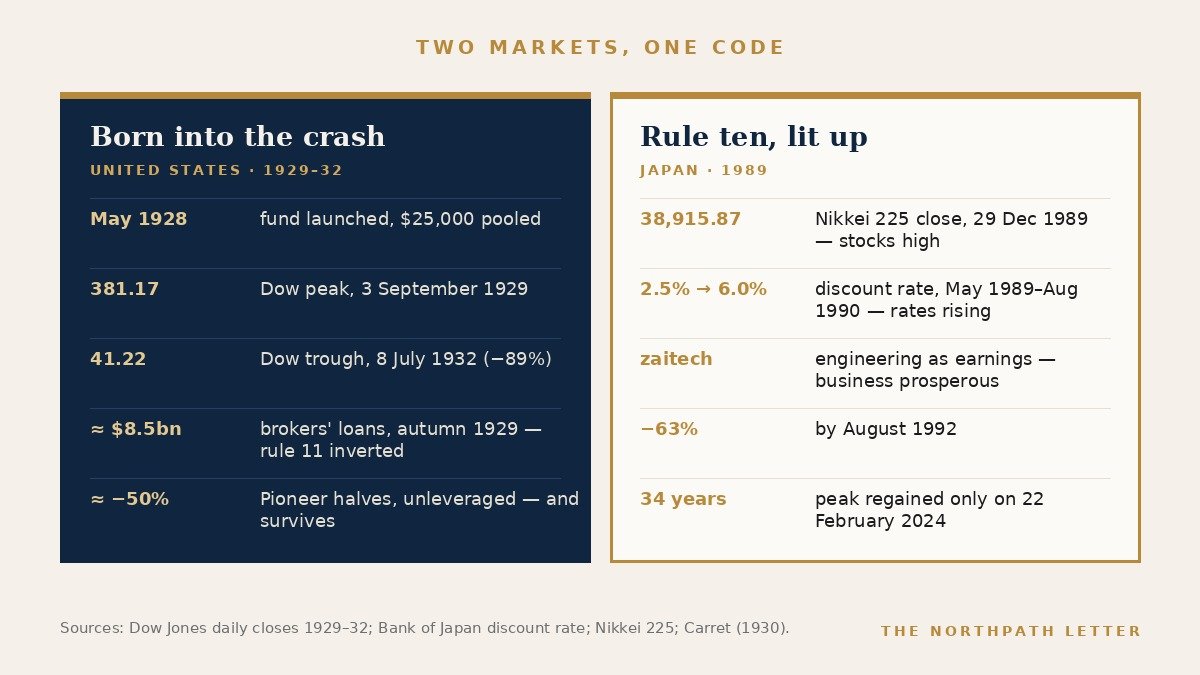
The second episode happened in a market Carret never managed and a currency he never held, which is precisely why it matters. Commandment ten names three observable conditions: stocks high, money rates rising, business prosperous. Consider Tokyo at the end of 1989. Stocks high: the Nikkei 225 closed at 38,915.87 on 29 December 1989, capping a decade in which it had risen roughly sixfold, on earnings multiples several times those of any other developed market. Money rates rising: the Bank of Japan raised its official discount rate from 2.5 per cent in May 1989 to 6.0 per cent by August 1990, five increases in fifteen months. Business prosperous: corporate Japan was so flush that financial engineering with surplus cash — zaitech — had become a reported line of earnings. Every condition of the rule was lit simultaneously. A Japanese reader of a sixty-year-old American book, mechanically obeying its tenth rule — half the fund into short-term instruments, no forecast required — would have sidestepped the deepest part of what followed: a sixty-three per cent collapse by August 1992, and a peak that was not seen again until 22 February 2024, thirty-four years later. The local stories of 1989 — land prices, trade surpluses, a new era of Japanese management — were not portable. The conduct rule was.
The application framework: three written disciplines
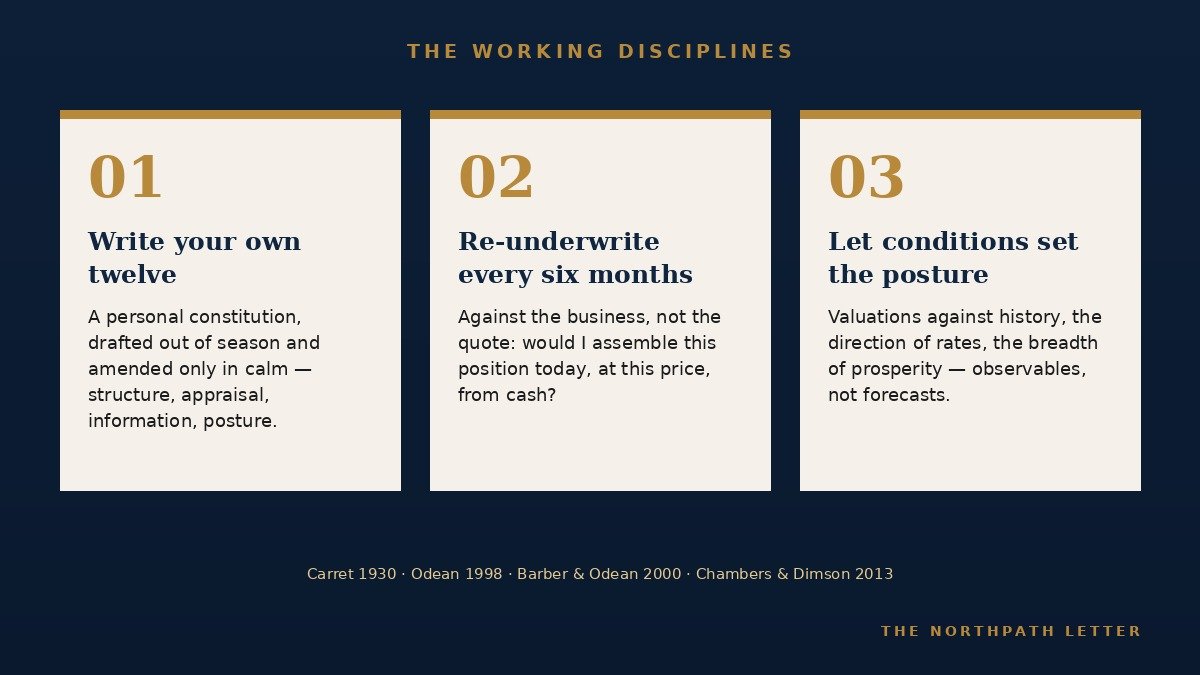
The lesson of the twelve is not that a modern investor should adopt them verbatim — rule twelve’s long-term options, for instance, belong to the capital structure of 1930. The lesson is that the investor should possess a written code at all. Three disciplines translate Carret into current practice.
First: write your own twelve, out of season. A personal investment constitution — drafted in calm, amended only in calm — covering the same four duties Carret’s rules cover: structure (a floor on the number of holdings, a ceiling on any single position, a hard cap on anything thinly documented), appraisal (a fixed re-examination calendar), information (what is read, what is refused), and posture (the leverage prohibition, stated unconditionally). The test of each clause is Carret’s: it must bind behaviour observably, so that a third party auditing the portfolio could verify compliance from the record alone.
Second: re-underwrite every six months, against the business, not the quote. Commandment two does not say watch every security; it says reappraise it. The working form of the discipline is a semi-annual question, answered in writing for every holding: knowing what I now know, would I assemble this position today, at this price, from cash? Where the honest answer is no, commandment five takes over — the error leaves promptly, however embarrassing the exit, and the compounder is left undisturbed, however tempting the profit.
Third: let observable conditions, not forecasts, set the defensive posture. Rules ten and eleven require no view about what markets will do next. They name conditions a practitioner can read from public data — the level of valuations against their own history, the direction of policy rates, the breadth of prosperity consensus — and attach a posture to each configuration. The investor who obeys them will look too cautious near every top and too aggressive near every bottom, which is the visible cost of a rule that cannot be negotiated with. Carret’s record suggests the cost is worth paying once, and then worth paying every time.
How long-term practitioners actually applied it
Carret’s own application was the slowest part of his method. In the 1940s, on visits to Omaha, he traded ideas with a local stockbroker named Howard Buffett, and through that friendship took a position in Greif Brothers, an unglamorous Ohio maker of barrels and industrial packaging, which he then held for decades. Asked at ninety-seven to state his strategy, he gave Zweig a sentence a child could audit: “I have a very simple strategy. I buy good companies at attractive prices. Then I sit on them.” He sat on the Pioneer Fund’s chair for fifty-five years, remained a trustee until his hundredth birthday, and was still working forty-hour weeks into his nineties. The stockbroker’s son rendered the verdict that has followed Carret since: Warren Buffett told The New York Times in 1995 that Carret had “the best long-term investment record of anyone I know”, and saluted the ninety-nine-year-old from the stage of Berkshire Hathaway’s 1996 annual meeting as a hero of investing.
The more instructive second practitioner is John Maynard Keynes, because he arrived at Carret’s code from the opposite direction — by failing without it. Managing the discretionary Chest Fund of King’s College, Cambridge from 1921, Keynes spent the 1920s practising exactly what Carret’s rules forbid: top-down “credit cycle” timing, switching between asset classes on macroeconomic forecasts. David Chambers and Elroy Dimson’s archival reconstruction (“John Maynard Keynes, Investment Innovator”, Journal of Economic Perspectives, 2013) shows the approach failed even in its author’s celebrated hands; from the early 1930s he abandoned it for concentrated, patient ownership of businesses he understood. His 1938 memorandum to the College’s Estates Committee distils the converted position into three principles — careful selection of a few investments judged cheap against their probable worth over years; holding them steadfastly “through thick and thin”, perhaps for several years, until they have fulfilled their promise or proven a mistake; and a balanced position with opposed risks. They are, in different prose, commandments six, five and one. Across 1921–46 the Chest compounded at 16.0 per cent a year against 10.4 for the British market — with effectively all of the outperformance earned after the conversion.
Two practitioners, one born to the code and one converted to it under examination by the 1929 crash, in two different markets, with the same result: the rules about conduct, not the cleverness of any single appraisal, carried the record. The author holds no position in any company named in this letter; Greif and Berkshire Hathaway appear only as historical illustrations of a discipline, not as suggestions of any kind.
Key takeaways
- The oldest surviving value document is a code of conduct, not a valuation method. Eleven of Carret’s twelve commandments (The Art of Speculation, 1930) regulate the investor’s own behaviour — structure, appraisal, information, posture — and behaviour is the only input the investor fully controls.
- The record is the audit. Pioneer Fund compounded at roughly 13 per cent for 55 years against about 8 for the market — five unheroic points a year, sustained by survival through a market that fell nine-tenths.
- Modern data convicts the violations. Households that traded most earned 11.4 per cent against the market’s 17.9 (Barber & Odean, 2000); investors realise gains half again as readily as losses (Odean, 1998). Commandments five and eight anticipated both findings by seven decades.
- The cycle rules are portable across borders. Tokyo in 1989 lit all three conditions of commandment ten — stocks high, rates rising, business prosperous — and then spent thirty-four years regaining its peak. Stories are local; conduct rules travel.
- Write your own twelve. A personal constitution drafted out of season, a six-month re-underwriting ritual, and a posture set by observable conditions will do more for a lifetime result than any single appraisal — because, as Carret put it, turnover usually indicates a failure of judgment.
— Manish Goel, FCA / NorthPath Advisory OÜ / Tallinn, Estonia
|
Important. |