THE NORTHPATH LETTER · MORNING EDITION · VALUE INVESTING
Benjamin Graham did not invent value investing in 1934. He did, however, write down in that year a single formula crisp enough that, nine decades later, academics in Detroit, Tokyo, London and Sydney could rerun it against their own market histories and produce the same answer: a stock bought for less than the liquidation value of its current assets, in a basket large enough to wash out the failures, has compounded faster than the market index across every multi-decade window the data covers. That formula is net-net working capital, also called the net current-asset value. This letter looks at where it came from, why it works, what the empirical replications have actually found, and how two practitioners we now treat as monuments — Warren Buffett’s partnership-era self and Walter Schloss — turned the formula into a forty-seven-year track record without ever meeting a single management team.
1. The principle: a balance-sheet floor, not an earnings forecast
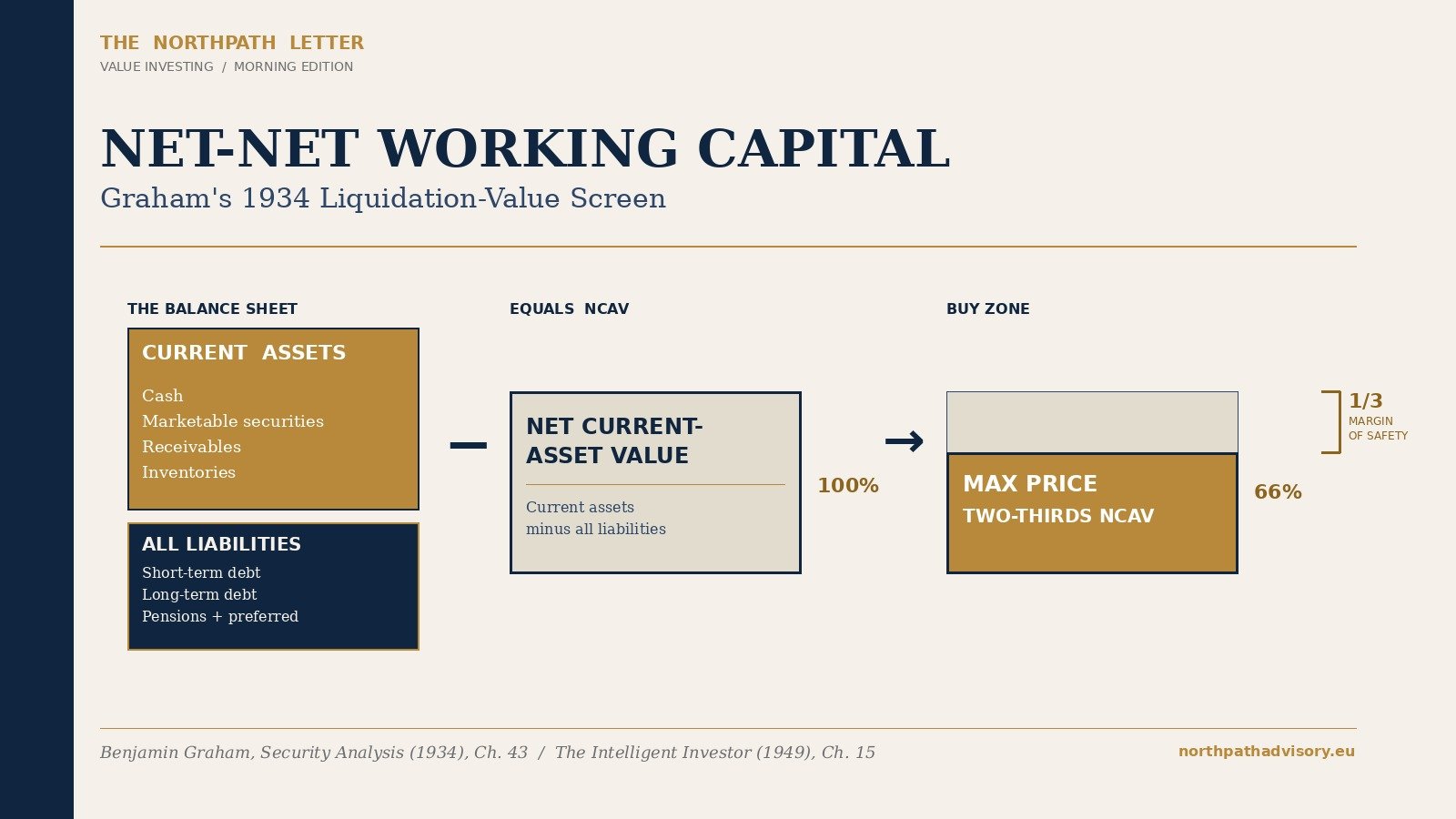
Graham first set the formula out in Security Analysis (1934), the textbook he co-wrote with David Dodd while teaching at Columbia Business School during the depths of the Depression. Chapter forty-three of that edition is titled “Significance of the Current-Asset Value,” and the argument is mechanical to the point of being almost rude. Take a company’s current assets — cash, marketable securities, receivables and inventories — and subtract every liability the firm carries: short-term debt, long-term debt, pensions, preferred stock, the lot. What is left is the net current-asset value, the NCAV. Divide by the share count and you have a per-share liquidation floor that owes nothing to the income statement, nothing to a discount rate, nothing to a five-year growth forecast.
Graham then added a second step. He would buy a stock only when its market price was no more than two-thirds of that NCAV. The one-third haircut between NCAV and price was the margin of safety — the buffer against the receivables that would not collect, the inventories that would not move at book, the liabilities that had not yet surfaced. He repeated the formula, almost word for word, in chapter fifteen of The Intelligent Investor (1949), reissued unchanged in the 1973 revision, and in the 1976 Medical Economics interview with Hartman Butler that became part of the posthumous Graham canon, he singled it out as “the one method in which I have the greatest confidence.”
What the formula refuses to do is more important than what it does. It refuses to forecast. It refuses to opine on whether the business model has a future, whether the chief executive is talented, whether the next product cycle will recover demand. It says, instead, that on this balance sheet, after every named claim has been settled, the residual current-asset value is worth more than what the stock market is asking the buyer to pay. The investor is being handed the inventory and the cash for less than what the inventory and the cash, alone, would fetch in an orderly wind-down. Everything else — the plant, the goodwill, the brand, the recurring franchise — comes free.
2. The mechanism: why the discount exists and why it closes
A reader new to the formula reasonably asks: if the discount is so visible, why does it persist? Graham’s own answer, and the answer the modern academic replications have converged on, has three parts.
The first is the agency problem of professional money management. A portfolio manager paid quarterly to deliver relative returns cannot, in practice, hold a portfolio of small, ugly, money-losing stocks no client recognises. The career risk of explaining a position in a textile mill whose share price has fallen ninety per cent from its peak is asymmetric: if it works, the manager is competent; if it does not, the manager is fired. The result is a structural supply of forced sellers among institutions that owns the stock when it falls into the net-net zone, and a structural shortage of professional buyers willing to take the other side.
The second is the salience asymmetry. A balance sheet does not put out press releases. A stock that has lost ninety per cent of its peak price does. The income statement of a net-net candidate is, by construction, ugly — that is how the stock got there. The narrative that surrounds the company is uniformly negative, and the negative narrative is the only thing most market participants are reading. The current-asset value sits, accountant-quiet, on page three of the annual report, waiting for someone to add it up.
The third is asymmetric pay-off mathematics. A net-net’s downside is not zero, but it is bounded by the floor of the current assets; the upside, in the cases where the discount closes by an operating turn, a takeover, a liquidation or a recapitalisation, is multiples. The empirical work that follows quantifies how that asymmetry plays out across hundreds of names. The mechanism is durable because each of its three pillars is structural — institutional incentives, narrative salience and the arithmetic of bounded downside against unbounded upside — and none has been arbitraged away in nine decades of replication, even as the universe of net-nets has migrated from country to country.
There is a further point worth naming, because it is the point most modern readers struggle with. The net-net formula deliberately ignores the income statement. To a generation of investors trained to begin every analysis with revenue growth and free-cash-flow conversion, that omission feels reckless. Graham’s argument was the opposite: precisely because the income statement is where the narrative lives, the income statement is the surface most aggressively repriced by the crowd. The balance sheet, by contrast, is a more boring document, and the boring document is the one that gets ignored. The discount that opens up between current-asset value and market capitalisation is, in this reading, a direct measurement of the crowd’s preference for narrative arithmetic over accounting arithmetic. The formula is a tax on that preference, payable to the investor patient enough to read the footnotes.
3. The empirical record: nine decades, four continents
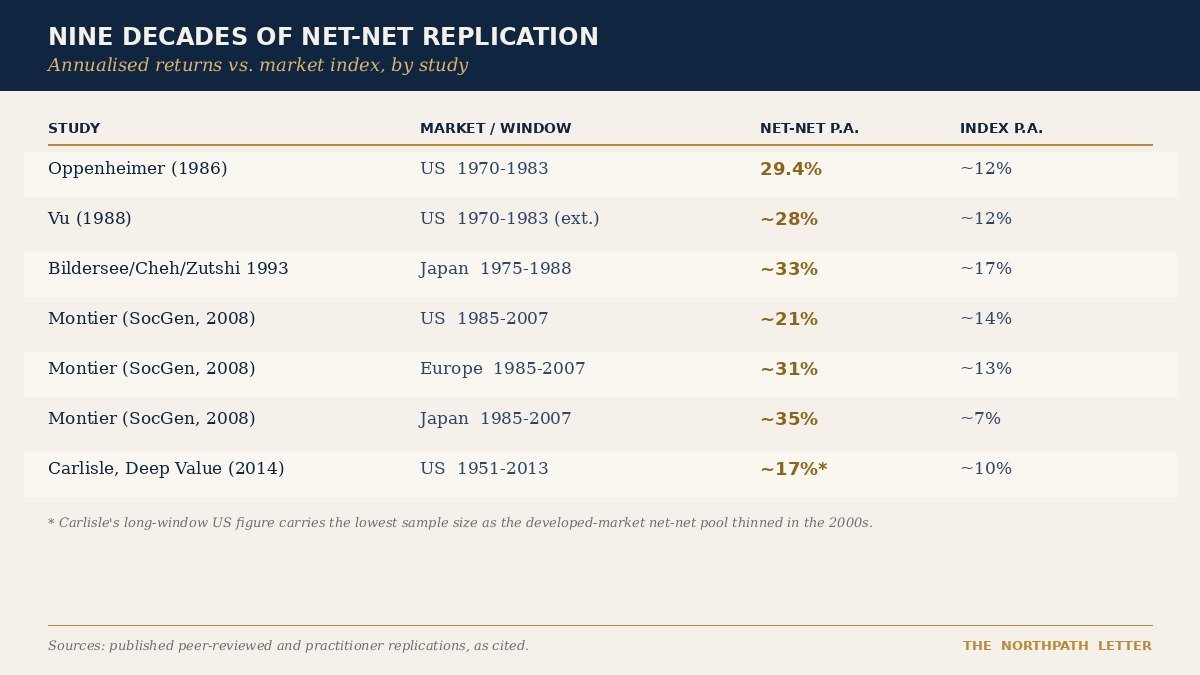
The first rigorous post-Graham test was Henry Oppenheimer’s 1986 paper in the Financial Analysts Journal, titled “Ben Graham’s Net Current Asset Values: A Performance Update.” Oppenheimer screened the US tape from 1970 to 1983, formed an annual portfolio of every stock trading at sixty-six per cent or less of NCAV, and reported a mean annualised return of 29.4 per cent against the S&P 500’s ~12 per cent over the same window. Joseph Vu of the University of Detroit Mercy replicated the work in 1988 in the Journal of Portfolio Management, extended the holding-period analysis, and confirmed that the excess return persisted even when transaction costs and bid-ask spreads were modelled explicitly.
Bildersee, Cheh and Zutshi extended the test to Japan in 1993 in the Pacific-Basin Finance Journal, finding excess returns of similar magnitude in the 1975-1988 sample. James Montier’s 2008 piece for Société Générale, “Graham’s Net-Nets: Outdated or Outstanding?”, was the most ambitious global replication: 1985-2007 across US, Japan and Europe, with annualised returns of roughly 35 per cent in Japan, 31 per cent in Europe and 21 per cent in the US, against market returns of 13-17 per cent. Critically, Montier also published the failure rate — roughly five per cent of net-nets experienced a permanent loss greater than ninety per cent of cost — which made clear that the discipline only works as a basket and is destroyed by concentration.
Tobias Carlisle’s 2014 book Deep Value ran the screen against the longest US window yet attempted, 1951-2013, and confirmed that the excess return persisted across the full sweep, with the important caveat that the US universe had thinned from several hundred candidates in the 1970s to fewer than thirty in normal markets by the 2010s. The pool, however, had not vanished — it had migrated. Carlisle and Wesley Gray formalised the screen rules and the trap-avoidance overlays in Quantitative Value (2016). The accumulated body of evidence now spans four continents, nine decades and four full market cycles, with broadly the same finding each time: a diversified basket of stocks priced below two-thirds of NCAV outperforms the broad market index by a margin large enough to survive transaction costs, survivorship adjustments and the failure-rate tail. No single replication is a perfect proof. The fact that the same answer keeps surfacing in independent samples, by independent authors, in different decades and in different currencies, is something stronger.
4. Two historical episodes when the screen lit up
The first episode is Japan after 1989. The Nikkei 225 peaked at 38,915 in December 1989 and would not retake that level for thirty-four years. By the late 1990s, with the index seventy per cent below its peak, a peculiar feature of corporate Japan became visible: hundreds of mid-cap and small-cap industrials had accumulated cash and marketable-security positions on their balance sheets large enough to exceed their own market capitalisations, even before any operating value was credited. Montier’s 2008 piece counted several hundred Japanese names trading below two-thirds of NCAV at the lows of 2003, and the cohort repeated itself in March 2009. The structural reason was unique to Japan — conservative corporate balance-sheet management combined with the absence of an activist investor base — but the pricing pattern was textbook Graham. The basket compounded materially faster than the Topix across the next decade, even though the operating businesses inside the basket were, on average, mediocre.
The second episode is the United States in March 2009, with a smaller echo in March 2020. The GFC sell-off opened a brief window in which roughly one hundred US micro-caps traded below two-thirds of NCAV, concentrated in technology, contract manufacturing, semiconductor equipment and small specialty retail. The window closed quickly — by early 2010 the count was back below forty — but the cohort that was bought in that six-month window outperformed the Russell 2000 by a wide margin over the following three years. The COVID crash of March 2020 produced a similar but shorter window, lasting roughly six weeks and concentrated in oil-field services and small-cap travel. Both episodes are reminders that the net-net opportunity in a developed market is not a chronic state but an episodic one, supplied by panic, and the investor who has done the work in advance is the one who can act inside the window.
A third episode is worth mentioning briefly because it underscores how geography rather than time-period now dictates where the formula works. Korean small-caps from 2014 to 2020 carried a population of net-nets large enough to support a dedicated cottage industry of foreign value funds. The structural cause was again local — the ‘Korea discount,’ a persistent valuation gap attributed to chaebol governance concerns — and again the underlying screen behaved exactly as Graham’s 1934 mechanics predicted. The pattern is consistent across each of these dislocations: a structural reason produces forced selling or sustained neglect; the balance sheets do not move; the gap between current-asset value and market price widens beyond two-thirds; a patient diversified buyer is paid for closing it. The supply of the opportunity is local and episodic; the formula that converts the opportunity into a return is universal.
5. The application framework: three process disciplines
Reading the academic record without reading the process record is dangerous. The same papers that document the excess return also document the destruction of the excess return when the basket is mishandled. Three disciplines do the work.
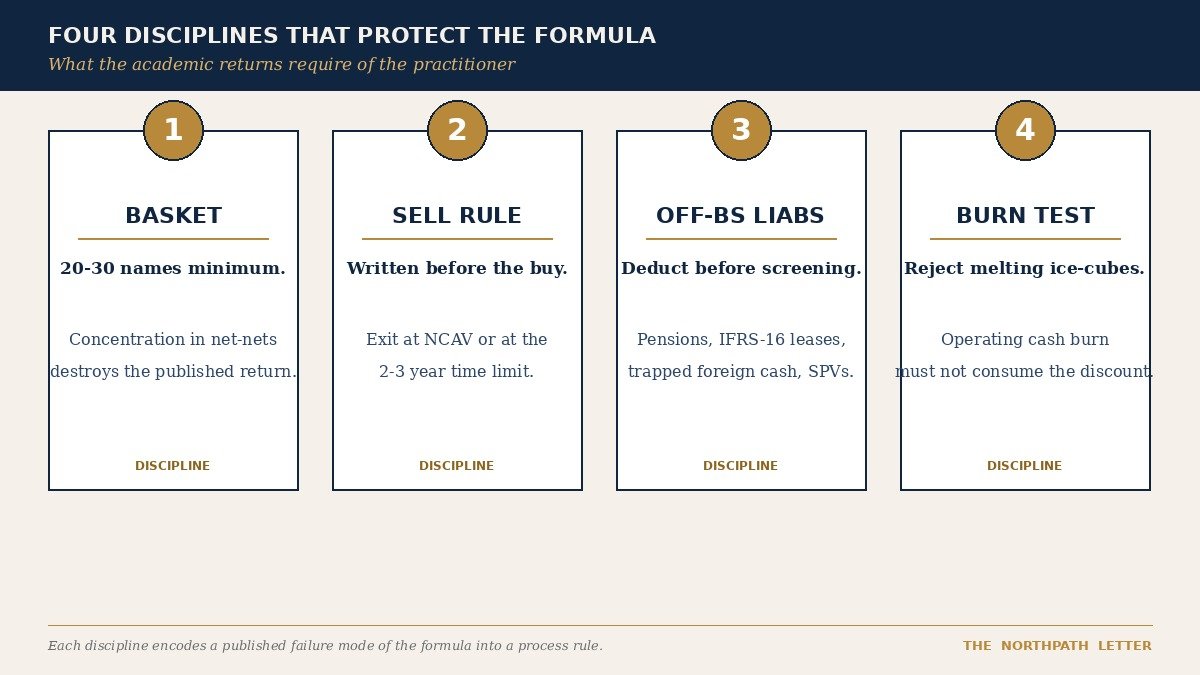
Discipline one: a basket, never a bet. The minimum diversification at which the published returns hold is approximately twenty to thirty names. Below that, the failure-rate tail — the five per cent of net-nets that go to zero or near-zero — swamps the winners’ returns. Schloss is on record as having held between sixty and one hundred names at any time across his forty-seven-year track record. Concentration in a net-net portfolio is not a sign of conviction; it is a sign that the investor has not internalised the asymmetric pay-off mathematics on which the discipline rests.
Discipline two: a written sell rule, applied without negotiation. Graham’s own rule, and Schloss’s, was to sell when the stock returned to NCAV — not when the business “looked good,” not when an operating turn was confirmed, not when the chief executive gave a credible interview. The discipline is mechanical because the buy was mechanical. A two-to-three-year time limit on a position that has not closed its discount is a useful default; capital tied up in a slowly-decaying net-net is opportunity cost that the headline statistics do not capture.
Discipline three: deduct the off-balance-sheet liabilities before applying the formula. Modern accounting is full of liabilities that do not appear cleanly on a 1934 balance sheet: unfunded pensions, multi-year operating leases now capitalised under IFRS 16 and ASC 842, environmental remediation obligations, frozen foreign cash that cannot be repatriated without tax leakage, off-balance-sheet special-purpose vehicles. Each must be deducted from NCAV before the two-thirds test is applied. The formula is robust; the inputs to it are only as good as the analyst’s reading of the footnotes.
A fourth discipline, less often spelled out, is the avoidance of the perpetually-burning candle. A company whose operating losses are larger than the cash buffer on the balance sheet is not a net-net; it is a melting ice-cube the formula has temporarily lit up. The simple test is to compare the trailing twelve-month operating cash burn against the surplus of NCAV over market capitalisation. If the cash burn would consume the discount within twelve months, the position fails before it begins, regardless of how cheap the screen has flagged it. Schloss applied a cruder version of this test by glance — he avoided heavy losers — and modern quantitative-value implementations encode it as an explicit overlay on top of Graham’s original screen.
6. How two practitioners actually applied it
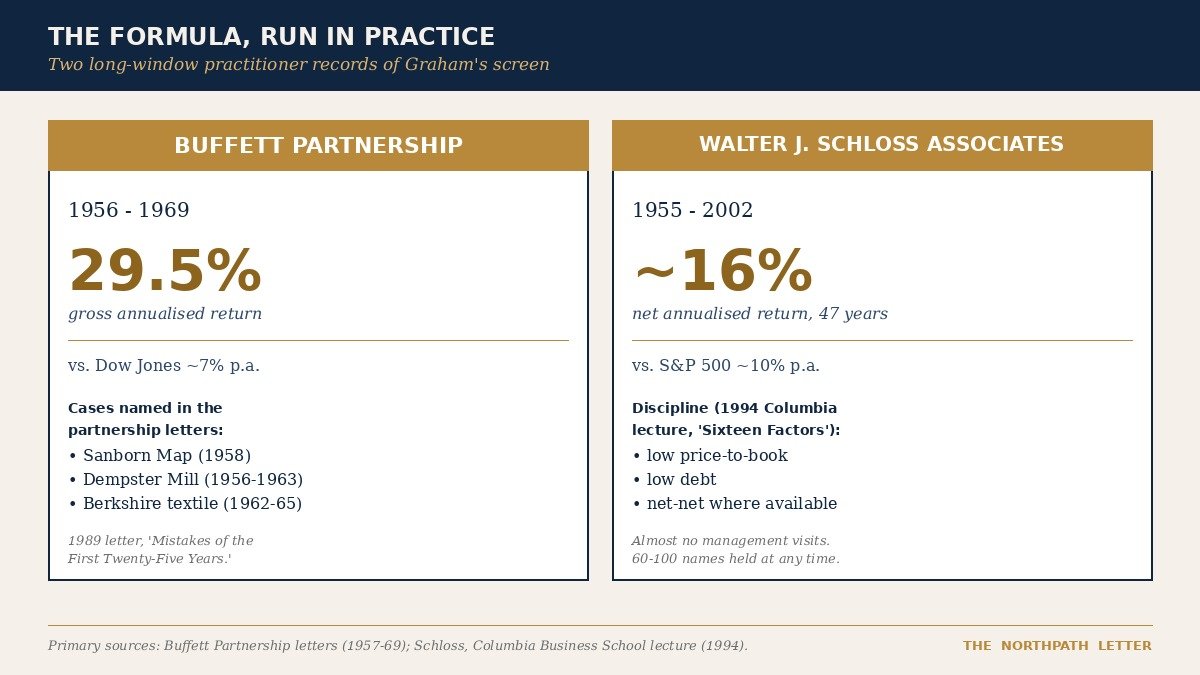
Warren Buffett ran Buffett Partnership Ltd from 1956 to 1969 and compounded gross capital at 29.5 per cent annualised across that period, against the Dow’s roughly seven per cent. The 1957 through 1969 partnership letters, all of them now in the public record, make plain that the largest single category of holdings inside that engine was what Buffett called “generals,” and within the generals, a heavy weighting of net-nets. The cases he cited by name over those years — Sanborn Map (1958), Dempster Mill Manufacturing (1956-1963), the original Berkshire Hathaway textile mill (1962-1965) — were each, at the point of initial purchase, classic Graham net-nets. In the 1989 Berkshire shareholder letter, in the passage now circulated as “Mistakes of the First Twenty-Five Years,” Buffett described this approach as “the cigar-butt method,” noted that it had worked for him for fifteen years, and explained that he had moved away from it largely because the US small-cap net-net universe had thinned to the point where capital of Berkshire’s growing size could no longer be deployed. The migration of approach was not a repudiation of the formula; it was a function of scale. (Disclosure: the author holds no position in Berkshire Hathaway shares as of the date of this letter.)
Walter Schloss ran Walter J. Schloss Associates from 1955 to 2002 and compounded net capital at approximately fifteen to sixteen per cent annualised across that forty-seven-year window, against the S&P 500’s roughly ten per cent. Schloss almost never met a management team, almost never built a discounted-cash-flow model, and famously kept his office to a small leased room. His method, set out in his own 1994 Columbia Business School lecture “Sixteen Factors Needed to Make Money in the Stock Market” and corroborated by Buffett’s 2006 memorial essay, was overwhelmingly balance-sheet-driven: low price-to-book, low debt, and where available, net-net. Schloss’s record is, with the exception of Buffett’s partnership window, the cleanest long-horizon practitioner proof of Graham’s formula. He is also the cleanest available answer to the recurring objection that the discipline cannot survive its own simplicity: it has survived its own simplicity for forty-seven verified years.
7. Key takeaways
The discipline is durable, but the practitioner has to do four things consistently. First, define the formula precisely — current assets minus all liabilities, after deducting off-balance-sheet items, and never pay more than two-thirds of the result. Second, hold a basket of at least twenty-to-thirty names, because the failure rate is real and only the basket arithmetic captures the published return profile. Third, write the sell rule before the buy and apply it without renegotiation — either the discount closes, or the time limit runs, or both. Fourth, accept that the net-net opportunity in developed markets is episodic, not chronic, and that the work of screening must be done in advance of the panic, not during it. Done that way, the formula does what Graham promised in 1934: it asks nothing of the future, demands nothing of forecasting skill, and pays the investor for the patience to wait through balance-sheet uncertainty rather than for the bravery to wait through earnings-statement uncertainty. That is a meaningful distinction, and it is the distinction that keeps the formula in print.
— Manish Goel, FCA / NorthPath Advisory OÜ / Tallinn, Estonia
|
Important. |